
Ever wondered what makes your favourite songs so catchy? It's... Ipakita pa
 Music4 views·Na-update May 15, 2026·5 mga pahina
Understanding Beat and Rhythm in Music
1 / 5
1
of 5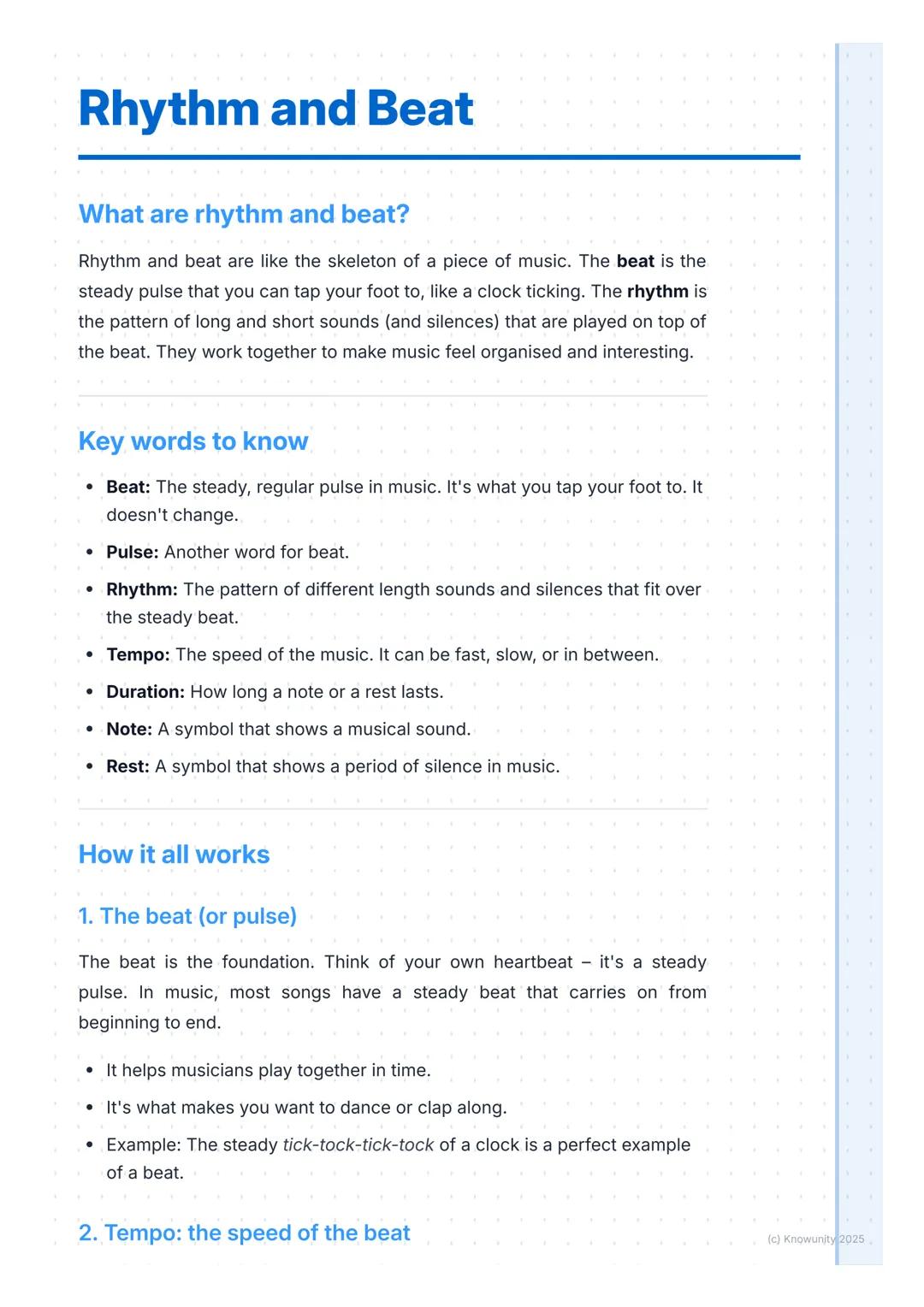
What Are Rhythm and Beat?
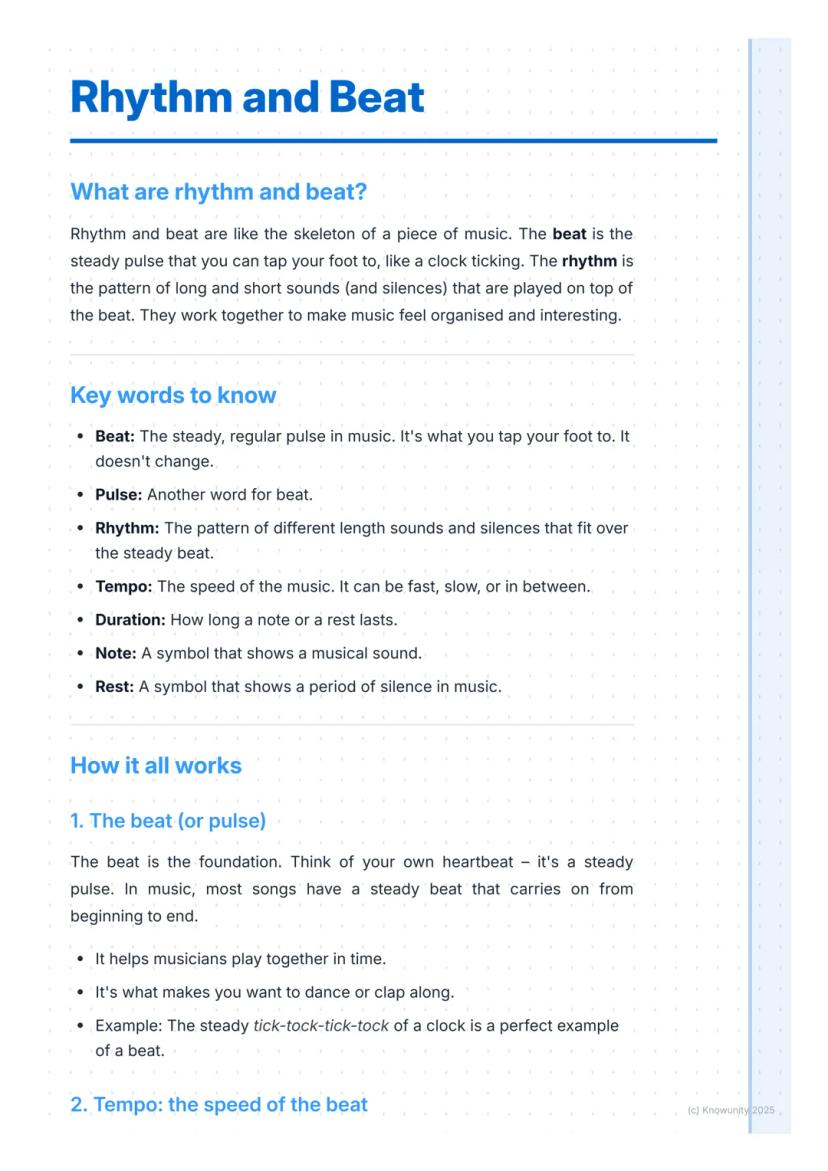
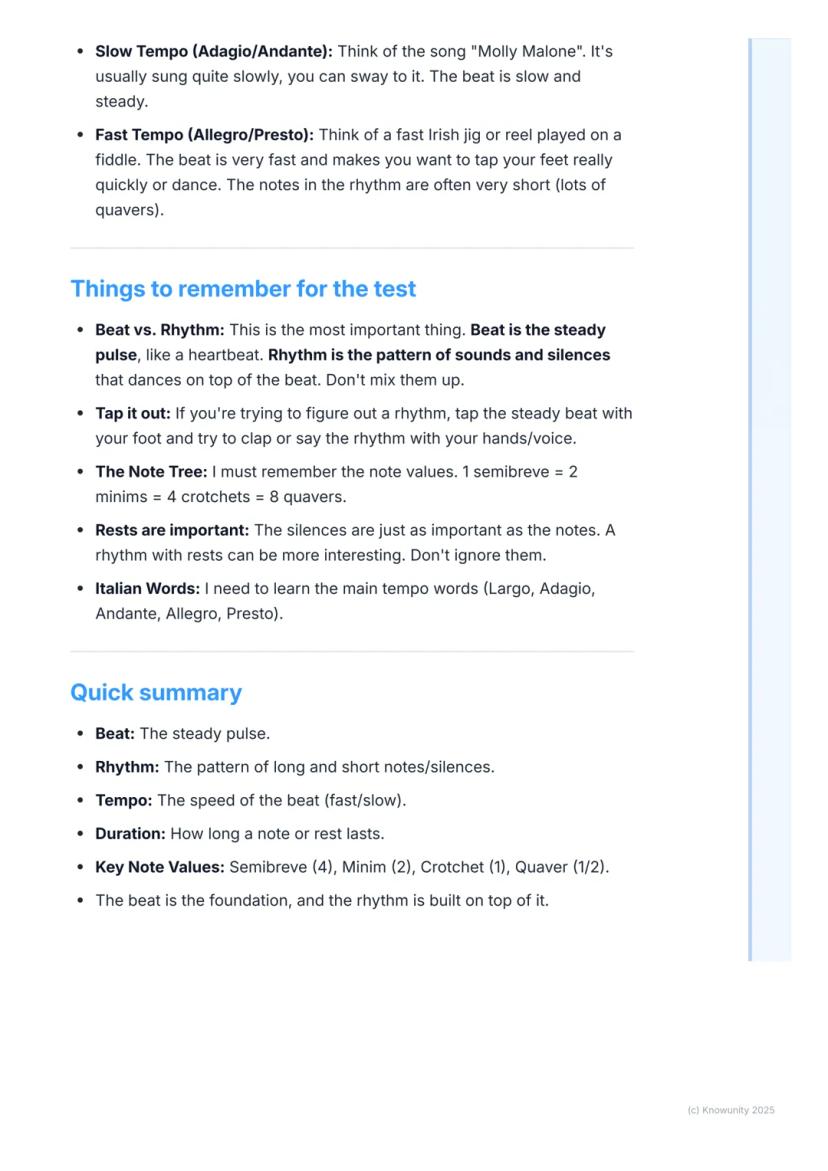
Think of music like a skeleton - the beat is the steady backbone that holds everything together, whilst the rhythm is the exciting pattern that dances on top. The beat is that steady pulse you naturally tap your foot to, just like a clock ticking away. It never changes and keeps everything organised.
Rhythm is much more interesting - it's the pattern of long and short sounds (plus the silences) that make each song unique. When you combine beat and rhythm, you get music that feels both steady and exciting at the same time.
Musicians use the beat to stay together when playing, which is why bands don't fall apart on stage! The pulse is just another word for beat, so don't get confused if you see both terms.
Quick Tip: Try listening to any song and tapping your foot - that steady tap is the beat, whilst everything else happening is the rhythm!
2
of 5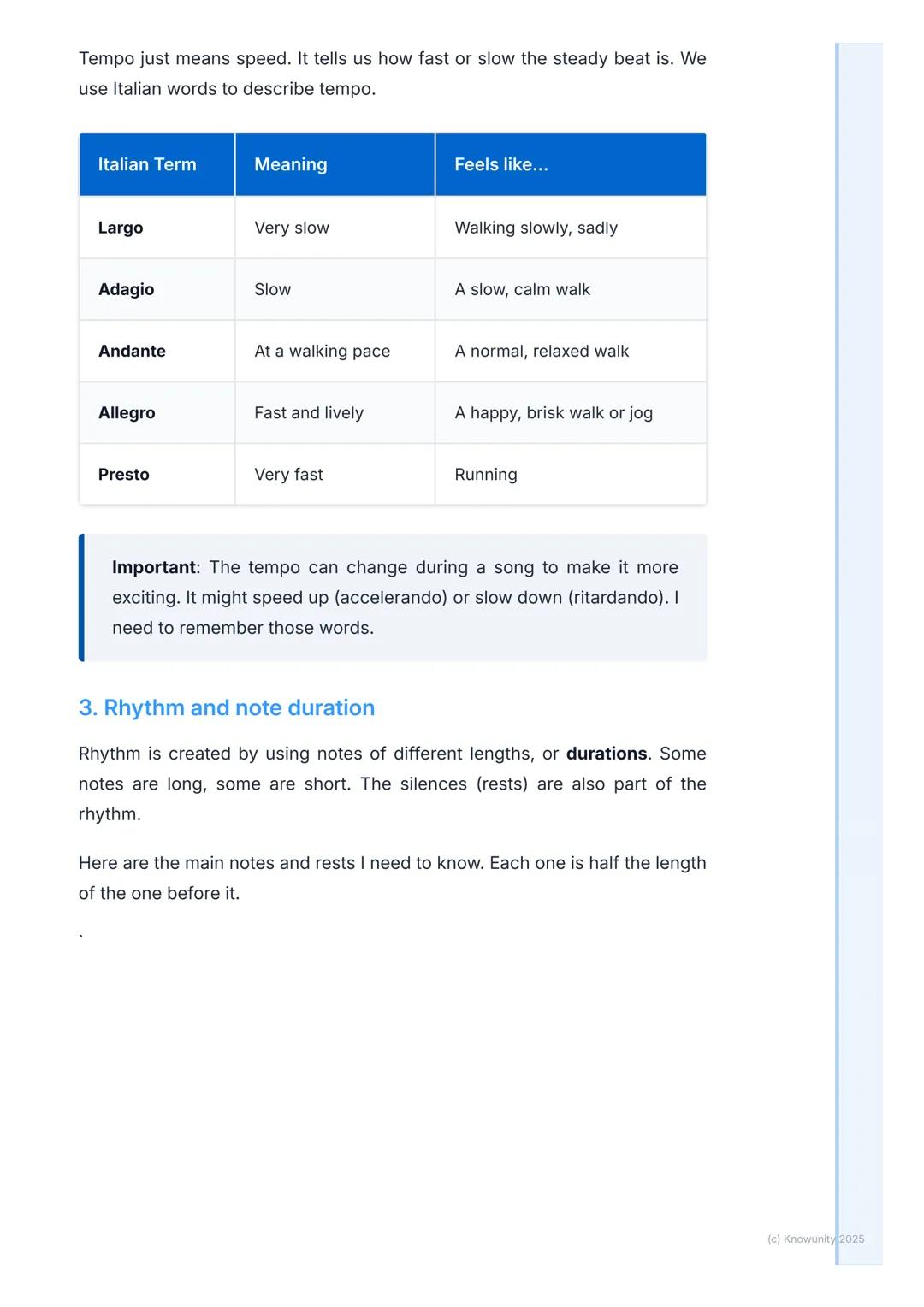
Understanding Tempo
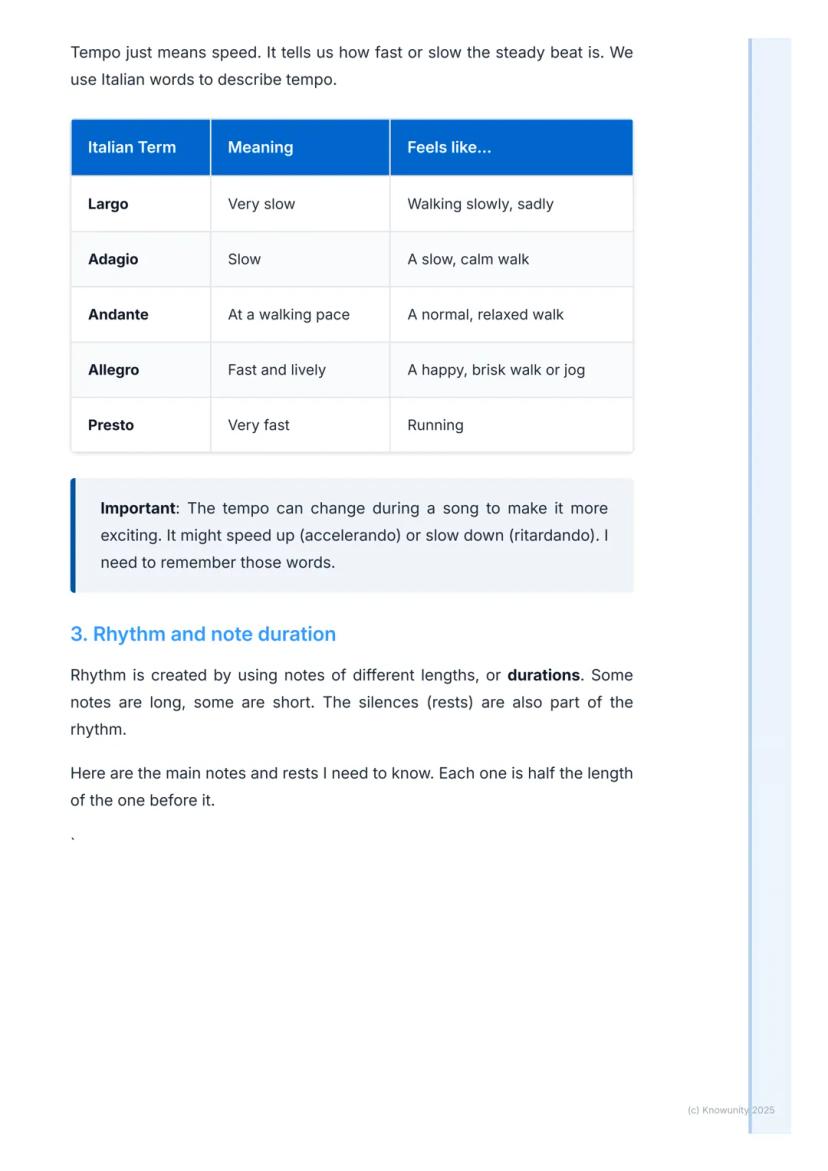
Tempo simply means how fast or slow the music goes. Musicians use fancy Italian words to describe different speeds, but they're actually quite logical once you think about them as different types of walking.
Largo means very slow - imagine walking sadly after losing a match. Adagio is slow like a calm, peaceful walk. Andante feels like your normal walking pace to school. Allegro is fast and lively, like rushing to meet your mates. Presto is super fast - basically running!
Here's the cool bit: tempo can change during a song to create excitement. When music speeds up, it's called accelerando. When it slows down, it's called ritardando. Think about how film music builds up during action scenes!
Remember This: Most Irish jigs are Allegro or Presto, whilst traditional ballads like "Molly Malone" are usually Andante or Adagio.
3
of 5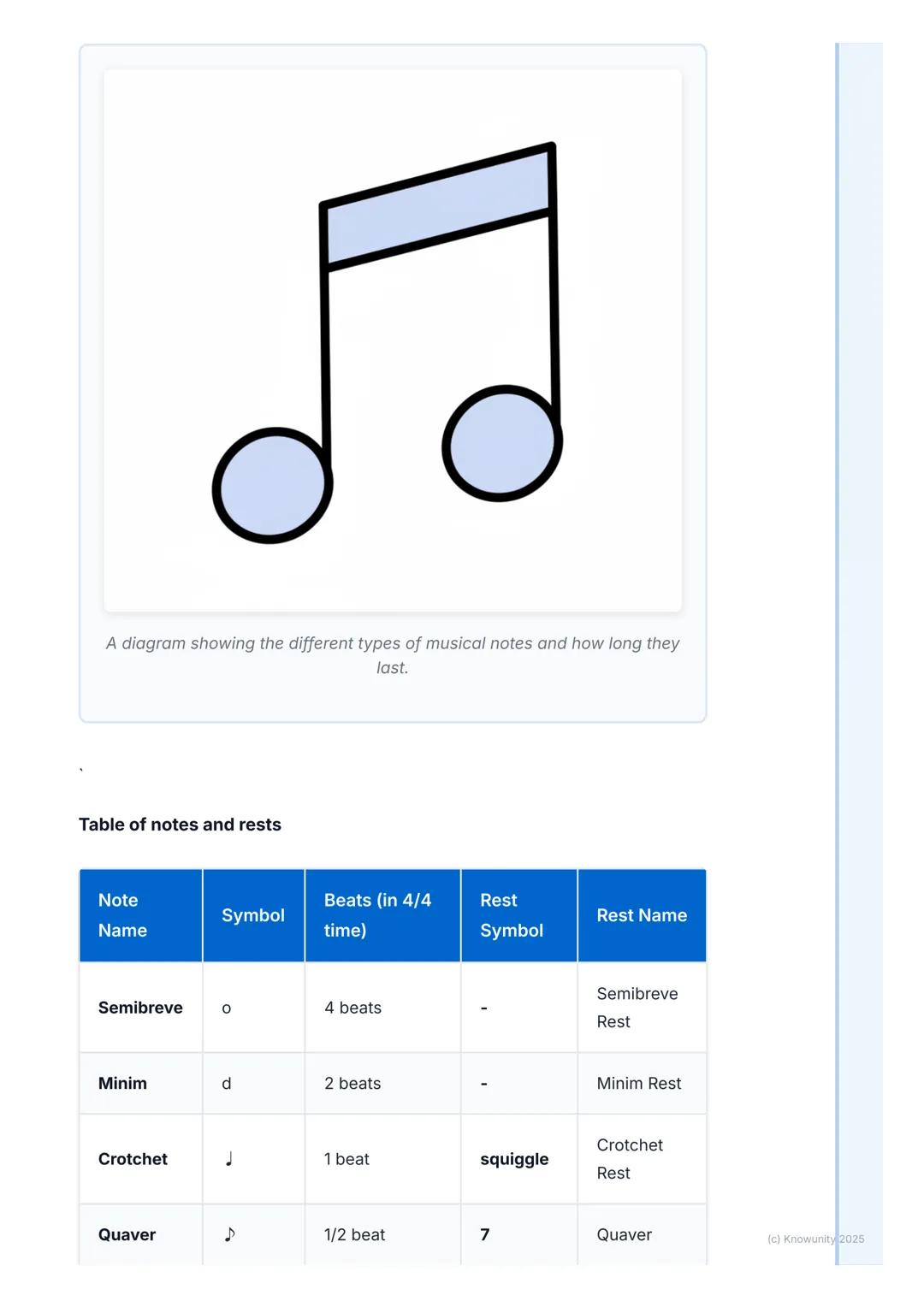
Note Values and Duration
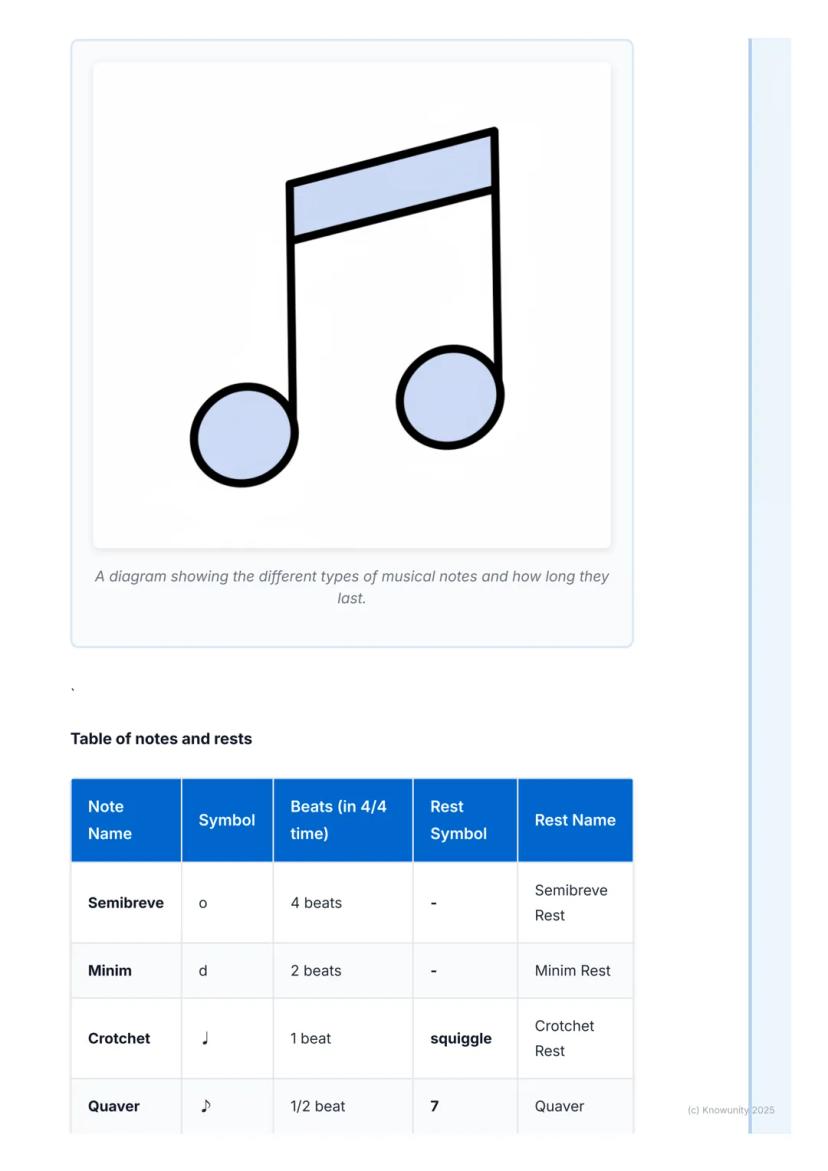
This is where rhythm gets its building blocks. Different notes last for different amounts of time - some are long, some are short. Think of it like a family tree where each note is exactly half the length of the one above it.
A semibreve lasts for 4 beats (the longest), a minim lasts for 2 beats, a crotchet lasts for 1 beat, and a quaver lasts for half a beat. It's like cutting a pizza in half, then in half again!
Rests are the silent gaps in music, and they're just as important as the notes themselves. Each note has a matching rest that lasts the same amount of time. The silences often make rhythms more interesting than constant noise would.
Memory Trick: Remember "1 semibreve = 2 minims = 4 crotchets = 8 quavers" - it's like a mathematical pattern that never changes!
4
of 5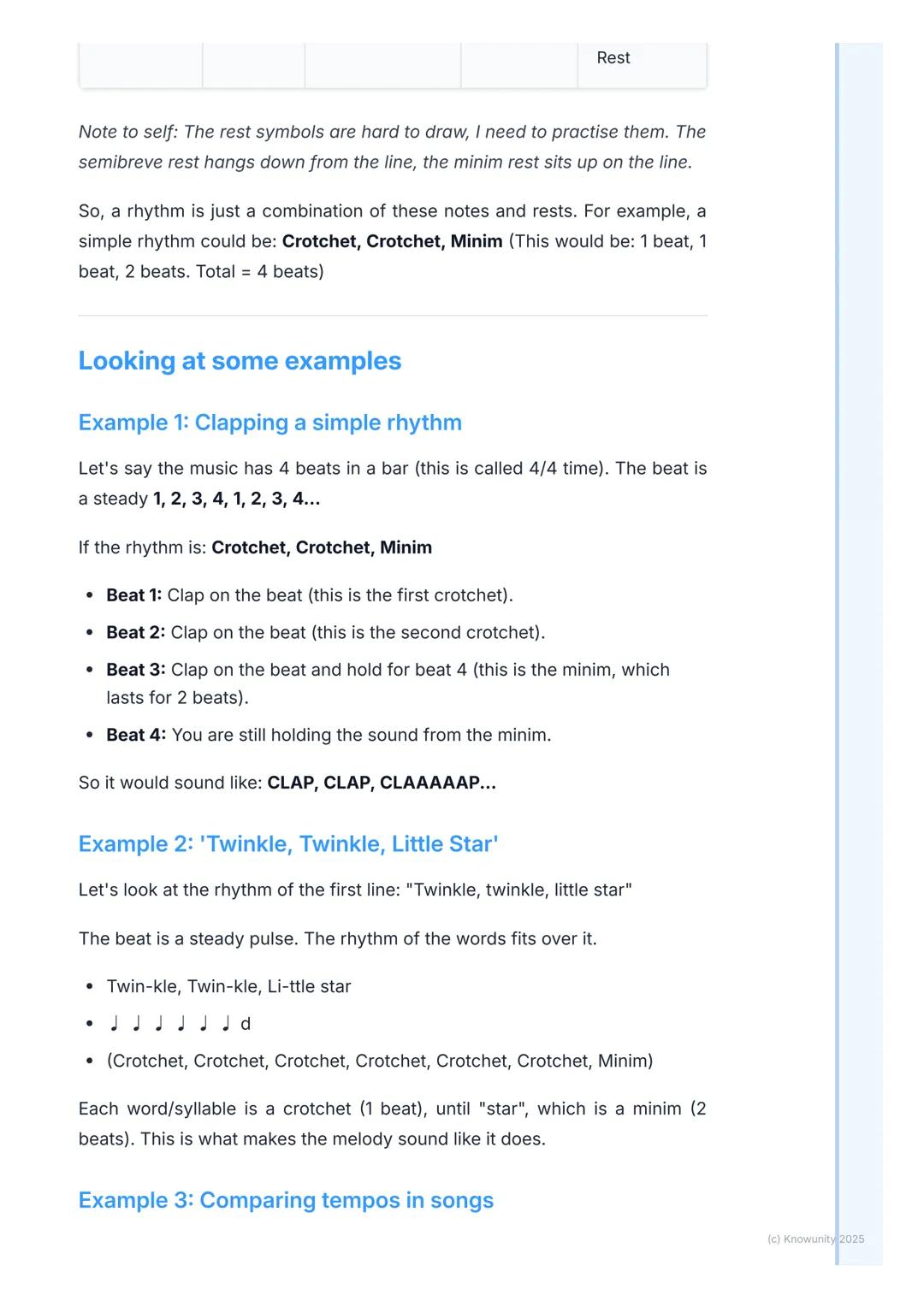
Putting It All Together
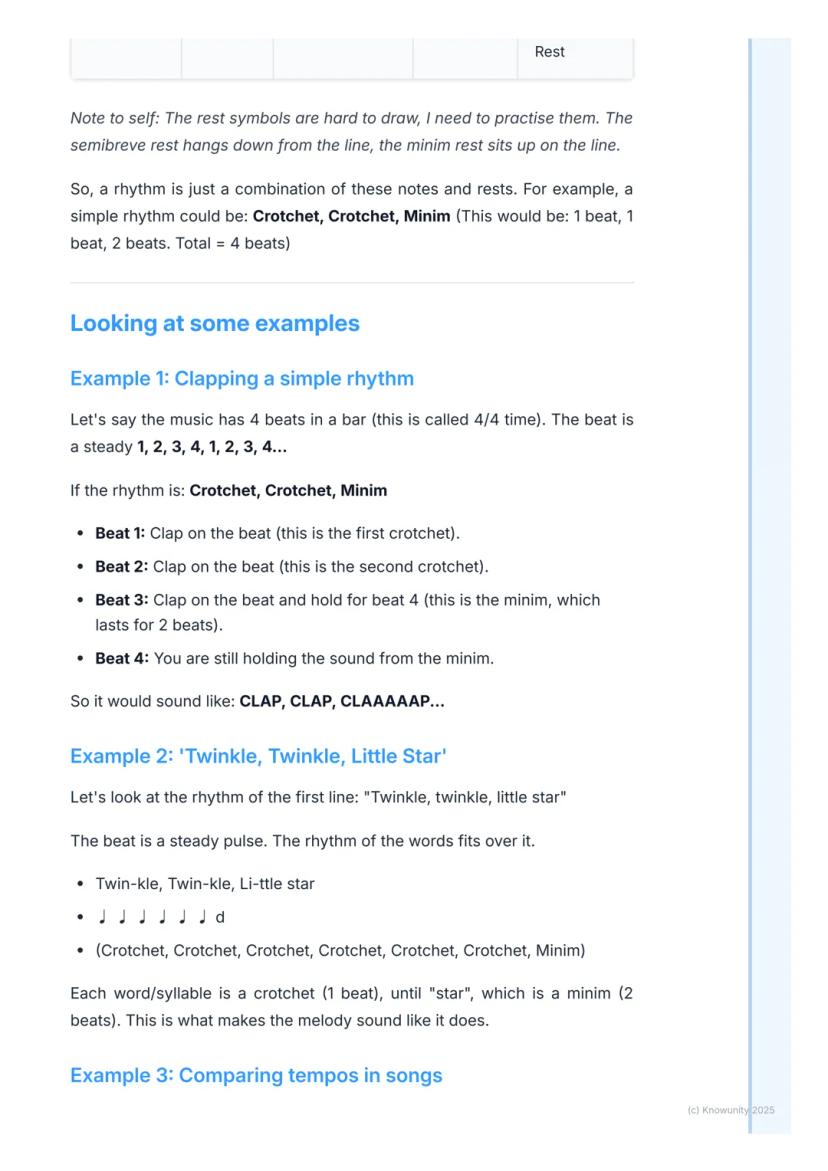
Let's see how this works with something you know. In "Twinkle, Twinkle, Little Star", each syllable gets one beat (crotchet), but "star" gets stretched out for two beats (minim). That's why it sounds complete at the end of the line.
When you're clapping rhythms, keep your foot tapping the steady beat whilst your hands clap the rhythm pattern. It's like patting your head and rubbing your stomach - tricky at first, but brilliant once you've got it!
Most popular music uses 4/4 time, which means there are 4 beats in each section (called a bar). Count along: 1, 2, 3, 4, 1, 2, 3, 4... and you'll hear how songs are organised into these groups.
Practice Tip: Try clapping simple patterns like "clap, clap, clap-hold-hold, clap" whilst keeping your foot tapping steadily - this builds your rhythm skills!
5
of 5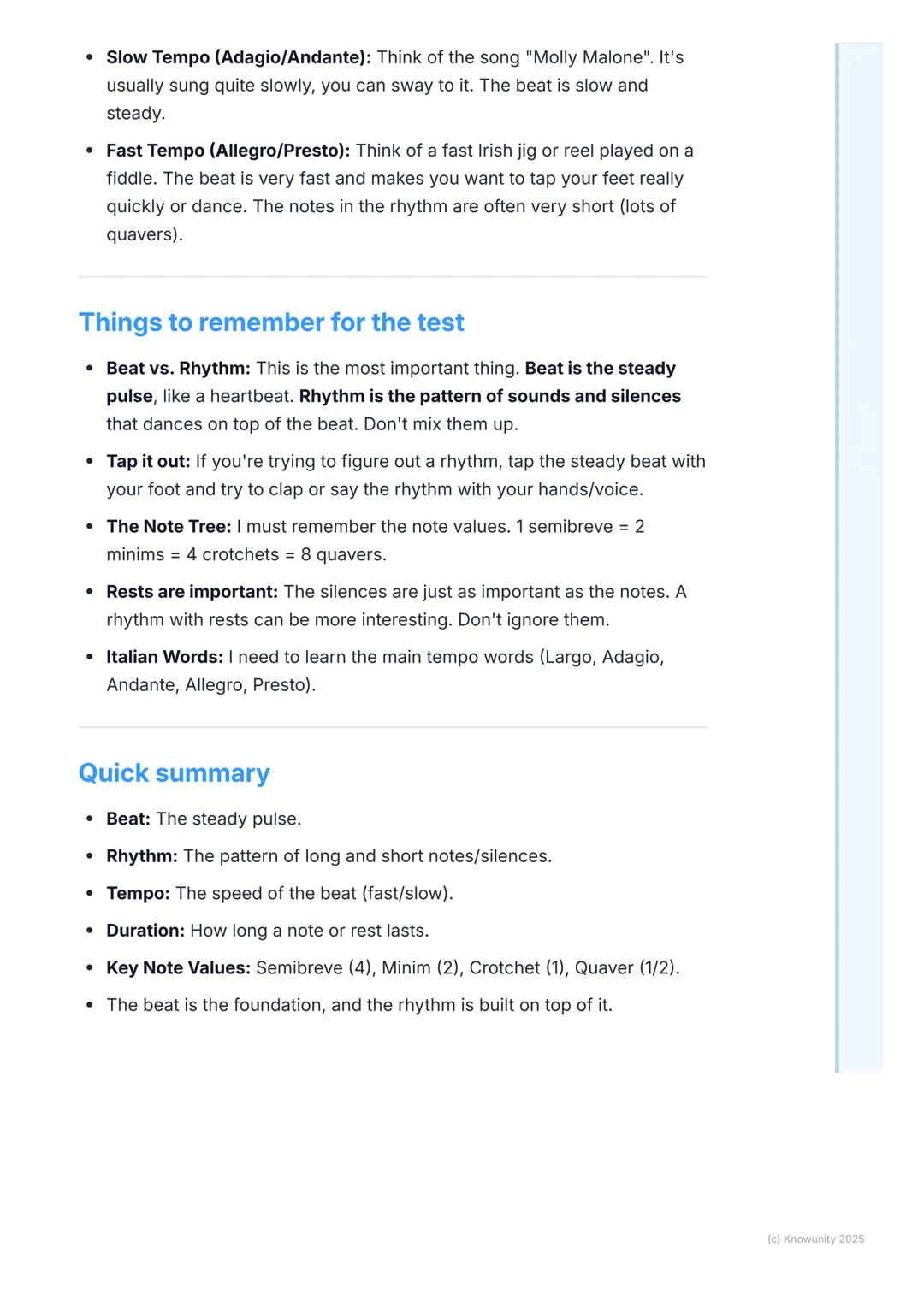
Test Success Tips
The most important thing to remember is that beat and rhythm are different. Beat = steady pulse (like your heartbeat), rhythm = the exciting pattern on top. Mix these up and you'll lose marks, so drill this difference into your brain!
For your exams, practice the note value relationships. Know that a semibreve equals 4 crotchets, and be able to work out simple rhythm patterns. The Italian tempo terms pop up regularly, so memorise Largo through to Presto.
Don't forget about rests - they're not just empty space, they're crucial parts of rhythms that create interest and breathing room. Many students ignore rests in exams and miss easy marks.
Exam Strategy: If you're stuck on a rhythm question, tap out the beat first, then work out where the sounds and silences fit over that steady pulse.
Akala namin hindi mo na itatanong...
Ano ang Knowunity AI companion?
Ang aming AI Companion ay isang AI tool na nakatuon sa mga estudyante na nag-aalok ng higit pa sa mga sagot lang. Binuo mula sa milyong Knowunity resources, nagbibigay ito ng may-kaugnayang impormasyon, personalized na study plans, quizzes, at content direkta sa chat, na umaangkop sa iyong sariling learning journey.
Saan ko mada-download ang Knowunity app?
Maaari mong i-download ang app mula sa Google Play Store at Apple App Store.
Talaga bang libre ang Knowunity?
Tama 'yan! Mag-enjoy sa libreng access sa mga study content, makipag-connect sa kapwa mga estudyante, at kumuha ng instant na tulong – lahat nasa iyong daliri lang.
Pinaka-sikat na nilalaman
9 Irish
IrishIrish oral questions and answers
Questions and answers for the leaving cert oral
5th Year4254
IrishIrish oral questions
Outline of oral questions
5th Year2055
IrishGaeilge Grammar Office
All the basics you need to know on Irish grammar.
6th Year863
 English
Key Quotes : Sive
Key Quotes and explanations: Sive
6th Year2161
IrishAn Gaeilge Aiste
Irish Language essay
6th Year1250
IrishIrish poetry 2027
Iníon + Dínit an Bhróin
5th Year1133
IrishMé Féin & Mo Chlann (Myself & My Family)
Students will learn vocabulary to describe themselves, their family members, and daily routines. This helps in personal introductions and discussions.
TY291
IrishLC HL notes- Iníon (poem)
Includes poem in English and Irish, theme, key words & phrases
5th Year2274
 Geography
Territory, economic activities in Paris basin
essay
6th Year80
Hindi mo mahanap ang hinahanap mo? Tuklasin ang iba pang mga asignatura.
Gustong-gusto kami ng mga estudyante — at magiging ganoon ka rin.
4.6/5App Store
4.7/5Google Play
Napakadaling gamitin at maganda ang disenyo ng app. Nahanap ko lahat ng hinahanap ko hanggang ngayon at natuto ako ng marami mula sa mga presentasyon! Tiyak na gagamitin ko ang app para sa isang takdang-aralin sa klase! At siyempre, nakakatulong din ito bilang inspirasyon.
Stefan Sgumagamit ng iOS
Sobrang ganda talaga ng app na ito. Maraming mga study notes at tulong [...]. Ang problemang subject ko ay Pranses, halimbawa, at ang app ay may maraming options para tumulong. Salamat sa app na ito, bumuti ang Pranses ko. Irerekumenda ko ito sa lahat.
Samantha KlichAndroid user
Wow, talagang namangha ako. Sinubukan ko lang ang app dahil nakita ko itong ina-advertise nang maraming beses at sobrang nagulat ako. Ang app na ito ang TULONG na gusto mo para sa paaralan at higit sa lahat, nag-aalok ito ng maraming bagay, tulad ng workouts at fact sheets, na SOBRANG nakatulong sa akin.
AnnaiOS user
Music4 views·Na-update May 15, 2026·5 mga pahinaUnderstanding Beat and Rhythm in Music
Ever wondered what makes your favourite songs so catchy? It's all about rhythm and beat - the musical elements that make you want to tap your feet and dance along. Understanding these concepts is like learning the secret language that... Ipakita pa
1
of 5Mag-sign up para makita ang content. Libre ito!
- Access sa lahat ng dokumento
- Pagbutihin ang iyong mga grado
- Sumali sa milyong mga estudyante
What Are Rhythm and Beat?
Think of music like a skeleton - the beat is the steady backbone that holds everything together, whilst the rhythm is the exciting pattern that dances on top. The beat is that steady pulse you naturally tap your foot to, just like a clock ticking away. It never changes and keeps everything organised.
Rhythm is much more interesting - it's the pattern of long and short sounds (plus the silences) that make each song unique. When you combine beat and rhythm, you get music that feels both steady and exciting at the same time.
Musicians use the beat to stay together when playing, which is why bands don't fall apart on stage! The pulse is just another word for beat, so don't get confused if you see both terms.
Quick Tip: Try listening to any song and tapping your foot - that steady tap is the beat, whilst everything else happening is the rhythm!
2
of 5Mag-sign up para makita ang content. Libre ito!
- Access sa lahat ng dokumento
- Pagbutihin ang iyong mga grado
- Sumali sa milyong mga estudyante
Understanding Tempo
Tempo simply means how fast or slow the music goes. Musicians use fancy Italian words to describe different speeds, but they're actually quite logical once you think about them as different types of walking.
Largo means very slow - imagine walking sadly after losing a match. Adagio is slow like a calm, peaceful walk. Andante feels like your normal walking pace to school. Allegro is fast and lively, like rushing to meet your mates. Presto is super fast - basically running!
Here's the cool bit: tempo can change during a song to create excitement. When music speeds up, it's called accelerando. When it slows down, it's called ritardando. Think about how film music builds up during action scenes!
Remember This: Most Irish jigs are Allegro or Presto, whilst traditional ballads like "Molly Malone" are usually Andante or Adagio.
3
of 5Mag-sign up para makita ang content. Libre ito!
- Access sa lahat ng dokumento
- Pagbutihin ang iyong mga grado
- Sumali sa milyong mga estudyante
Note Values and Duration
This is where rhythm gets its building blocks. Different notes last for different amounts of time - some are long, some are short. Think of it like a family tree where each note is exactly half the length of the one above it.
A semibreve lasts for 4 beats (the longest), a minim lasts for 2 beats, a crotchet lasts for 1 beat, and a quaver lasts for half a beat. It's like cutting a pizza in half, then in half again!
Rests are the silent gaps in music, and they're just as important as the notes themselves. Each note has a matching rest that lasts the same amount of time. The silences often make rhythms more interesting than constant noise would.
Memory Trick: Remember "1 semibreve = 2 minims = 4 crotchets = 8 quavers" - it's like a mathematical pattern that never changes!
4
of 5Mag-sign up para makita ang content. Libre ito!
- Access sa lahat ng dokumento
- Pagbutihin ang iyong mga grado
- Sumali sa milyong mga estudyante
Putting It All Together
Let's see how this works with something you know. In "Twinkle, Twinkle, Little Star", each syllable gets one beat (crotchet), but "star" gets stretched out for two beats (minim). That's why it sounds complete at the end of the line.
When you're clapping rhythms, keep your foot tapping the steady beat whilst your hands clap the rhythm pattern. It's like patting your head and rubbing your stomach - tricky at first, but brilliant once you've got it!
Most popular music uses 4/4 time, which means there are 4 beats in each section (called a bar). Count along: 1, 2, 3, 4, 1, 2, 3, 4... and you'll hear how songs are organised into these groups.
Practice Tip: Try clapping simple patterns like "clap, clap, clap-hold-hold, clap" whilst keeping your foot tapping steadily - this builds your rhythm skills!
5
of 5Mag-sign up para makita ang content. Libre ito!
- Access sa lahat ng dokumento
- Pagbutihin ang iyong mga grado
- Sumali sa milyong mga estudyante
Test Success Tips
The most important thing to remember is that beat and rhythm are different. Beat = steady pulse (like your heartbeat), rhythm = the exciting pattern on top. Mix these up and you'll lose marks, so drill this difference into your brain!
For your exams, practice the note value relationships. Know that a semibreve equals 4 crotchets, and be able to work out simple rhythm patterns. The Italian tempo terms pop up regularly, so memorise Largo through to Presto.
Don't forget about rests - they're not just empty space, they're crucial parts of rhythms that create interest and breathing room. Many students ignore rests in exams and miss easy marks.
Exam Strategy: If you're stuck on a rhythm question, tap out the beat first, then work out where the sounds and silences fit over that steady pulse.
Akala namin hindi mo na itatanong...
Ano ang Knowunity AI companion?
Ang aming AI Companion ay isang AI tool na nakatuon sa mga estudyante na nag-aalok ng higit pa sa mga sagot lang. Binuo mula sa milyong Knowunity resources, nagbibigay ito ng may-kaugnayang impormasyon, personalized na study plans, quizzes, at content direkta sa chat, na umaangkop sa iyong sariling learning journey.
Saan ko mada-download ang Knowunity app?
Maaari mong i-download ang app mula sa Google Play Store at Apple App Store.
Talaga bang libre ang Knowunity?
Tama 'yan! Mag-enjoy sa libreng access sa mga study content, makipag-connect sa kapwa mga estudyante, at kumuha ng instant na tulong – lahat nasa iyong daliri lang.
Pinaka-sikat na nilalaman
9IrishIrish oral questions and answers
Questions and answers for the leaving cert oral
5th Year4254
IrishIrish oral questions
Outline of oral questions
5th Year2055
IrishGaeilge Grammar Office
All the basics you need to know on Irish grammar.
6th Year863
EnglishKey Quotes : Sive
Key Quotes and explanations: Sive
6th Year2161
IrishAn Gaeilge Aiste
Irish Language essay
6th Year1250
IrishIrish poetry 2027
Iníon + Dínit an Bhróin
5th Year1133
IrishMé Féin & Mo Chlann (Myself & My Family)
Students will learn vocabulary to describe themselves, their family members, and daily routines. This helps in personal introductions and discussions.
TY291
IrishLC HL notes- Iníon (poem)
Includes poem in English and Irish, theme, key words & phrases
5th Year2274
GeographyTerritory, economic activities in Paris basin
essay
6th Year80
Hindi mo mahanap ang hinahanap mo? Tuklasin ang iba pang mga asignatura.
Gustong-gusto kami ng mga estudyante — at magiging ganoon ka rin.
4.6/5App Store
4.7/5Google Play
Napakadaling gamitin at maganda ang disenyo ng app. Nahanap ko lahat ng hinahanap ko hanggang ngayon at natuto ako ng marami mula sa mga presentasyon! Tiyak na gagamitin ko ang app para sa isang takdang-aralin sa klase! At siyempre, nakakatulong din ito bilang inspirasyon.
Stefan Sgumagamit ng iOS
Sobrang ganda talaga ng app na ito. Maraming mga study notes at tulong [...]. Ang problemang subject ko ay Pranses, halimbawa, at ang app ay may maraming options para tumulong. Salamat sa app na ito, bumuti ang Pranses ko. Irerekumenda ko ito sa lahat.
Samantha KlichAndroid user
Wow, talagang namangha ako. Sinubukan ko lang ang app dahil nakita ko itong ina-advertise nang maraming beses at sobrang nagulat ako. Ang app na ito ang TULONG na gusto mo para sa paaralan at higit sa lahat, nag-aalok ito ng maraming bagay, tulad ng workouts at fact sheets, na SOBRANG nakatulong sa akin.
AnnaiOS user