
Sports and physical activity should be for everyone, but the...
 LCPE2 views·Na-update Jun 17, 2026·7 mga pahina
Promoting Inclusion and Equity in Sports and Activities
1 / 7
1
of 7
Understanding Inclusion and Equity
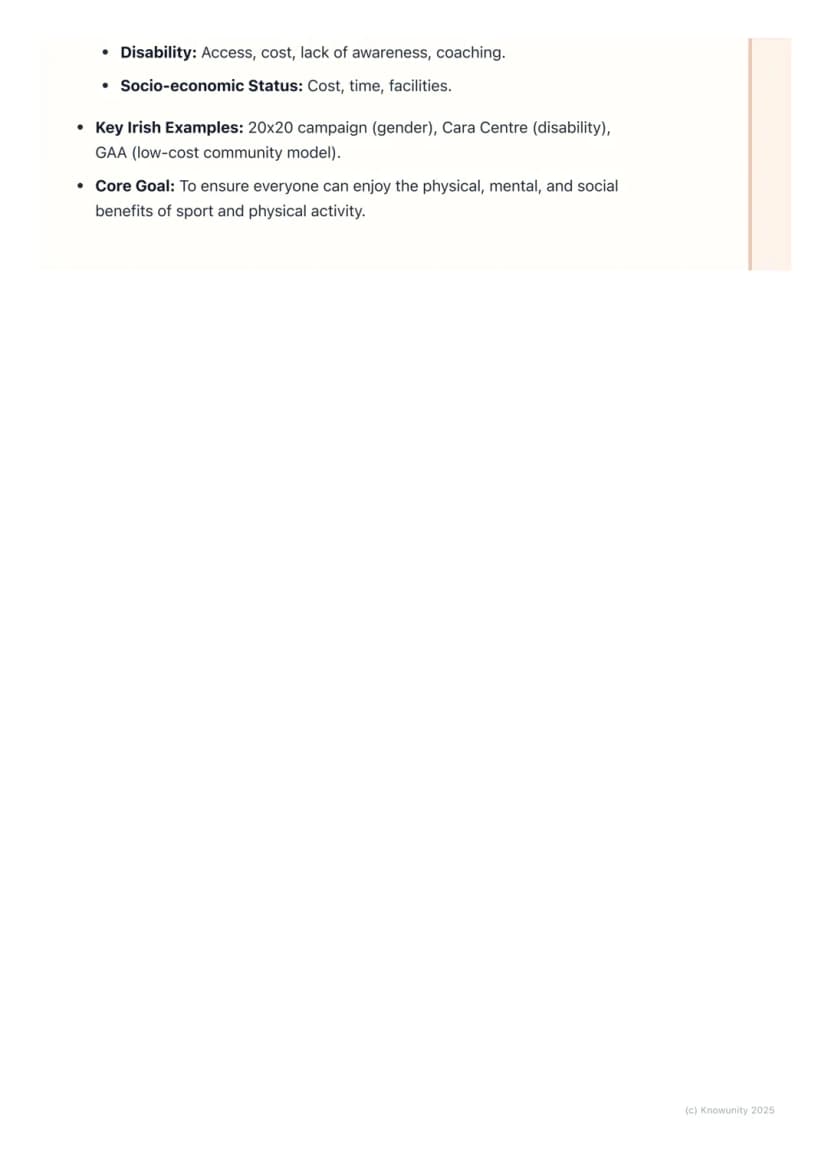
Think about your PE class - does everyone feel like they truly belong, or are some students just "getting by"? Inclusion goes way beyond just letting someone join in. It's about creating an environment where everyone feels valued and like the activity is genuinely designed for them too.
Here's where it gets interesting: equity and equality aren't the same thing. Equality means giving everyone identical treatment, whilst equity recognises that people start from different places and might need different support to reach the same outcome. Picture three people of different heights trying to watch over a fence - equality gives them all the same box to stand on, but equity gives them whatever they need to actually see.
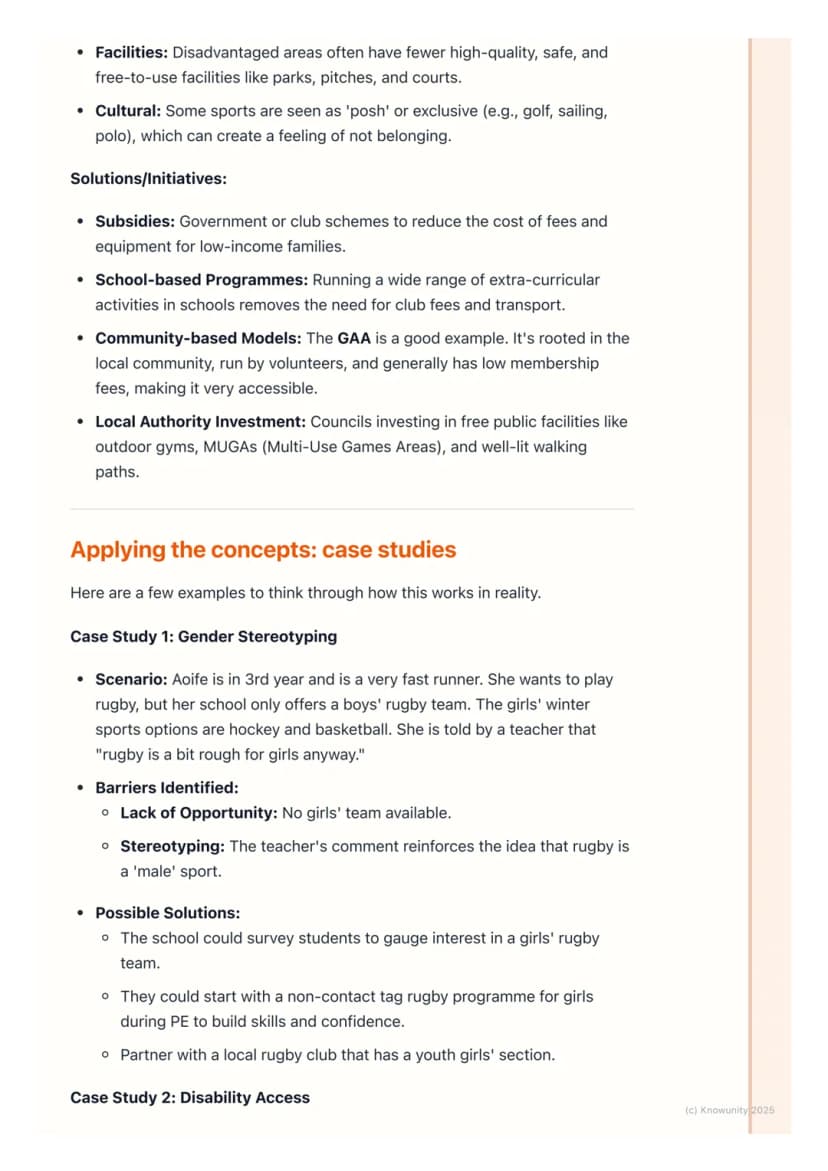
Barriers to participation are the obstacles that stop people getting involved in sport. These might be obvious (like expensive equipment) or hidden (like feeling judged). Stereotyping creates some of the toughest barriers - those oversimplified beliefs like "girls aren't good at football" or "older people are too frail for exercise."
Remember: Equity leads to equal outcomes, whilst equal treatment doesn't always work when people have different starting points.
2
of 7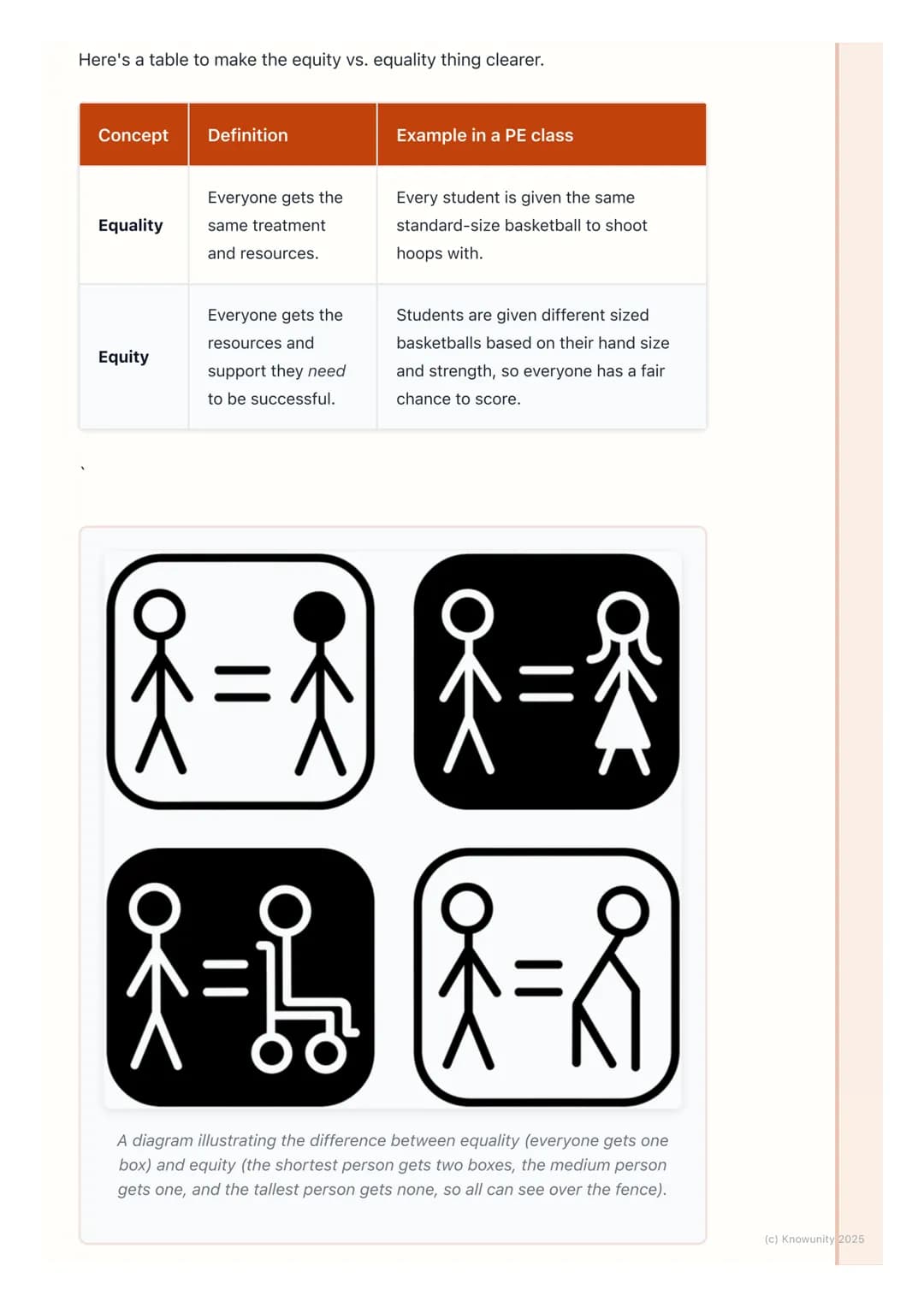
Gender Barriers and Solutions
Ever notice how men's sports dominate the headlines whilst women's achievements get barely a mention? This media coverage gap creates a serious problem - if girls can't see female role models in sport, they're less likely to see themselves as athletes.
Stereotyping hits hard here too. Certain sports get labelled as "masculine" (rugby, weightlifting) or "feminine" (dance, gymnastics), which puts pressure on young people to stick to what's "expected." Schools might offer fewer opportunities for girls' teams, and facilities often aren't designed with female athletes in mind.
The 20x20 campaign in Ireland tackled this head-on with the slogan "If she can't see it, she can't be it." The campaign pushed for more media coverage, better attendance at women's events, and increased participation. Schools are also stepping up by offering mixed-gender sports and more flexible uniform policies.
Investment is key - more funding for female sports at every level, from grassroots clubs to elite competition. Getting more women into coaching roles creates those vital role models that young girls need to see.
Key insight: Representation matters - seeing someone like yourself succeeding in sport makes participation feel possible and worthwhile.
3
of 7
Disability and Accessibility Challenges
Imagine wanting to join your local gym but finding steps at the entrance and no accessible changing rooms. For people with disabilities, these physical barriers are just the start of the challenges they face in sport and physical activity.
The financial side hits differently too. Specialised equipment costs a fortune, and transport to accessible facilities can be a major expense. Then there are the psychological barriers - lack of confidence, fear of judgment, or simply not seeing yourself as "sporty" because of your disability.
Many people just don't know what's available. Adapted sports like wheelchair basketball and boccia offer brilliant opportunities, but awareness is often low. Coaches might want to help but lack the training to adapt activities effectively.
Paralympics Ireland promotes elite sport whilst the Cara Centre works nationally to make sport more inclusive. Their disability inclusion training gives coaches the skills to adapt activities for everyone. The push for universal design in new facilities and retrofitting older ones means accessibility is becoming the standard, not an afterthought.
Game changer: Universal design benefits everyone - ramps help wheelchair users, parents with buggies, and people with mobility aids alike.
4
of 7
Socio-economic Barriers
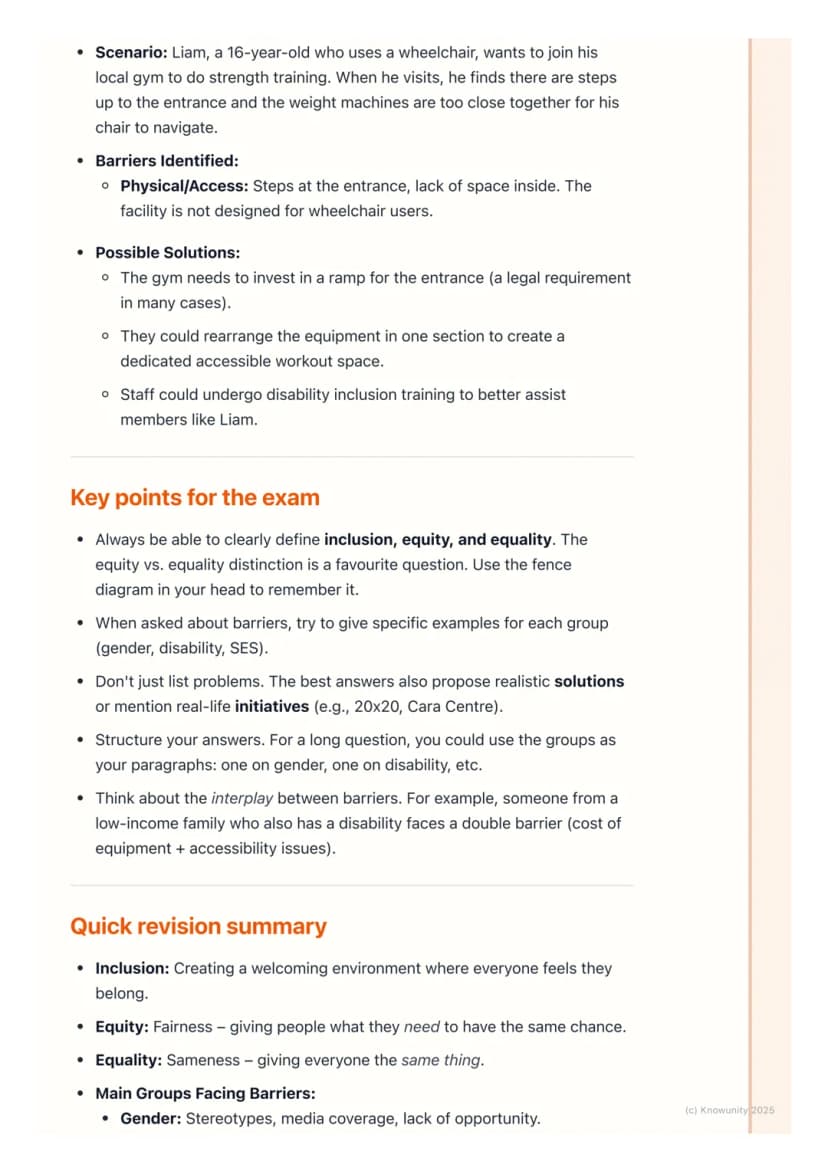
Let's be honest - sport can be expensive, and for families on tight budgets, those costs can be a real barrier. Club membership fees, expensive equipment, and travel costs for training and matches add up quickly. A hurling helmet, hockey stick, or riding boots can cost more than some families have spare.
Time becomes a barrier when parents work long hours and can't provide transport, or when teenagers need part-time jobs themselves. Disadvantaged areas often lack quality, safe, and free facilities like parks and sports courts.
Some sports carry a "posh" image - golf, sailing, and polo can feel exclusive and unwelcoming. This cultural barrier creates a sense of not belonging before people even try to participate.
Smart solutions are making a difference though. Subsidies help reduce costs for low-income families, whilst school-based programmes remove the need for expensive club fees. The GAA model shows how community-rooted sports with volunteer leadership and low fees can stay accessible. Local councils investing in free facilities like outdoor gyms and well-lit walking paths opens up opportunities for everyone.
Reality check: The GAA's success comes from being genuinely community-based - local volunteers, affordable fees, and facilities that belong to the people who use them.
5
of 7
Real-world Applications
Picture Aoife, a fast 3rd year who wants to play rugby, but her school only offers boys' rugby. When she asks about it, a teacher says "rugby's a bit rough for girls anyway." She's facing both lack of opportunity and gender stereotyping. The school could survey students about interest in girls' rugby, start with tag rugby in PE, or partner with local clubs.
Now think about Liam, who uses a wheelchair and wants to join his local gym for strength training. He finds steps at the entrance and weight machines too close together for navigation. These accessibility barriers need practical solutions - a ramp (which is often legally required anyway), rearranged equipment to create accessible workout space, and staff training.
These examples show how multiple barriers can overlap. Someone from a low-income family who also has a disability faces doubled challenges - both cost issues and accessibility problems. The best solutions recognise these intersections and address them together.
For your exam, always define terms clearly (especially equity vs equality), give specific examples for each group, and propose realistic solutions. Structure answers using the main groups as paragraphs, and remember to mention real initiatives like 20x20 and the Cara Centre.
Exam tip: Don't just list problems - the strongest answers combine barrier identification with practical, realistic solutions and real-world examples.
6
of 7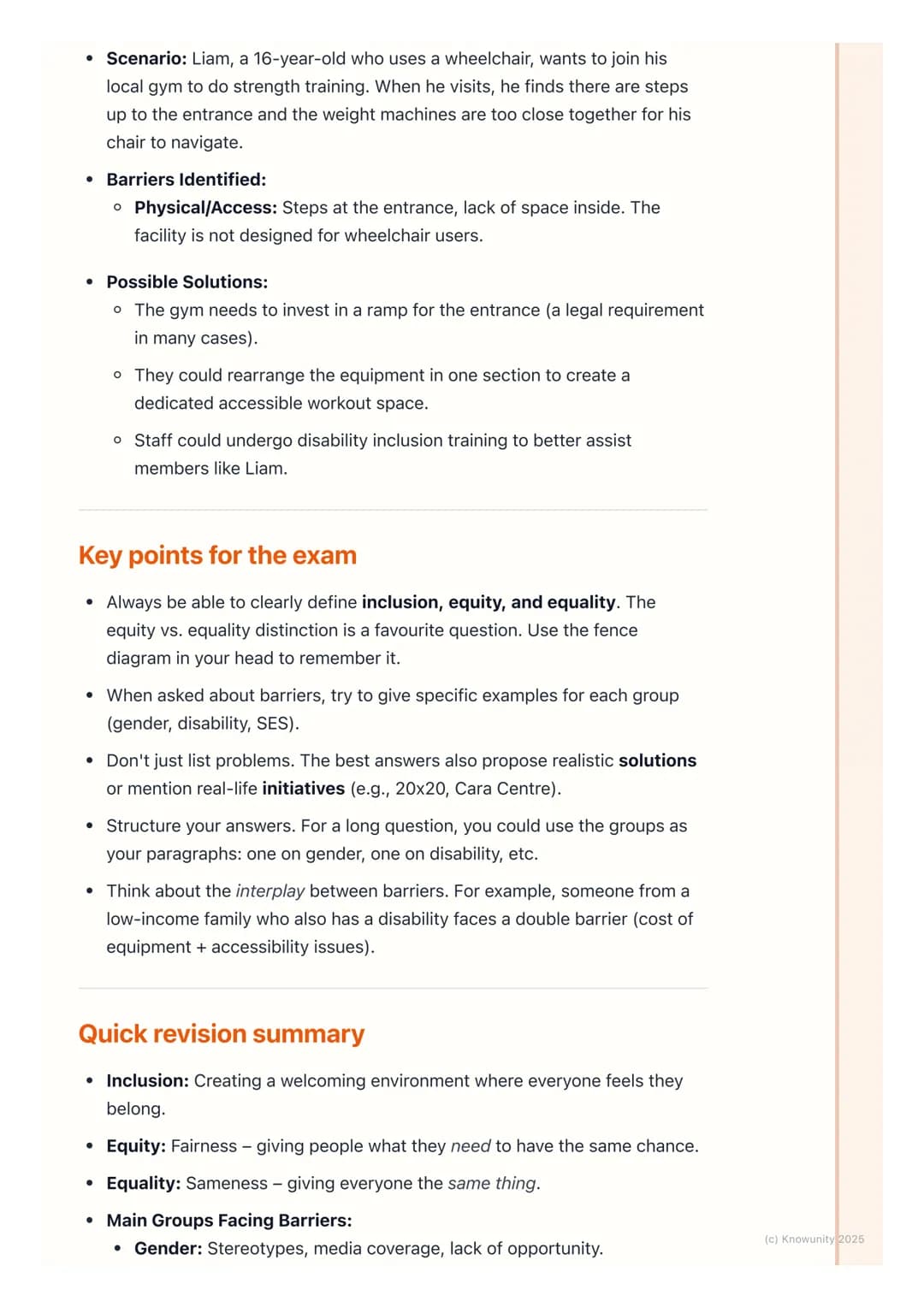
Quick Revision Summary
Core definitions: Inclusion creates belonging, equity provides fairness through different support levels, equality gives identical treatment. The goal is ensuring everyone can access the physical, mental, and social benefits of sport.
Gender barriers include stereotyping, poor media coverage, and limited opportunities. Solutions involve campaigns like 20x20, school policy changes, increased investment, and more female coaches.
Disability barriers encompass physical access, high costs, lack of awareness, and coaching gaps. The Cara Centre and Paralympics Ireland lead inclusion efforts through training, adapted sports, and facility improvements.
Socio-economic barriers centre on cost, time constraints, and facility access in disadvantaged areas. The GAA community model shows how volunteer-led, affordable sport can stay accessible whilst government subsidies and school programmes help bridge gaps.
Bottom line: True inclusion means everyone can participate fully, feel valued, and access sport's benefits regardless of gender, ability, or economic background.
7
of 7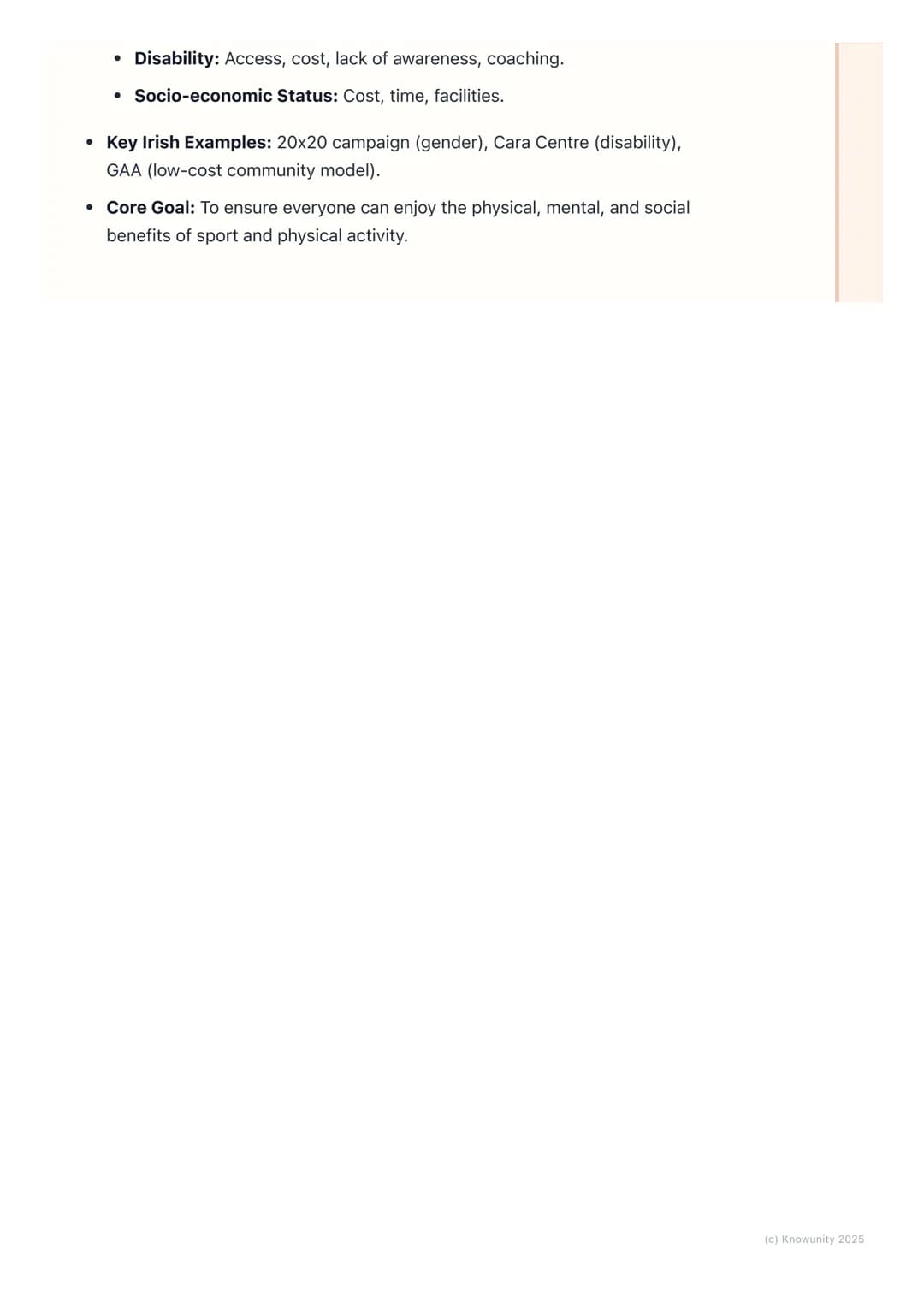
Akala namin hindi mo na itatanong...
Ano ang Knowunity AI companion?
Ang aming AI Companion ay isang AI tool na nakatuon sa mga estudyante na nag-aalok ng higit pa sa mga sagot lang. Binuo mula sa milyong Knowunity resources, nagbibigay ito ng may-kaugnayang impormasyon, personalized na study plans, quizzes, at content direkta sa chat, na umaangkop sa iyong sariling learning journey.
Saan ko mada-download ang Knowunity app?
Maaari mong i-download ang app mula sa Google Play Store at Apple App Store.
Talaga bang libre ang Knowunity?
Tama 'yan! Mag-enjoy sa libreng access sa mga study content, makipag-connect sa kapwa mga estudyante, at kumuha ng instant na tulong – lahat nasa iyong daliri lang.
Pinaka-sikat na nilalaman sa LCPE
4LCPEHealthy Eating Guidelines
This section explores national healthy eating guidelines, such as the food pyramid or healthy eating plate, to promote balanced dietary choices.
5th Year50
LCPEBiomechanics of Movement
Applying fundamental biomechanical principles such as force, motion, levers, and stability to analyse and improve human movement efficiency and performance in sport.
6th Year200
LCPEFactors effecting sports psychology ( confidence and self efficacy)
Higher Level LCPE psychological preprration notes
5th Year230
LCPETechnology in Sport
Investigating how technology is used in areas such as performance analysis, equipment design, officiating, and athlete monitoring to enhance training and competition.
6th Year50
Pinaka-sikat na nilalaman
9 Irish
IrishIrish oral questions and answers
Questions and answers for the leaving cert oral
5th Year4264
 English
Key Quotes : Sive
Key Quotes and explanations: Sive
6th Year2842
IrishIrish oral questions
Outline of oral questions
5th Year2055
IrishIníon- le hÁine Durkin
Aine Durkin’s poem, Iníon: Themes & summary
5th Year890
IrishIrish poetry 2027
Iníon + Dínit an Bhróin
5th Year1153
IrishLC HL notes- Iníon (poem)
Includes poem in English and Irish, theme, key words & phrases
5th Year2304
EnglishCultural Context : Shawshank Redemption : Sive : Small Things Like These
Comparative Study : Cultural Context : Shawshank Redemption, Sive and Small Things Like These
6th Year1430
IrishMo Ghrá-sa (Idir Lúibíní)
Notes on mo ghrá-sa
5th Year380
IrishAn Gaeilge Aiste
Irish Language essay
6th Year1320
Hindi mo mahanap ang hinahanap mo? Tuklasin ang iba pang mga asignatura.
Gustong-gusto kami ng mga estudyante — at magiging ganoon ka rin.
4.6/5App Store
4.7/5Google Play
Napakadaling gamitin at maganda ang disenyo ng app. Nahanap ko lahat ng hinahanap ko hanggang ngayon at natuto ako ng marami mula sa mga presentasyon! Tiyak na gagamitin ko ang app para sa isang takdang-aralin sa klase! At siyempre, nakakatulong din ito bilang inspirasyon.
Stefan Sgumagamit ng iOS
Sobrang ganda talaga ng app na ito. Maraming mga study notes at tulong [...]. Ang problemang subject ko ay Pranses, halimbawa, at ang app ay may maraming options para tumulong. Salamat sa app na ito, bumuti ang Pranses ko. Irerekumenda ko ito sa lahat.
Samantha KlichAndroid user
Wow, talagang namangha ako. Sinubukan ko lang ang app dahil nakita ko itong ina-advertise nang maraming beses at sobrang nagulat ako. Ang app na ito ang TULONG na gusto mo para sa paaralan at higit sa lahat, nag-aalok ito ng maraming bagay, tulad ng workouts at fact sheets, na SOBRANG nakatulong sa akin.
AnnaiOS user
LCPE2 views·Na-update Jun 17, 2026·7 mga pahinaPromoting Inclusion and Equity in Sports and Activities
Sports and physical activity should be for everyone, but the reality is that many people face barriers that keep them from participating. This topic explores how we can create truly inclusive environments where everyone feels they belong and has fair...
1
of 7
Mag-sign up para makita ang content. Libre ito!
- Access sa lahat ng dokumento
- Pagbutihin ang iyong mga grado
- Sumali sa milyong mga estudyante
Understanding Inclusion and Equity
Think about your PE class - does everyone feel like they truly belong, or are some students just "getting by"? Inclusion goes way beyond just letting someone join in. It's about creating an environment where everyone feels valued and like the activity is genuinely designed for them too.
Here's where it gets interesting: equity and equality aren't the same thing. Equality means giving everyone identical treatment, whilst equity recognises that people start from different places and might need different support to reach the same outcome. Picture three people of different heights trying to watch over a fence - equality gives them all the same box to stand on, but equity gives them whatever they need to actually see.
Barriers to participation are the obstacles that stop people getting involved in sport. These might be obvious (like expensive equipment) or hidden (like feeling judged). Stereotyping creates some of the toughest barriers - those oversimplified beliefs like "girls aren't good at football" or "older people are too frail for exercise."
Remember: Equity leads to equal outcomes, whilst equal treatment doesn't always work when people have different starting points.
2
of 7Mag-sign up para makita ang content. Libre ito!
- Access sa lahat ng dokumento
- Pagbutihin ang iyong mga grado
- Sumali sa milyong mga estudyante
Gender Barriers and Solutions
Ever notice how men's sports dominate the headlines whilst women's achievements get barely a mention? This media coverage gap creates a serious problem - if girls can't see female role models in sport, they're less likely to see themselves as athletes.
Stereotyping hits hard here too. Certain sports get labelled as "masculine" (rugby, weightlifting) or "feminine" (dance, gymnastics), which puts pressure on young people to stick to what's "expected." Schools might offer fewer opportunities for girls' teams, and facilities often aren't designed with female athletes in mind.
The 20x20 campaign in Ireland tackled this head-on with the slogan "If she can't see it, she can't be it." The campaign pushed for more media coverage, better attendance at women's events, and increased participation. Schools are also stepping up by offering mixed-gender sports and more flexible uniform policies.
Investment is key - more funding for female sports at every level, from grassroots clubs to elite competition. Getting more women into coaching roles creates those vital role models that young girls need to see.
Key insight: Representation matters - seeing someone like yourself succeeding in sport makes participation feel possible and worthwhile.
3
of 7Mag-sign up para makita ang content. Libre ito!
- Access sa lahat ng dokumento
- Pagbutihin ang iyong mga grado
- Sumali sa milyong mga estudyante
Disability and Accessibility Challenges
Imagine wanting to join your local gym but finding steps at the entrance and no accessible changing rooms. For people with disabilities, these physical barriers are just the start of the challenges they face in sport and physical activity.
The financial side hits differently too. Specialised equipment costs a fortune, and transport to accessible facilities can be a major expense. Then there are the psychological barriers - lack of confidence, fear of judgment, or simply not seeing yourself as "sporty" because of your disability.
Many people just don't know what's available. Adapted sports like wheelchair basketball and boccia offer brilliant opportunities, but awareness is often low. Coaches might want to help but lack the training to adapt activities effectively.
Paralympics Ireland promotes elite sport whilst the Cara Centre works nationally to make sport more inclusive. Their disability inclusion training gives coaches the skills to adapt activities for everyone. The push for universal design in new facilities and retrofitting older ones means accessibility is becoming the standard, not an afterthought.
Game changer: Universal design benefits everyone - ramps help wheelchair users, parents with buggies, and people with mobility aids alike.
4
of 7Mag-sign up para makita ang content. Libre ito!
- Access sa lahat ng dokumento
- Pagbutihin ang iyong mga grado
- Sumali sa milyong mga estudyante
Socio-economic Barriers
Let's be honest - sport can be expensive, and for families on tight budgets, those costs can be a real barrier. Club membership fees, expensive equipment, and travel costs for training and matches add up quickly. A hurling helmet, hockey stick, or riding boots can cost more than some families have spare.
Time becomes a barrier when parents work long hours and can't provide transport, or when teenagers need part-time jobs themselves. Disadvantaged areas often lack quality, safe, and free facilities like parks and sports courts.
Some sports carry a "posh" image - golf, sailing, and polo can feel exclusive and unwelcoming. This cultural barrier creates a sense of not belonging before people even try to participate.
Smart solutions are making a difference though. Subsidies help reduce costs for low-income families, whilst school-based programmes remove the need for expensive club fees. The GAA model shows how community-rooted sports with volunteer leadership and low fees can stay accessible. Local councils investing in free facilities like outdoor gyms and well-lit walking paths opens up opportunities for everyone.
Reality check: The GAA's success comes from being genuinely community-based - local volunteers, affordable fees, and facilities that belong to the people who use them.
5
of 7Mag-sign up para makita ang content. Libre ito!
- Access sa lahat ng dokumento
- Pagbutihin ang iyong mga grado
- Sumali sa milyong mga estudyante
Real-world Applications
Picture Aoife, a fast 3rd year who wants to play rugby, but her school only offers boys' rugby. When she asks about it, a teacher says "rugby's a bit rough for girls anyway." She's facing both lack of opportunity and gender stereotyping. The school could survey students about interest in girls' rugby, start with tag rugby in PE, or partner with local clubs.
Now think about Liam, who uses a wheelchair and wants to join his local gym for strength training. He finds steps at the entrance and weight machines too close together for navigation. These accessibility barriers need practical solutions - a ramp (which is often legally required anyway), rearranged equipment to create accessible workout space, and staff training.
These examples show how multiple barriers can overlap. Someone from a low-income family who also has a disability faces doubled challenges - both cost issues and accessibility problems. The best solutions recognise these intersections and address them together.
For your exam, always define terms clearly (especially equity vs equality), give specific examples for each group, and propose realistic solutions. Structure answers using the main groups as paragraphs, and remember to mention real initiatives like 20x20 and the Cara Centre.
Exam tip: Don't just list problems - the strongest answers combine barrier identification with practical, realistic solutions and real-world examples.
6
of 7Mag-sign up para makita ang content. Libre ito!
- Access sa lahat ng dokumento
- Pagbutihin ang iyong mga grado
- Sumali sa milyong mga estudyante
Quick Revision Summary
Core definitions: Inclusion creates belonging, equity provides fairness through different support levels, equality gives identical treatment. The goal is ensuring everyone can access the physical, mental, and social benefits of sport.
Gender barriers include stereotyping, poor media coverage, and limited opportunities. Solutions involve campaigns like 20x20, school policy changes, increased investment, and more female coaches.
Disability barriers encompass physical access, high costs, lack of awareness, and coaching gaps. The Cara Centre and Paralympics Ireland lead inclusion efforts through training, adapted sports, and facility improvements.
Socio-economic barriers centre on cost, time constraints, and facility access in disadvantaged areas. The GAA community model shows how volunteer-led, affordable sport can stay accessible whilst government subsidies and school programmes help bridge gaps.
Bottom line: True inclusion means everyone can participate fully, feel valued, and access sport's benefits regardless of gender, ability, or economic background.
7
of 7Mag-sign up para makita ang content. Libre ito!
- Access sa lahat ng dokumento
- Pagbutihin ang iyong mga grado
- Sumali sa milyong mga estudyante
Akala namin hindi mo na itatanong...
Ano ang Knowunity AI companion?
Ang aming AI Companion ay isang AI tool na nakatuon sa mga estudyante na nag-aalok ng higit pa sa mga sagot lang. Binuo mula sa milyong Knowunity resources, nagbibigay ito ng may-kaugnayang impormasyon, personalized na study plans, quizzes, at content direkta sa chat, na umaangkop sa iyong sariling learning journey.
Saan ko mada-download ang Knowunity app?
Maaari mong i-download ang app mula sa Google Play Store at Apple App Store.
Talaga bang libre ang Knowunity?
Tama 'yan! Mag-enjoy sa libreng access sa mga study content, makipag-connect sa kapwa mga estudyante, at kumuha ng instant na tulong – lahat nasa iyong daliri lang.
Pinaka-sikat na nilalaman sa LCPE
4LCPEHealthy Eating Guidelines
This section explores national healthy eating guidelines, such as the food pyramid or healthy eating plate, to promote balanced dietary choices.
5th Year50
LCPEBiomechanics of Movement
Applying fundamental biomechanical principles such as force, motion, levers, and stability to analyse and improve human movement efficiency and performance in sport.
6th Year200
LCPEFactors effecting sports psychology ( confidence and self efficacy)
Higher Level LCPE psychological preprration notes
5th Year230
LCPETechnology in Sport
Investigating how technology is used in areas such as performance analysis, equipment design, officiating, and athlete monitoring to enhance training and competition.
6th Year50
Pinaka-sikat na nilalaman
9IrishIrish oral questions and answers
Questions and answers for the leaving cert oral
5th Year4264
EnglishKey Quotes : Sive
Key Quotes and explanations: Sive
6th Year2842
IrishIrish oral questions
Outline of oral questions
5th Year2055
IrishIníon- le hÁine Durkin
Aine Durkin’s poem, Iníon: Themes & summary
5th Year890
IrishIrish poetry 2027
Iníon + Dínit an Bhróin
5th Year1153
IrishLC HL notes- Iníon (poem)
Includes poem in English and Irish, theme, key words & phrases
5th Year2304
EnglishCultural Context : Shawshank Redemption : Sive : Small Things Like These
Comparative Study : Cultural Context : Shawshank Redemption, Sive and Small Things Like These
6th Year1430
IrishMo Ghrá-sa (Idir Lúibíní)
Notes on mo ghrá-sa
5th Year380
IrishAn Gaeilge Aiste
Irish Language essay
6th Year1320
Hindi mo mahanap ang hinahanap mo? Tuklasin ang iba pang mga asignatura.
Gustong-gusto kami ng mga estudyante — at magiging ganoon ka rin.
4.6/5App Store
4.7/5Google Play
Napakadaling gamitin at maganda ang disenyo ng app. Nahanap ko lahat ng hinahanap ko hanggang ngayon at natuto ako ng marami mula sa mga presentasyon! Tiyak na gagamitin ko ang app para sa isang takdang-aralin sa klase! At siyempre, nakakatulong din ito bilang inspirasyon.
Stefan Sgumagamit ng iOS
Sobrang ganda talaga ng app na ito. Maraming mga study notes at tulong [...]. Ang problemang subject ko ay Pranses, halimbawa, at ang app ay may maraming options para tumulong. Salamat sa app na ito, bumuti ang Pranses ko. Irerekumenda ko ito sa lahat.
Samantha KlichAndroid user
Wow, talagang namangha ako. Sinubukan ko lang ang app dahil nakita ko itong ina-advertise nang maraming beses at sobrang nagulat ako. Ang app na ito ang TULONG na gusto mo para sa paaralan at higit sa lahat, nag-aalok ito ng maraming bagay, tulad ng workouts at fact sheets, na SOBRANG nakatulong sa akin.
AnnaiOS user