
The Picture Sequence (An Sraith Pictiúr) is your chance to...
 Irish54 views·Na-update Jun 6, 2026·6 mga pahina
Mastering An Sraith Pictiúr for Irish Storytelling
1 / 6
1
of 6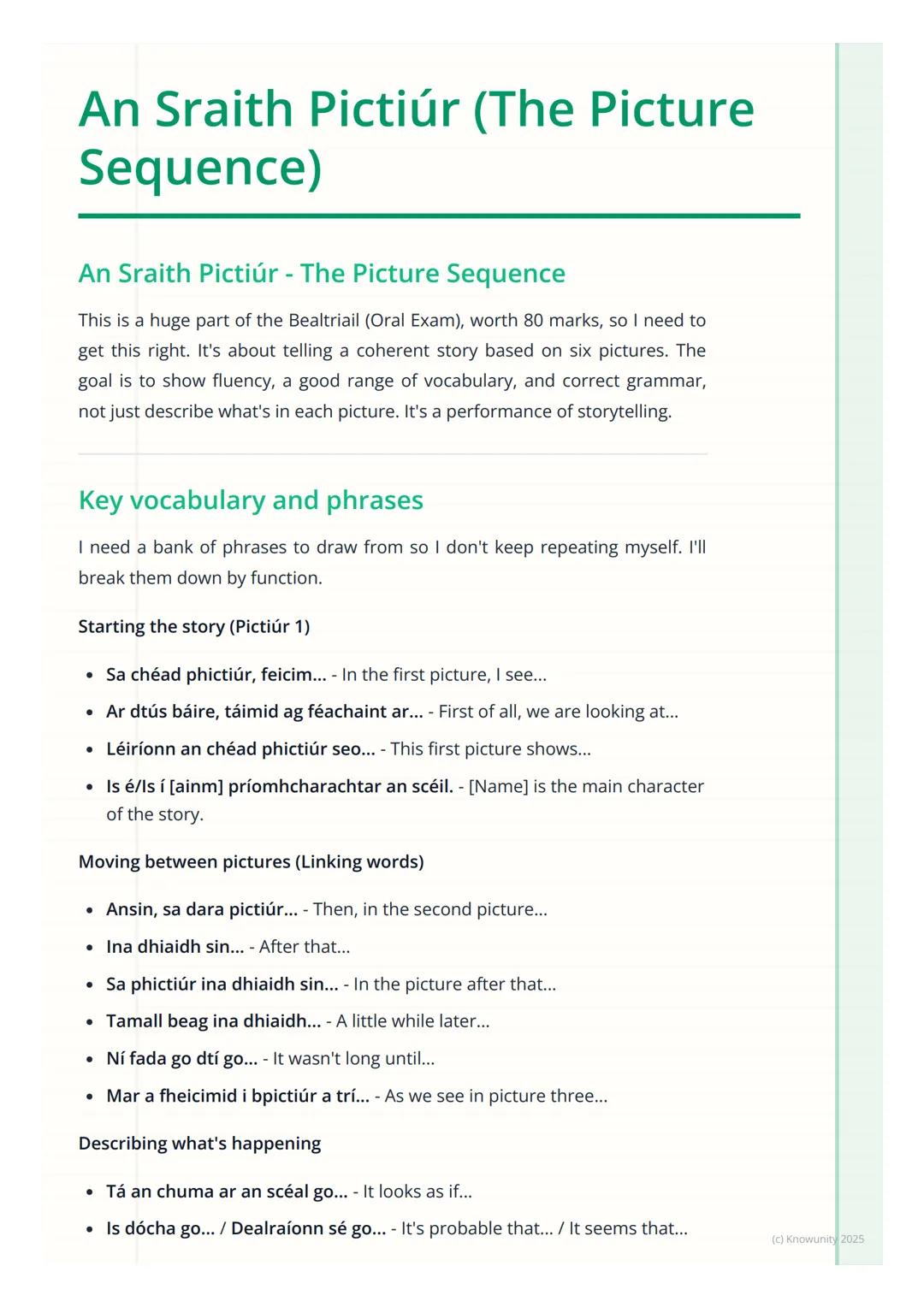
An Sraith Pictiúr - The Picture Sequence
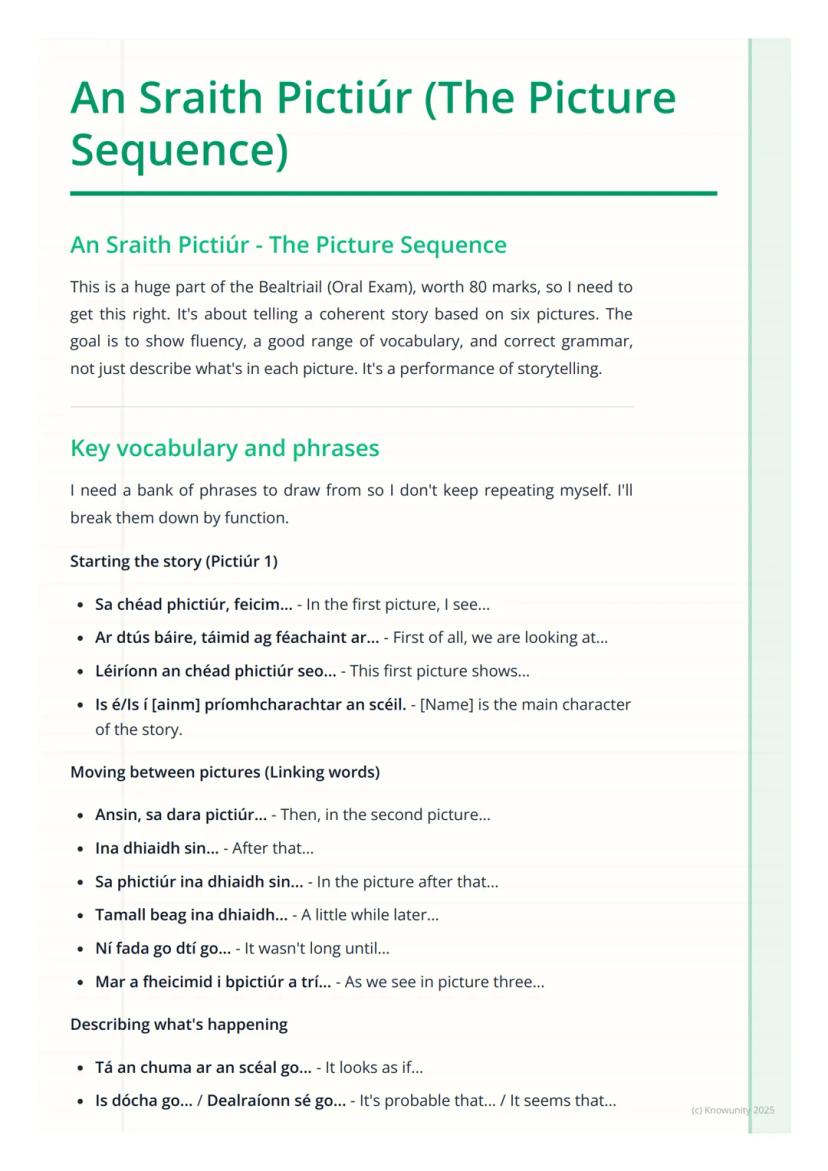
Think of this as your moment to shine as a storyteller, not just someone listing what they see in pictures. You've got six pictures to work with, and your job is to create a coherent narrative that shows off your vocabulary range and grammar skills.
The secret sauce here is having a bank of phrases ready to go. You don't want to be stuck repeating the same old "agus ansin..." (and then) over and over again.
For starting your story, try phrases like "Sa chéad phictiúr, feicim..." or "Ar dtús báire, táimid ag féachaint ar..." These immediately show you're confident and ready to tell a proper story.
Top Tip: Think performance, not description. You're entertaining your examiner with a story, not giving them a boring list of what's happening in each picture.
2
of 6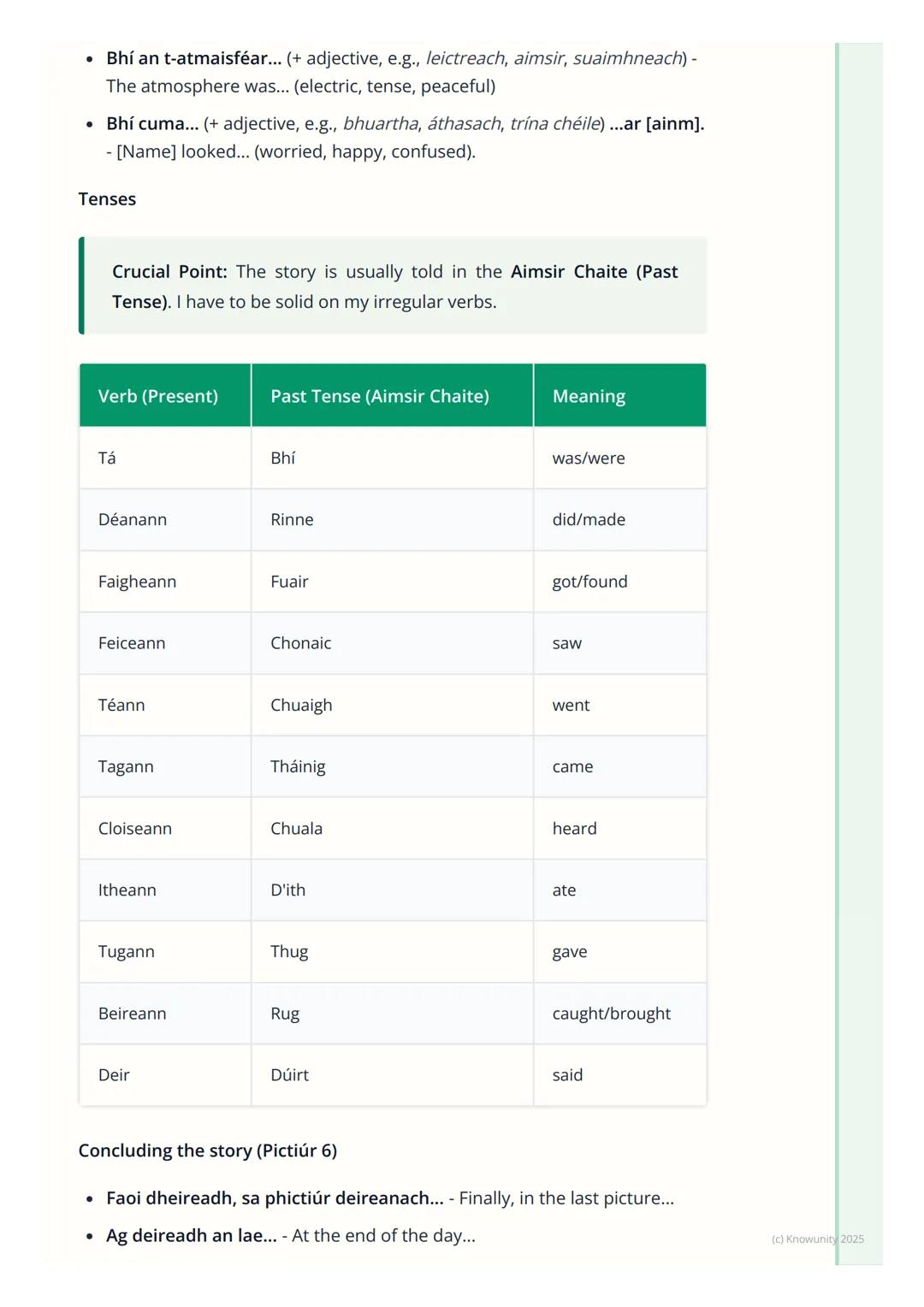
Essential Phrases and Past Tense Mastery
Linking phrases are your best friends for smooth transitions between pictures. Mix it up with "Ina dhiaidh sin...", "Tamall beag ina dhiaidh...", or "Ní fada go dtí go..." instead of always using the same connector.
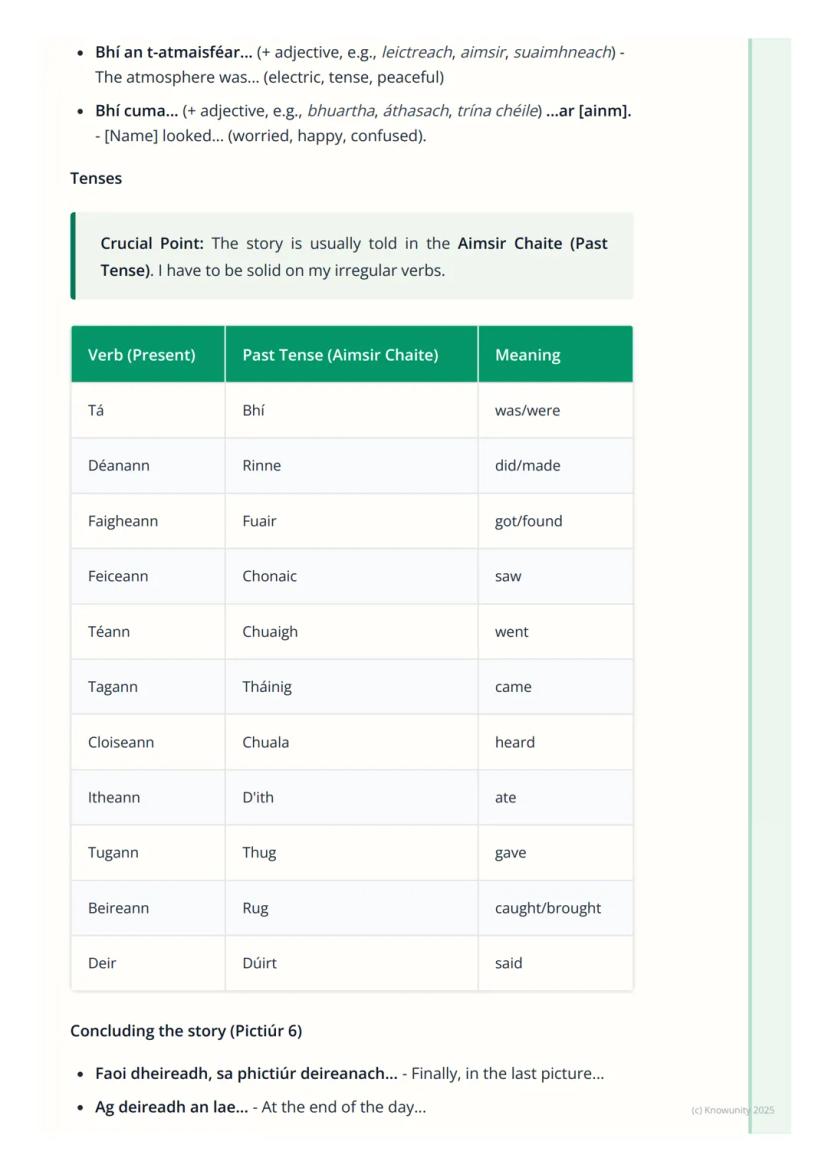
The Aimsir Chaite (past tense) is absolutely crucial since you're telling a story that's already happened. Get those irregular verbs locked down tight – bhí, rinne, fuair, chonaic, chuaigh and the rest need to roll off your tongue automatically.
Don't forget to bring the atmosphere to life. Instead of just saying what happened, describe how characters felt: "Bhí cuma bhuartha air" (he looked worried) or "Bhí an t-atmaisféar leictreach" (the atmosphere was electric).
Confidence Boost: Once you've got these phrases memorised, you'll never be stuck for words. Your story will flow naturally, and you'll sound like a native speaker!
3
of 6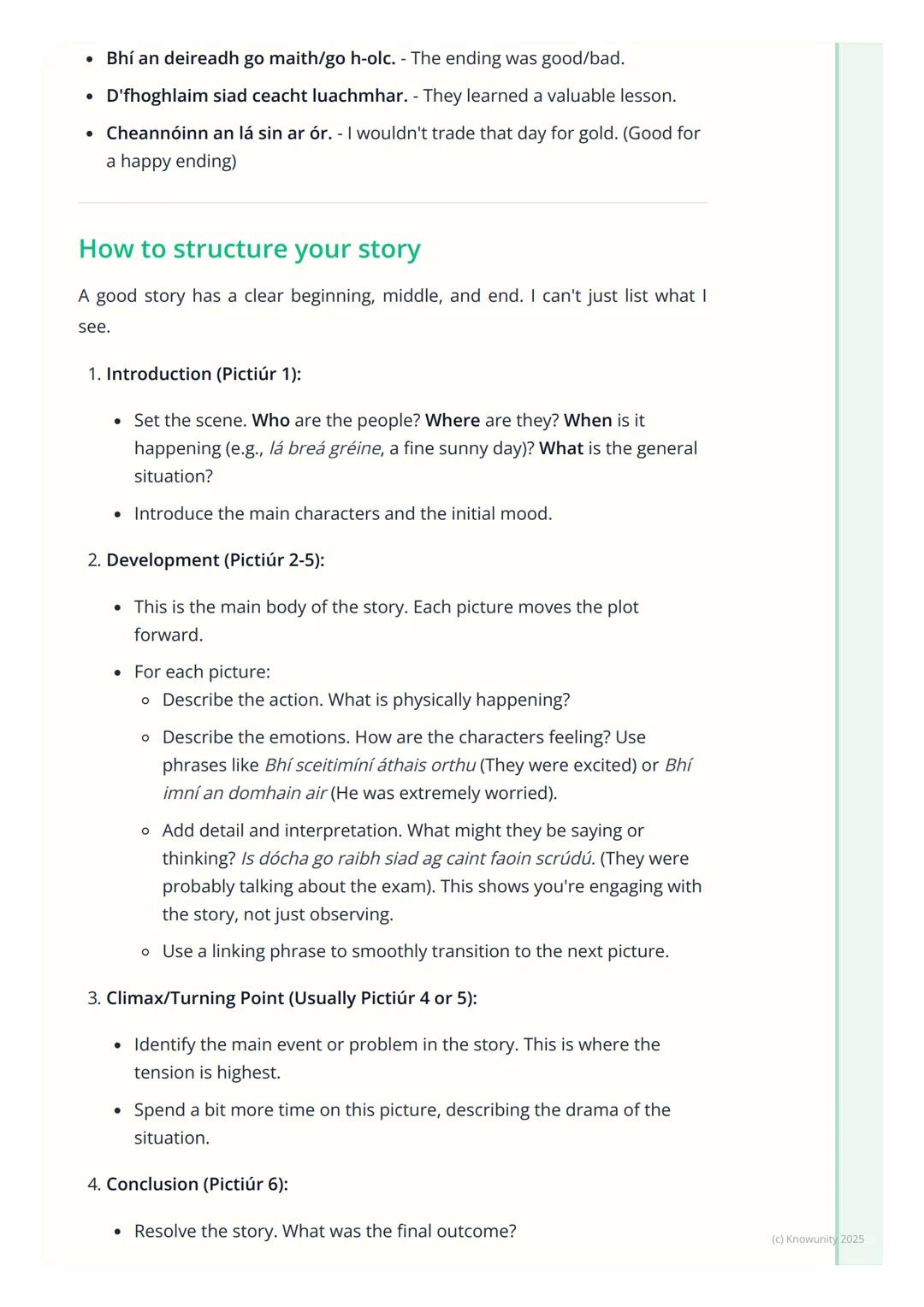
Story Structure That Works
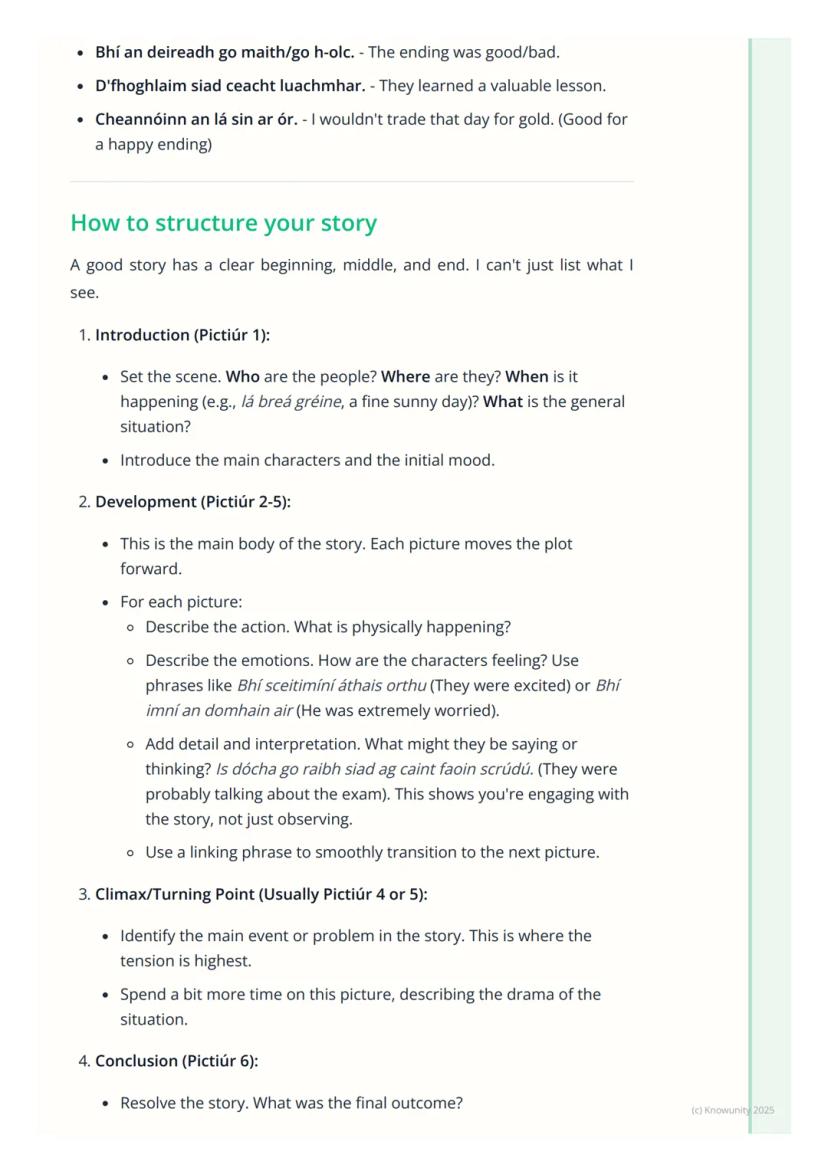
A proper story isn't just six separate descriptions stuck together – it needs a clear beginning, middle, and end that makes sense. Start by setting the scene in picture one: who are your characters, where are they, what's the initial mood?
Pictures 2-5 are your main development. Each picture should move the plot forward while you add emotional depth and interpretation. Don't just say what's happening – explain what characters might be thinking or feeling.
The climax usually hits around picture 4 or 5. This is where the drama peaks, so spend extra time here describing the tension and emotions. Your examiner wants to see you can identify the story's turning point.
Smart Strategy: Look for the problem or conflict in the middle pictures – that's your story's heart. Everything else builds up to it or resolves from it.
Wrap up with picture 6 by resolving everything and maybe throwing in a lesson learned. Phrases like "D'fhoghlaim siad ceacht luachmhar" show you understand the story's deeper meaning.
4
of 6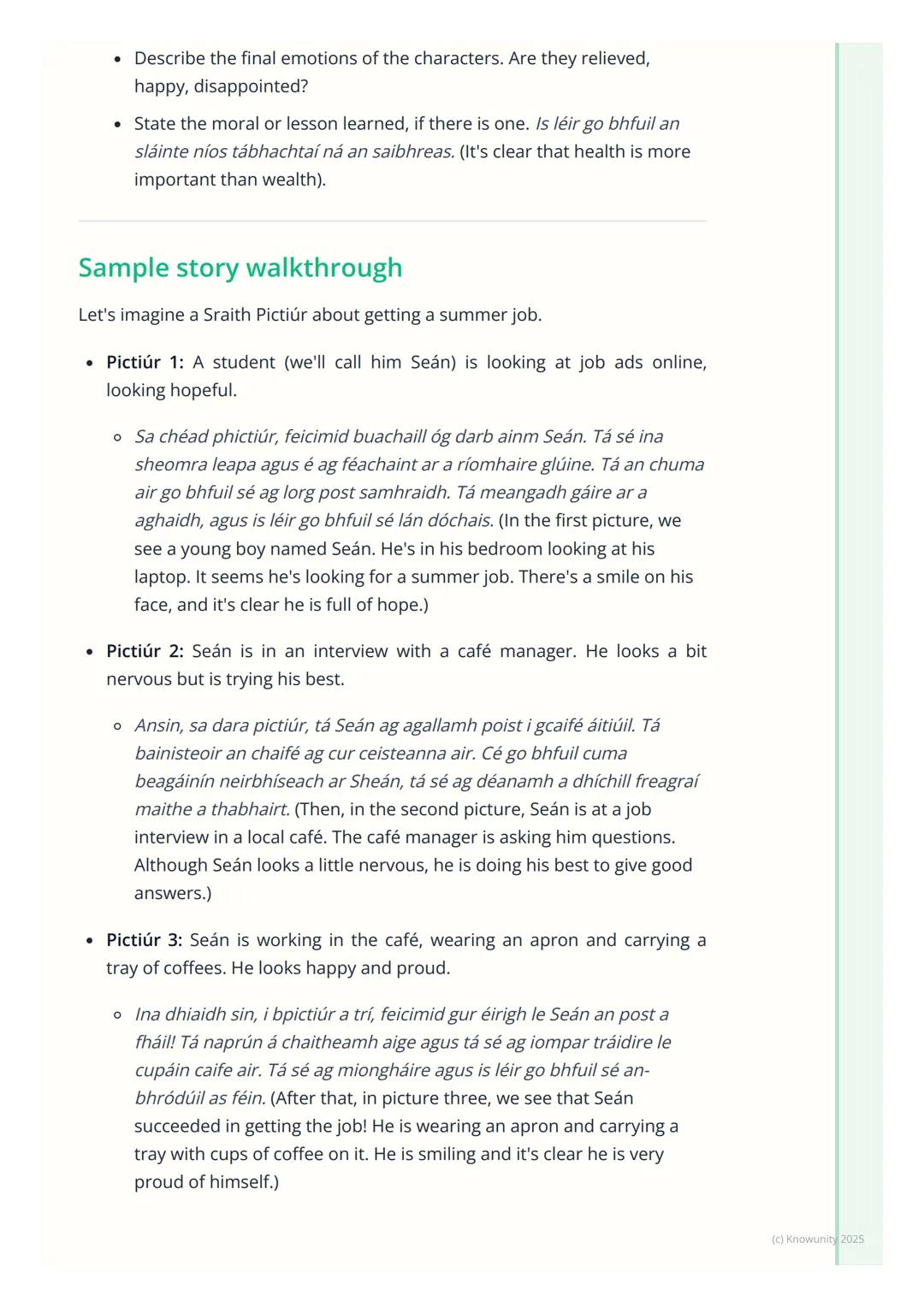
Sample Story Walkthrough
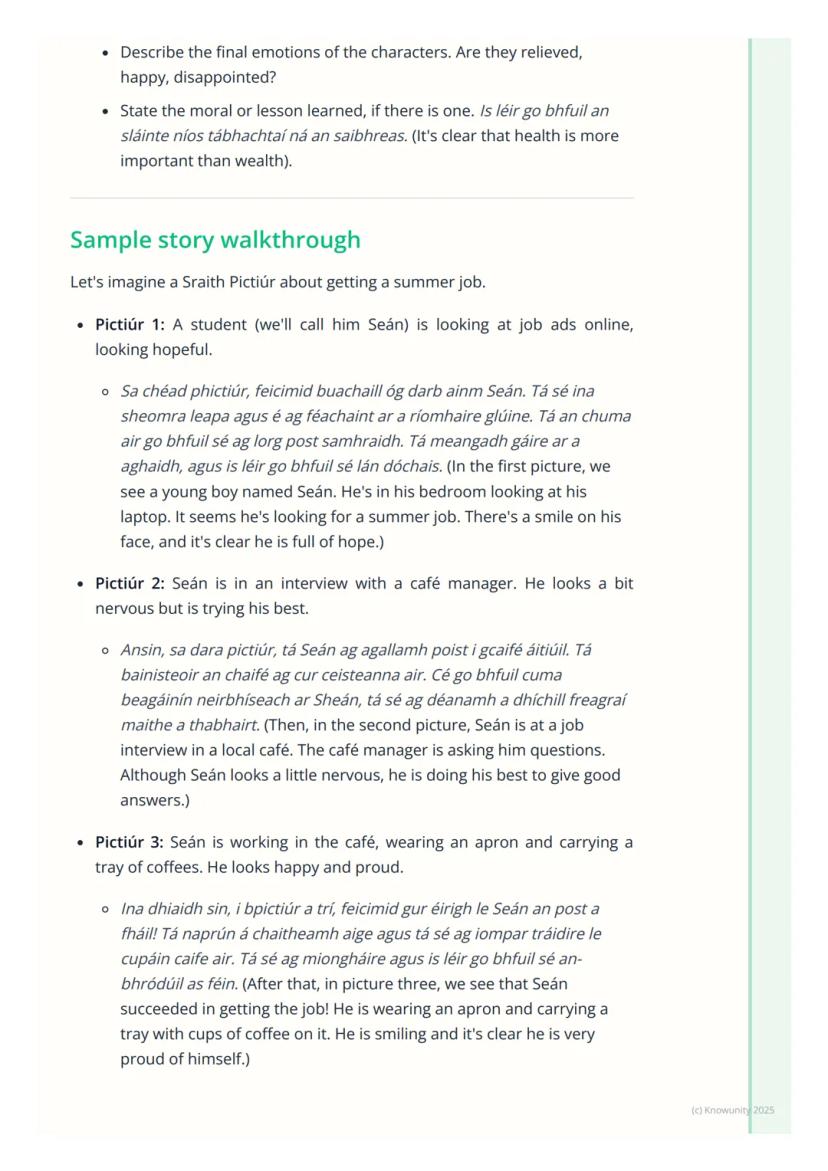
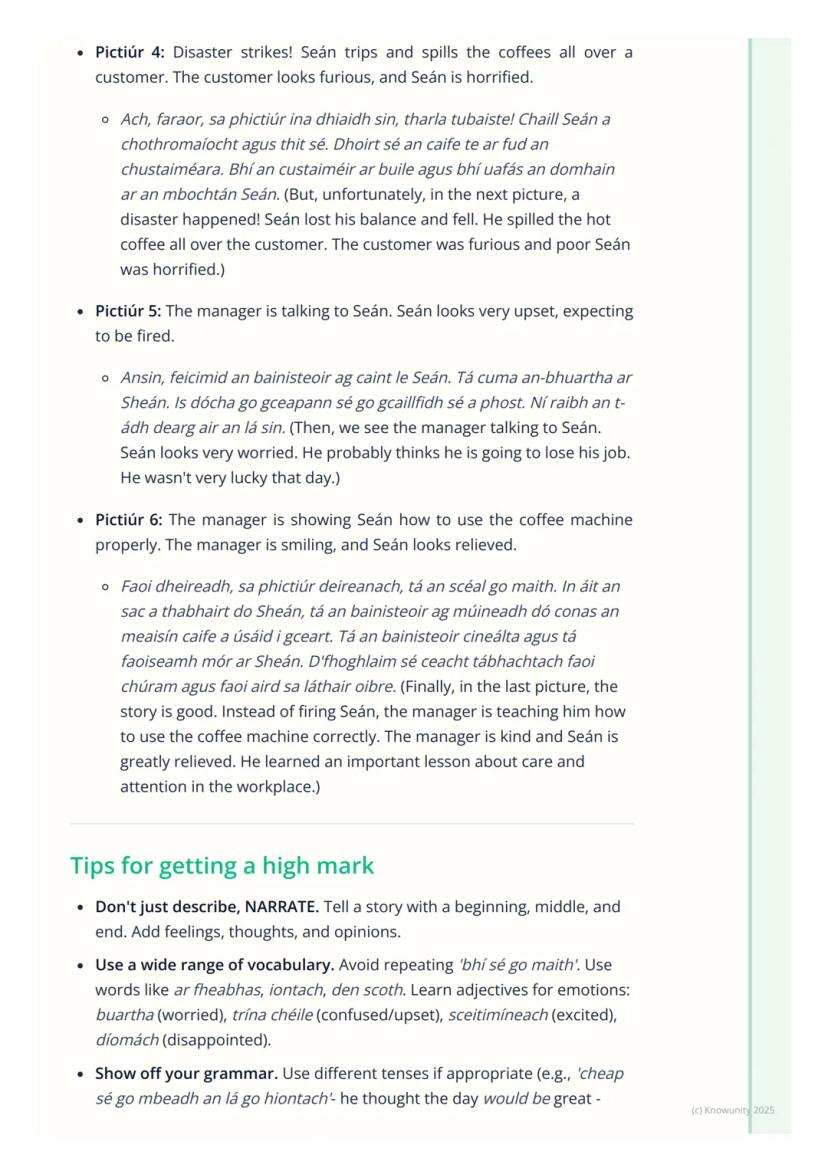
Let's break down a summer job story to see how this works in practice. Picture 1 shows Seán looking hopefully at job ads: "Sa chéad phictiúr, feicimid buachaill óg darb ainm Seán... Tá meangadh gáire ar a aghaidh, agus is léir go bhfuil sé lán dóchais."
Picture 2 moves to his job interview: "Ansin, sa dara pictiúr, tá Seán ag agallamh poist i gcaifé áitiúil... Cé go bhfuil cuma beagáinín neirbhíseach air, tá sé ag déanamh a dhíchill."
By picture 3, he's got the job and looks proud wearing his apron. But then disaster strikes in picture 4 – he spills coffee everywhere! "Chaill Seán a chothromaíocht agus thit sé. Dhoirt sé an caife te ar fud an chustaiméara."
Story Magic: Notice how each picture builds tension, then releases it. That's what makes your examiner want to keep listening instead of just waiting for you to finish.
5
of 6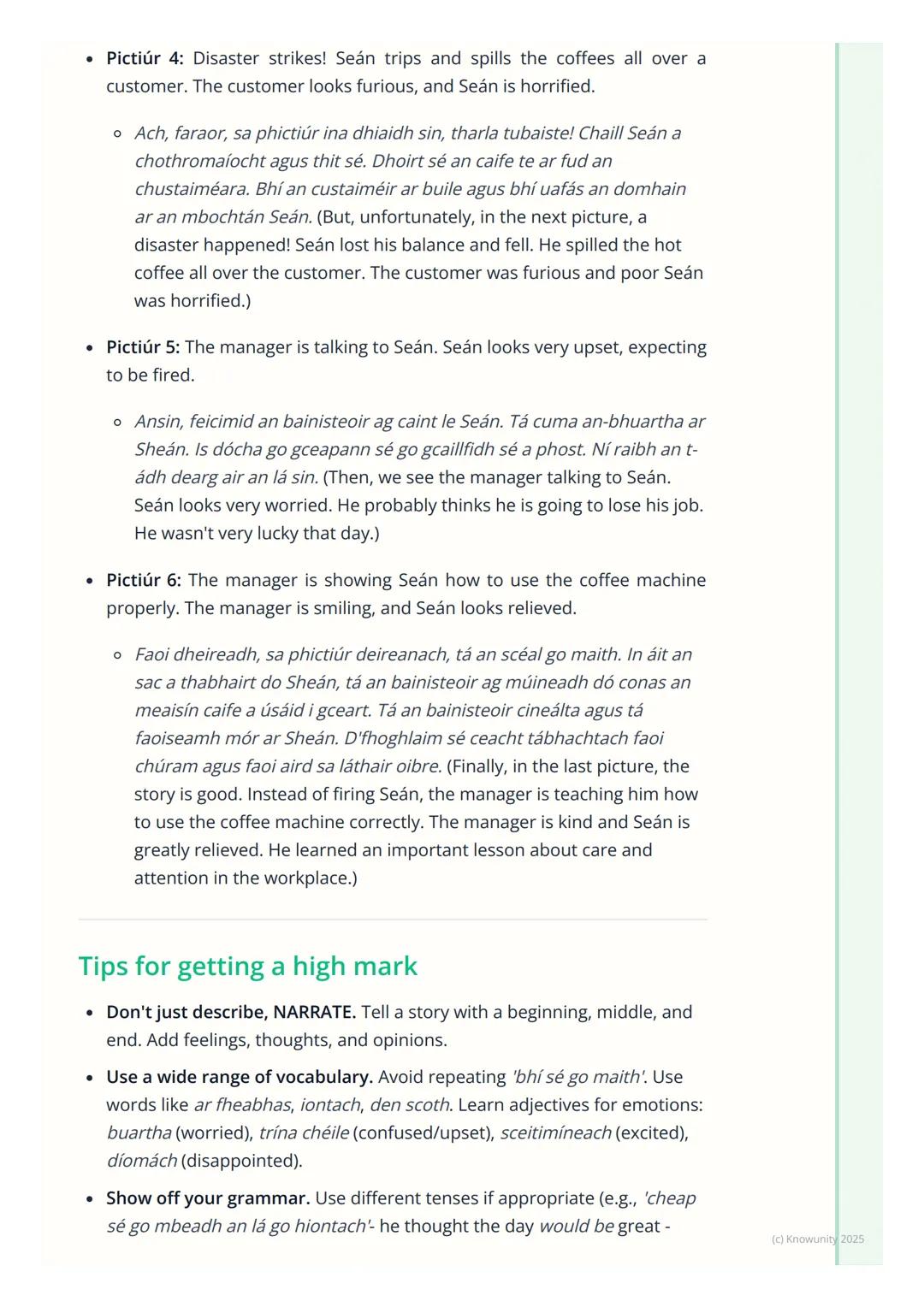
High-Mark Strategies
Narrate, don't just describe – this is the golden rule. Add thoughts, feelings, and interpretations to show you're really engaging with the story. Use phrases like "Is dócha go gceapann sé..." (he probably thinks) to show deeper understanding.
Your vocabulary range needs to impress. Don't stick with basic words when you could use ar fheabhas, iontach, den scoth instead of just "go maith". Learn emotional adjectives like sceitimíneach (excited), díomách (disappointed), and trína chéile (confused).
Show off your grammar skills by throwing in different tenses when appropriate. A bit of Modh Coinníollach (conditional) like "cheap sé go mbeadh an lá go hiontach" demonstrates real language mastery.
Panic-Buster: If you forget a word, describe it in Irish instead. Can't remember "ambulance"? Try "an carr mór bán a thagann ón ospidéal" – problem solved!
Remember you'll face 2-3 follow-up questions after your story, so have some opinions ready about what might happen next or whether characters made good choices.
6
of 6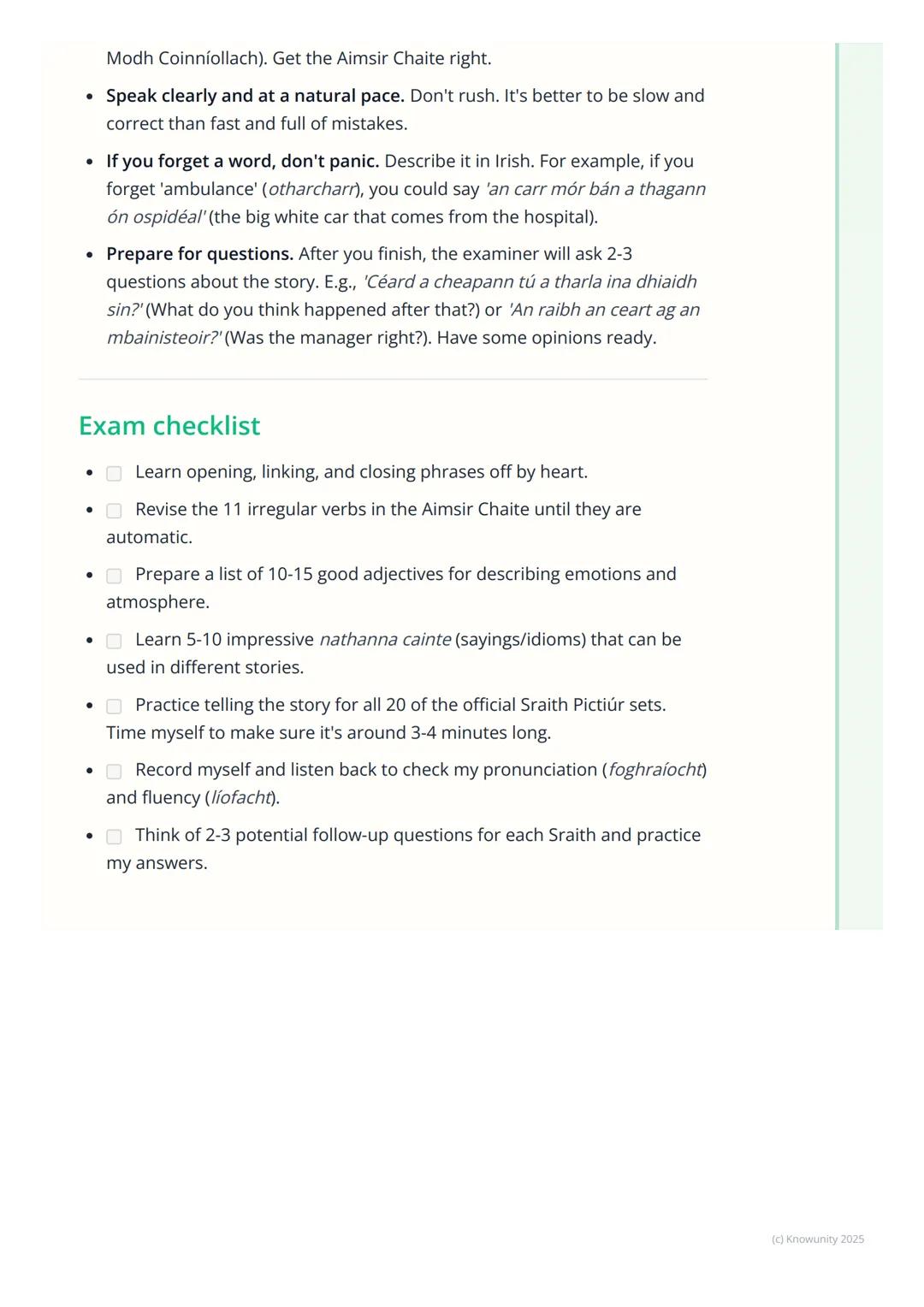
Exam Success Checklist
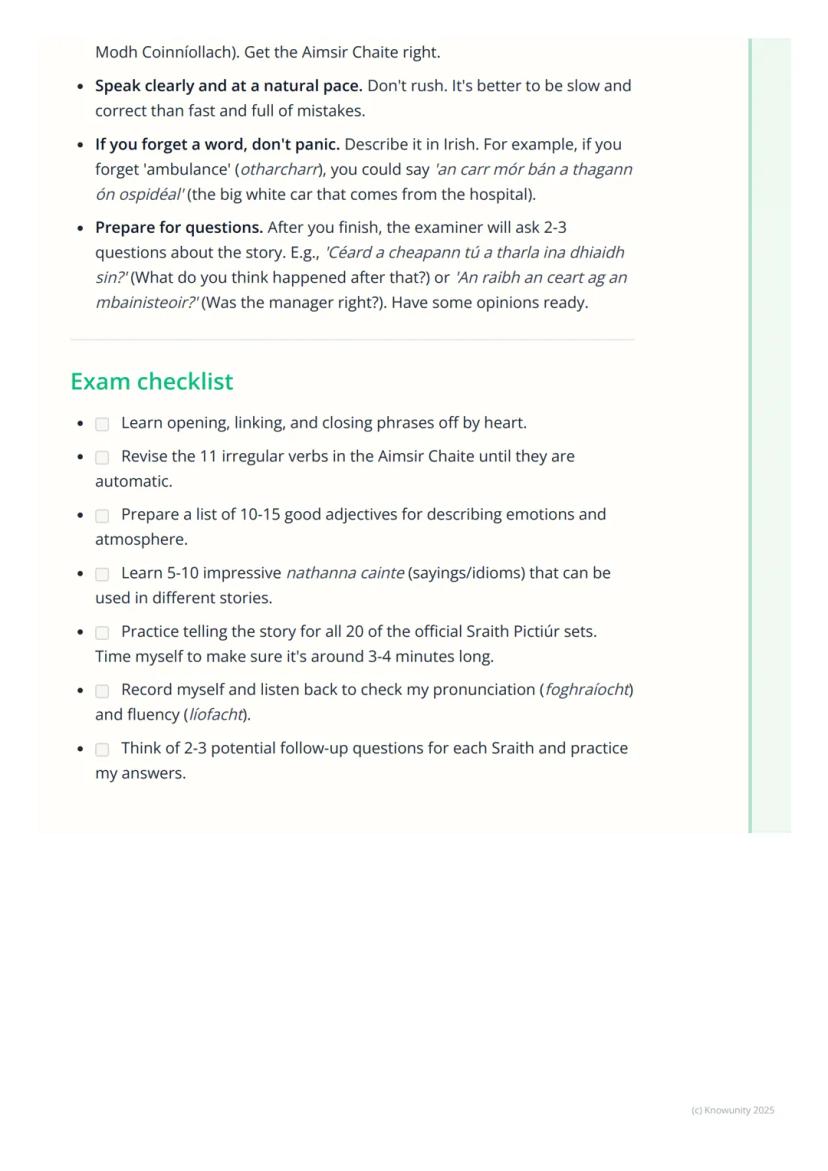
Get your opening, linking, and closing phrases memorised until they're automatic. These are your safety net when nerves kick in during the actual exam.
Those 11 irregular verbs in the Aimsir Chaite need to be rock solid. Practice them until you don't even have to think about whether it's "chonaic" or "fheic" – it should just flow naturally.
Build up your emotional vocabulary with 10-15 solid adjectives for describing feelings and atmosphere. The examiners love seeing students who can paint vivid pictures with words.
Final Power Move: Practice all 20 official Sraith Pictiúr sets and time yourself. Aim for 3-4 minutes per story – long enough to show your skills, short enough to stay focused and confident.
Record yourself telling stories and listen back. You'll spot pronunciation issues and awkward phrases that need smoothing out before the real thing.
Most importantly, prepare potential follow-up questions for each story set. Think about themes, character motivations, and alternative endings – this shows you're thinking critically, not just memorising scripts.
Akala namin hindi mo na itatanong...
Ano ang Knowunity AI companion?
Ang aming AI Companion ay isang AI tool na nakatuon sa mga estudyante na nag-aalok ng higit pa sa mga sagot lang. Binuo mula sa milyong Knowunity resources, nagbibigay ito ng may-kaugnayang impormasyon, personalized na study plans, quizzes, at content direkta sa chat, na umaangkop sa iyong sariling learning journey.
Saan ko mada-download ang Knowunity app?
Maaari mong i-download ang app mula sa Google Play Store at Apple App Store.
Talaga bang libre ang Knowunity?
Tama 'yan! Mag-enjoy sa libreng access sa mga study content, makipag-connect sa kapwa mga estudyante, at kumuha ng instant na tulong – lahat nasa iyong daliri lang.
Pinaka-sikat na nilalaman sa Irish
9IrishIrish oral questions and answers
Questions and answers for the leaving cert oral
5th Year4264
IrishIrish oral questions
Outline of oral questions
5th Year2055
IrishIrish poetry 2027
Iníon + Dínit an Bhróin
5th Year1133
IrishIníon- le hÁine Durkin
Aine Durkin’s poem, Iníon: Themes & summary
5th Year850
IrishLC HL notes- Iníon (poem)
Includes poem in English and Irish, theme, key words & phrases
5th Year2284
IrishMo Ghrá-sa (Idir Lúibíní)
Notes on mo ghrá-sa
5th Year380
IrishGaeilge Grammar Office
All the basics you need to know on Irish grammar.
6th Year1063
IrishAn Gaeilge Aiste
Irish Language essay
6th Year1320
IrishMé Féin & Mo Chlann (Myself & My Family)
Students will learn vocabulary to describe themselves, their family members, and daily routines. This helps in personal introductions and discussions.
TY291
Pinaka-sikat na nilalaman
9IrishIrish oral questions and answers
Questions and answers for the leaving cert oral
5th Year4264
 English
Key Quotes : Sive
Key Quotes and explanations: Sive
6th Year2842
IrishIrish oral questions
Outline of oral questions
5th Year2055
IrishIníon- le hÁine Durkin
Aine Durkin’s poem, Iníon: Themes & summary
5th Year850
IrishIrish poetry 2027
Iníon + Dínit an Bhróin
5th Year1133
IrishLC HL notes- Iníon (poem)
Includes poem in English and Irish, theme, key words & phrases
5th Year2284
EnglishCultural Context : Shawshank Redemption : Sive : Small Things Like These
Comparative Study : Cultural Context : Shawshank Redemption, Sive and Small Things Like These
6th Year1430
IrishMo Ghrá-sa (Idir Lúibíní)
Notes on mo ghrá-sa
5th Year380
IrishAn Gaeilge Aiste
Irish Language essay
6th Year1320
Hindi mo mahanap ang hinahanap mo? Tuklasin ang iba pang mga asignatura.
Gustong-gusto kami ng mga estudyante — at magiging ganoon ka rin.
4.6/5App Store
4.7/5Google Play
Napakadaling gamitin at maganda ang disenyo ng app. Nahanap ko lahat ng hinahanap ko hanggang ngayon at natuto ako ng marami mula sa mga presentasyon! Tiyak na gagamitin ko ang app para sa isang takdang-aralin sa klase! At siyempre, nakakatulong din ito bilang inspirasyon.
Stefan Sgumagamit ng iOS
Sobrang ganda talaga ng app na ito. Maraming mga study notes at tulong [...]. Ang problemang subject ko ay Pranses, halimbawa, at ang app ay may maraming options para tumulong. Salamat sa app na ito, bumuti ang Pranses ko. Irerekumenda ko ito sa lahat.
Samantha KlichAndroid user
Wow, talagang namangha ako. Sinubukan ko lang ang app dahil nakita ko itong ina-advertise nang maraming beses at sobrang nagulat ako. Ang app na ito ang TULONG na gusto mo para sa paaralan at higit sa lahat, nag-aalok ito ng maraming bagay, tulad ng workouts at fact sheets, na SOBRANG nakatulong sa akin.
AnnaiOS user
Irish54 views·Na-update Jun 6, 2026·6 mga pahinaMastering An Sraith Pictiúr for Irish Storytelling
The Picture Sequence (An Sraith Pictiúr) is your chance to show off your Irish storytelling skills in the oral exam. Worth a massive 80 marks, this isn't just about describing six pictures – it's about weaving them into a proper...
1
of 6
Mag-sign up para makita ang content. Libre ito!
- Access sa lahat ng dokumento
- Pagbutihin ang iyong mga grado
- Sumali sa milyong mga estudyante
An Sraith Pictiúr - The Picture Sequence
Think of this as your moment to shine as a storyteller, not just someone listing what they see in pictures. You've got six pictures to work with, and your job is to create a coherent narrative that shows off your vocabulary range and grammar skills.
The secret sauce here is having a bank of phrases ready to go. You don't want to be stuck repeating the same old "agus ansin..." (and then) over and over again.
For starting your story, try phrases like "Sa chéad phictiúr, feicim..." or "Ar dtús báire, táimid ag féachaint ar..." These immediately show you're confident and ready to tell a proper story.
Top Tip: Think performance, not description. You're entertaining your examiner with a story, not giving them a boring list of what's happening in each picture.
2
of 6Mag-sign up para makita ang content. Libre ito!
- Access sa lahat ng dokumento
- Pagbutihin ang iyong mga grado
- Sumali sa milyong mga estudyante
Essential Phrases and Past Tense Mastery
Linking phrases are your best friends for smooth transitions between pictures. Mix it up with "Ina dhiaidh sin...", "Tamall beag ina dhiaidh...", or "Ní fada go dtí go..." instead of always using the same connector.
The Aimsir Chaite (past tense) is absolutely crucial since you're telling a story that's already happened. Get those irregular verbs locked down tight – bhí, rinne, fuair, chonaic, chuaigh and the rest need to roll off your tongue automatically.
Don't forget to bring the atmosphere to life. Instead of just saying what happened, describe how characters felt: "Bhí cuma bhuartha air" (he looked worried) or "Bhí an t-atmaisféar leictreach" (the atmosphere was electric).
Confidence Boost: Once you've got these phrases memorised, you'll never be stuck for words. Your story will flow naturally, and you'll sound like a native speaker!
3
of 6Mag-sign up para makita ang content. Libre ito!
- Access sa lahat ng dokumento
- Pagbutihin ang iyong mga grado
- Sumali sa milyong mga estudyante
Story Structure That Works
A proper story isn't just six separate descriptions stuck together – it needs a clear beginning, middle, and end that makes sense. Start by setting the scene in picture one: who are your characters, where are they, what's the initial mood?
Pictures 2-5 are your main development. Each picture should move the plot forward while you add emotional depth and interpretation. Don't just say what's happening – explain what characters might be thinking or feeling.
The climax usually hits around picture 4 or 5. This is where the drama peaks, so spend extra time here describing the tension and emotions. Your examiner wants to see you can identify the story's turning point.
Smart Strategy: Look for the problem or conflict in the middle pictures – that's your story's heart. Everything else builds up to it or resolves from it.
Wrap up with picture 6 by resolving everything and maybe throwing in a lesson learned. Phrases like "D'fhoghlaim siad ceacht luachmhar" show you understand the story's deeper meaning.
4
of 6Mag-sign up para makita ang content. Libre ito!
- Access sa lahat ng dokumento
- Pagbutihin ang iyong mga grado
- Sumali sa milyong mga estudyante
Sample Story Walkthrough
Let's break down a summer job story to see how this works in practice. Picture 1 shows Seán looking hopefully at job ads: "Sa chéad phictiúr, feicimid buachaill óg darb ainm Seán... Tá meangadh gáire ar a aghaidh, agus is léir go bhfuil sé lán dóchais."
Picture 2 moves to his job interview: "Ansin, sa dara pictiúr, tá Seán ag agallamh poist i gcaifé áitiúil... Cé go bhfuil cuma beagáinín neirbhíseach air, tá sé ag déanamh a dhíchill."
By picture 3, he's got the job and looks proud wearing his apron. But then disaster strikes in picture 4 – he spills coffee everywhere! "Chaill Seán a chothromaíocht agus thit sé. Dhoirt sé an caife te ar fud an chustaiméara."
Story Magic: Notice how each picture builds tension, then releases it. That's what makes your examiner want to keep listening instead of just waiting for you to finish.
5
of 6Mag-sign up para makita ang content. Libre ito!
- Access sa lahat ng dokumento
- Pagbutihin ang iyong mga grado
- Sumali sa milyong mga estudyante
High-Mark Strategies
Narrate, don't just describe – this is the golden rule. Add thoughts, feelings, and interpretations to show you're really engaging with the story. Use phrases like "Is dócha go gceapann sé..." (he probably thinks) to show deeper understanding.
Your vocabulary range needs to impress. Don't stick with basic words when you could use ar fheabhas, iontach, den scoth instead of just "go maith". Learn emotional adjectives like sceitimíneach (excited), díomách (disappointed), and trína chéile (confused).
Show off your grammar skills by throwing in different tenses when appropriate. A bit of Modh Coinníollach (conditional) like "cheap sé go mbeadh an lá go hiontach" demonstrates real language mastery.
Panic-Buster: If you forget a word, describe it in Irish instead. Can't remember "ambulance"? Try "an carr mór bán a thagann ón ospidéal" – problem solved!
Remember you'll face 2-3 follow-up questions after your story, so have some opinions ready about what might happen next or whether characters made good choices.
6
of 6Mag-sign up para makita ang content. Libre ito!
- Access sa lahat ng dokumento
- Pagbutihin ang iyong mga grado
- Sumali sa milyong mga estudyante
Exam Success Checklist
Get your opening, linking, and closing phrases memorised until they're automatic. These are your safety net when nerves kick in during the actual exam.
Those 11 irregular verbs in the Aimsir Chaite need to be rock solid. Practice them until you don't even have to think about whether it's "chonaic" or "fheic" – it should just flow naturally.
Build up your emotional vocabulary with 10-15 solid adjectives for describing feelings and atmosphere. The examiners love seeing students who can paint vivid pictures with words.
Final Power Move: Practice all 20 official Sraith Pictiúr sets and time yourself. Aim for 3-4 minutes per story – long enough to show your skills, short enough to stay focused and confident.
Record yourself telling stories and listen back. You'll spot pronunciation issues and awkward phrases that need smoothing out before the real thing.
Most importantly, prepare potential follow-up questions for each story set. Think about themes, character motivations, and alternative endings – this shows you're thinking critically, not just memorising scripts.
Akala namin hindi mo na itatanong...
Ano ang Knowunity AI companion?
Ang aming AI Companion ay isang AI tool na nakatuon sa mga estudyante na nag-aalok ng higit pa sa mga sagot lang. Binuo mula sa milyong Knowunity resources, nagbibigay ito ng may-kaugnayang impormasyon, personalized na study plans, quizzes, at content direkta sa chat, na umaangkop sa iyong sariling learning journey.
Saan ko mada-download ang Knowunity app?
Maaari mong i-download ang app mula sa Google Play Store at Apple App Store.
Talaga bang libre ang Knowunity?
Tama 'yan! Mag-enjoy sa libreng access sa mga study content, makipag-connect sa kapwa mga estudyante, at kumuha ng instant na tulong – lahat nasa iyong daliri lang.
Pinaka-sikat na nilalaman sa Irish
9IrishIrish oral questions and answers
Questions and answers for the leaving cert oral
5th Year4264
IrishIrish oral questions
Outline of oral questions
5th Year2055
IrishIrish poetry 2027
Iníon + Dínit an Bhróin
5th Year1133
IrishIníon- le hÁine Durkin
Aine Durkin’s poem, Iníon: Themes & summary
5th Year850
IrishLC HL notes- Iníon (poem)
Includes poem in English and Irish, theme, key words & phrases
5th Year2284
IrishMo Ghrá-sa (Idir Lúibíní)
Notes on mo ghrá-sa
5th Year380
IrishGaeilge Grammar Office
All the basics you need to know on Irish grammar.
6th Year1063
IrishAn Gaeilge Aiste
Irish Language essay
6th Year1320
IrishMé Féin & Mo Chlann (Myself & My Family)
Students will learn vocabulary to describe themselves, their family members, and daily routines. This helps in personal introductions and discussions.
TY291
Pinaka-sikat na nilalaman
9IrishIrish oral questions and answers
Questions and answers for the leaving cert oral
5th Year4264
EnglishKey Quotes : Sive
Key Quotes and explanations: Sive
6th Year2842
IrishIrish oral questions
Outline of oral questions
5th Year2055
IrishIníon- le hÁine Durkin
Aine Durkin’s poem, Iníon: Themes & summary
5th Year850
IrishIrish poetry 2027
Iníon + Dínit an Bhróin
5th Year1133
IrishLC HL notes- Iníon (poem)
Includes poem in English and Irish, theme, key words & phrases
5th Year2284
EnglishCultural Context : Shawshank Redemption : Sive : Small Things Like These
Comparative Study : Cultural Context : Shawshank Redemption, Sive and Small Things Like These
6th Year1430
IrishMo Ghrá-sa (Idir Lúibíní)
Notes on mo ghrá-sa
5th Year380
IrishAn Gaeilge Aiste
Irish Language essay
6th Year1320
Hindi mo mahanap ang hinahanap mo? Tuklasin ang iba pang mga asignatura.
Gustong-gusto kami ng mga estudyante — at magiging ganoon ka rin.
4.6/5App Store
4.7/5Google Play
Napakadaling gamitin at maganda ang disenyo ng app. Nahanap ko lahat ng hinahanap ko hanggang ngayon at natuto ako ng marami mula sa mga presentasyon! Tiyak na gagamitin ko ang app para sa isang takdang-aralin sa klase! At siyempre, nakakatulong din ito bilang inspirasyon.
Stefan Sgumagamit ng iOS
Sobrang ganda talaga ng app na ito. Maraming mga study notes at tulong [...]. Ang problemang subject ko ay Pranses, halimbawa, at ang app ay may maraming options para tumulong. Salamat sa app na ito, bumuti ang Pranses ko. Irerekumenda ko ito sa lahat.
Samantha KlichAndroid user
Wow, talagang namangha ako. Sinubukan ko lang ang app dahil nakita ko itong ina-advertise nang maraming beses at sobrang nagulat ako. Ang app na ito ang TULONG na gusto mo para sa paaralan at higit sa lahat, nag-aalok ito ng maraming bagay, tulad ng workouts at fact sheets, na SOBRANG nakatulong sa akin.
AnnaiOS user