
The Irish future tense (an aimsir fháistineach) is your tool... Ipakita pa
 Irish5 views·Na-update Jun 4, 2026·5 mga pahina
Learn About An Aimsir Fháistineach: Forming Future Tense in Irish
1 / 5
1
of 5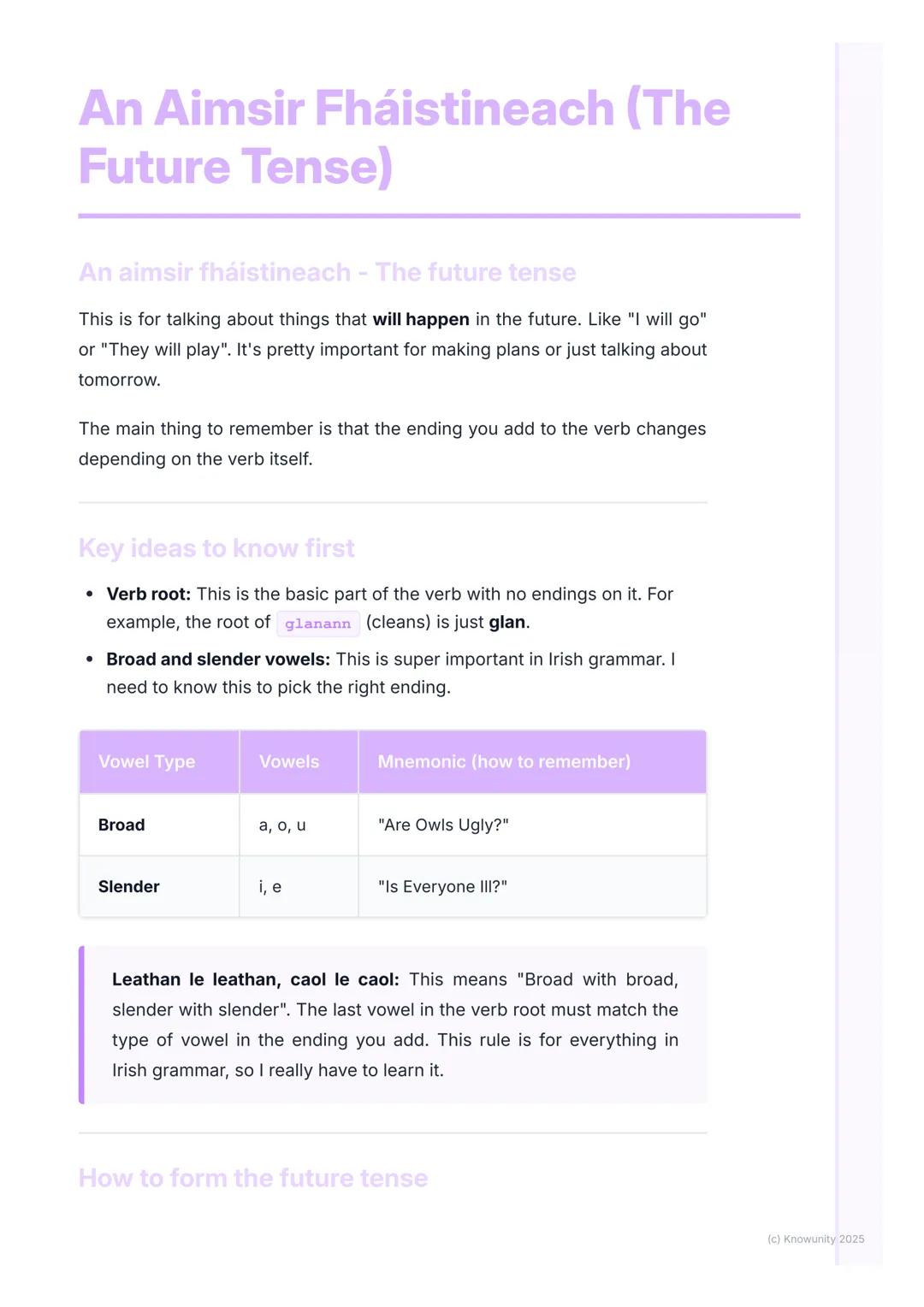
An Aimsir Fháistineach - Getting Started
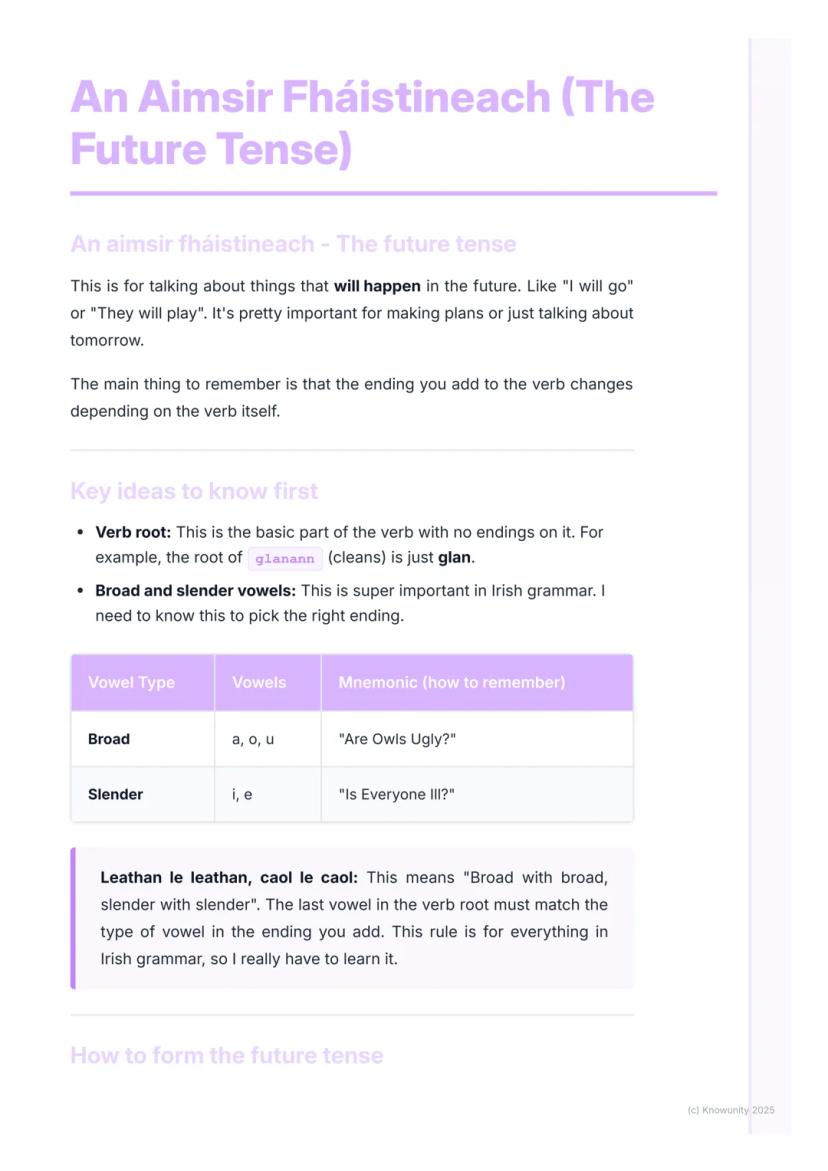
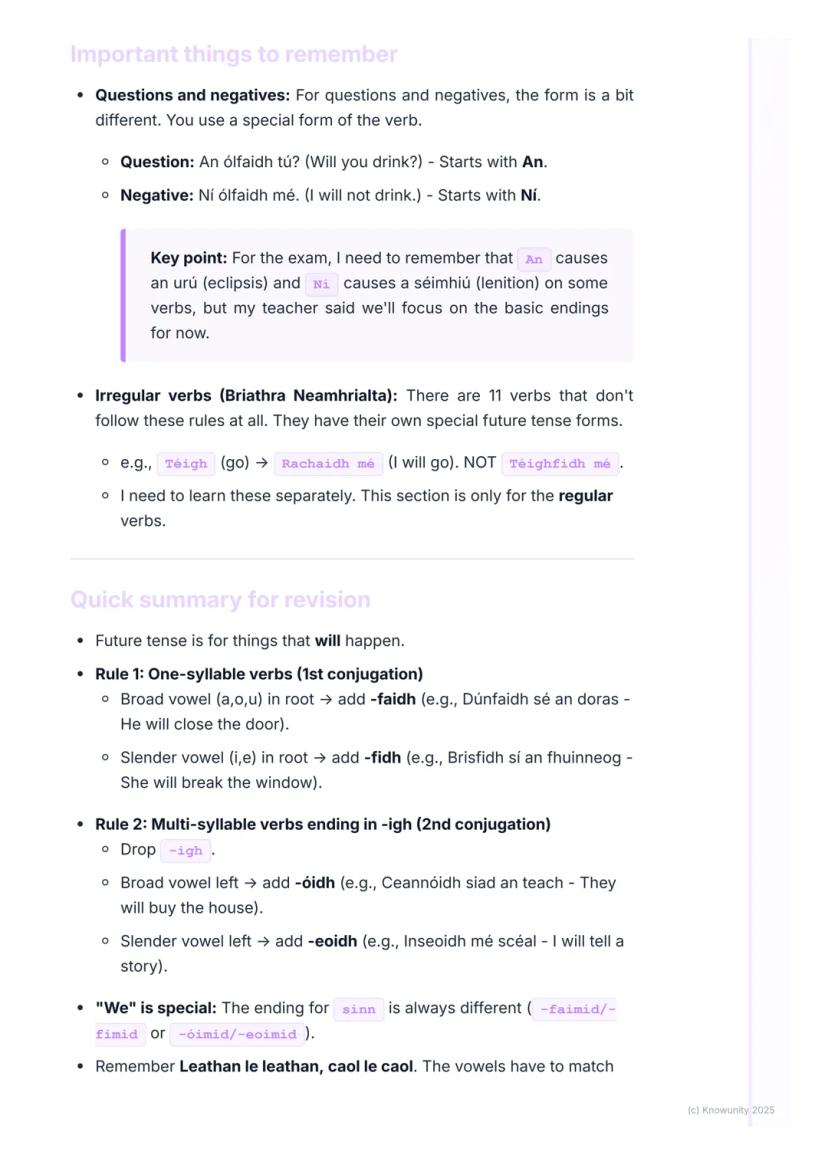
Think of the future tense as your planning language - it's how you say "I will go" or "they will play" in Irish. The trick is knowing which ending to stick on your verb, and that depends on the vowels inside it.
Before diving in, you need to master broad and slender vowels. Broad vowels are a, o, u (remember: "Are Owls Ugly?") and slender vowels are i, e ("Is Everyone Ill?"). This matters because of the golden rule: leathan le leathan, caol le caol - broad with broad, slender with slender.
The verb root is your starting point - it's the basic form without any endings. For example, glanann (cleans) has the root glan. Once you've got your root, check its last vowel to decide which ending fits.
Quick tip: Master the vowel types first - they're used throughout Irish grammar, not just the future tense!
2
of 5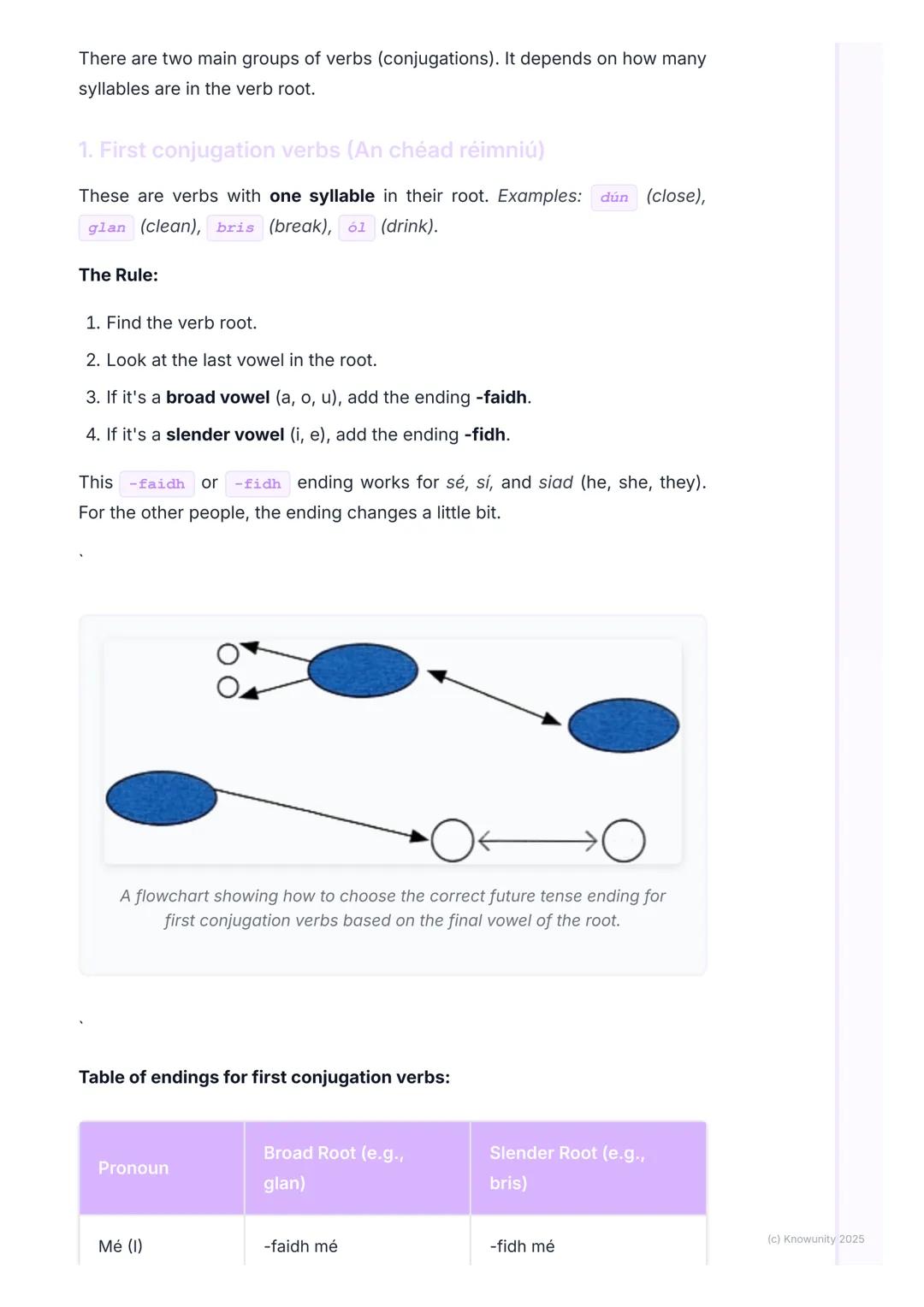
First Conjugation Verbs - The One-Syllable Gang
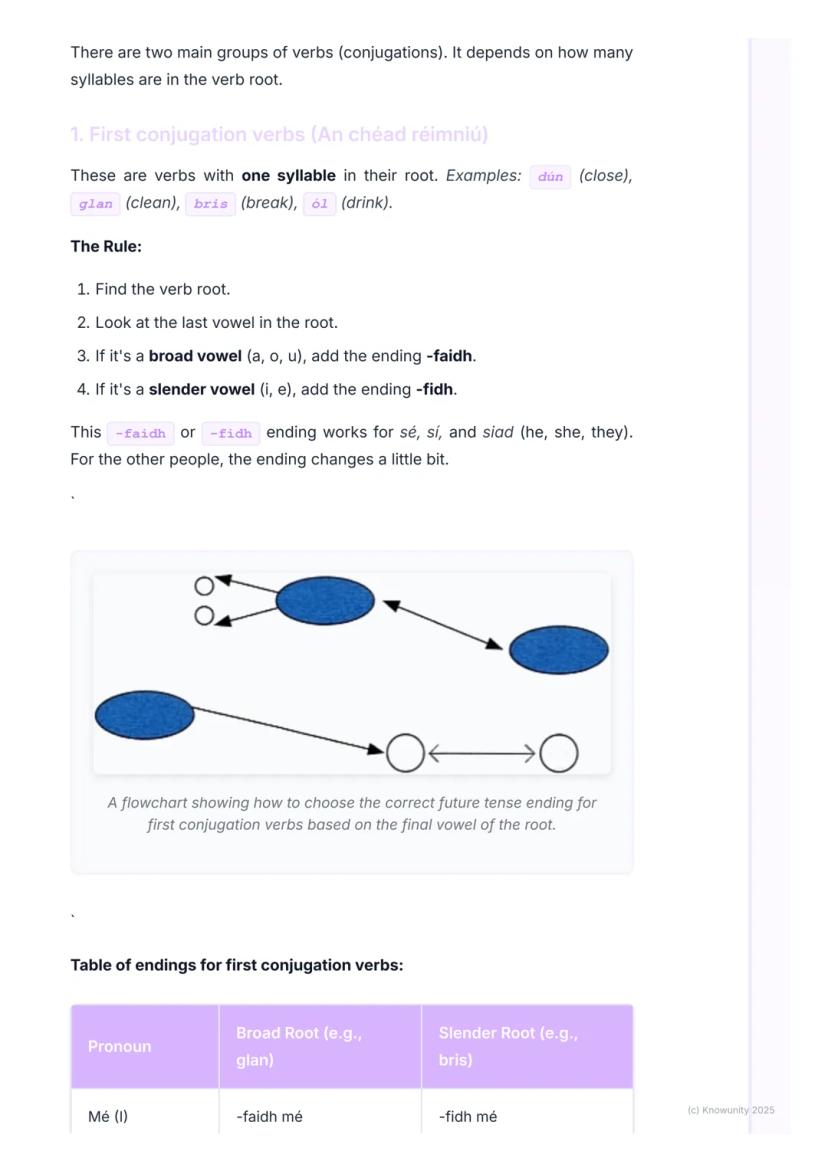
First conjugation verbs have just one syllable in their root - words like dún (close), glan (clean), bris (break), and ól (drink). These are actually the easiest once you get the pattern.
Here's the system: if your verb root ends with a broad vowel (a, o, u), you add -faidh. If it ends with a slender vowel (i, e), you add -fidh. So glan becomes glanfaidh and bris becomes brisfidh.
The endings work perfectly for sé, sí, and siad (he, she, they). For other pronouns like mé and tú, you just add the pronoun after: glanfaidh mé, glanfaidh tú. The only special case is sinn (we) - it gets its own endings: -faimid for broad roots and -fimid for slender ones.
Remember: The broad/slender rule applies to every single verb - there are no exceptions here!
3
of 5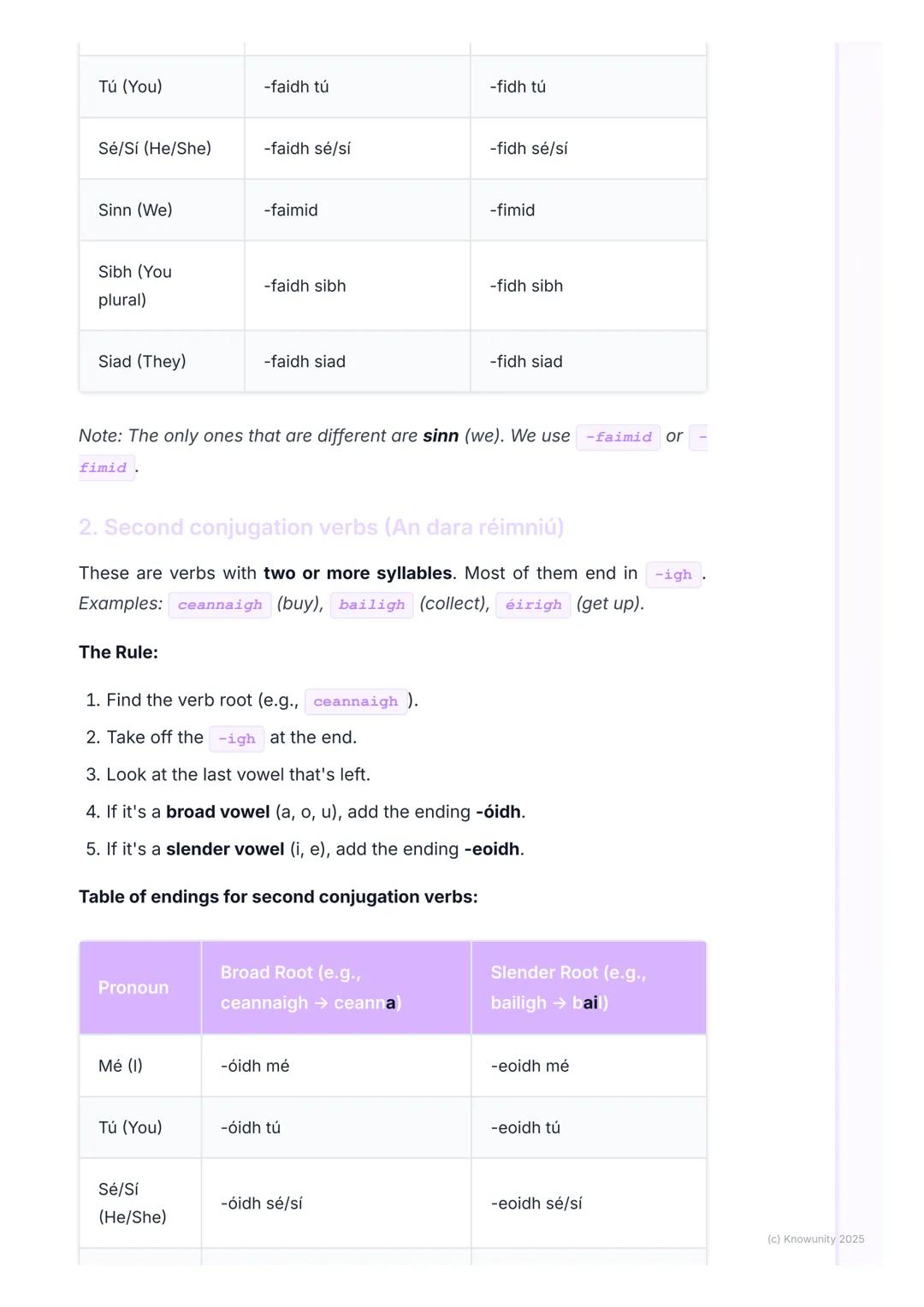
Second Conjugation Verbs - The Multi-Syllable Squad
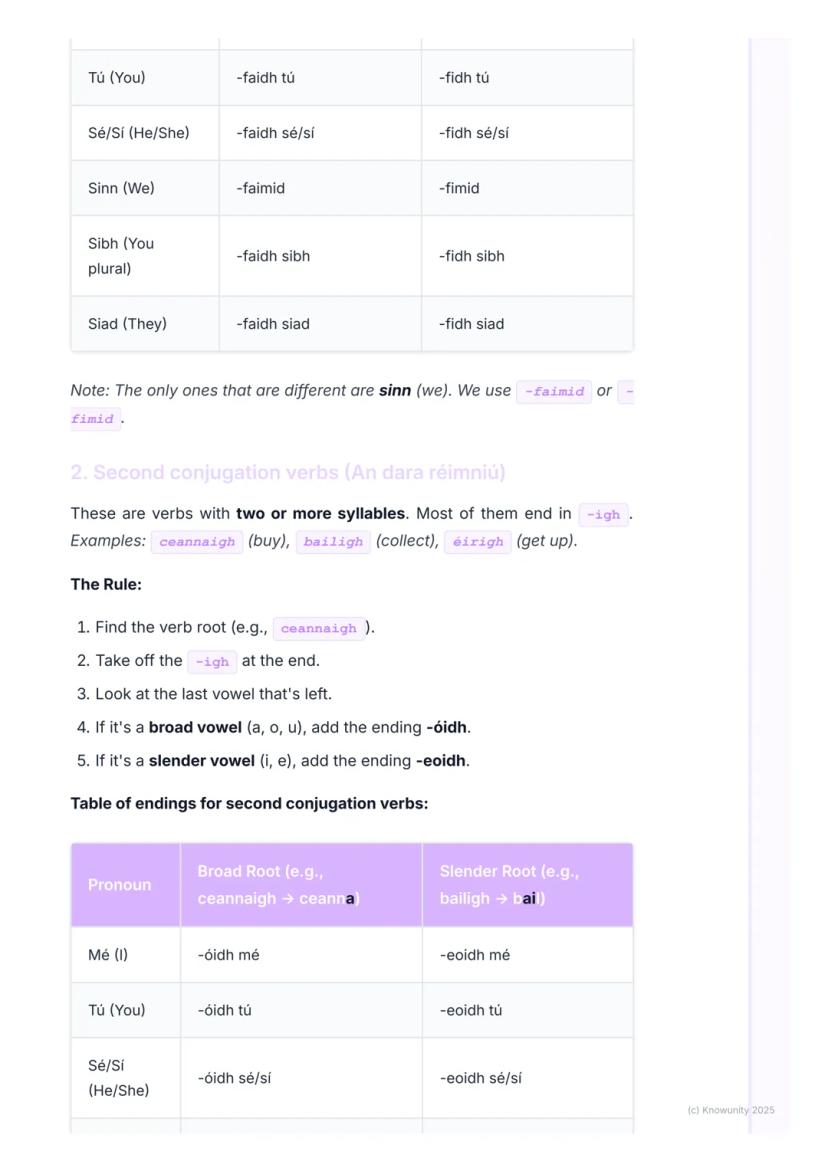
Second conjugation verbs have two or more syllables and usually end in -igh. Think ceannaigh (buy), bailigh (collect), or éirigh (get up) - they're longer words that need a different approach.
The process is straightforward: chop off the -igh ending first. Then check what vowel you're left with at the end. If it's broad (a, o, u), add -óidh. If it's slender (i, e), add -eoidh.
So ceannaigh loses its -igh to become ceanna (ending in broad 'a'), then gets -óidh to make ceannóidh. Bailigh becomes bail (ending in slender 'i'), then gets -eoidh to make baileoidh.
Just like first conjugation, sinn (we) is special again. It uses -óimid for broad roots and -eoimid for slender ones instead of the regular endings.
Pro tip: Most verbs you'll meet ending in -igh follow this pattern - it's more common than you might think!
4
of 5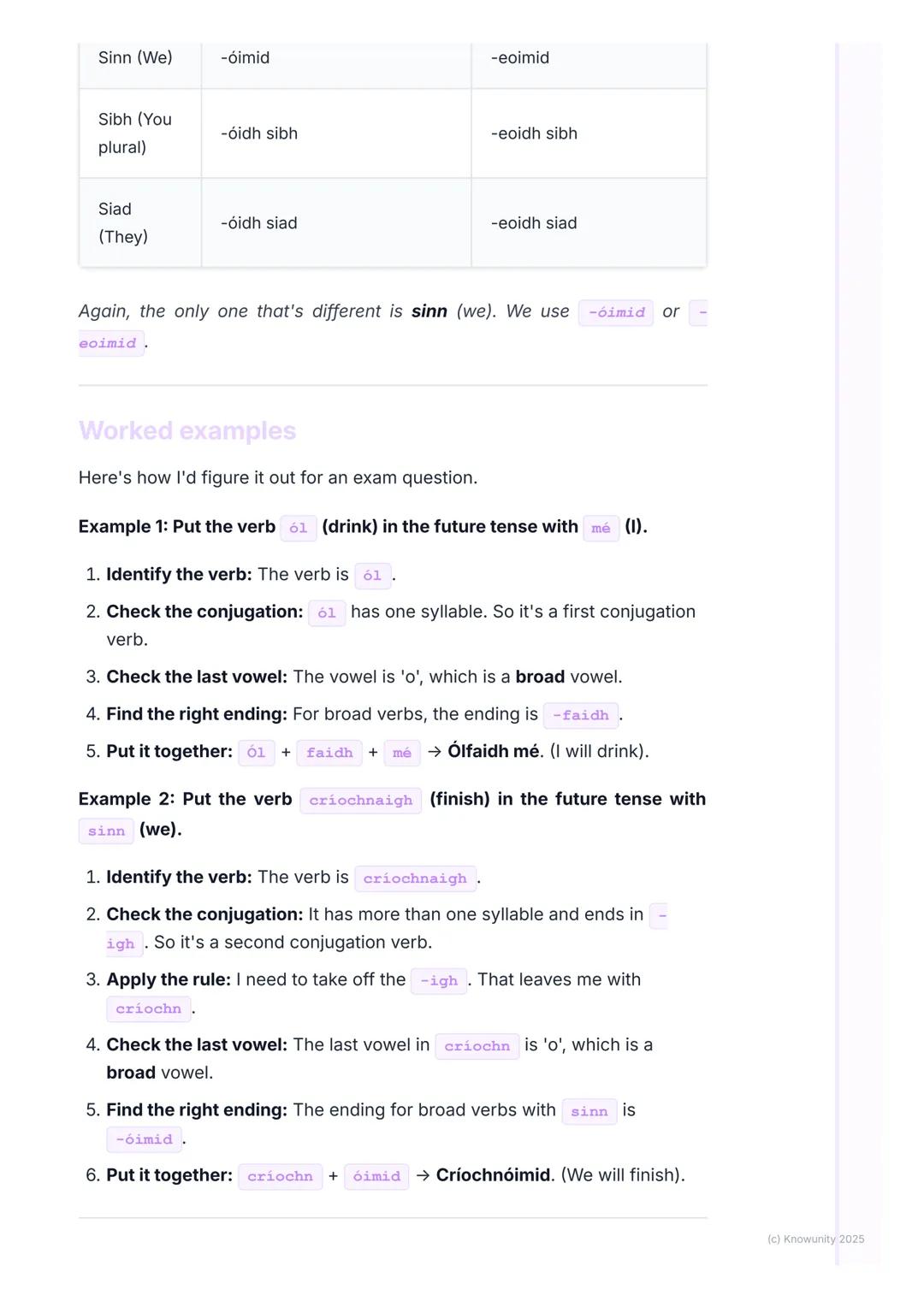
Working Through Examples
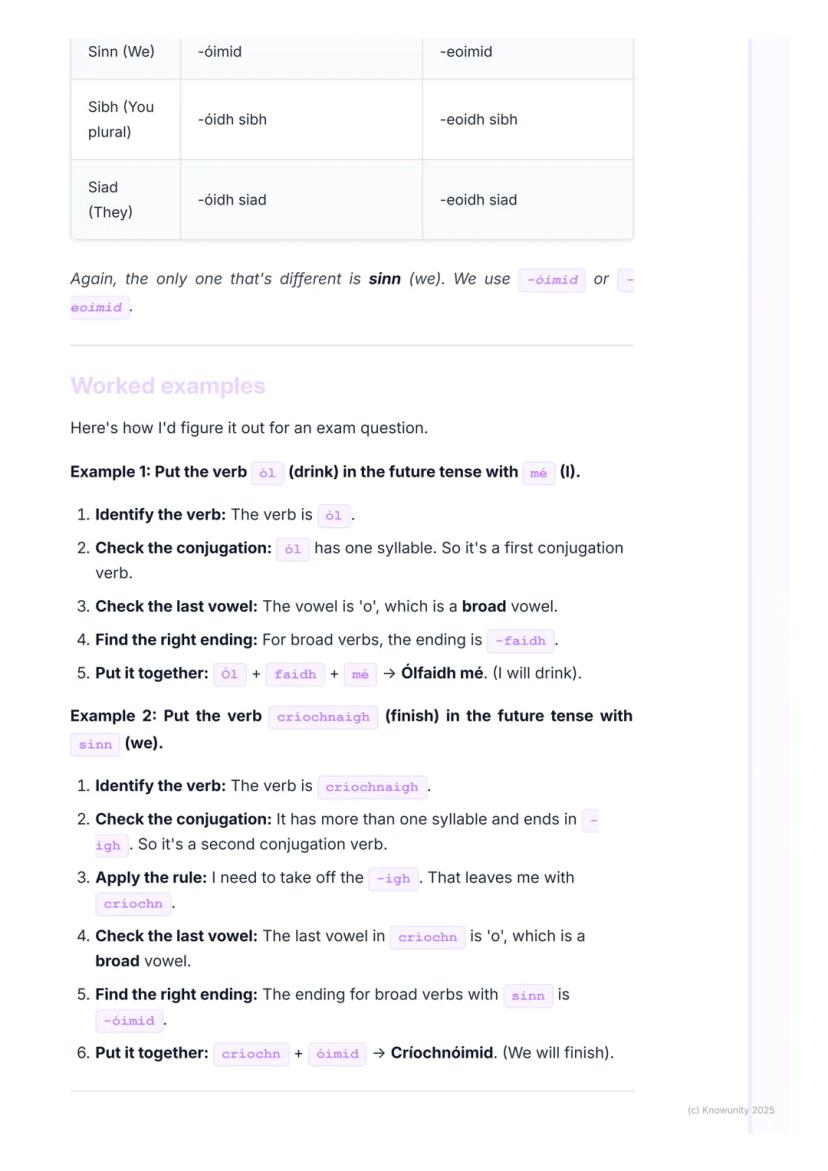
Let's tackle some exam-style questions to see how this works in practice. Take ól (drink) with mé (I) - it's one syllable, so it's first conjugation. The 'o' is broad, so we add -faidh: ólfaidh mé (I will drink).
For something trickier, try críochnaigh (finish) with sinn (we). It's multi-syllable and ends in -igh, so it's second conjugation. Drop the -igh to get críochn, which ends in broad 'o'. Since it's sinn, we use -óimid: críochnóimid (we will finish).
The key is taking it step by step: identify the conjugation type, find the root, check the vowel type, pick the right ending. Once you've done a few, the pattern becomes automatic.
Questions and negatives change things slightly - they start with An (will...?) or Ní (will not...), but the verb endings stay the same. An ólfaidh tú? (Will you drink?) and Ní ólfaidh mé (I will not drink).
Exam hack: Always identify conjugation type first - it saves you from mixing up the ending patterns!
5
of 5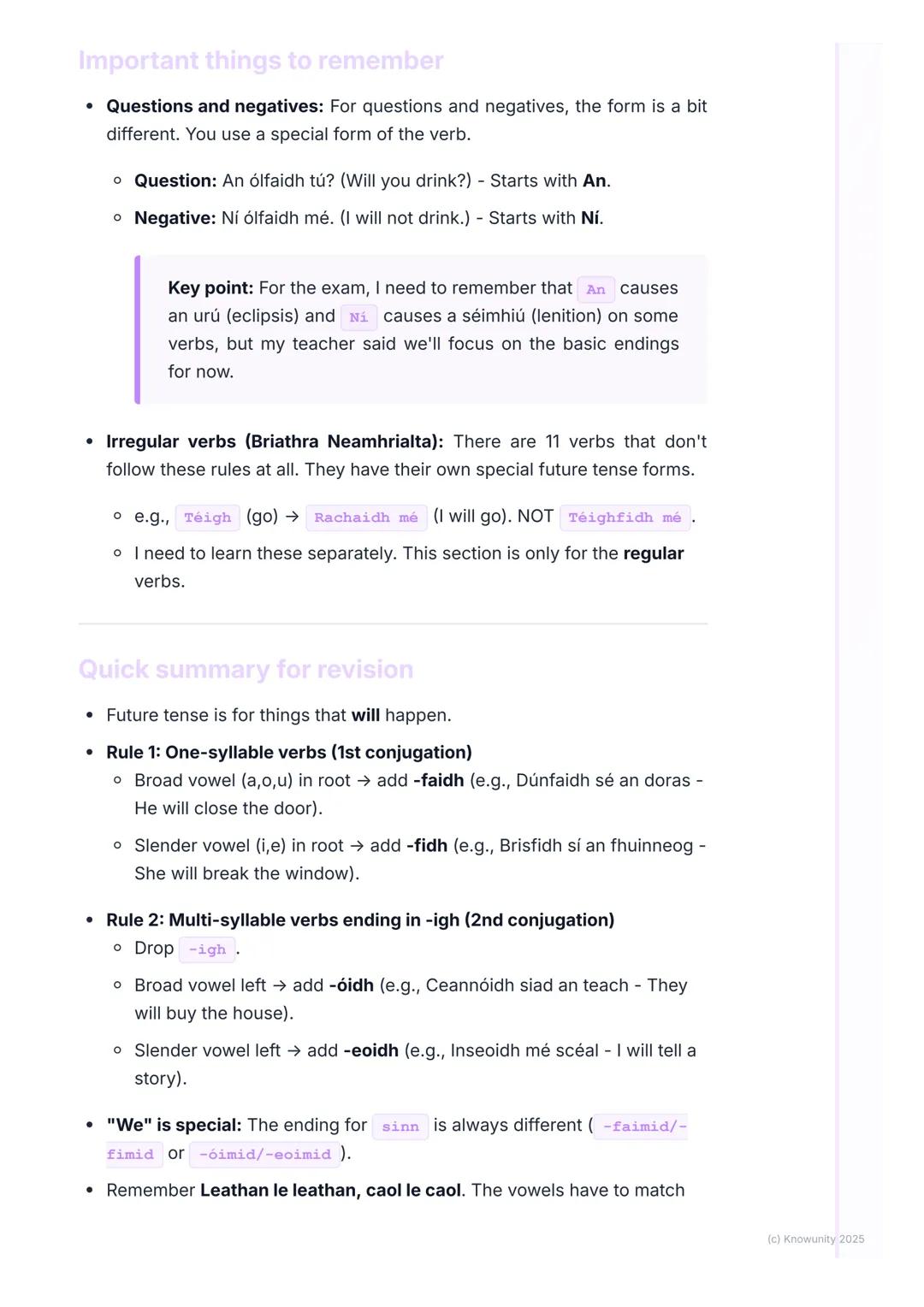
Quick Revision Summary
You've got two main patterns to remember. First conjugation : broad vowel gets -faidh, slender vowel gets -fidh. Second conjugation : drop the -igh, then broad gets -óidh, slender gets -eoidh.
The pronoun sinn (we) always gets special treatment with its own endings: -faimid/-fimid for first conjugation, -óimid/-eoimid for second conjugation. Every other pronoun just tags along after the main verb form.
Remember that irregular verbs like téigh (go) completely ignore these rules - téigh becomes rachaidh mé (I will go), not téighfidh mé. You'll need to learn those 11 irregular verbs separately.
The leathan le leathan, caol le caol rule is your safety net - if your vowels don't match up, you've made a mistake somewhere. This future tense system works for the vast majority of Irish verbs once you've mastered the basics.
Final reminder: Practice with regular verbs first - once these patterns are automatic, irregular verbs become much easier to handle!
Akala namin hindi mo na itatanong...
Ano ang Knowunity AI companion?
Ang aming AI Companion ay isang AI tool na nakatuon sa mga estudyante na nag-aalok ng higit pa sa mga sagot lang. Binuo mula sa milyong Knowunity resources, nagbibigay ito ng may-kaugnayang impormasyon, personalized na study plans, quizzes, at content direkta sa chat, na umaangkop sa iyong sariling learning journey.
Saan ko mada-download ang Knowunity app?
Maaari mong i-download ang app mula sa Google Play Store at Apple App Store.
Talaga bang libre ang Knowunity?
Tama 'yan! Mag-enjoy sa libreng access sa mga study content, makipag-connect sa kapwa mga estudyante, at kumuha ng instant na tulong – lahat nasa iyong daliri lang.
Pinaka-sikat na nilalaman sa Irish
9Pinaka-sikat na nilalaman
9Hindi mo mahanap ang hinahanap mo? Tuklasin ang iba pang mga asignatura.
Gustong-gusto kami ng mga estudyante — at magiging ganoon ka rin.
4.6/5App Store
4.7/5Google Play
Napakadaling gamitin at maganda ang disenyo ng app. Nahanap ko lahat ng hinahanap ko hanggang ngayon at natuto ako ng marami mula sa mga presentasyon! Tiyak na gagamitin ko ang app para sa isang takdang-aralin sa klase! At siyempre, nakakatulong din ito bilang inspirasyon.
Stefan Sgumagamit ng iOS
Sobrang ganda talaga ng app na ito. Maraming mga study notes at tulong [...]. Ang problemang subject ko ay Pranses, halimbawa, at ang app ay may maraming options para tumulong. Salamat sa app na ito, bumuti ang Pranses ko. Irerekumenda ko ito sa lahat.
Samantha KlichAndroid user
Wow, talagang namangha ako. Sinubukan ko lang ang app dahil nakita ko itong ina-advertise nang maraming beses at sobrang nagulat ako. Ang app na ito ang TULONG na gusto mo para sa paaralan at higit sa lahat, nag-aalok ito ng maraming bagay, tulad ng workouts at fact sheets, na SOBRANG nakatulong sa akin.
AnnaiOS user
Irish5 views·Na-update Jun 4, 2026·5 mga pahinaLearn About An Aimsir Fháistineach: Forming Future Tense in Irish
The Irish future tense (an aimsir fháistineach) is your tool for talking about things that will happen - from tomorrow's plans to next year's goals. It's built on a simple system of adding specific endings to verb roots, but you... Ipakita pa
1
of 5Mag-sign up para makita ang content. Libre ito!
- Access sa lahat ng dokumento
- Pagbutihin ang iyong mga grado
- Sumali sa milyong mga estudyante
An Aimsir Fháistineach - Getting Started
Think of the future tense as your planning language - it's how you say "I will go" or "they will play" in Irish. The trick is knowing which ending to stick on your verb, and that depends on the vowels inside it.
Before diving in, you need to master broad and slender vowels. Broad vowels are a, o, u (remember: "Are Owls Ugly?") and slender vowels are i, e ("Is Everyone Ill?"). This matters because of the golden rule: leathan le leathan, caol le caol - broad with broad, slender with slender.
The verb root is your starting point - it's the basic form without any endings. For example, glanann (cleans) has the root glan. Once you've got your root, check its last vowel to decide which ending fits.
Quick tip: Master the vowel types first - they're used throughout Irish grammar, not just the future tense!
2
of 5Mag-sign up para makita ang content. Libre ito!
- Access sa lahat ng dokumento
- Pagbutihin ang iyong mga grado
- Sumali sa milyong mga estudyante
First Conjugation Verbs - The One-Syllable Gang
First conjugation verbs have just one syllable in their root - words like dún (close), glan (clean), bris (break), and ól (drink). These are actually the easiest once you get the pattern.
Here's the system: if your verb root ends with a broad vowel (a, o, u), you add -faidh. If it ends with a slender vowel (i, e), you add -fidh. So glan becomes glanfaidh and bris becomes brisfidh.
The endings work perfectly for sé, sí, and siad (he, she, they). For other pronouns like mé and tú, you just add the pronoun after: glanfaidh mé, glanfaidh tú. The only special case is sinn (we) - it gets its own endings: -faimid for broad roots and -fimid for slender ones.
Remember: The broad/slender rule applies to every single verb - there are no exceptions here!
3
of 5Mag-sign up para makita ang content. Libre ito!
- Access sa lahat ng dokumento
- Pagbutihin ang iyong mga grado
- Sumali sa milyong mga estudyante
Second Conjugation Verbs - The Multi-Syllable Squad
Second conjugation verbs have two or more syllables and usually end in -igh. Think ceannaigh (buy), bailigh (collect), or éirigh (get up) - they're longer words that need a different approach.
The process is straightforward: chop off the -igh ending first. Then check what vowel you're left with at the end. If it's broad (a, o, u), add -óidh. If it's slender (i, e), add -eoidh.
So ceannaigh loses its -igh to become ceanna (ending in broad 'a'), then gets -óidh to make ceannóidh. Bailigh becomes bail (ending in slender 'i'), then gets -eoidh to make baileoidh.
Just like first conjugation, sinn (we) is special again. It uses -óimid for broad roots and -eoimid for slender ones instead of the regular endings.
Pro tip: Most verbs you'll meet ending in -igh follow this pattern - it's more common than you might think!
4
of 5Mag-sign up para makita ang content. Libre ito!
- Access sa lahat ng dokumento
- Pagbutihin ang iyong mga grado
- Sumali sa milyong mga estudyante
Working Through Examples
Let's tackle some exam-style questions to see how this works in practice. Take ól (drink) with mé (I) - it's one syllable, so it's first conjugation. The 'o' is broad, so we add -faidh: ólfaidh mé (I will drink).
For something trickier, try críochnaigh (finish) with sinn (we). It's multi-syllable and ends in -igh, so it's second conjugation. Drop the -igh to get críochn, which ends in broad 'o'. Since it's sinn, we use -óimid: críochnóimid (we will finish).
The key is taking it step by step: identify the conjugation type, find the root, check the vowel type, pick the right ending. Once you've done a few, the pattern becomes automatic.
Questions and negatives change things slightly - they start with An (will...?) or Ní (will not...), but the verb endings stay the same. An ólfaidh tú? (Will you drink?) and Ní ólfaidh mé (I will not drink).
Exam hack: Always identify conjugation type first - it saves you from mixing up the ending patterns!
5
of 5Mag-sign up para makita ang content. Libre ito!
- Access sa lahat ng dokumento
- Pagbutihin ang iyong mga grado
- Sumali sa milyong mga estudyante
Quick Revision Summary
You've got two main patterns to remember. First conjugation : broad vowel gets -faidh, slender vowel gets -fidh. Second conjugation : drop the -igh, then broad gets -óidh, slender gets -eoidh.
The pronoun sinn (we) always gets special treatment with its own endings: -faimid/-fimid for first conjugation, -óimid/-eoimid for second conjugation. Every other pronoun just tags along after the main verb form.
Remember that irregular verbs like téigh (go) completely ignore these rules - téigh becomes rachaidh mé (I will go), not téighfidh mé. You'll need to learn those 11 irregular verbs separately.
The leathan le leathan, caol le caol rule is your safety net - if your vowels don't match up, you've made a mistake somewhere. This future tense system works for the vast majority of Irish verbs once you've mastered the basics.
Final reminder: Practice with regular verbs first - once these patterns are automatic, irregular verbs become much easier to handle!
Akala namin hindi mo na itatanong...
Ano ang Knowunity AI companion?
Ang aming AI Companion ay isang AI tool na nakatuon sa mga estudyante na nag-aalok ng higit pa sa mga sagot lang. Binuo mula sa milyong Knowunity resources, nagbibigay ito ng may-kaugnayang impormasyon, personalized na study plans, quizzes, at content direkta sa chat, na umaangkop sa iyong sariling learning journey.
Saan ko mada-download ang Knowunity app?
Maaari mong i-download ang app mula sa Google Play Store at Apple App Store.
Talaga bang libre ang Knowunity?
Tama 'yan! Mag-enjoy sa libreng access sa mga study content, makipag-connect sa kapwa mga estudyante, at kumuha ng instant na tulong – lahat nasa iyong daliri lang.
Pinaka-sikat na nilalaman sa Irish
9Pinaka-sikat na nilalaman
9Hindi mo mahanap ang hinahanap mo? Tuklasin ang iba pang mga asignatura.
Gustong-gusto kami ng mga estudyante — at magiging ganoon ka rin.
4.6/5App Store
4.7/5Google Play
Napakadaling gamitin at maganda ang disenyo ng app. Nahanap ko lahat ng hinahanap ko hanggang ngayon at natuto ako ng marami mula sa mga presentasyon! Tiyak na gagamitin ko ang app para sa isang takdang-aralin sa klase! At siyempre, nakakatulong din ito bilang inspirasyon.
Stefan Sgumagamit ng iOS
Sobrang ganda talaga ng app na ito. Maraming mga study notes at tulong [...]. Ang problemang subject ko ay Pranses, halimbawa, at ang app ay may maraming options para tumulong. Salamat sa app na ito, bumuti ang Pranses ko. Irerekumenda ko ito sa lahat.
Samantha KlichAndroid user
Wow, talagang namangha ako. Sinubukan ko lang ang app dahil nakita ko itong ina-advertise nang maraming beses at sobrang nagulat ako. Ang app na ito ang TULONG na gusto mo para sa paaralan at higit sa lahat, nag-aalok ito ng maraming bagay, tulad ng workouts at fact sheets, na SOBRANG nakatulong sa akin.
AnnaiOS user