
Ever wondered how to say "I am" or "you are"...
 German6 views·Na-update May 30, 2026·4 mga pahina
Mastering the German Verb 'sein' - Conjugation Made Simple
1 / 4
1
of 4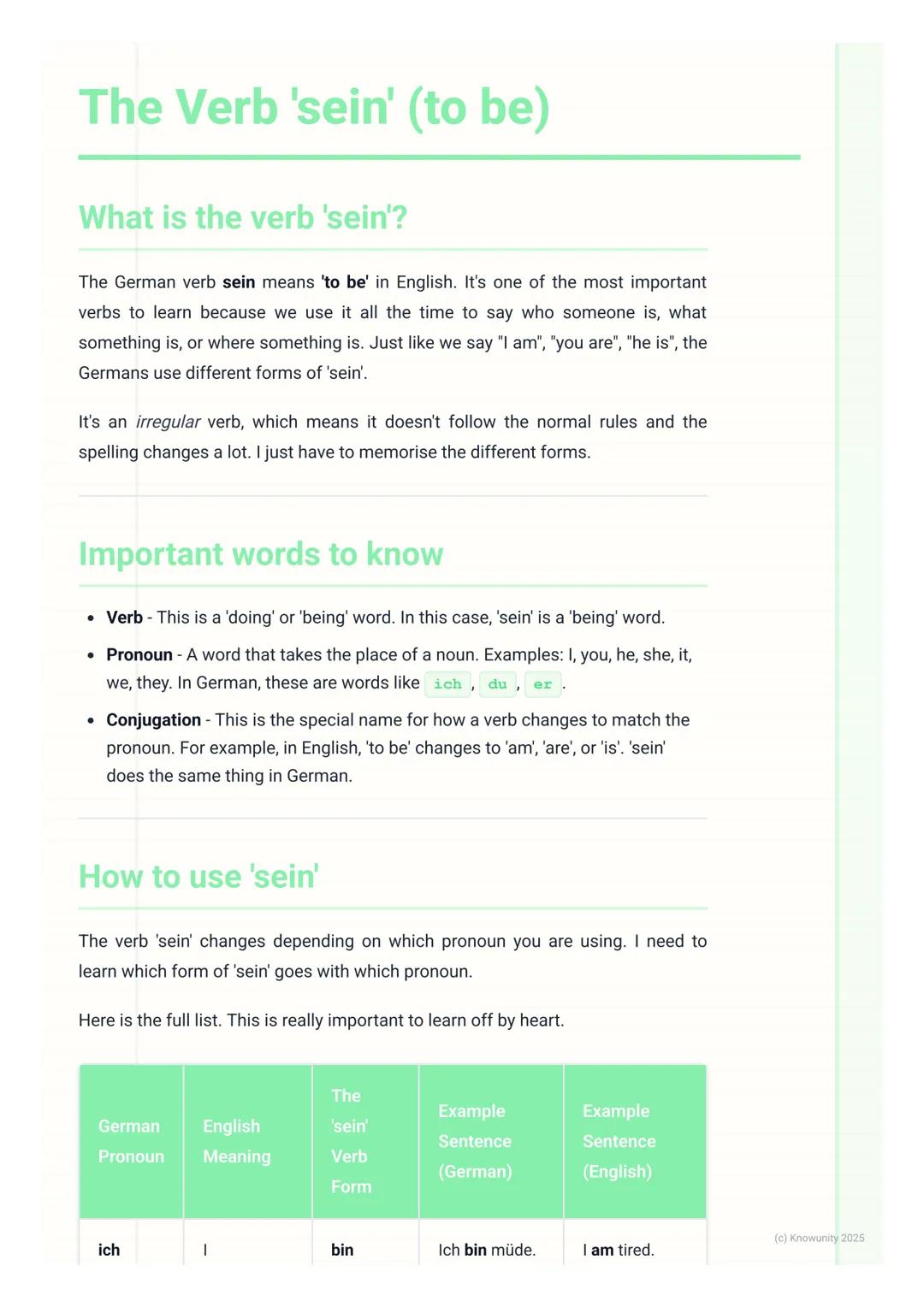
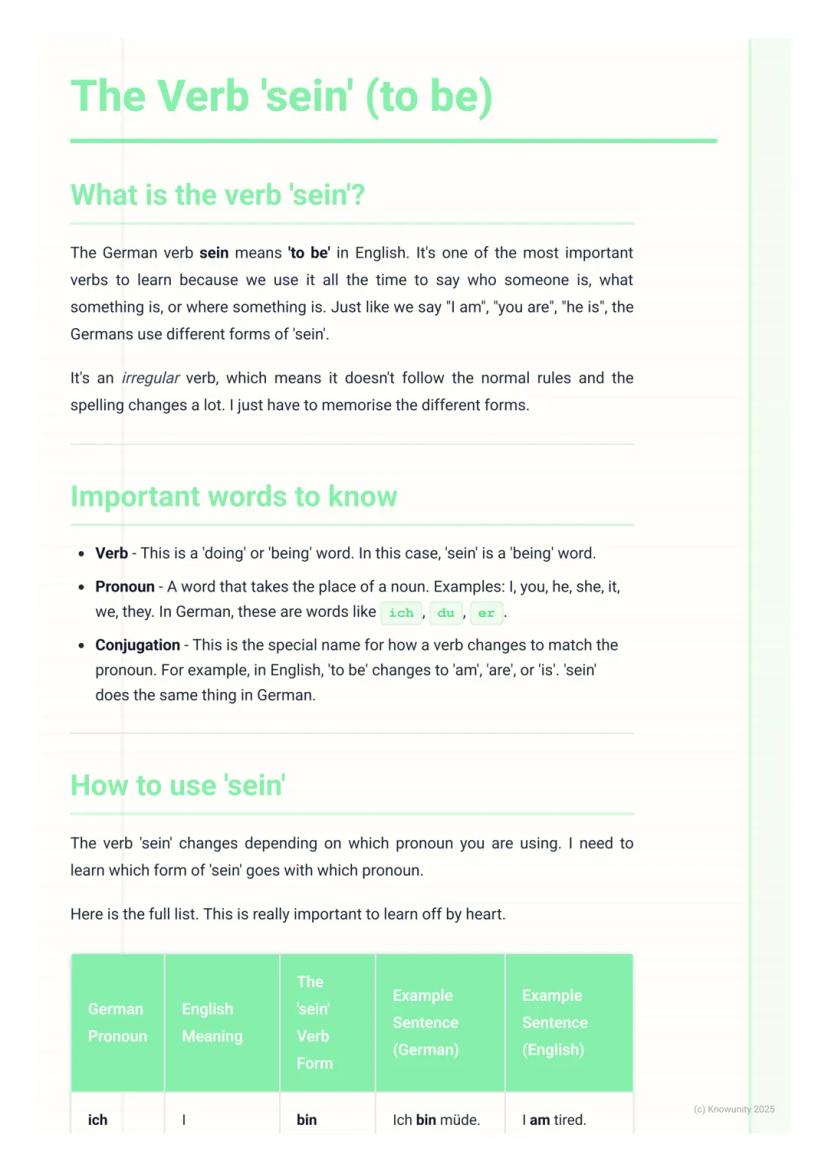
Understanding the Verb 'sein'
Think of sein as the building block of German - you'll use it constantly to describe yourself, others, and everything around you. Just like English changes "to be" into "am", "are", and "is", German does the same thing with sein, but with its own special patterns.
Here's the tricky bit: sein is an irregular verb, which means it doesn't follow normal rules and changes quite dramatically. There's no clever shortcut here - you've got to memorise each form, but once you do, you'll be chatting away in German!
💡 Quick tip: Don't worry about understanding why the forms change so much - even native German speakers just memorise them as children. Focus on learning the patterns rather than the grammar rules.
The key terms you need to know are conjugation (how verbs change to match different people) and pronouns (words like "I", "you", "he" that replace names).
2
of 4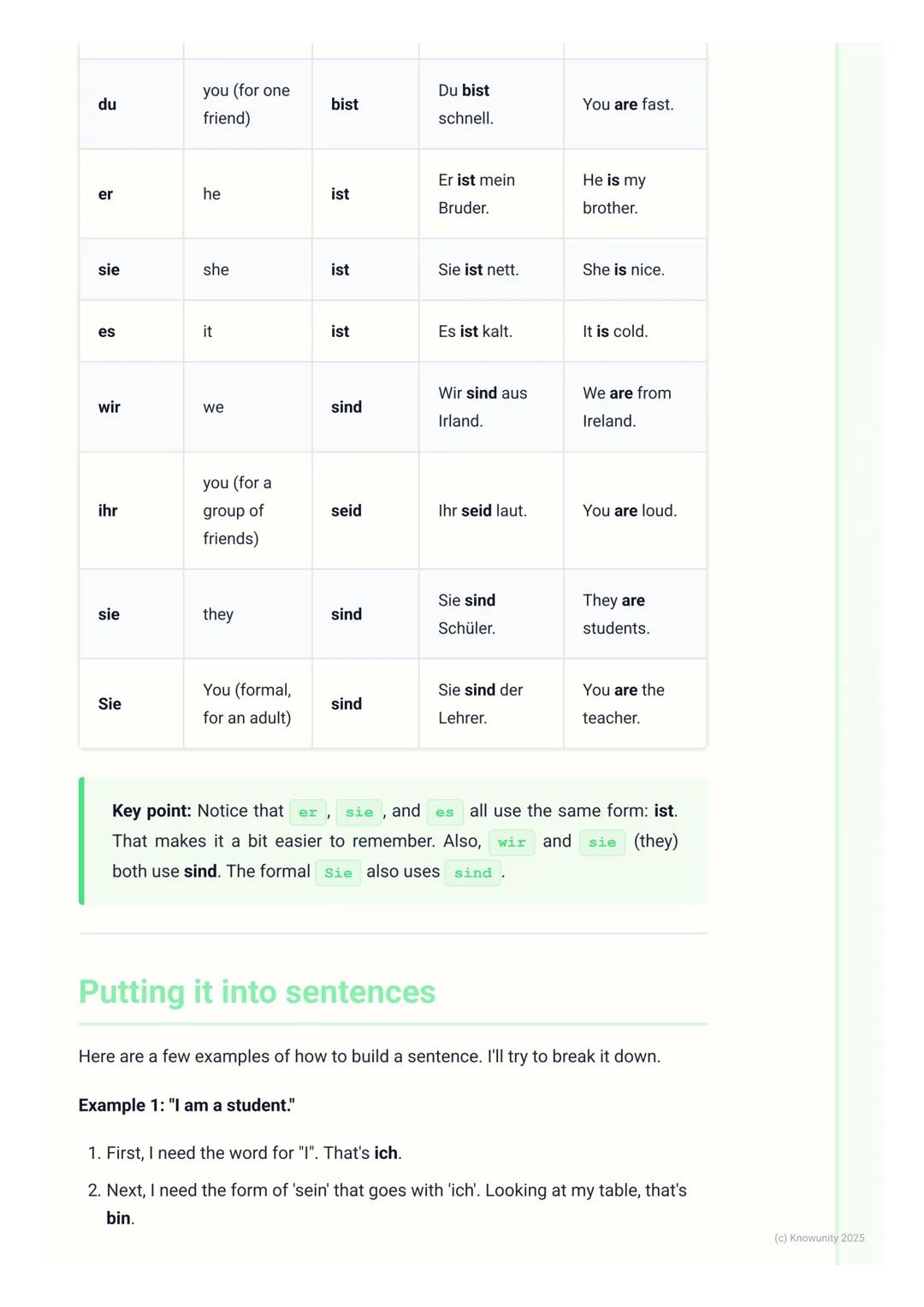
The Complete sein Table
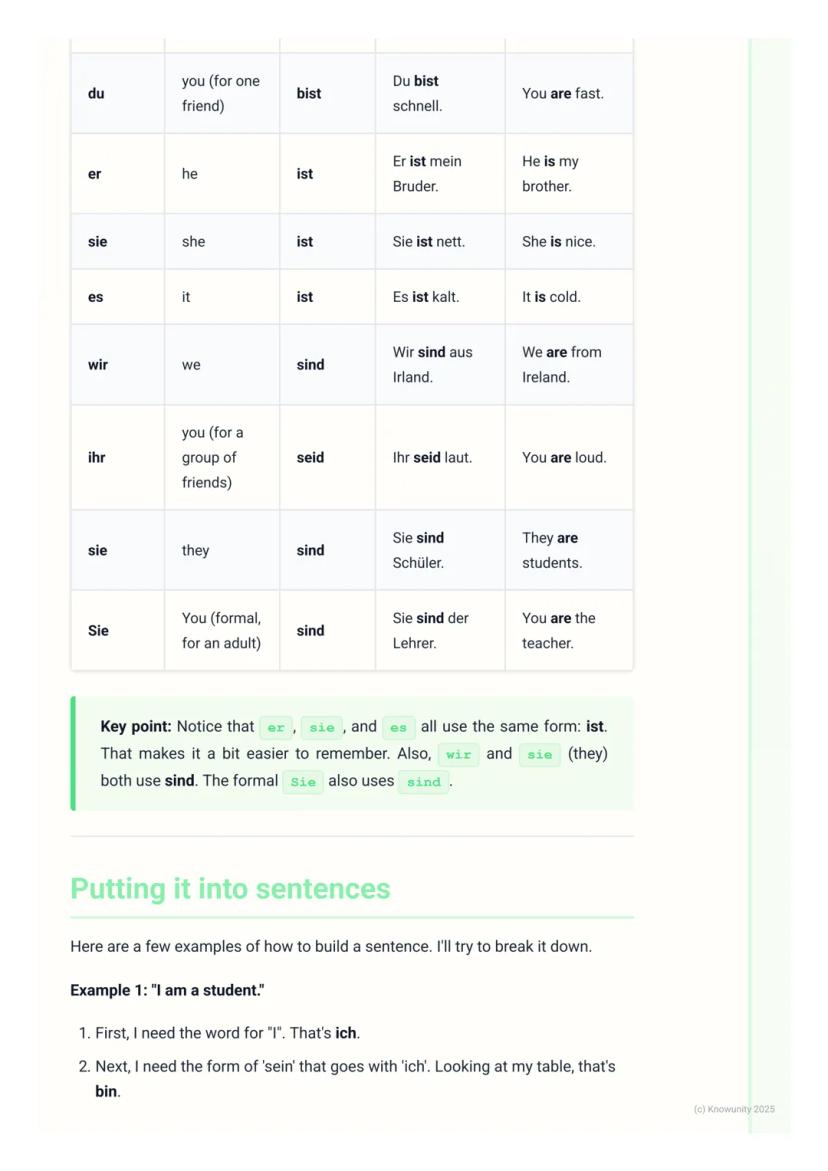
Here's the essential table you need to memorise - think of it as your German survival kit! Each German pronoun pairs with its specific form of sein, and there's no wiggling around this.
The good news? There are some helpful patterns hidden in the chaos. Notice that er, sie, and es all use ist - that's three pronouns sorted with one word. Similarly, wir and sie (they) both use sind, making your memorisation job a bit easier.
💡 Remember this: The formal Sie (for adults) also uses sind and always has a capital S, so you can spot it easily in writing.
Watch out for the trickiest pair: sind vs seid. Most students mix these up, but here's the secret - sind goes with "we" and "they", whilst seid is only for groups of friends (ihr).
3
of 4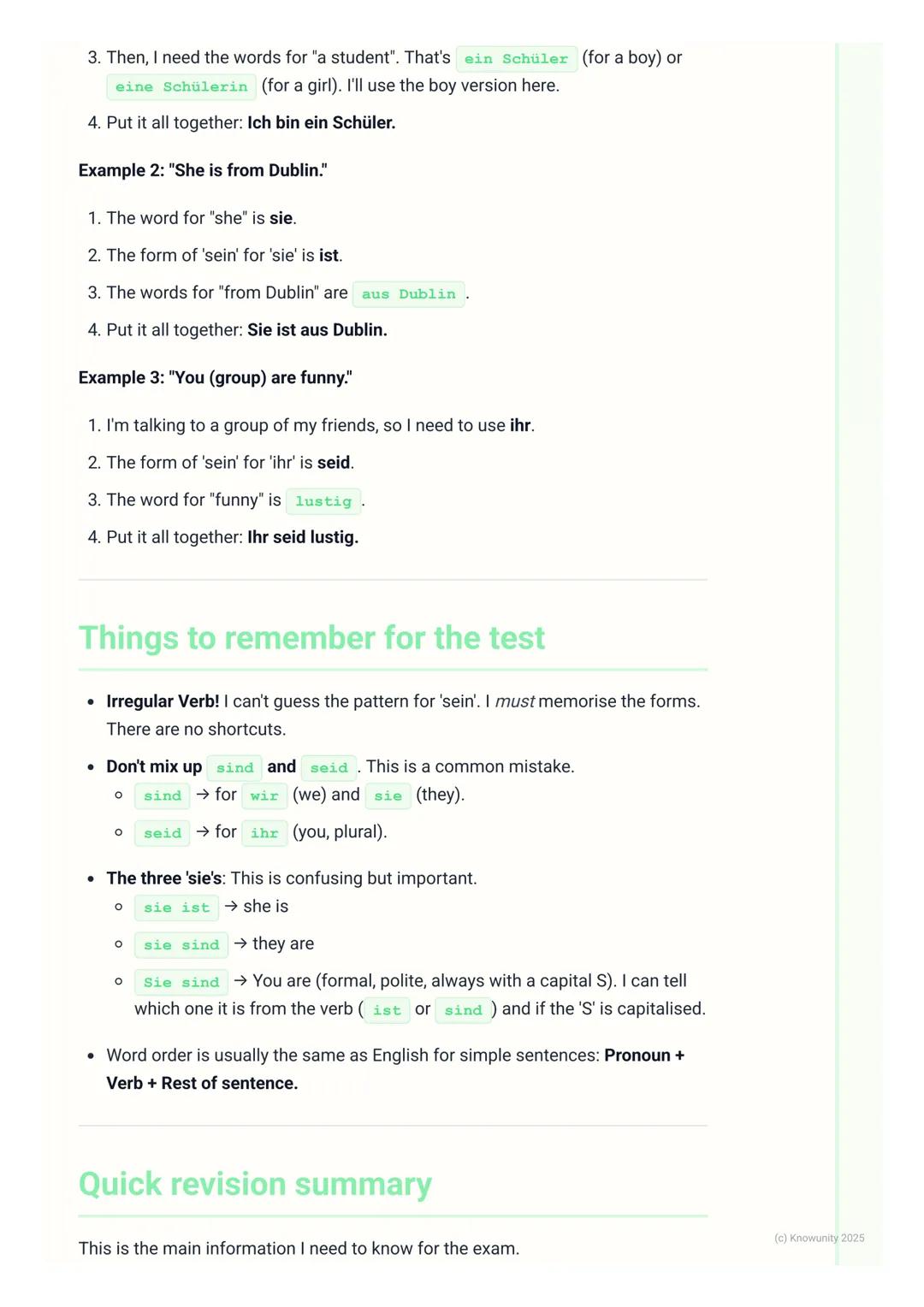
Building Your First German Sentences
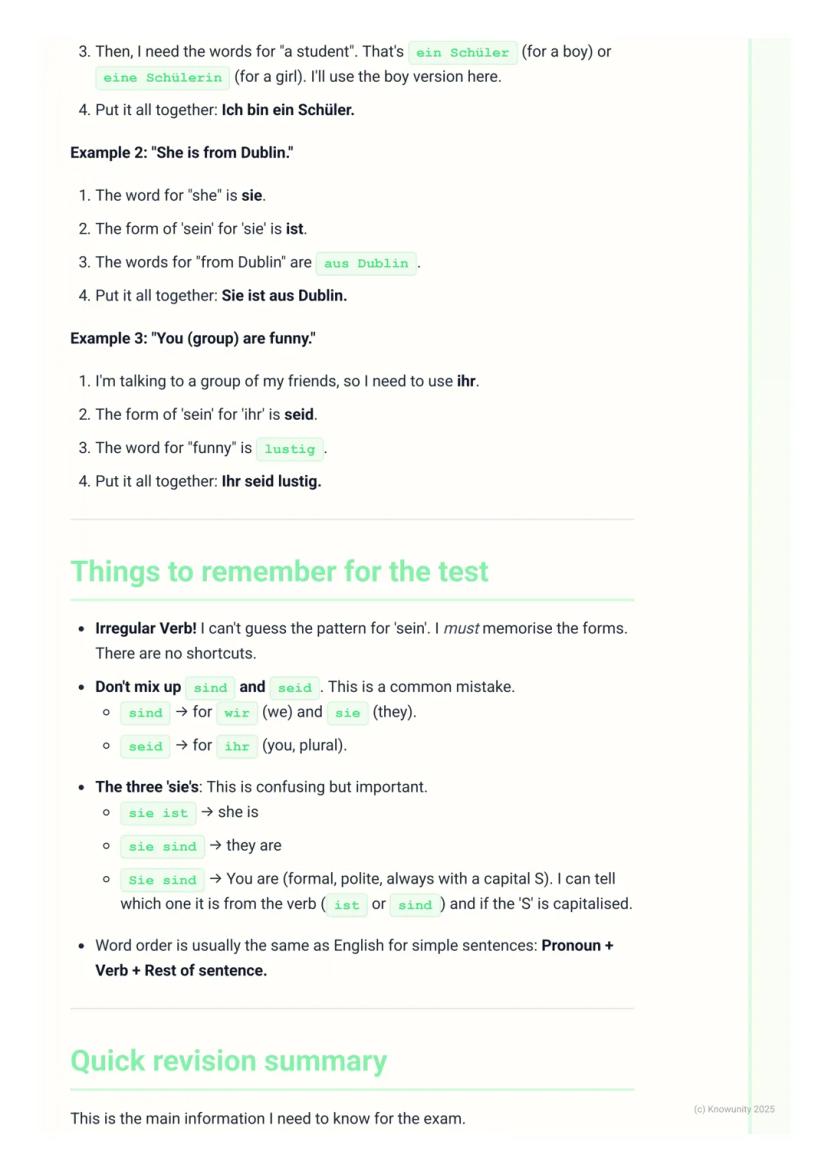
Now comes the fun part - putting your knowledge into action! German sentence structure follows the same pattern as English for basic sentences: pronoun + verb + rest of sentence.
Let's break down "Ich bin müde" (I am tired). Start with ich (I), add the matching form bin, then finish with müde (tired). See how straightforward that is?
For "Sie ist aus Dublin" (She is from Dublin), you follow the same pattern: sie (she) + ist (the form for she) + aus Dublin (from Dublin). Once you know the sein forms, sentence building becomes quite logical.
💡 Pro tip: Practice with simple sentences first. Don't worry about complex grammar yet - master the basic pattern and you'll gain confidence quickly.
4
of 4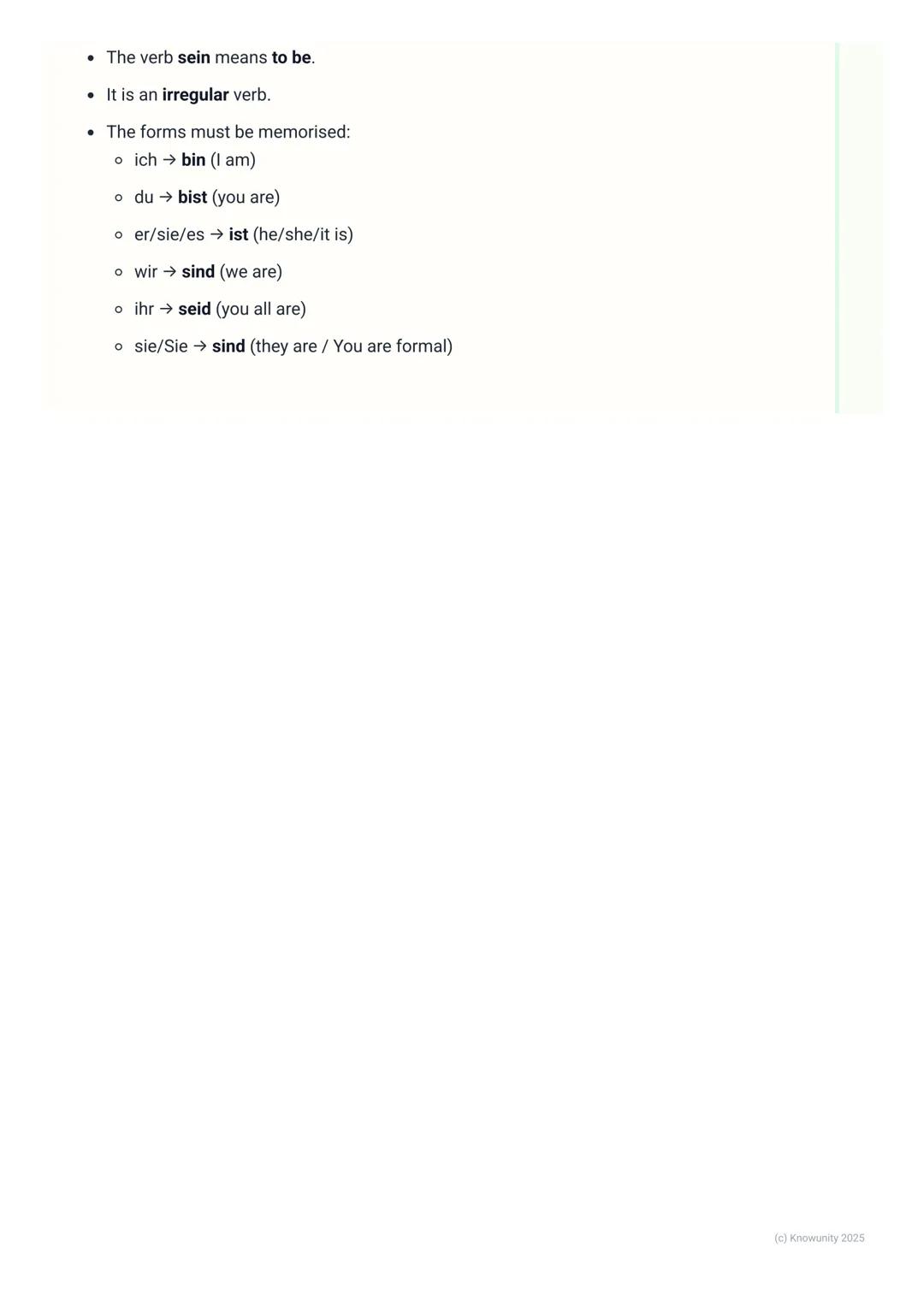
Test Success Strategies
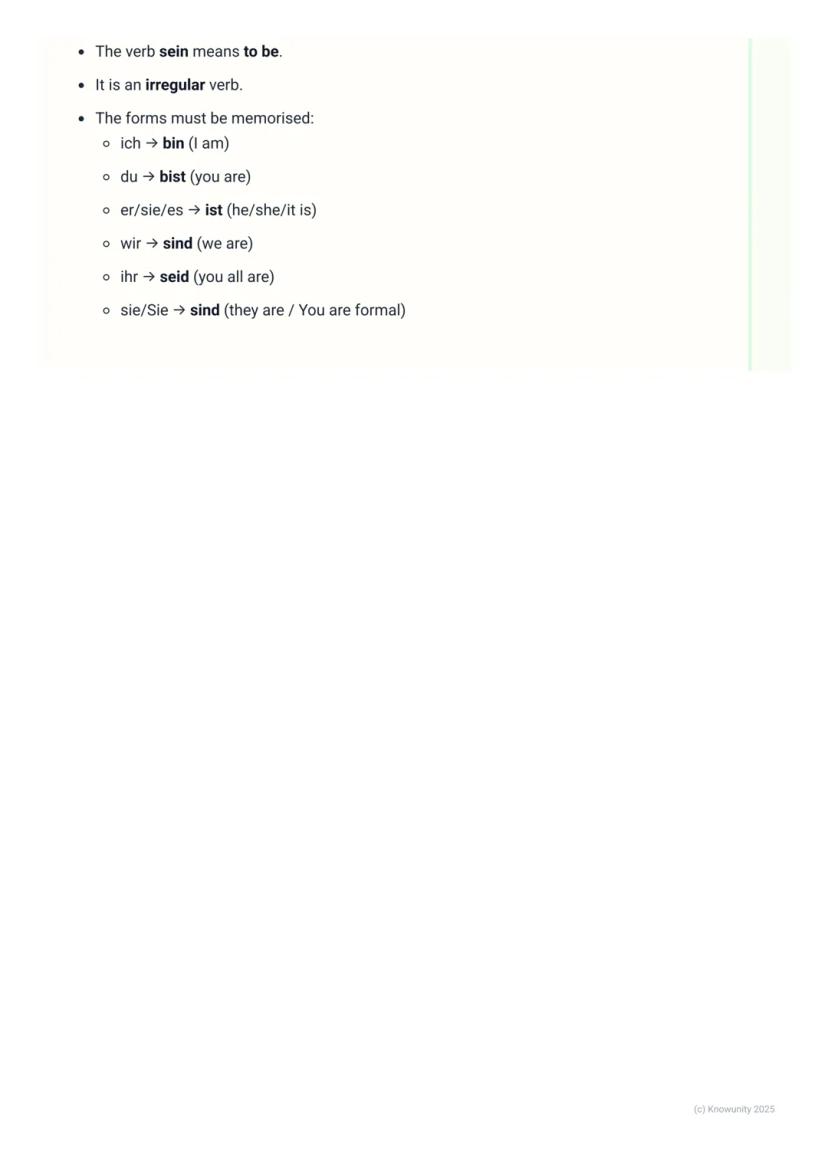
Your exam success depends on memorising those sein forms perfectly - there's simply no way around it. Create flashcards, practice daily, or make up silly songs, but make sure you know ich bin, du bist, er/sie/es ist, wir sind, ihr seid, sie/Sie sind by heart.
The biggest test trap is confusing the different meanings of sie. Remember: sie ist means "she is", sie sind means "they are", and Sie sind (capital S) means "You are" in formal situations.
💡 Final reminder: Don't panic if this feels overwhelming at first. Every German speaker has mastered these forms, and with consistent practice, you absolutely can too. Focus on one pronoun at a time and build up gradually.
Word order in basic sentences mirrors English, so you're already halfway there!
Akala namin hindi mo na itatanong...
Ano ang Knowunity AI companion?
Ang aming AI Companion ay isang AI tool na nakatuon sa mga estudyante na nag-aalok ng higit pa sa mga sagot lang. Binuo mula sa milyong Knowunity resources, nagbibigay ito ng may-kaugnayang impormasyon, personalized na study plans, quizzes, at content direkta sa chat, na umaangkop sa iyong sariling learning journey.
Saan ko mada-download ang Knowunity app?
Maaari mong i-download ang app mula sa Google Play Store at Apple App Store.
Talaga bang libre ang Knowunity?
Tama 'yan! Mag-enjoy sa libreng access sa mga study content, makipag-connect sa kapwa mga estudyante, at kumuha ng instant na tulong – lahat nasa iyong daliri lang.
Pinaka-sikat na nilalaman sa German
2Pinaka-sikat na nilalaman
9Hindi mo mahanap ang hinahanap mo? Tuklasin ang iba pang mga asignatura.
Gustong-gusto kami ng mga estudyante — at magiging ganoon ka rin.
4.6/5App Store
4.7/5Google Play
Napakadaling gamitin at maganda ang disenyo ng app. Nahanap ko lahat ng hinahanap ko hanggang ngayon at natuto ako ng marami mula sa mga presentasyon! Tiyak na gagamitin ko ang app para sa isang takdang-aralin sa klase! At siyempre, nakakatulong din ito bilang inspirasyon.
Stefan Sgumagamit ng iOS
Sobrang ganda talaga ng app na ito. Maraming mga study notes at tulong [...]. Ang problemang subject ko ay Pranses, halimbawa, at ang app ay may maraming options para tumulong. Salamat sa app na ito, bumuti ang Pranses ko. Irerekumenda ko ito sa lahat.
Samantha KlichAndroid user
Wow, talagang namangha ako. Sinubukan ko lang ang app dahil nakita ko itong ina-advertise nang maraming beses at sobrang nagulat ako. Ang app na ito ang TULONG na gusto mo para sa paaralan at higit sa lahat, nag-aalok ito ng maraming bagay, tulad ng workouts at fact sheets, na SOBRANG nakatulong sa akin.
AnnaiOS user
German6 views·Na-update May 30, 2026·4 mga pahinaMastering the German Verb 'sein' - Conjugation Made Simple
Ever wondered how to say "I am" or "you are" in German? The verb sein (to be) is your gateway to building basic German sentences and it's absolutely essential for any conversation.
1
of 4
Mag-sign up para makita ang content. Libre ito!
- Access sa lahat ng dokumento
- Pagbutihin ang iyong mga grado
- Sumali sa milyong mga estudyante
Understanding the Verb 'sein'
Think of sein as the building block of German - you'll use it constantly to describe yourself, others, and everything around you. Just like English changes "to be" into "am", "are", and "is", German does the same thing with sein, but with its own special patterns.
Here's the tricky bit: sein is an irregular verb, which means it doesn't follow normal rules and changes quite dramatically. There's no clever shortcut here - you've got to memorise each form, but once you do, you'll be chatting away in German!
💡 Quick tip: Don't worry about understanding why the forms change so much - even native German speakers just memorise them as children. Focus on learning the patterns rather than the grammar rules.
The key terms you need to know are conjugation (how verbs change to match different people) and pronouns (words like "I", "you", "he" that replace names).
2
of 4Mag-sign up para makita ang content. Libre ito!
- Access sa lahat ng dokumento
- Pagbutihin ang iyong mga grado
- Sumali sa milyong mga estudyante
The Complete sein Table
Here's the essential table you need to memorise - think of it as your German survival kit! Each German pronoun pairs with its specific form of sein, and there's no wiggling around this.
The good news? There are some helpful patterns hidden in the chaos. Notice that er, sie, and es all use ist - that's three pronouns sorted with one word. Similarly, wir and sie (they) both use sind, making your memorisation job a bit easier.
💡 Remember this: The formal Sie (for adults) also uses sind and always has a capital S, so you can spot it easily in writing.
Watch out for the trickiest pair: sind vs seid. Most students mix these up, but here's the secret - sind goes with "we" and "they", whilst seid is only for groups of friends (ihr).
3
of 4Mag-sign up para makita ang content. Libre ito!
- Access sa lahat ng dokumento
- Pagbutihin ang iyong mga grado
- Sumali sa milyong mga estudyante
Building Your First German Sentences
Now comes the fun part - putting your knowledge into action! German sentence structure follows the same pattern as English for basic sentences: pronoun + verb + rest of sentence.
Let's break down "Ich bin müde" (I am tired). Start with ich (I), add the matching form bin, then finish with müde (tired). See how straightforward that is?
For "Sie ist aus Dublin" (She is from Dublin), you follow the same pattern: sie (she) + ist (the form for she) + aus Dublin (from Dublin). Once you know the sein forms, sentence building becomes quite logical.
💡 Pro tip: Practice with simple sentences first. Don't worry about complex grammar yet - master the basic pattern and you'll gain confidence quickly.
4
of 4Mag-sign up para makita ang content. Libre ito!
- Access sa lahat ng dokumento
- Pagbutihin ang iyong mga grado
- Sumali sa milyong mga estudyante
Test Success Strategies
Your exam success depends on memorising those sein forms perfectly - there's simply no way around it. Create flashcards, practice daily, or make up silly songs, but make sure you know ich bin, du bist, er/sie/es ist, wir sind, ihr seid, sie/Sie sind by heart.
The biggest test trap is confusing the different meanings of sie. Remember: sie ist means "she is", sie sind means "they are", and Sie sind (capital S) means "You are" in formal situations.
💡 Final reminder: Don't panic if this feels overwhelming at first. Every German speaker has mastered these forms, and with consistent practice, you absolutely can too. Focus on one pronoun at a time and build up gradually.
Word order in basic sentences mirrors English, so you're already halfway there!
Akala namin hindi mo na itatanong...
Ano ang Knowunity AI companion?
Ang aming AI Companion ay isang AI tool na nakatuon sa mga estudyante na nag-aalok ng higit pa sa mga sagot lang. Binuo mula sa milyong Knowunity resources, nagbibigay ito ng may-kaugnayang impormasyon, personalized na study plans, quizzes, at content direkta sa chat, na umaangkop sa iyong sariling learning journey.
Saan ko mada-download ang Knowunity app?
Maaari mong i-download ang app mula sa Google Play Store at Apple App Store.
Talaga bang libre ang Knowunity?
Tama 'yan! Mag-enjoy sa libreng access sa mga study content, makipag-connect sa kapwa mga estudyante, at kumuha ng instant na tulong – lahat nasa iyong daliri lang.
Pinaka-sikat na nilalaman sa German
2Pinaka-sikat na nilalaman
9Hindi mo mahanap ang hinahanap mo? Tuklasin ang iba pang mga asignatura.
Gustong-gusto kami ng mga estudyante — at magiging ganoon ka rin.
4.6/5App Store
4.7/5Google Play
Napakadaling gamitin at maganda ang disenyo ng app. Nahanap ko lahat ng hinahanap ko hanggang ngayon at natuto ako ng marami mula sa mga presentasyon! Tiyak na gagamitin ko ang app para sa isang takdang-aralin sa klase! At siyempre, nakakatulong din ito bilang inspirasyon.
Stefan Sgumagamit ng iOS
Sobrang ganda talaga ng app na ito. Maraming mga study notes at tulong [...]. Ang problemang subject ko ay Pranses, halimbawa, at ang app ay may maraming options para tumulong. Salamat sa app na ito, bumuti ang Pranses ko. Irerekumenda ko ito sa lahat.
Samantha KlichAndroid user
Wow, talagang namangha ako. Sinubukan ko lang ang app dahil nakita ko itong ina-advertise nang maraming beses at sobrang nagulat ako. Ang app na ito ang TULONG na gusto mo para sa paaralan at higit sa lahat, nag-aalok ito ng maraming bagay, tulad ng workouts at fact sheets, na SOBRANG nakatulong sa akin.
AnnaiOS user