
Learning the German verb 'haben' (to have) is absolutely essential...
 German4 views·Na-update Jun 7, 2026·4 mga pahina
Mastering the German Verb 'haben' (to have)
1 / 4
1
of 4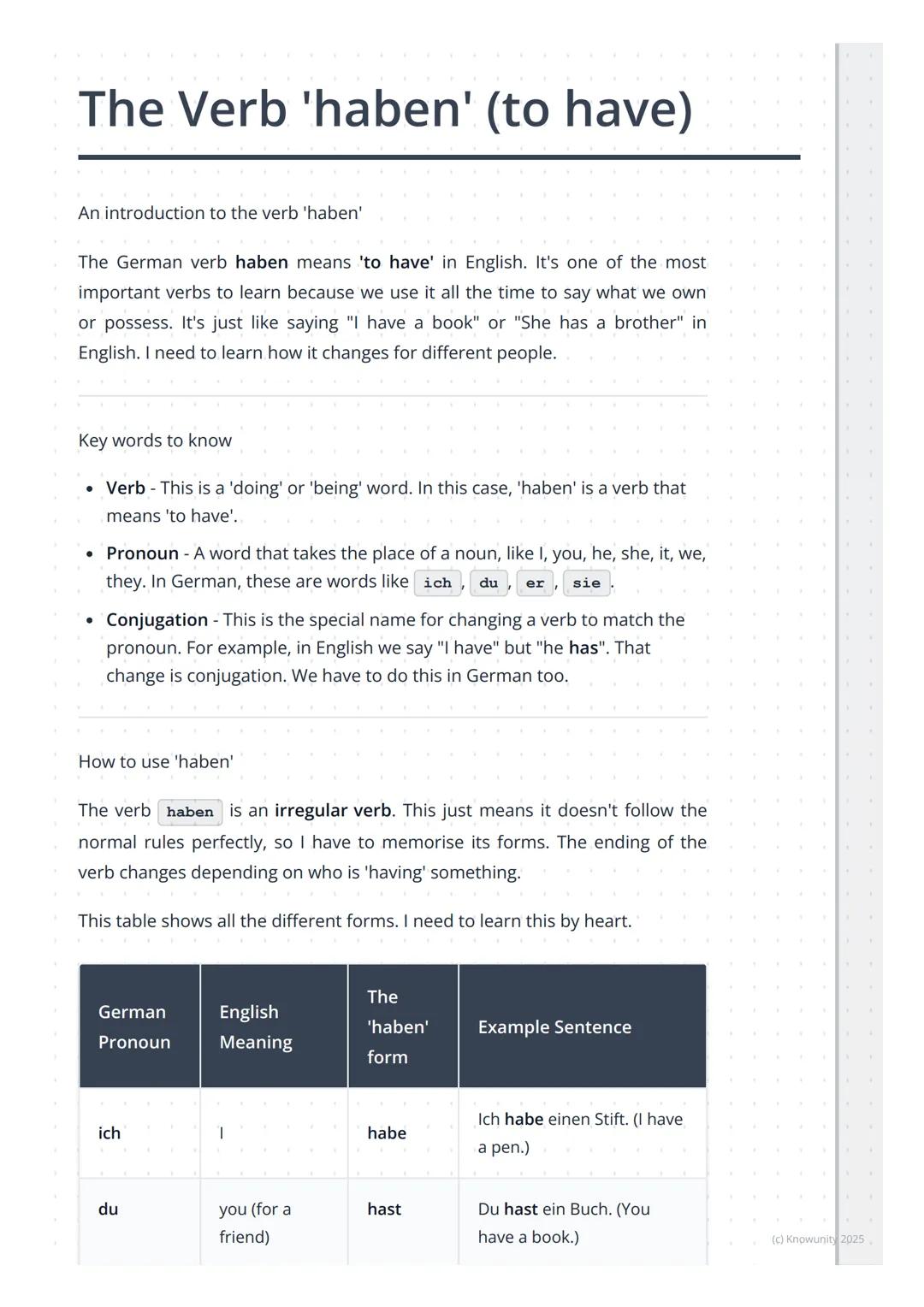
What is 'haben' and why does it matter?
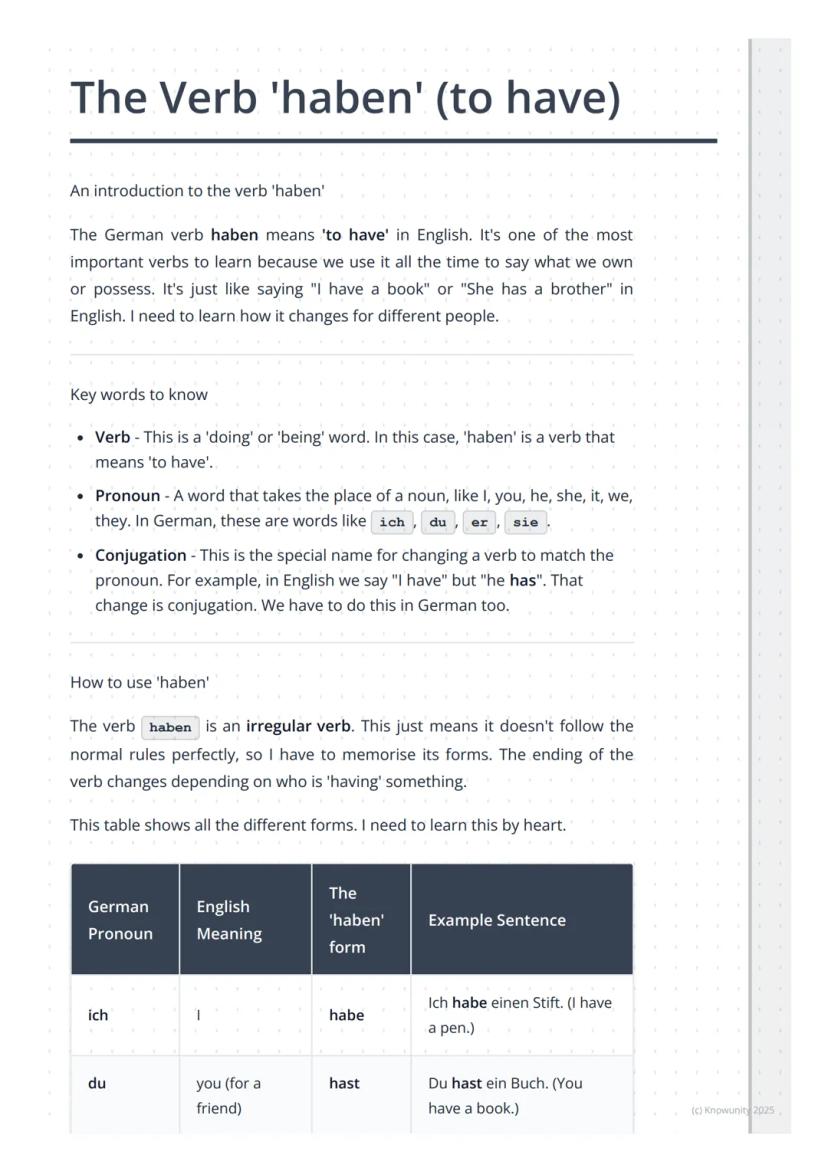
The German verb haben means 'to have' in English, and you'll use it loads to talk about what you own or possess. Think "I have a phone" or "My mate has a new bike" - that's haben in action!
Here's the thing though - haben is an irregular verb. This means it doesn't follow the normal patterns, so you can't just guess the endings. You've got to memorise how it changes for different people.
The key terms you need to know are conjugation (when verbs change to match different people) and pronouns (words like I, you, he, she). In German, these are ich, du, er, sie, and so on.
Quick Tip: Don't worry if this feels tricky at first - even native German speakers had to learn these patterns when they were young!
2
of 4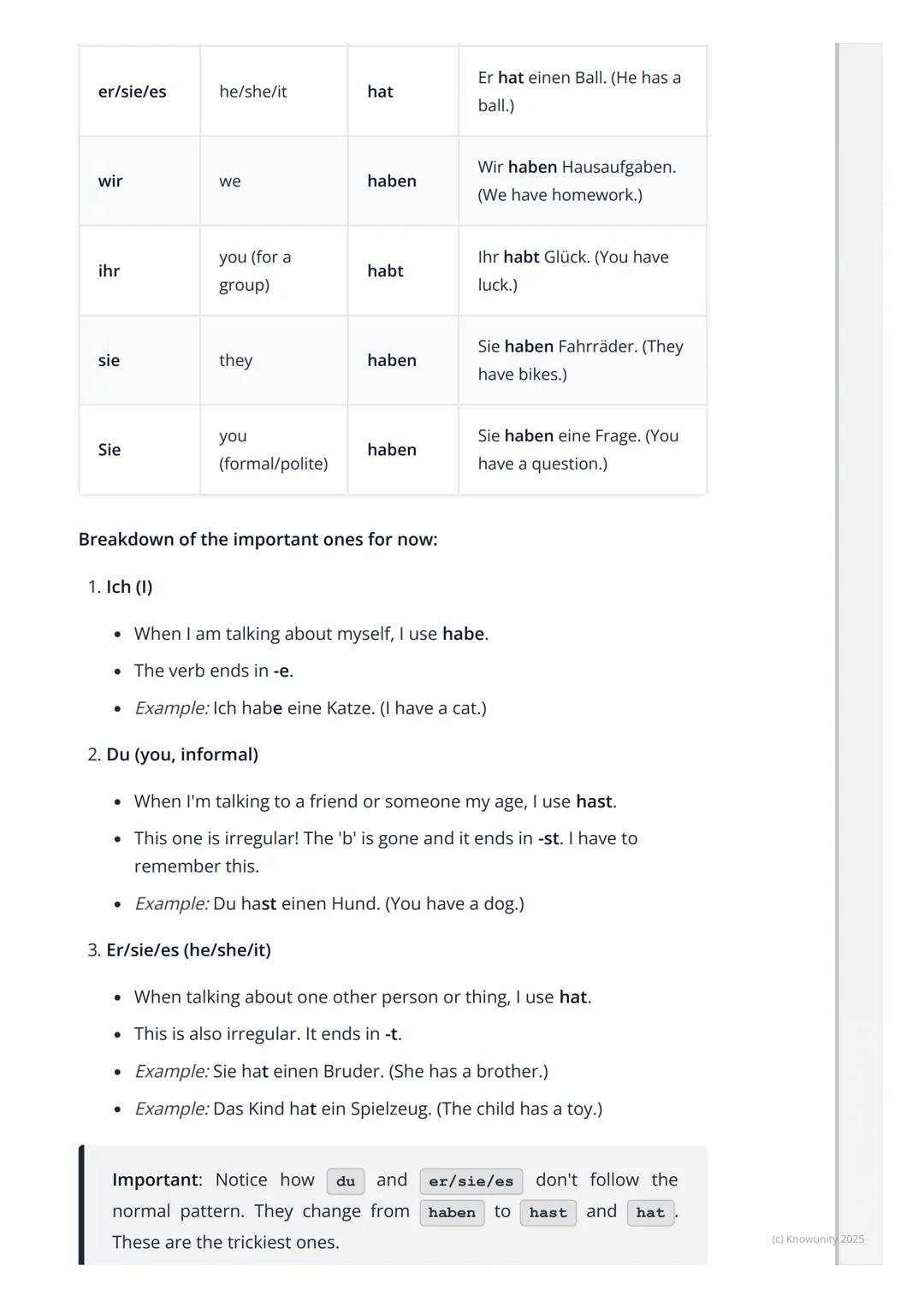
The haben forms you absolutely must know
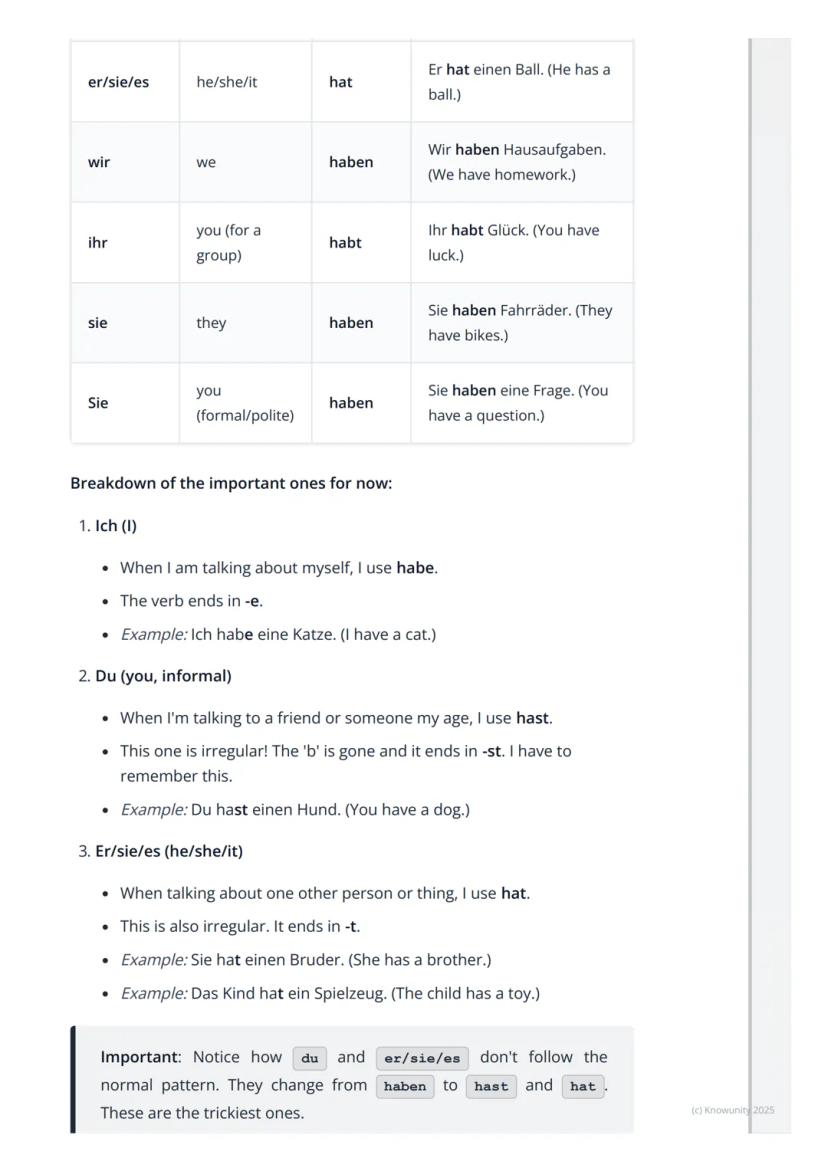
The three most important forms are the irregular ones that break the rules. Let's focus on these first: ich habe (I have), du hast (you have), and er/sie/es hat .
Notice how 'du hast' loses the 'b' completely - it's not 'du habst'! And 'hat' is super short compared to the original 'haben'. These two are the trickiest because they're so different.
The easier ones to remember are wir haben (we have) and sie haben (they have) because they stay the same as the original verb. There's also ihr habt (you all have), which just adds a 't' on the end.
Memory Trick: Think "Du HAST to remember this one!" for the du form - it's the most common mistake students make.
3
of 4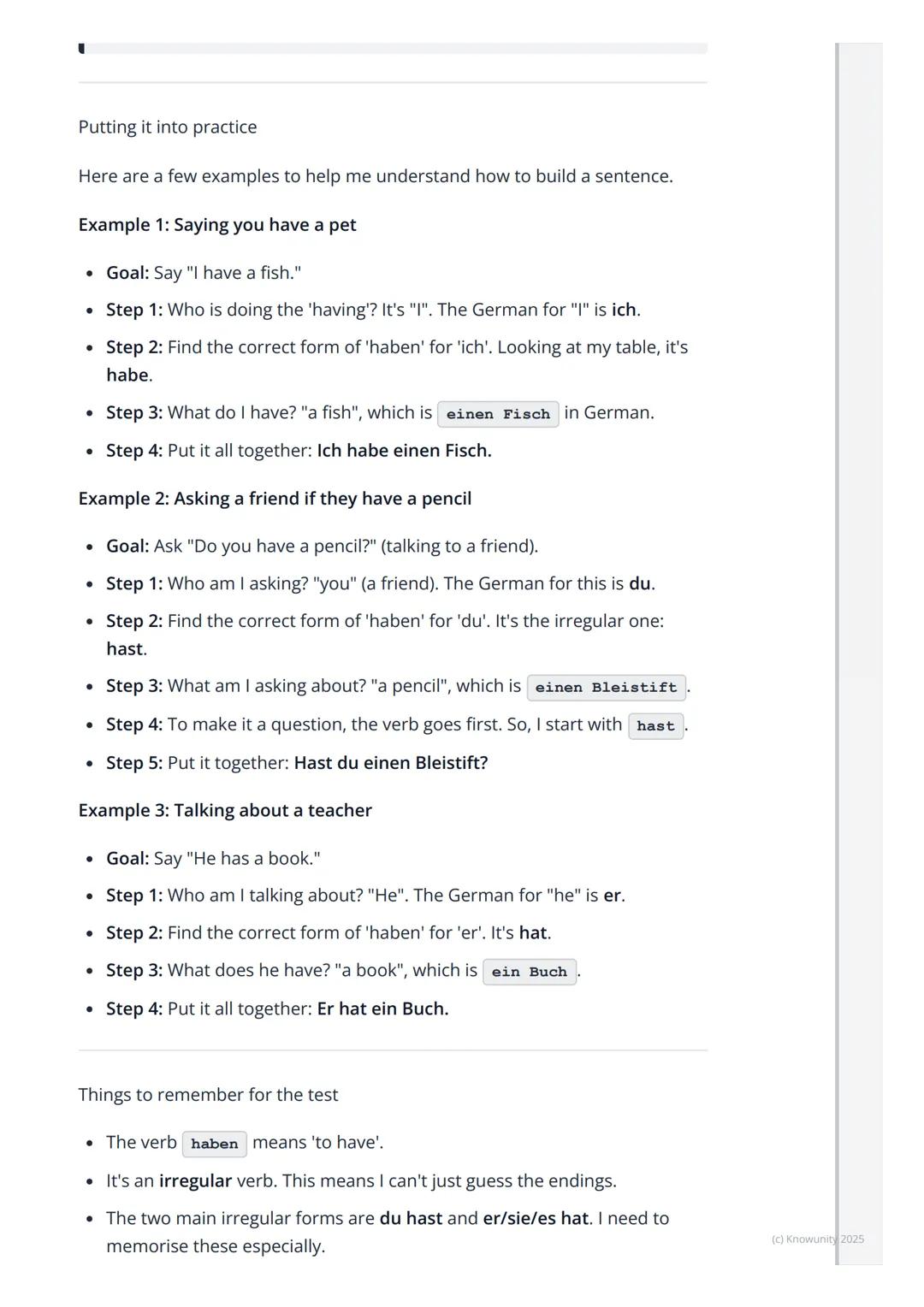
Building sentences with haben
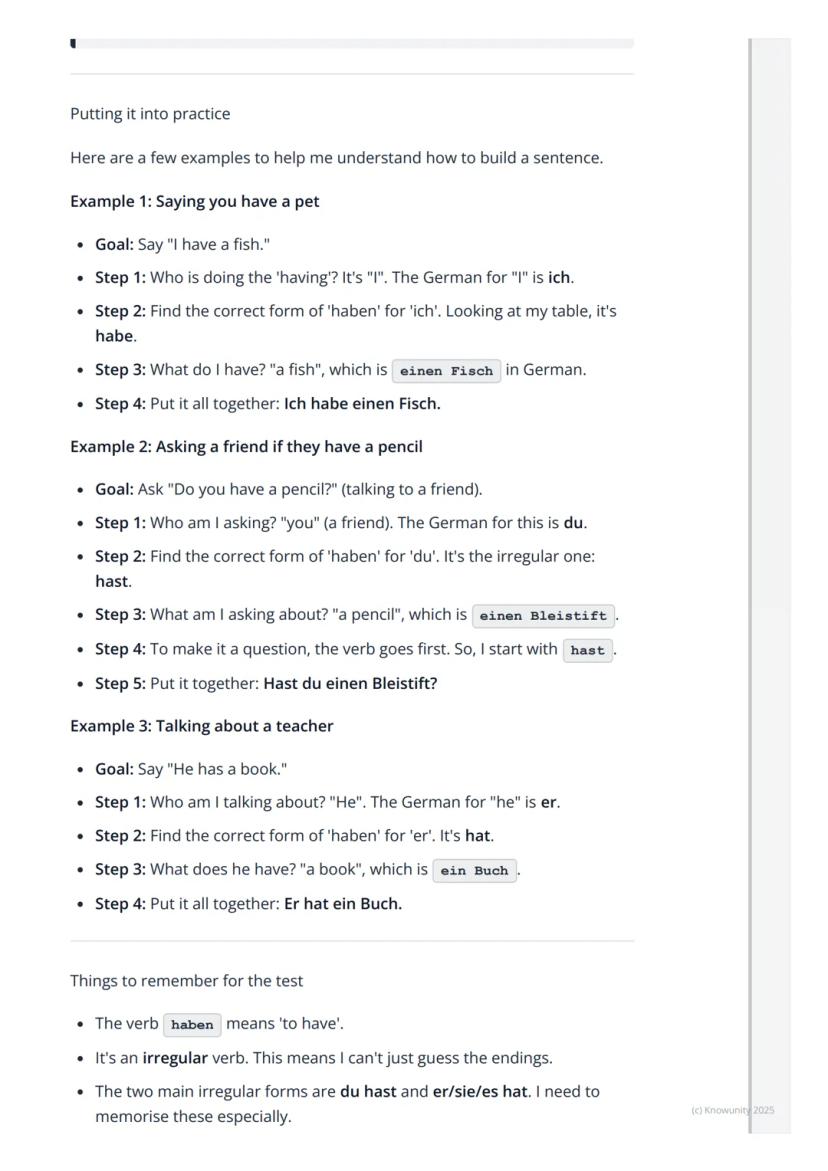
Let's put this into practice with real examples you might actually use! When saying "I have a cat", start with ich (I), then habe (have), then eine Katze (a cat). Simple as that: "Ich habe eine Katze."
For questions, flip the order around. Instead of "Du hast einen Stift" (You have a pen), ask "Hast du einen Stift?" (Do you have a pen?). The verb jumps to the front in German questions.
When talking about someone else, like "She has a brother", use sie hat einen Bruder. Remember, it's 'hat' not 'hast' because you're talking about her, not to her directly.
Pro Tip: Practice by describing what people in your class have - "Emma hat ein neues Handy" or "Wir haben Mathe heute."
4
of 4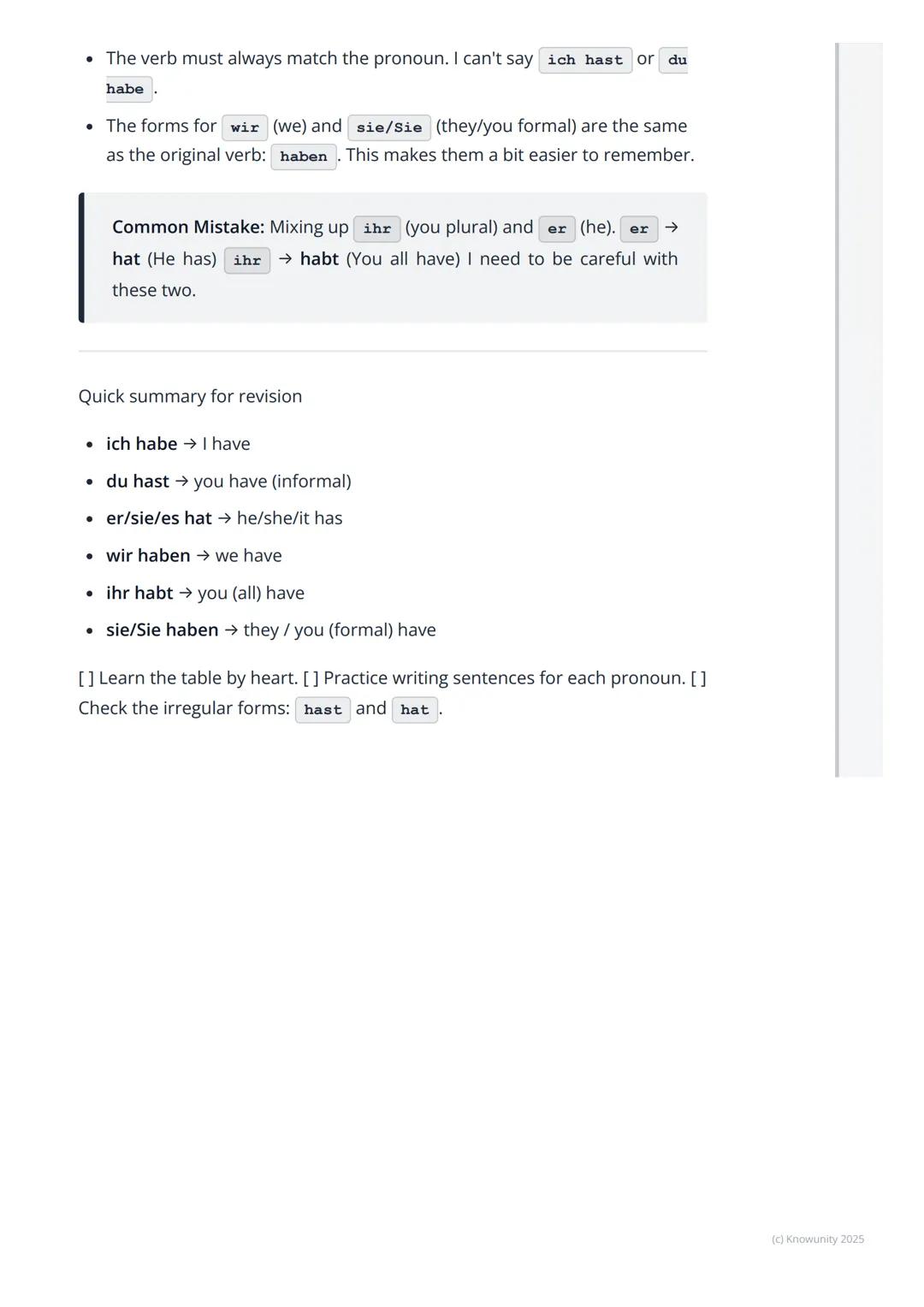
Avoiding the most common mistakes
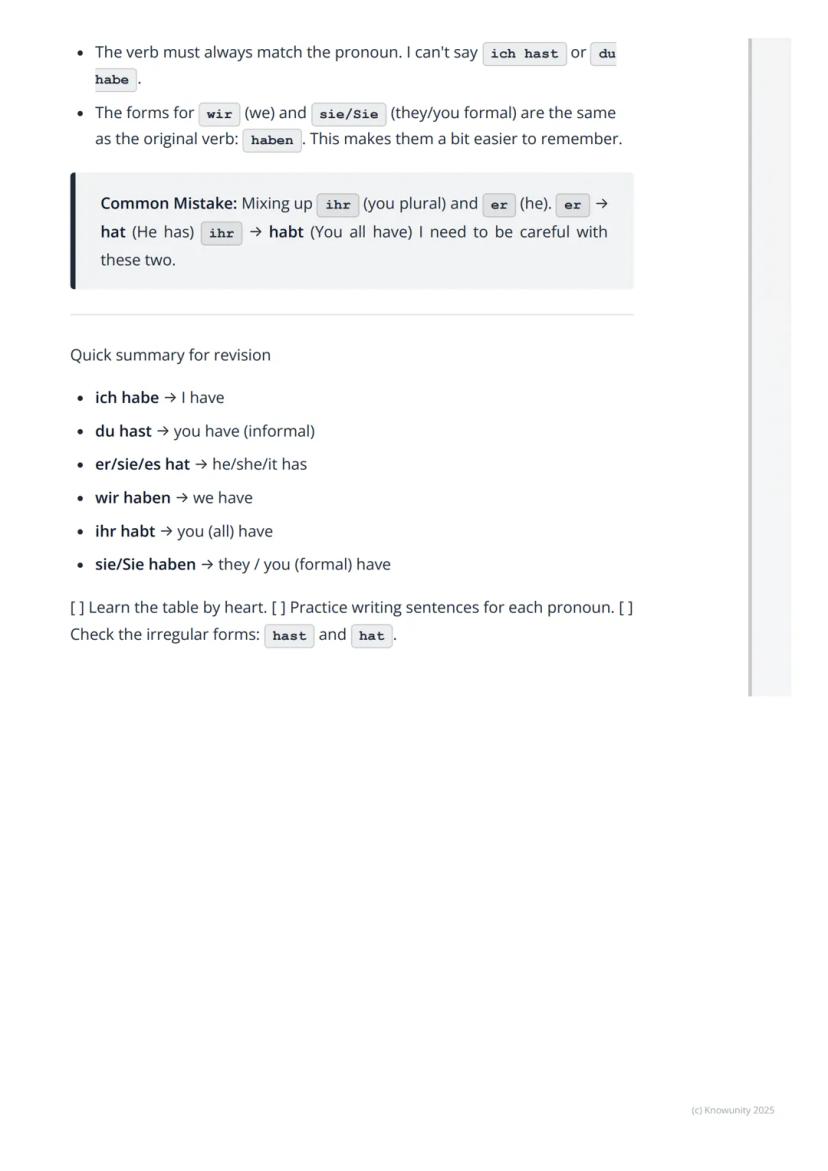
The biggest mistake is mixing up du hast and er hat. Remember: if you're talking TO someone (like your mate), use 'hast'. If you're talking ABOUT someone (like your teacher), use 'hat'.
Don't confuse ihr habt (you all have) with er hat (he has) either. 'Ihr' is when you're talking to a whole group of friends, whilst 'er' is just one person you're talking about.
Here's your quick revision list: ich habe, du hast, er/sie/es hat, wir haben, ihr habt, sie haben. The irregular ones (hast and hat) are your priority - get these rock solid first!
Test Prep: Make flashcards with just the tricky forms and quiz yourself daily until they're automatic.
Akala namin hindi mo na itatanong...
Ano ang Knowunity AI companion?
Ang aming AI Companion ay isang AI tool na nakatuon sa mga estudyante na nag-aalok ng higit pa sa mga sagot lang. Binuo mula sa milyong Knowunity resources, nagbibigay ito ng may-kaugnayang impormasyon, personalized na study plans, quizzes, at content direkta sa chat, na umaangkop sa iyong sariling learning journey.
Saan ko mada-download ang Knowunity app?
Maaari mong i-download ang app mula sa Google Play Store at Apple App Store.
Talaga bang libre ang Knowunity?
Tama 'yan! Mag-enjoy sa libreng access sa mga study content, makipag-connect sa kapwa mga estudyante, at kumuha ng instant na tulong – lahat nasa iyong daliri lang.
Pinaka-sikat na nilalaman sa German
2Pinaka-sikat na nilalaman
9 Irish
IrishIrish oral questions and answers
Questions and answers for the leaving cert oral
5th Year4264
 English
Key Quotes : Sive
Key Quotes and explanations: Sive
6th Year2842
IrishIrish oral questions
Outline of oral questions
5th Year2055
IrishIníon- le hÁine Durkin
Aine Durkin’s poem, Iníon: Themes & summary
5th Year890
IrishIrish poetry 2027
Iníon + Dínit an Bhróin
5th Year1153
IrishLC HL notes- Iníon (poem)
Includes poem in English and Irish, theme, key words & phrases
5th Year2304
EnglishCultural Context : Shawshank Redemption : Sive : Small Things Like These
Comparative Study : Cultural Context : Shawshank Redemption, Sive and Small Things Like These
6th Year1430
IrishMo Ghrá-sa (Idir Lúibíní)
Notes on mo ghrá-sa
5th Year380
IrishAn Gaeilge Aiste
Irish Language essay
6th Year1320
Hindi mo mahanap ang hinahanap mo? Tuklasin ang iba pang mga asignatura.
Gustong-gusto kami ng mga estudyante — at magiging ganoon ka rin.
4.6/5App Store
4.7/5Google Play
Napakadaling gamitin at maganda ang disenyo ng app. Nahanap ko lahat ng hinahanap ko hanggang ngayon at natuto ako ng marami mula sa mga presentasyon! Tiyak na gagamitin ko ang app para sa isang takdang-aralin sa klase! At siyempre, nakakatulong din ito bilang inspirasyon.
Stefan Sgumagamit ng iOS
Sobrang ganda talaga ng app na ito. Maraming mga study notes at tulong [...]. Ang problemang subject ko ay Pranses, halimbawa, at ang app ay may maraming options para tumulong. Salamat sa app na ito, bumuti ang Pranses ko. Irerekumenda ko ito sa lahat.
Samantha KlichAndroid user
Wow, talagang namangha ako. Sinubukan ko lang ang app dahil nakita ko itong ina-advertise nang maraming beses at sobrang nagulat ako. Ang app na ito ang TULONG na gusto mo para sa paaralan at higit sa lahat, nag-aalok ito ng maraming bagay, tulad ng workouts at fact sheets, na SOBRANG nakatulong sa akin.
AnnaiOS user
German4 views·Na-update Jun 7, 2026·4 mga pahinaMastering the German Verb 'haben' (to have)
Learning the German verb 'haben' (to have) is absolutely essential - you'll use it constantly! Just like in English where we say "I have" but "she has", German verbs change their endings depending on who's doing the action.
1
of 4
Mag-sign up para makita ang content. Libre ito!
- Access sa lahat ng dokumento
- Pagbutihin ang iyong mga grado
- Sumali sa milyong mga estudyante
What is 'haben' and why does it matter?
The German verb haben means 'to have' in English, and you'll use it loads to talk about what you own or possess. Think "I have a phone" or "My mate has a new bike" - that's haben in action!
Here's the thing though - haben is an irregular verb. This means it doesn't follow the normal patterns, so you can't just guess the endings. You've got to memorise how it changes for different people.
The key terms you need to know are conjugation (when verbs change to match different people) and pronouns (words like I, you, he, she). In German, these are ich, du, er, sie, and so on.
Quick Tip: Don't worry if this feels tricky at first - even native German speakers had to learn these patterns when they were young!
2
of 4Mag-sign up para makita ang content. Libre ito!
- Access sa lahat ng dokumento
- Pagbutihin ang iyong mga grado
- Sumali sa milyong mga estudyante
The haben forms you absolutely must know
The three most important forms are the irregular ones that break the rules. Let's focus on these first: ich habe (I have), du hast (you have), and er/sie/es hat .
Notice how 'du hast' loses the 'b' completely - it's not 'du habst'! And 'hat' is super short compared to the original 'haben'. These two are the trickiest because they're so different.
The easier ones to remember are wir haben (we have) and sie haben (they have) because they stay the same as the original verb. There's also ihr habt (you all have), which just adds a 't' on the end.
Memory Trick: Think "Du HAST to remember this one!" for the du form - it's the most common mistake students make.
3
of 4Mag-sign up para makita ang content. Libre ito!
- Access sa lahat ng dokumento
- Pagbutihin ang iyong mga grado
- Sumali sa milyong mga estudyante
Building sentences with haben
Let's put this into practice with real examples you might actually use! When saying "I have a cat", start with ich (I), then habe (have), then eine Katze (a cat). Simple as that: "Ich habe eine Katze."
For questions, flip the order around. Instead of "Du hast einen Stift" (You have a pen), ask "Hast du einen Stift?" (Do you have a pen?). The verb jumps to the front in German questions.
When talking about someone else, like "She has a brother", use sie hat einen Bruder. Remember, it's 'hat' not 'hast' because you're talking about her, not to her directly.
Pro Tip: Practice by describing what people in your class have - "Emma hat ein neues Handy" or "Wir haben Mathe heute."
4
of 4Mag-sign up para makita ang content. Libre ito!
- Access sa lahat ng dokumento
- Pagbutihin ang iyong mga grado
- Sumali sa milyong mga estudyante
Avoiding the most common mistakes
The biggest mistake is mixing up du hast and er hat. Remember: if you're talking TO someone (like your mate), use 'hast'. If you're talking ABOUT someone (like your teacher), use 'hat'.
Don't confuse ihr habt (you all have) with er hat (he has) either. 'Ihr' is when you're talking to a whole group of friends, whilst 'er' is just one person you're talking about.
Here's your quick revision list: ich habe, du hast, er/sie/es hat, wir haben, ihr habt, sie haben. The irregular ones (hast and hat) are your priority - get these rock solid first!
Test Prep: Make flashcards with just the tricky forms and quiz yourself daily until they're automatic.
Akala namin hindi mo na itatanong...
Ano ang Knowunity AI companion?
Ang aming AI Companion ay isang AI tool na nakatuon sa mga estudyante na nag-aalok ng higit pa sa mga sagot lang. Binuo mula sa milyong Knowunity resources, nagbibigay ito ng may-kaugnayang impormasyon, personalized na study plans, quizzes, at content direkta sa chat, na umaangkop sa iyong sariling learning journey.
Saan ko mada-download ang Knowunity app?
Maaari mong i-download ang app mula sa Google Play Store at Apple App Store.
Talaga bang libre ang Knowunity?
Tama 'yan! Mag-enjoy sa libreng access sa mga study content, makipag-connect sa kapwa mga estudyante, at kumuha ng instant na tulong – lahat nasa iyong daliri lang.
Pinaka-sikat na nilalaman sa German
2Pinaka-sikat na nilalaman
9IrishIrish oral questions and answers
Questions and answers for the leaving cert oral
5th Year4264
EnglishKey Quotes : Sive
Key Quotes and explanations: Sive
6th Year2842
IrishIrish oral questions
Outline of oral questions
5th Year2055
IrishIníon- le hÁine Durkin
Aine Durkin’s poem, Iníon: Themes & summary
5th Year890
IrishIrish poetry 2027
Iníon + Dínit an Bhróin
5th Year1153
IrishLC HL notes- Iníon (poem)
Includes poem in English and Irish, theme, key words & phrases
5th Year2304
EnglishCultural Context : Shawshank Redemption : Sive : Small Things Like These
Comparative Study : Cultural Context : Shawshank Redemption, Sive and Small Things Like These
6th Year1430
IrishMo Ghrá-sa (Idir Lúibíní)
Notes on mo ghrá-sa
5th Year380
IrishAn Gaeilge Aiste
Irish Language essay
6th Year1320
Hindi mo mahanap ang hinahanap mo? Tuklasin ang iba pang mga asignatura.
Gustong-gusto kami ng mga estudyante — at magiging ganoon ka rin.
4.6/5App Store
4.7/5Google Play
Napakadaling gamitin at maganda ang disenyo ng app. Nahanap ko lahat ng hinahanap ko hanggang ngayon at natuto ako ng marami mula sa mga presentasyon! Tiyak na gagamitin ko ang app para sa isang takdang-aralin sa klase! At siyempre, nakakatulong din ito bilang inspirasyon.
Stefan Sgumagamit ng iOS
Sobrang ganda talaga ng app na ito. Maraming mga study notes at tulong [...]. Ang problemang subject ko ay Pranses, halimbawa, at ang app ay may maraming options para tumulong. Salamat sa app na ito, bumuti ang Pranses ko. Irerekumenda ko ito sa lahat.
Samantha KlichAndroid user
Wow, talagang namangha ako. Sinubukan ko lang ang app dahil nakita ko itong ina-advertise nang maraming beses at sobrang nagulat ako. Ang app na ito ang TULONG na gusto mo para sa paaralan at higit sa lahat, nag-aalok ito ng maraming bagay, tulad ng workouts at fact sheets, na SOBRANG nakatulong sa akin.
AnnaiOS user