
Learning French numbers might seem tricky at first, but it's... Ipakita pa
 French10 views·Na-update May 19, 2026·5 mga pahina
Master French Numbers: Count from 1 to 50

1 / 5
1
of 5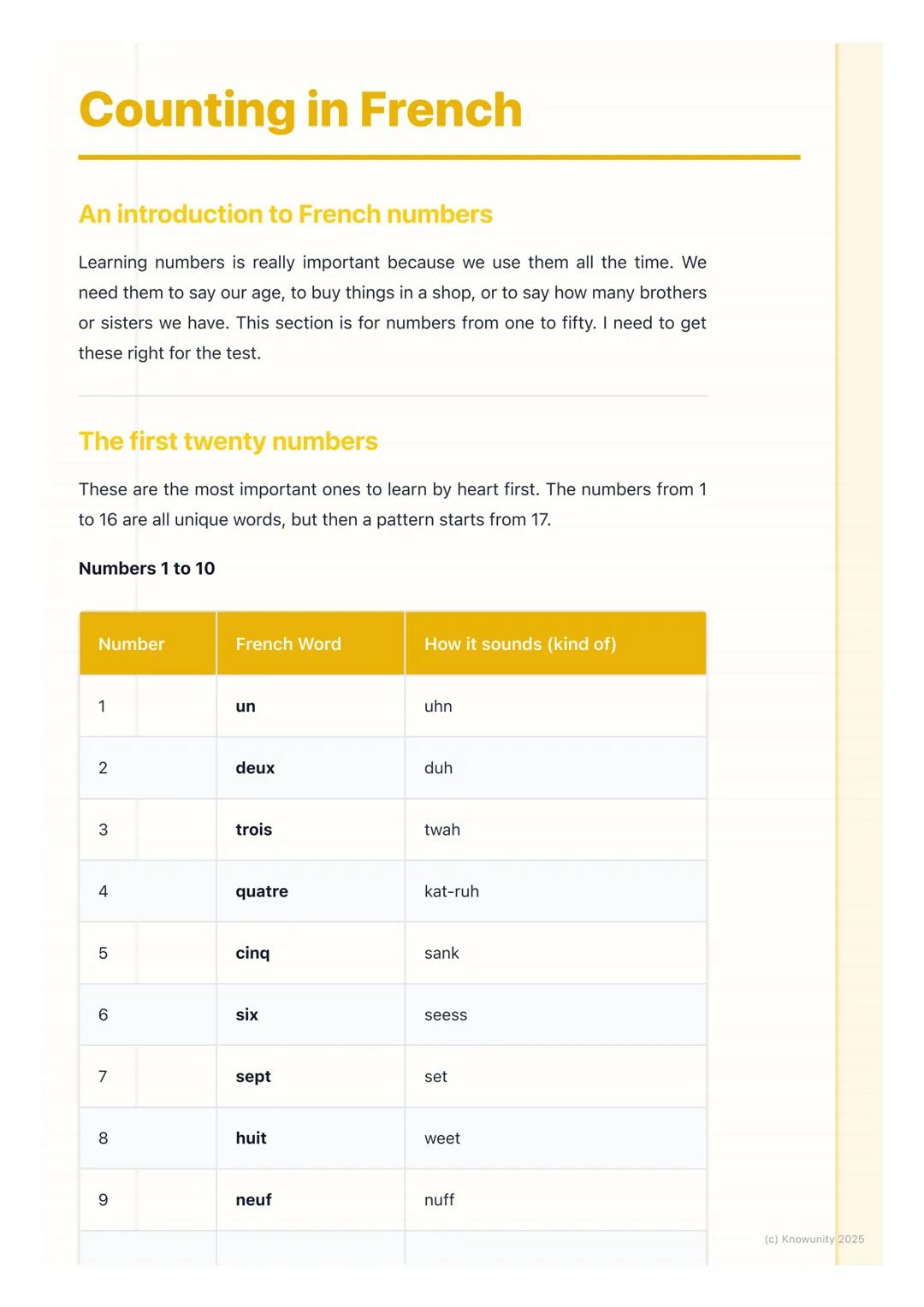
Getting Started with French Numbers 1-20
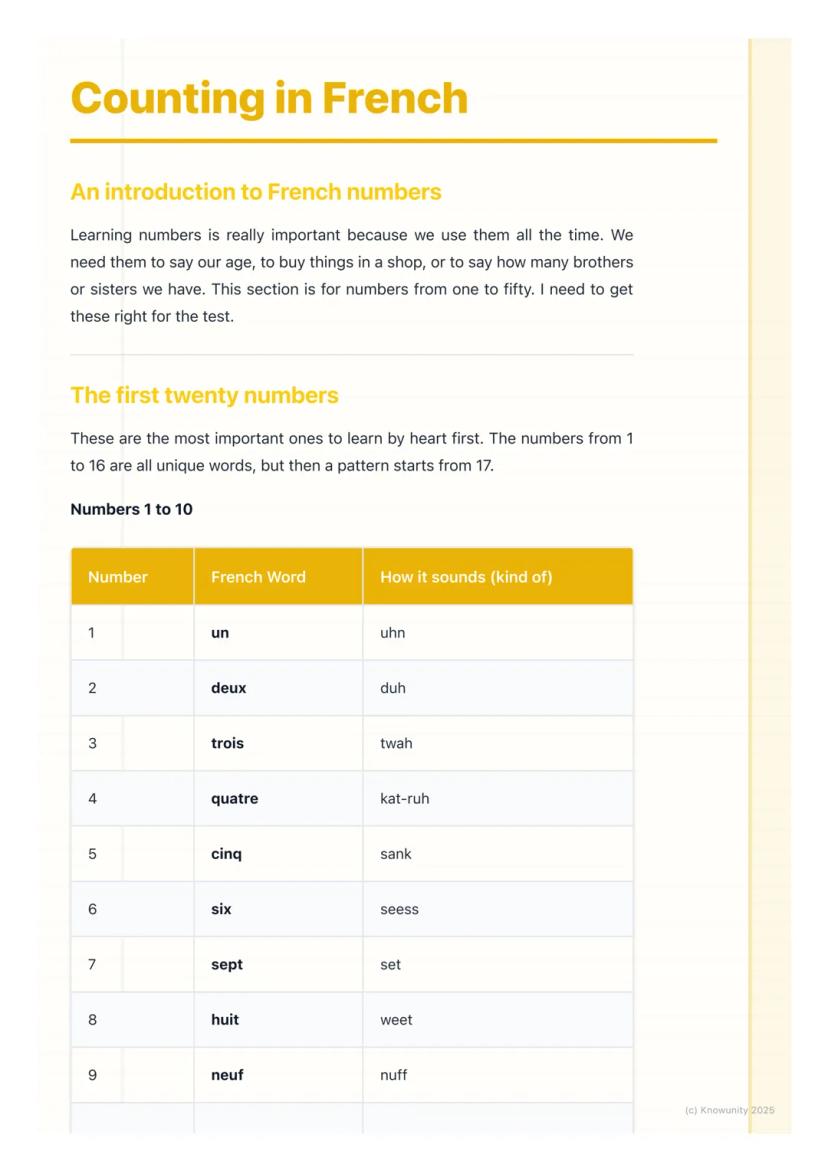
French numbers from 1-10 are completely unique words that you'll need to memorise properly. Think of them as your building blocks - once you've got these down, everything else becomes much easier!
The key ones to nail first are: un (1), deux (2), trois (3), quatre (4), cinq (5), six (6), sept (7), huit (8), neuf (9), and dix (10). Don't worry about perfect pronunciation yet - just get familiar with how they look.
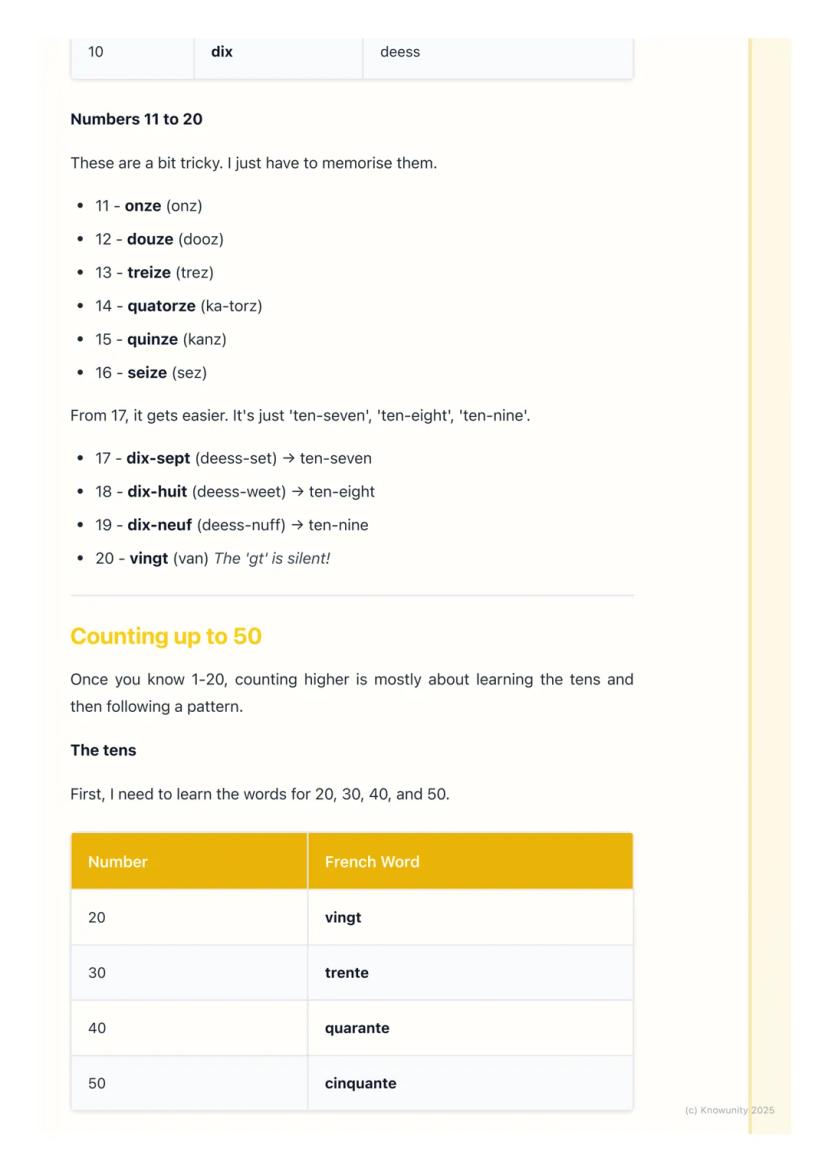
Numbers 11-16 are special cases that you'll have to learn separately: onze, douze, treize, quatorze, quinze, seize. There's no pattern here, so it's just memorisation time!
Quick Tip: Practice writing out numbers 1-16 from memory. Once you can do this without looking, you're ready for the clever bit that comes next!
2
of 5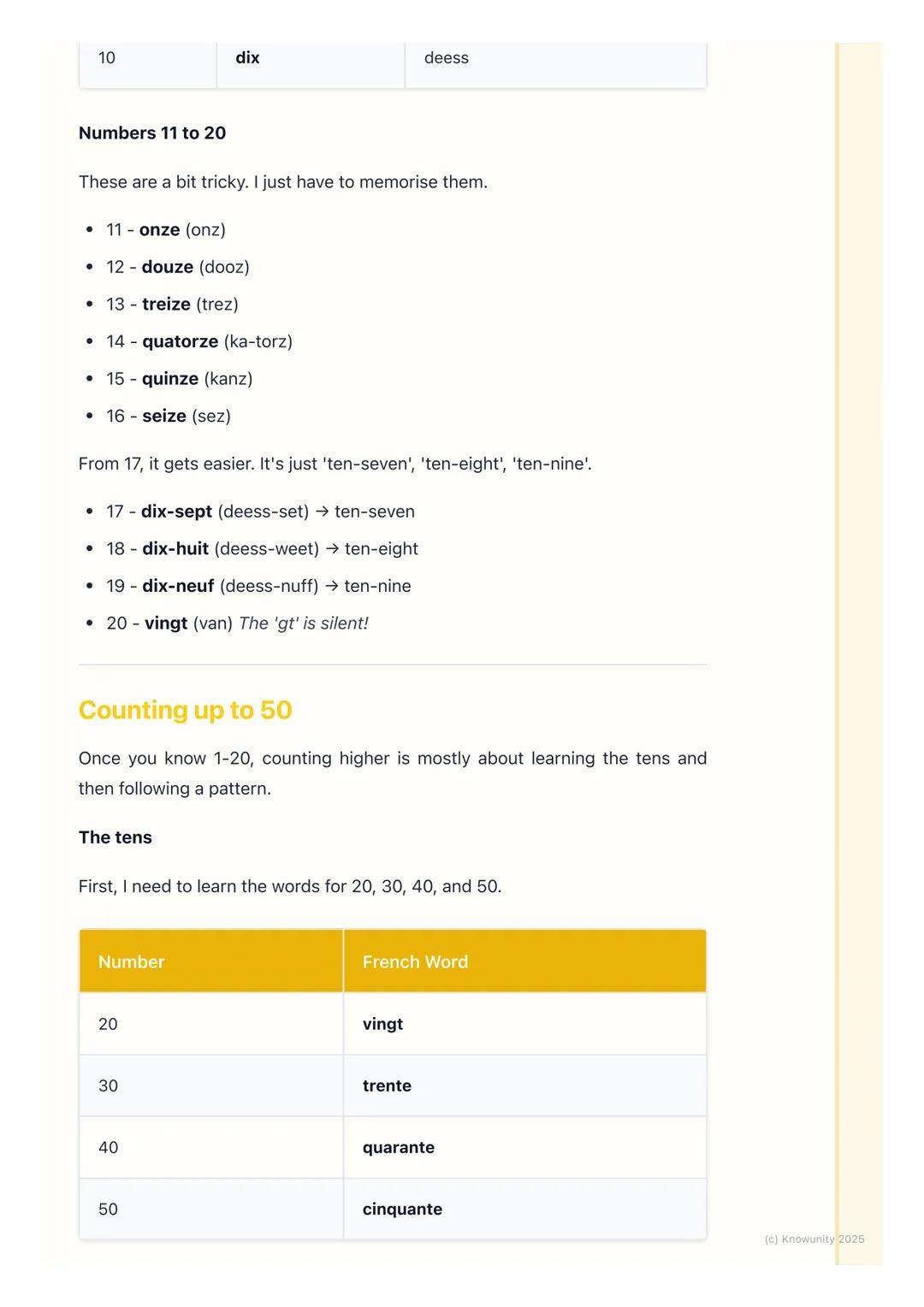
The Clever Pattern from 17-20 and Beyond
Here's where French gets really smart! Numbers 17-19 follow a simple pattern: they're literally "ten-seven", "ten-eight", "ten-nine". So you get dix-sept (17), dix-huit (18), and dix-neuf (19). Brilliant, right?
Twenty is "vingt" - and watch out because the 'gt' at the end is silent! This trips up loads of people, so remember it sounds like "van", not "vingt".
Now you need to learn the tens: vingt (20), trente (30), quarante (40), and cinquante (50). These are your next building blocks for making bigger numbers.
Remember: The teens from 11-16 are weird, but 17-19 follow the "dix-" pattern. After that, it's all about combining tens with units!
3
of 5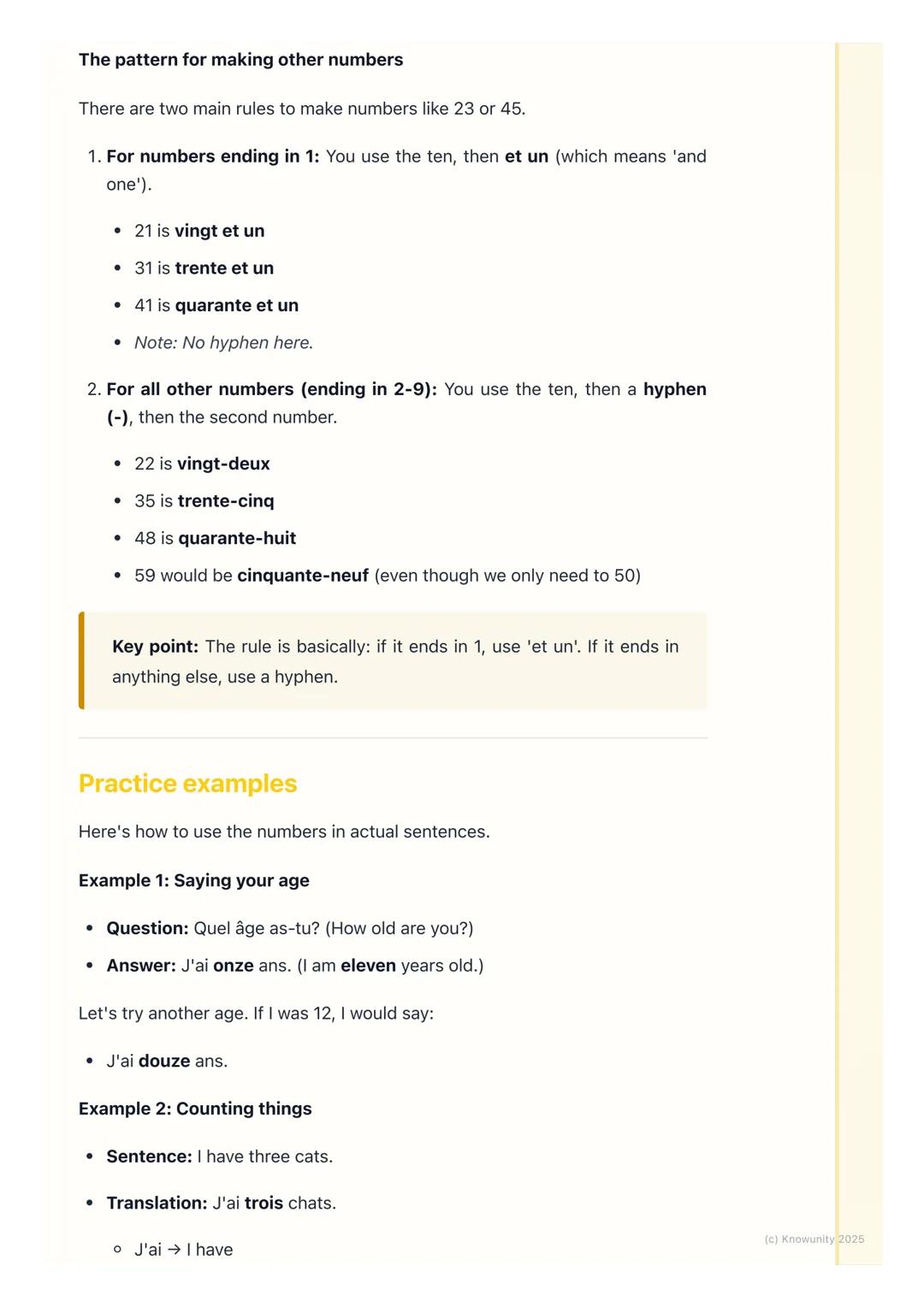
The Two Golden Rules for Making Numbers
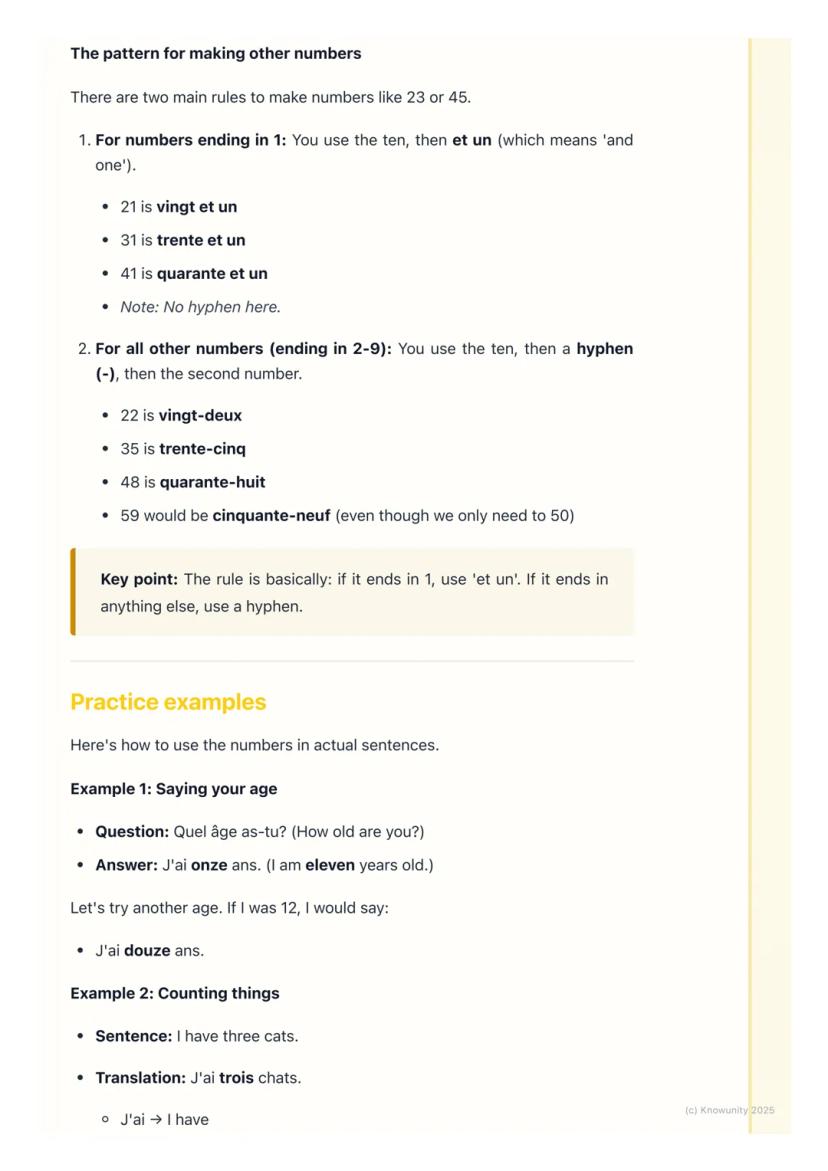
Right, this is the game-changer! There are only two rules you need to make any number up to 50, and they're dead simple once you get them.
Rule 1: Numbers ending in 1 use "et un" (meaning "and one"). So 21 becomes vingt et un, 31 becomes trente et un, and 41 becomes quarante et un. Notice there's no hyphen here - just the words flowing together.
Rule 2: All other numbers use a hyphen between the ten and the unit. So 22 is vingt-deux, 35 is trente-cinq, and 48 is quarante-huit. The hyphen keeps everything tidy!
Memory Trick: If it ends in 1, think "and one" (et un). If it ends in anything else, think "hyphen time"!
4
of 5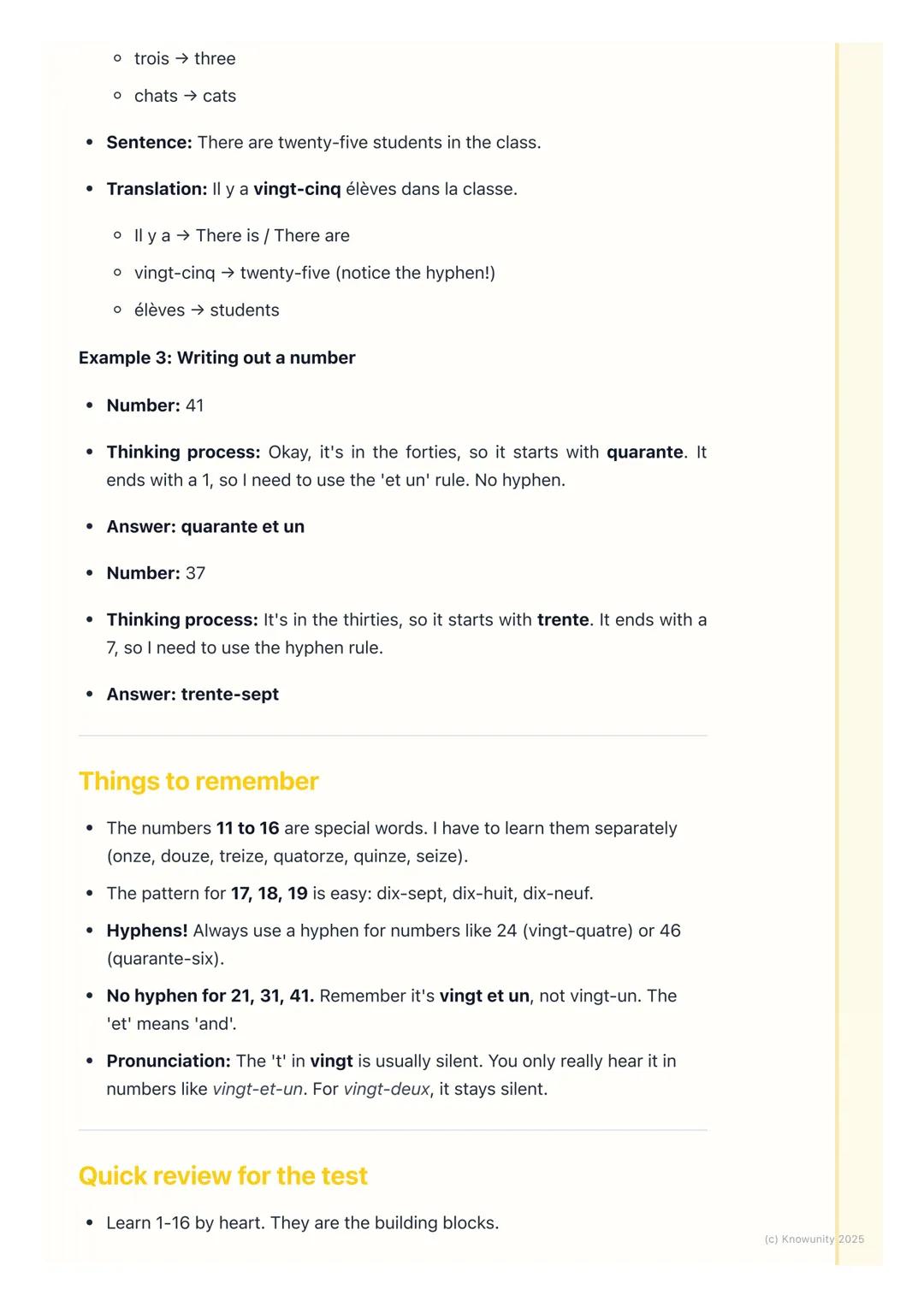
Using Numbers in Real French Sentences
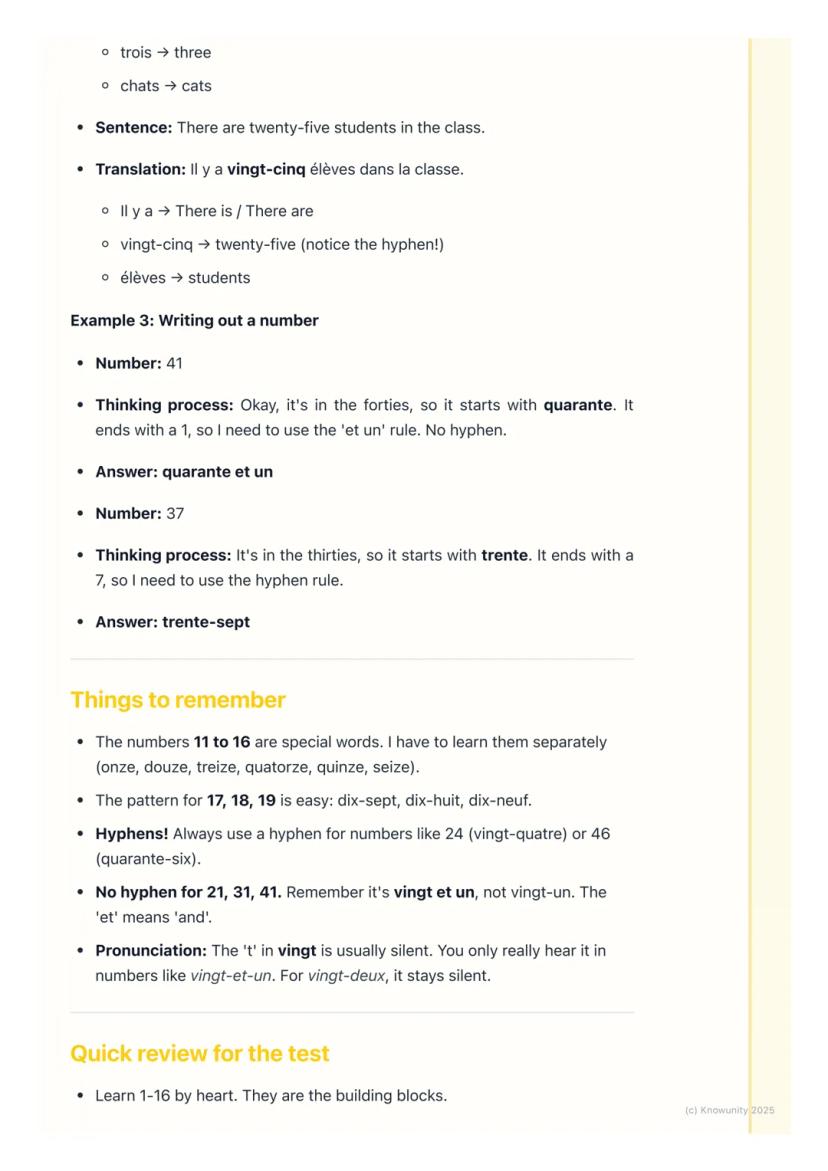
Time to put these numbers to work! Saying your age is probably the most useful thing you'll do with French numbers. The question "Quel âge as-tu?" means "How old are you?"
Your answer always starts with "J'ai" (I have) followed by the number and "ans" (years). So if you're 12, you'd say "J'ai douze ans." Easy!
Counting objects works similarly. "J'ai trois chats" means "I have three cats." For bigger groups, like "There are twenty-five students in the class," you'd say "Il y a vingt-cinq élèves dans la classe." Notice that hyphen in vingt-cinq!
When you're writing out numbers, just think through the process: Is it in the twenties, thirties, or forties? Does it end in 1 (use et un) or something else (use a hyphen)?
Practice Tip: Try saying your real age, your family members' ages, and count objects around your room. The more you use these numbers, the more automatic they become!
5
of 5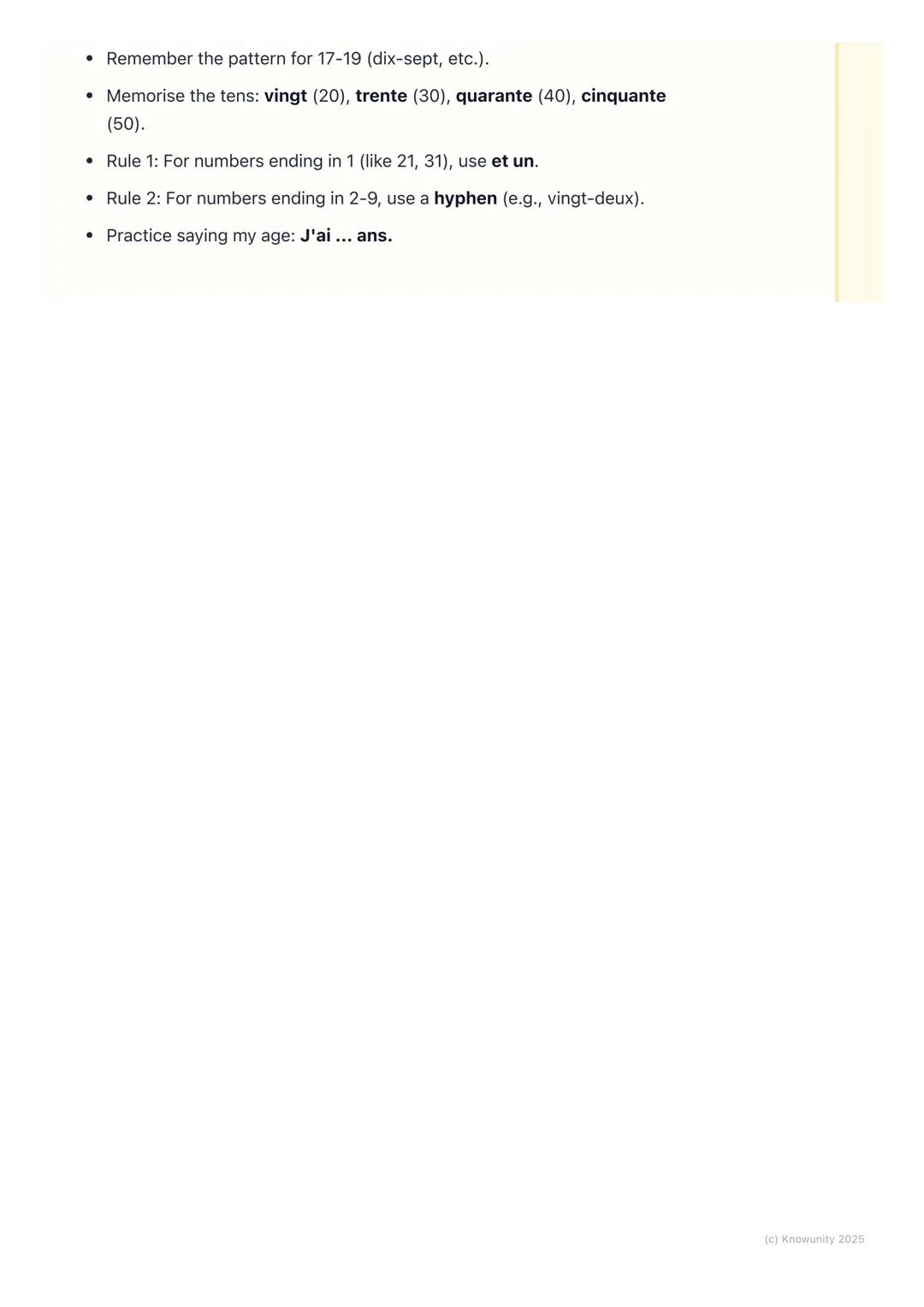
Quick Review and Test Prep
Master the foundation first: numbers 1-16 are your absolute essentials. If you know these cold, you can build everything else. The pattern for 17-19 is your bridge to the bigger numbers.
Don't forget the silent letters! The 't' in vingt is usually silent - it sounds like "van", not "vingt". This catches out loads of students in speaking tests.
Practice the two rules until they're automatic: "et un" for numbers ending in 1 (no hyphen), and hyphens for everything else. Try making random numbers like 23, 37, or 44 and see if you can write them out correctly.
The brilliant thing about French numbers is that once you've cracked this system up to 50, you've basically got the pattern for counting much higher too!
Final Check: Can you write your age in French? Can you count to 20 without looking? If yes, you're absolutely ready for that test!
Akala namin hindi mo na itatanong...
Ano ang Knowunity AI companion?
Ang aming AI Companion ay isang AI tool na nakatuon sa mga estudyante na nag-aalok ng higit pa sa mga sagot lang. Binuo mula sa milyong Knowunity resources, nagbibigay ito ng may-kaugnayang impormasyon, personalized na study plans, quizzes, at content direkta sa chat, na umaangkop sa iyong sariling learning journey.
Saan ko mada-download ang Knowunity app?
Maaari mong i-download ang app mula sa Google Play Store at Apple App Store.
Talaga bang libre ang Knowunity?
Tama 'yan! Mag-enjoy sa libreng access sa mga study content, makipag-connect sa kapwa mga estudyante, at kumuha ng instant na tulong – lahat nasa iyong daliri lang.
Pinaka-sikat na nilalaman sa French
1Pinaka-sikat na nilalaman
9 Irish
IrishIrish oral questions and answers
Questions and answers for the leaving cert oral
5th Year4254
IrishIrish oral questions
Outline of oral questions
5th Year2055
IrishIníon- le hÁine Durkin
Aine Durkin’s poem, Iníon: Themes & summary
5th Year850
 English
Key Quotes : Sive
Key Quotes and explanations: Sive
6th Year2402
IrishIrish poetry 2027
Iníon + Dínit an Bhróin
5th Year1133
IrishLC HL notes- Iníon (poem)
Includes poem in English and Irish, theme, key words & phrases
5th Year2284
IrishGaeilge Grammar Office
All the basics you need to know on Irish grammar.
6th Year913
IrishMo Ghrá-sa (Idir Lúibíní)
Notes on mo ghrá-sa
5th Year350
IrishAn Gaeilge Aiste
Irish Language essay
6th Year1250
Hindi mo mahanap ang hinahanap mo? Tuklasin ang iba pang mga asignatura.
Gustong-gusto kami ng mga estudyante — at magiging ganoon ka rin.
4.6/5App Store
4.7/5Google Play
Napakadaling gamitin at maganda ang disenyo ng app. Nahanap ko lahat ng hinahanap ko hanggang ngayon at natuto ako ng marami mula sa mga presentasyon! Tiyak na gagamitin ko ang app para sa isang takdang-aralin sa klase! At siyempre, nakakatulong din ito bilang inspirasyon.
Stefan Sgumagamit ng iOS
Sobrang ganda talaga ng app na ito. Maraming mga study notes at tulong [...]. Ang problemang subject ko ay Pranses, halimbawa, at ang app ay may maraming options para tumulong. Salamat sa app na ito, bumuti ang Pranses ko. Irerekumenda ko ito sa lahat.
Samantha KlichAndroid user
Wow, talagang namangha ako. Sinubukan ko lang ang app dahil nakita ko itong ina-advertise nang maraming beses at sobrang nagulat ako. Ang app na ito ang TULONG na gusto mo para sa paaralan at higit sa lahat, nag-aalok ito ng maraming bagay, tulad ng workouts at fact sheets, na SOBRANG nakatulong sa akin.
AnnaiOS user
French10 views·Na-update May 19, 2026·5 mga pahinaMaster French Numbers: Count from 1 to 50
Learning French numbers might seem tricky at first, but it's actually quite brilliant once you spot the patterns! You'll use these numbers constantly - for your age, buying things, or talking about your family - so getting them right is... Ipakita pa
1
of 5Mag-sign up para makita ang content. Libre ito!
- Access sa lahat ng dokumento
- Pagbutihin ang iyong mga grado
- Sumali sa milyong mga estudyante
Getting Started with French Numbers 1-20
French numbers from 1-10 are completely unique words that you'll need to memorise properly. Think of them as your building blocks - once you've got these down, everything else becomes much easier!
The key ones to nail first are: un (1), deux (2), trois (3), quatre (4), cinq (5), six (6), sept (7), huit (8), neuf (9), and dix (10). Don't worry about perfect pronunciation yet - just get familiar with how they look.
Numbers 11-16 are special cases that you'll have to learn separately: onze, douze, treize, quatorze, quinze, seize. There's no pattern here, so it's just memorisation time!
Quick Tip: Practice writing out numbers 1-16 from memory. Once you can do this without looking, you're ready for the clever bit that comes next!
2
of 5Mag-sign up para makita ang content. Libre ito!
- Access sa lahat ng dokumento
- Pagbutihin ang iyong mga grado
- Sumali sa milyong mga estudyante
The Clever Pattern from 17-20 and Beyond
Here's where French gets really smart! Numbers 17-19 follow a simple pattern: they're literally "ten-seven", "ten-eight", "ten-nine". So you get dix-sept (17), dix-huit (18), and dix-neuf (19). Brilliant, right?
Twenty is "vingt" - and watch out because the 'gt' at the end is silent! This trips up loads of people, so remember it sounds like "van", not "vingt".
Now you need to learn the tens: vingt (20), trente (30), quarante (40), and cinquante (50). These are your next building blocks for making bigger numbers.
Remember: The teens from 11-16 are weird, but 17-19 follow the "dix-" pattern. After that, it's all about combining tens with units!
3
of 5Mag-sign up para makita ang content. Libre ito!
- Access sa lahat ng dokumento
- Pagbutihin ang iyong mga grado
- Sumali sa milyong mga estudyante
The Two Golden Rules for Making Numbers
Right, this is the game-changer! There are only two rules you need to make any number up to 50, and they're dead simple once you get them.
Rule 1: Numbers ending in 1 use "et un" (meaning "and one"). So 21 becomes vingt et un, 31 becomes trente et un, and 41 becomes quarante et un. Notice there's no hyphen here - just the words flowing together.
Rule 2: All other numbers use a hyphen between the ten and the unit. So 22 is vingt-deux, 35 is trente-cinq, and 48 is quarante-huit. The hyphen keeps everything tidy!
Memory Trick: If it ends in 1, think "and one" (et un). If it ends in anything else, think "hyphen time"!
4
of 5Mag-sign up para makita ang content. Libre ito!
- Access sa lahat ng dokumento
- Pagbutihin ang iyong mga grado
- Sumali sa milyong mga estudyante
Using Numbers in Real French Sentences
Time to put these numbers to work! Saying your age is probably the most useful thing you'll do with French numbers. The question "Quel âge as-tu?" means "How old are you?"
Your answer always starts with "J'ai" (I have) followed by the number and "ans" (years). So if you're 12, you'd say "J'ai douze ans." Easy!
Counting objects works similarly. "J'ai trois chats" means "I have three cats." For bigger groups, like "There are twenty-five students in the class," you'd say "Il y a vingt-cinq élèves dans la classe." Notice that hyphen in vingt-cinq!
When you're writing out numbers, just think through the process: Is it in the twenties, thirties, or forties? Does it end in 1 (use et un) or something else (use a hyphen)?
Practice Tip: Try saying your real age, your family members' ages, and count objects around your room. The more you use these numbers, the more automatic they become!
5
of 5Mag-sign up para makita ang content. Libre ito!
- Access sa lahat ng dokumento
- Pagbutihin ang iyong mga grado
- Sumali sa milyong mga estudyante
Quick Review and Test Prep
Master the foundation first: numbers 1-16 are your absolute essentials. If you know these cold, you can build everything else. The pattern for 17-19 is your bridge to the bigger numbers.
Don't forget the silent letters! The 't' in vingt is usually silent - it sounds like "van", not "vingt". This catches out loads of students in speaking tests.
Practice the two rules until they're automatic: "et un" for numbers ending in 1 (no hyphen), and hyphens for everything else. Try making random numbers like 23, 37, or 44 and see if you can write them out correctly.
The brilliant thing about French numbers is that once you've cracked this system up to 50, you've basically got the pattern for counting much higher too!
Final Check: Can you write your age in French? Can you count to 20 without looking? If yes, you're absolutely ready for that test!
Akala namin hindi mo na itatanong...
Ano ang Knowunity AI companion?
Ang aming AI Companion ay isang AI tool na nakatuon sa mga estudyante na nag-aalok ng higit pa sa mga sagot lang. Binuo mula sa milyong Knowunity resources, nagbibigay ito ng may-kaugnayang impormasyon, personalized na study plans, quizzes, at content direkta sa chat, na umaangkop sa iyong sariling learning journey.
Saan ko mada-download ang Knowunity app?
Maaari mong i-download ang app mula sa Google Play Store at Apple App Store.
Talaga bang libre ang Knowunity?
Tama 'yan! Mag-enjoy sa libreng access sa mga study content, makipag-connect sa kapwa mga estudyante, at kumuha ng instant na tulong – lahat nasa iyong daliri lang.
Pinaka-sikat na nilalaman sa French
1Pinaka-sikat na nilalaman
9IrishIrish oral questions and answers
Questions and answers for the leaving cert oral
5th Year4254
IrishIrish oral questions
Outline of oral questions
5th Year2055
IrishIníon- le hÁine Durkin
Aine Durkin’s poem, Iníon: Themes & summary
5th Year850
EnglishKey Quotes : Sive
Key Quotes and explanations: Sive
6th Year2402
IrishIrish poetry 2027
Iníon + Dínit an Bhróin
5th Year1133
IrishLC HL notes- Iníon (poem)
Includes poem in English and Irish, theme, key words & phrases
5th Year2284
IrishGaeilge Grammar Office
All the basics you need to know on Irish grammar.
6th Year913
IrishMo Ghrá-sa (Idir Lúibíní)
Notes on mo ghrá-sa
5th Year350
IrishAn Gaeilge Aiste
Irish Language essay
6th Year1250
Hindi mo mahanap ang hinahanap mo? Tuklasin ang iba pang mga asignatura.
Gustong-gusto kami ng mga estudyante — at magiging ganoon ka rin.
4.6/5App Store
4.7/5Google Play
Napakadaling gamitin at maganda ang disenyo ng app. Nahanap ko lahat ng hinahanap ko hanggang ngayon at natuto ako ng marami mula sa mga presentasyon! Tiyak na gagamitin ko ang app para sa isang takdang-aralin sa klase! At siyempre, nakakatulong din ito bilang inspirasyon.
Stefan Sgumagamit ng iOS
Sobrang ganda talaga ng app na ito. Maraming mga study notes at tulong [...]. Ang problemang subject ko ay Pranses, halimbawa, at ang app ay may maraming options para tumulong. Salamat sa app na ito, bumuti ang Pranses ko. Irerekumenda ko ito sa lahat.
Samantha KlichAndroid user
Wow, talagang namangha ako. Sinubukan ko lang ang app dahil nakita ko itong ina-advertise nang maraming beses at sobrang nagulat ako. Ang app na ito ang TULONG na gusto mo para sa paaralan at higit sa lahat, nag-aalok ito ng maraming bagay, tulad ng workouts at fact sheets, na SOBRANG nakatulong sa akin.
AnnaiOS user