
Disasters are serious disruptions that cause widespread human, material, and... Ipakita pa
 DRRR
DRRR Araling Panlipunan (AP)
 Science
 Iba pa
 Filipino
 Econ
EconMag-sign up para makita ang contentLibre ito!
Access sa lahat ng dokumento
Pagbutihin ang iyong mga grado
Sumali sa milyong mga estudyante
Knowunity AI
Higit pa
Mga Asignatura
Triangle Congruence and Similarity Theorems
Triangle Properties and Classification
Linear Equations and Graphs
Geometric Angle Relationships
Trigonometric Functions and Identities
Equation Solving Techniques
Circle Geometry Fundamentals
Division Operations and Methods
Basic Differentiation Rules
Exponent and Logarithm Properties
Ipakita lahat ng paksa
Human Organ Systems
Reproductive Cell Cycles
Biological Sciences Subdisciplines
Cellular Energy Metabolism
Autotrophic Energy Processes
Inheritance Patterns and Principles
Biomolecular Structure and Organization
Cell Cycle and Division Mechanics
Cellular Organization and Development
Biological Structural Organization
Ipakita lahat ng paksa
Chemical Sciences and Applications
Atomic Structure and Composition
Molecular Electron Structure Representation
Atomic Electron Behavior
Matter Properties and Water
Mole Concept and Calculations
Gas Laws and Behavior
Periodic Table Organization
Chemical Thermodynamics Fundamentals
Chemical Bond Types and Properties
Ipakita lahat ng paksa
European Renaissance and Enlightenment
European Cultural Movements 800-1920
American Revolution Era 1763-1797
American Civil War 1861-1865
Global Imperial Systems
Mongol and Chinese Dynasties
U.S. Presidents and World Leaders
Historical Sources and Documentation
World Wars Era and Impact
World Religious Systems
Ipakita lahat ng paksa
Classic and Contemporary Novels
Literary Character Analysis
Rhetorical Theory and Practice
Classic Literary Narratives
Reading Analysis and Interpretation
Narrative Structure and Techniques
English Language Components
Influential English-Language Authors
Basic Sentence Structure
Narrative Voice and Perspective
Ipakita lahat ng paksa
334
•
Na-update Mar 16, 2026
•

Karen Gella
@cayennexxx
Disasters are serious disruptions that cause widespread human, material, and... Ipakita pa
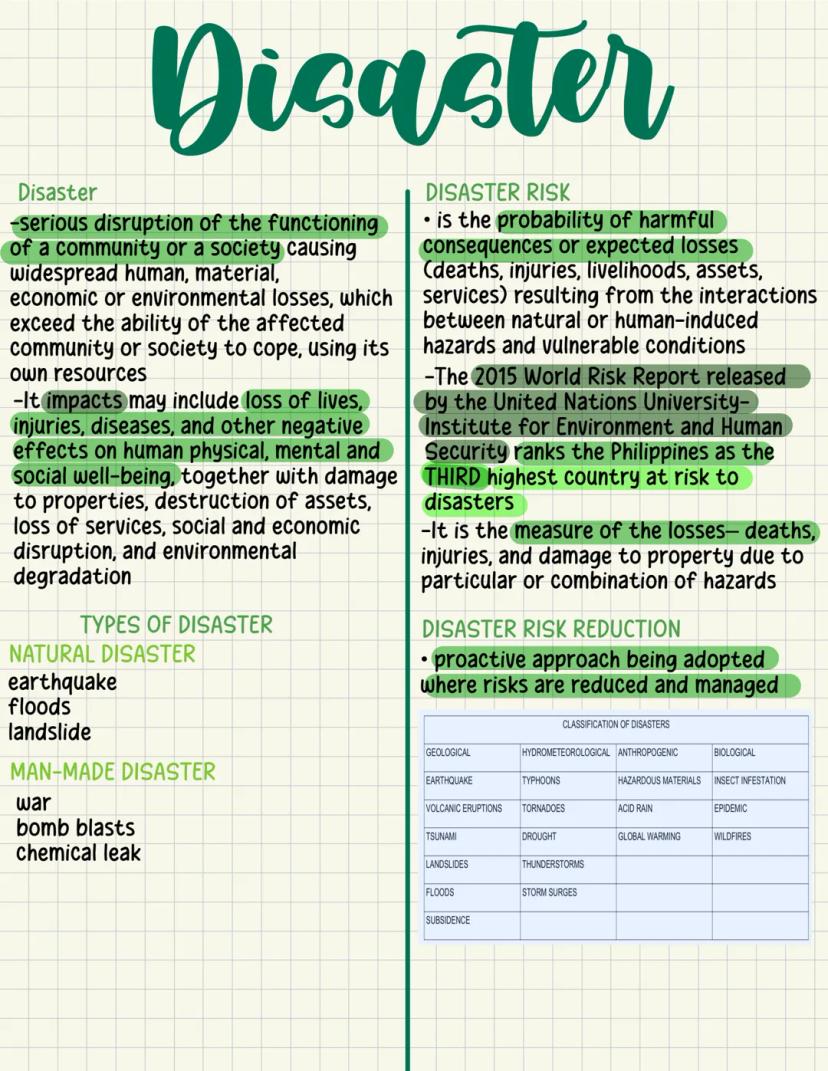










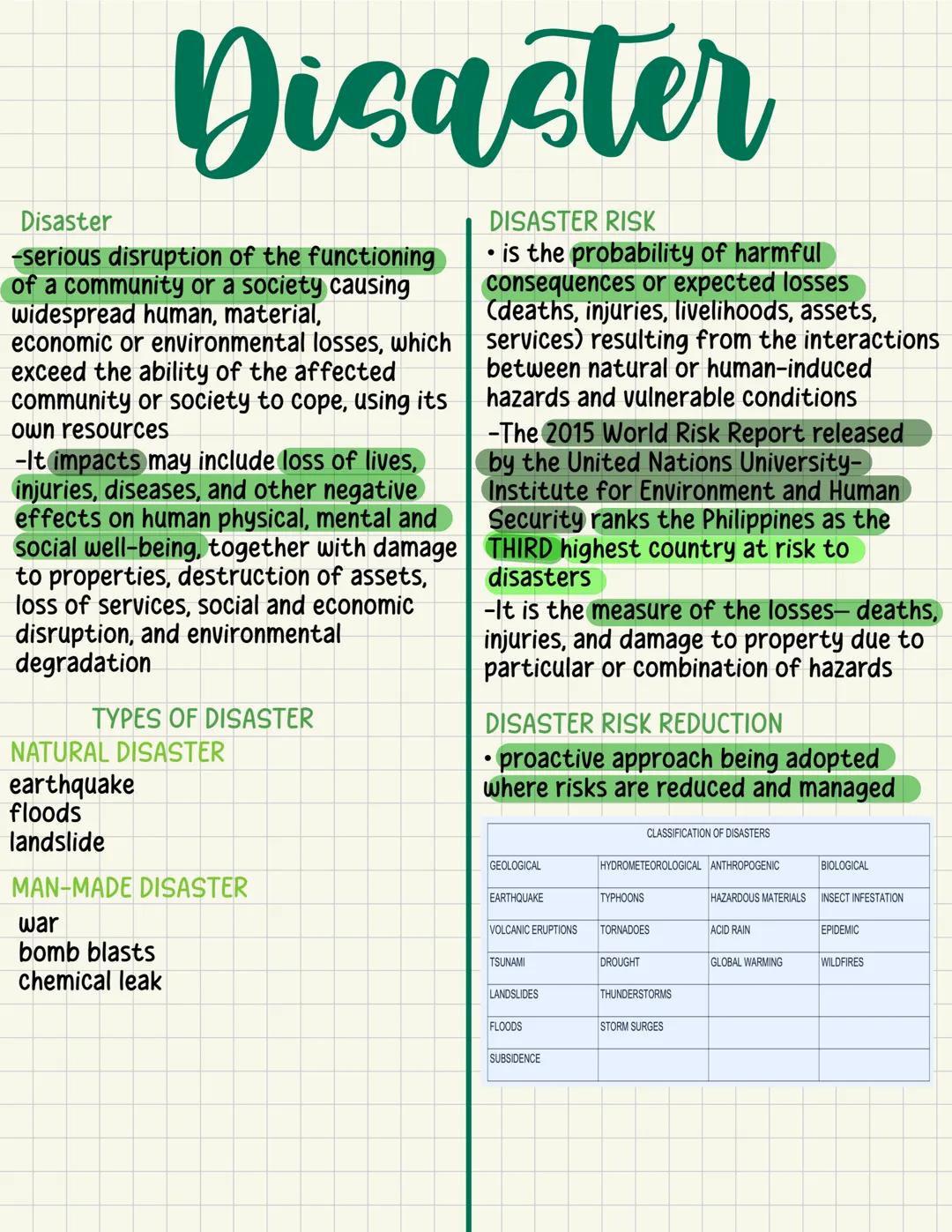
Disasters seriously disrupt communities by causing widespread losses that exceed a society's ability to cope using only its own resources. When disasters strike, they can impact everything from human health to economic stability and environmental wellbeing.
Disaster risk is the probability of harmful consequences resulting from interactions between natural or human-induced hazards and vulnerable conditions. The 2015 World Risk Report ranked the Philippines as the third highest country at risk to disasters globally, highlighting the urgency of understanding and preparing for potential threats.
Disasters can be classified into different categories based on their origin:
Natural disasters: Include geological events (earthquakes, volcanic eruptions, tsunamis), hydrometeorological events (typhoons, floods, storm surges), and biological threats (epidemics, insect infestations)
Human-induced (anthropogenic) disasters: Include technological failures, hazardous materials incidents, war, terrorism, and civil unrest
💡 Remember: Disaster Risk Reduction (DRR) uses a proactive approach where potential risks are identified, assessed, and managed before disasters happen rather than just responding after they occur.

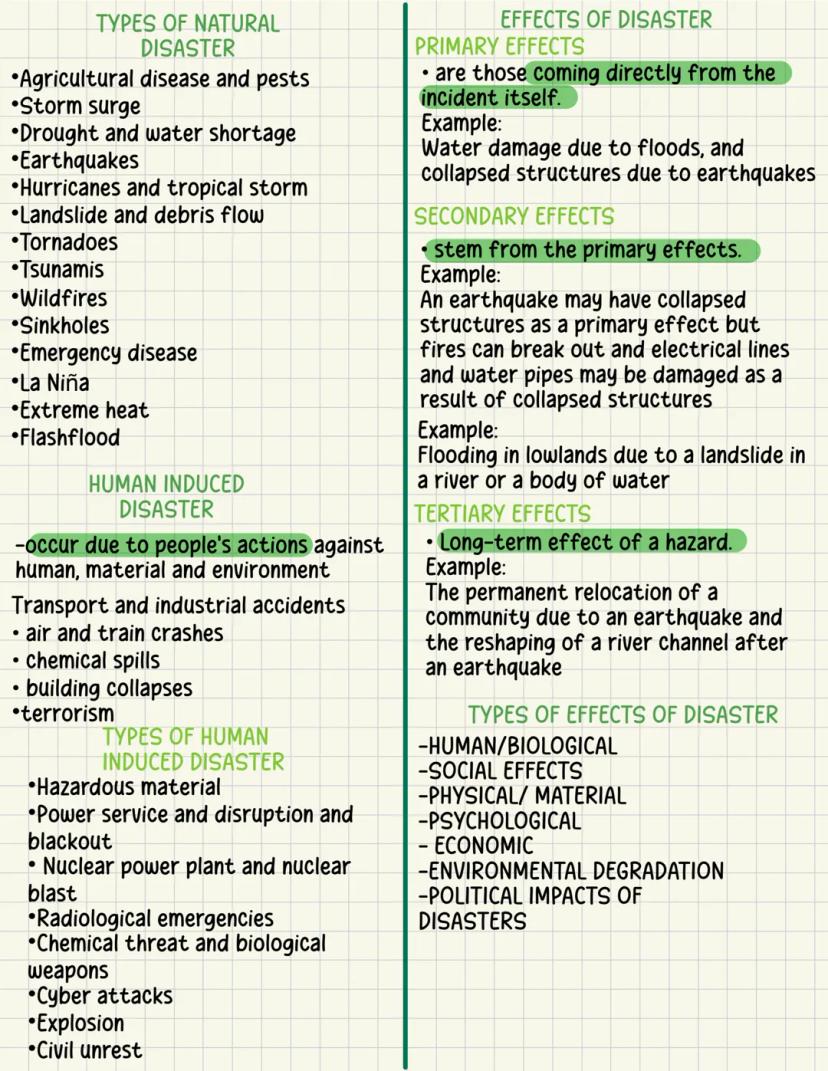
Natural disasters come in many forms and affect communities differently:
Human-induced disasters result from people's actions against humans, materials, and the environment:
The effects of disasters occur at different stages:
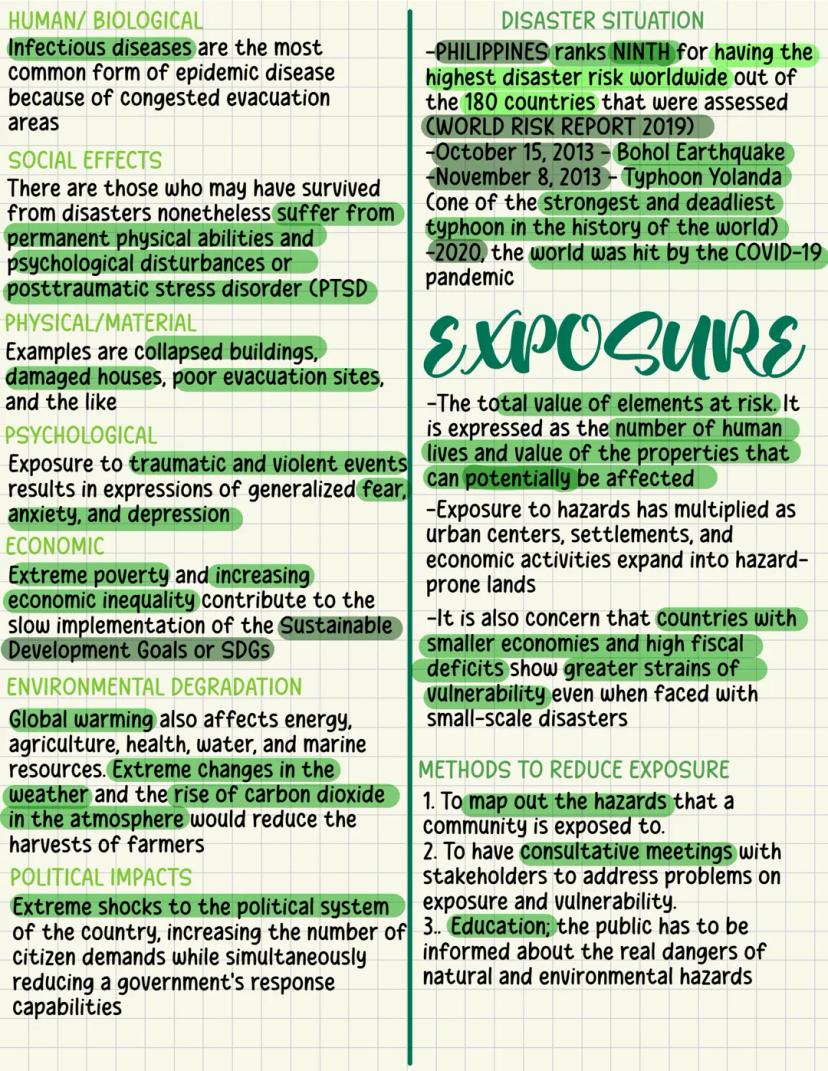
Disasters impact societies through multiple dimensions:
💡 Did you know? The Philippines ranks ninth for having the highest disaster risk worldwide out of 180 assessed countries according to the World Risk Report 2019.

Exposure refers to the total value of elements at risk—the number of lives and property value potentially affected by disasters. As urban centers and economic activities expand into hazard-prone areas, exposure increases dramatically.
Countries with smaller economies and high fiscal deficits show greater vulnerability even when faced with small-scale disasters. To reduce exposure, communities should:
Psychological impacts of disasters are significant but often overlooked. Exposure to traumatic events results in generalized fear, anxiety, and depression. Many survivors suffer from post-traumatic stress disorder (PTSD) even after physical recovery.
Environmental degradation from disasters compounds existing problems. Global warming affects energy, agriculture, health, and marine resources. Extreme weather changes and rising carbon dioxide reduce agricultural harvests, threatening food security.
The economic impacts of disasters contribute to extreme poverty and inequality, slowing the implementation of Sustainable Development Goals (SDGs). After major disasters, recovery often takes years of concentrated effort.
💡 Success Story: Albay province was one of the first in the Philippines to adopt a comprehensive disaster risk management approach. By focusing on reducing disaster risk and exposure while improving vulnerable areas, they've significantly decreased disaster impacts in their region.

Vulnerability refers to conditions that adversely affect a community's ability to prevent, mitigate, prepare for, and respond to hazards. It stems from various social, economic, physical, and environmental factors that make people susceptible to disasters.
The three main types of vulnerability are:
Physical and Environmental Vulnerability
Social Vulnerability
Economic Vulnerability
💡 Important fact: Your level of vulnerability to disasters depends not just on where you live, but also on your social status, economic resources, and access to information. Reducing vulnerability requires addressing all these dimensions.

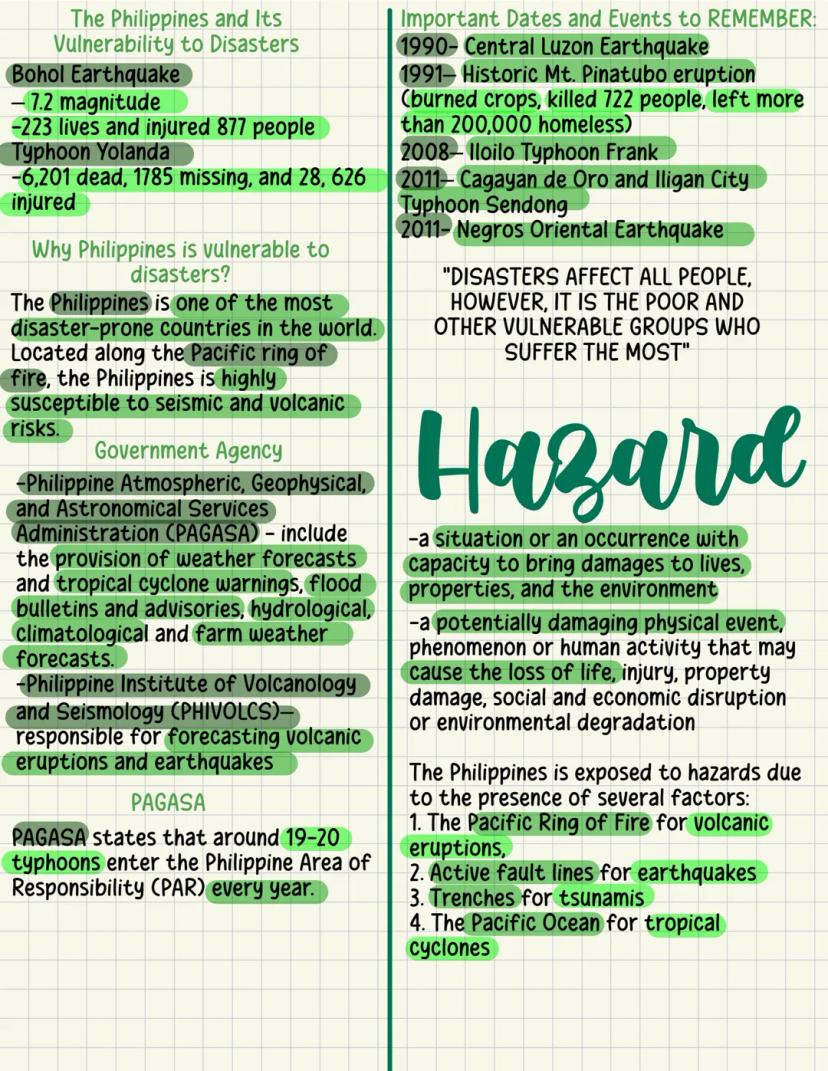
The Philippines ranks among the most disaster-prone countries in the world. Located along the Pacific Ring of Fire, the country is highly susceptible to seismic and volcanic risks. Additionally, about 19-20 typhoons enter the Philippine Area of Responsibility (PAR) annually, according to PAGASA.
Major disasters in recent Philippine history include:
Government agencies play crucial roles in disaster monitoring:
A hazard is a potentially damaging physical event, phenomenon, or human activity that may cause loss of life, injury, property damage, or environmental degradation. The Philippines faces multiple hazards due to:
💡 Remember: "Disasters affect all people; however, it is the poor and other vulnerable groups who suffer the most." This highlights why disaster preparation and education must be accessible to everyone.

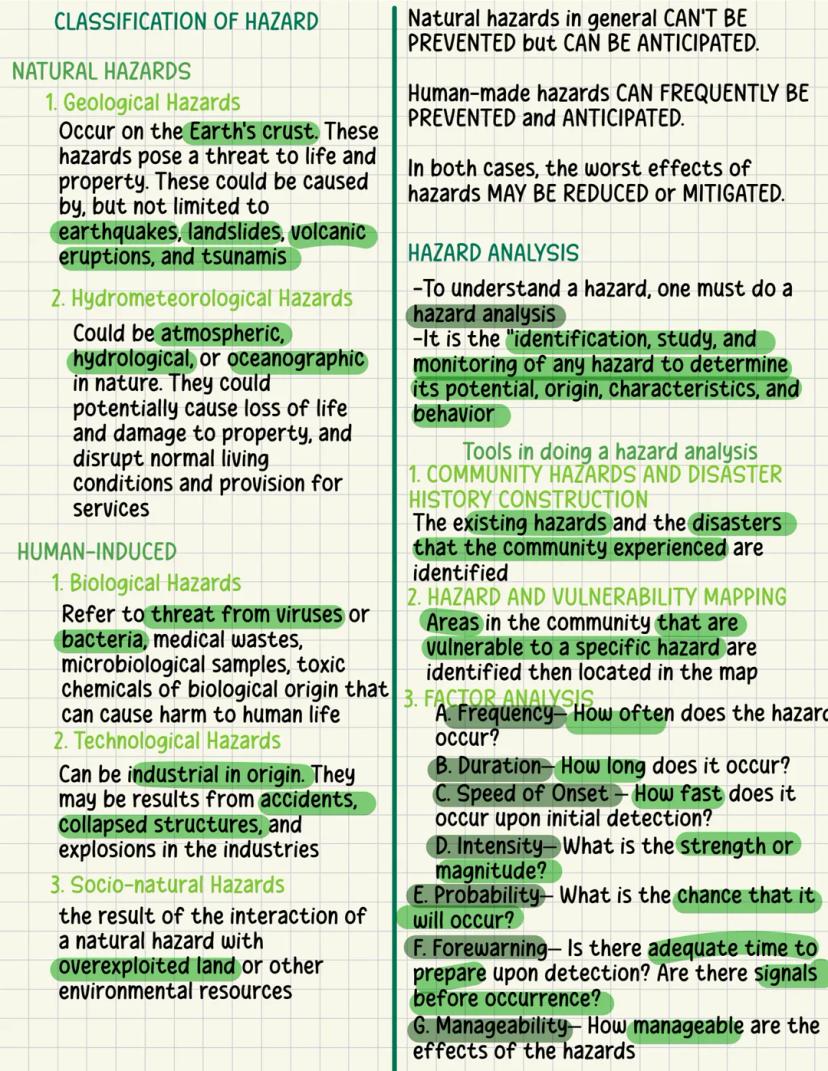
Hazards are classified into natural and human-induced categories, each with distinct characteristics and impacts.
Natural Hazards:
Geological Hazards occur within Earth's crust and pose threats to life and property, including:
Hydrometeorological Hazards are atmospheric, hydrological, or oceanographic events that can cause loss of life and damage:
Human-Induced Hazards:
Biological Hazards include threats from viruses, bacteria, medical wastes, and toxic chemicals of biological origin
Technological Hazards are industrial in origin, resulting from accidents, collapsed structures, and industrial explosions
Socio-natural Hazards result from interaction between natural hazards and overexploited environmental resources
While natural hazards generally can't be prevented but can be anticipated, human-made hazards can frequently be both prevented and anticipated. In all cases, the worst effects may be reduced or mitigated through proper planning.
Hazard analysis tools help communities understand and prepare for hazards:
💡 Pro tip: When analyzing a hazard in your community, remember to assess both its likelihood (how often it might occur) and its potential impact (how severe it could be). This helps prioritize which hazards need the most urgent attention.
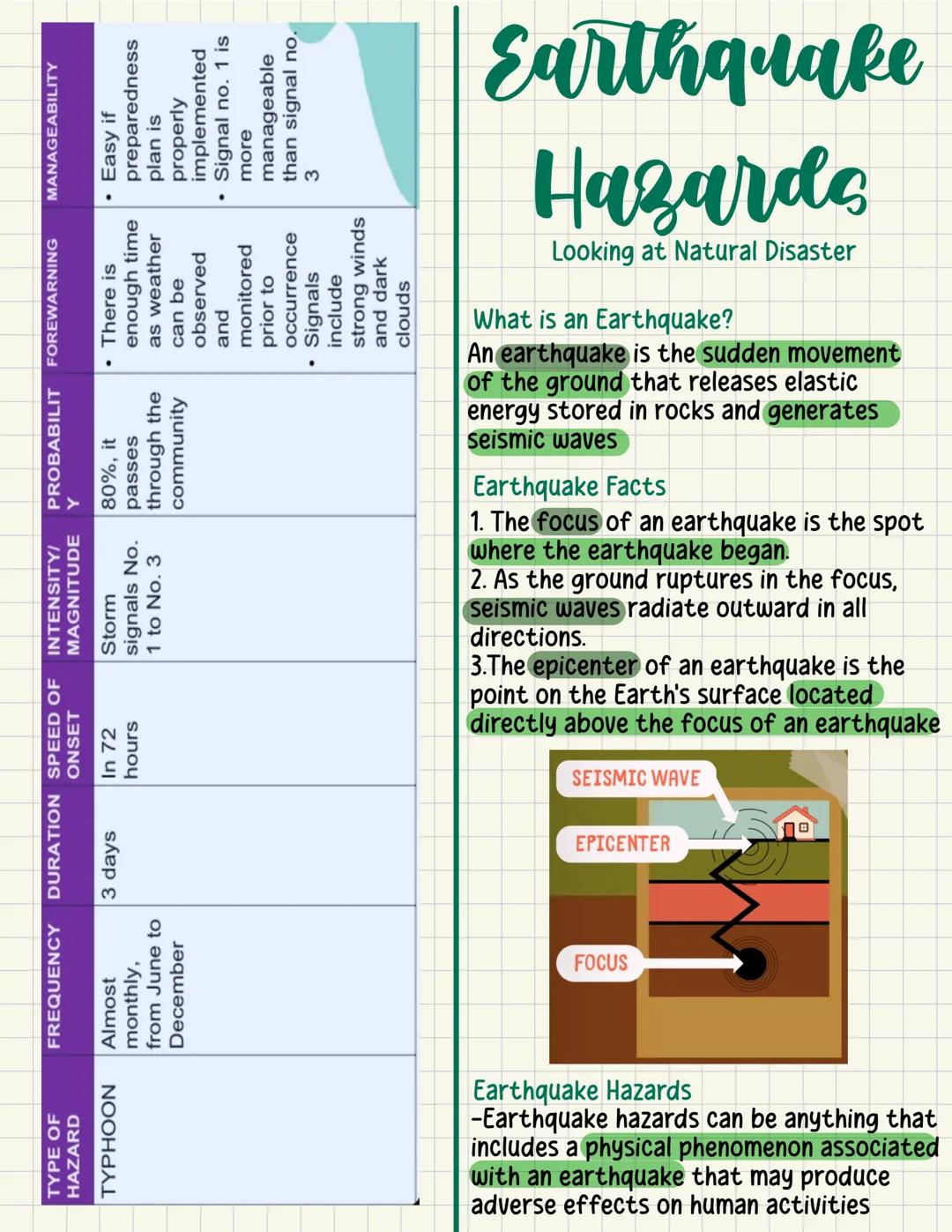
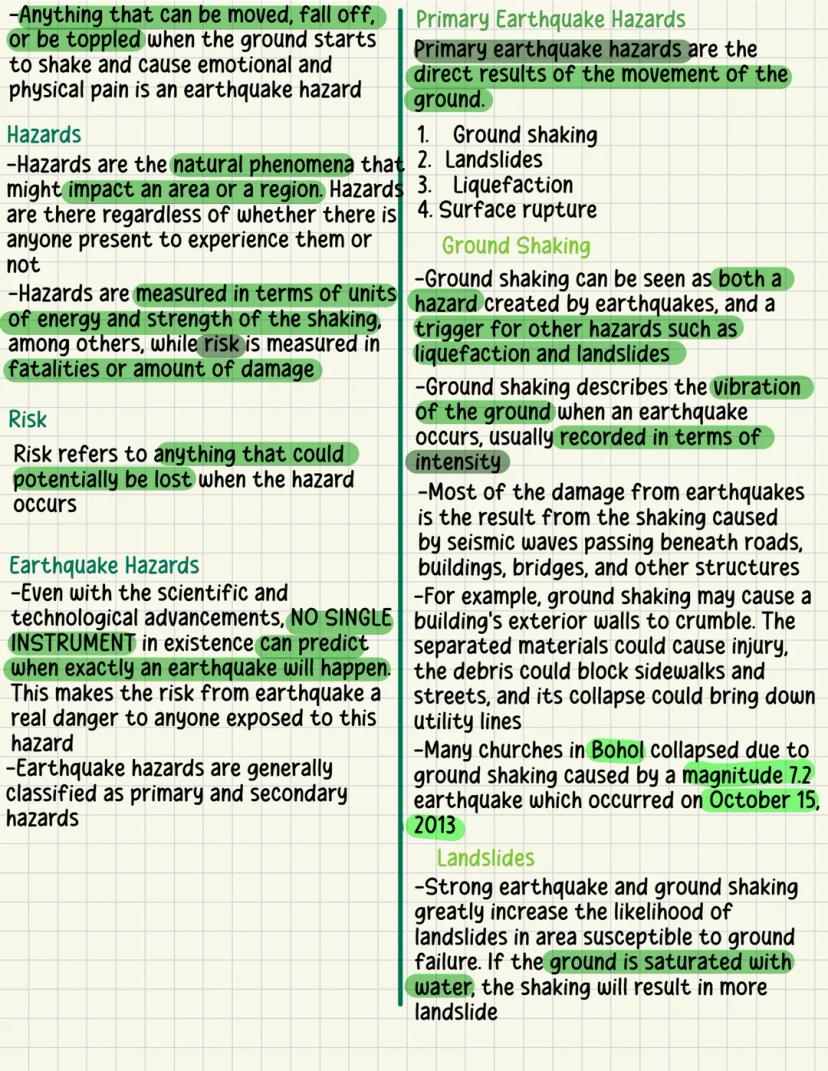
An earthquake is the sudden ground movement that releases elastic energy stored in rocks and generates seismic waves. Understanding earthquake basics can help you prepare for these unpredictable events.
Key earthquake terminology:
Earthquake hazards are physical phenomena associated with earthquakes that produce adverse effects on human activities. Essentially, anything that can move, fall, or topple when the ground shakes and cause harm is considered an earthquake hazard.
It's important to distinguish between hazards and risks:
Despite scientific advancements, no instrument can predict exactly when an earthquake will happen, making earthquake risk a real danger to those in vulnerable areas.
💡 Important distinction: A hazard is the natural event itself (like ground shaking), while risk involves the potential consequences to people and property. You can't stop an earthquake from happening, but you can reduce your risk through preparation and structural improvements.
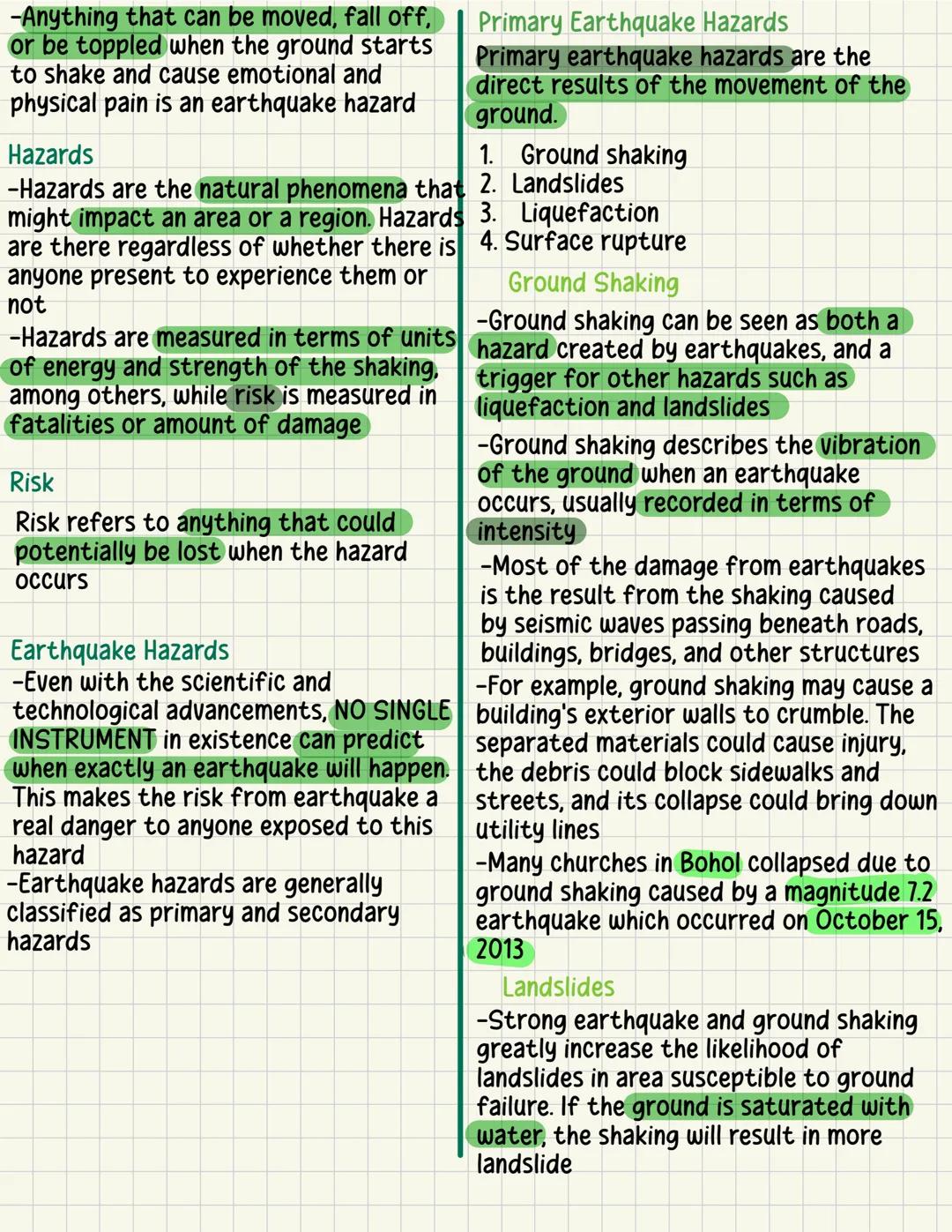
Primary earthquake hazards are the direct results of ground movement during an earthquake. Understanding these hazards helps you prepare for potential impacts.
Ground shaking is both a hazard itself and a trigger for other hazards:
Landslides become more likely during earthquakes:
Liquefaction occurs when soil and groundwater mix during moderate or strong earthquakes:
Surface rupture happens when fault movement reaches the surface:
💡 Safety tip: During an earthquake, remember to "Drop, Cover, and Hold On." Drop to the ground before the earthquake drops you, take cover under a sturdy desk or table, and hold on until the shaking stops.
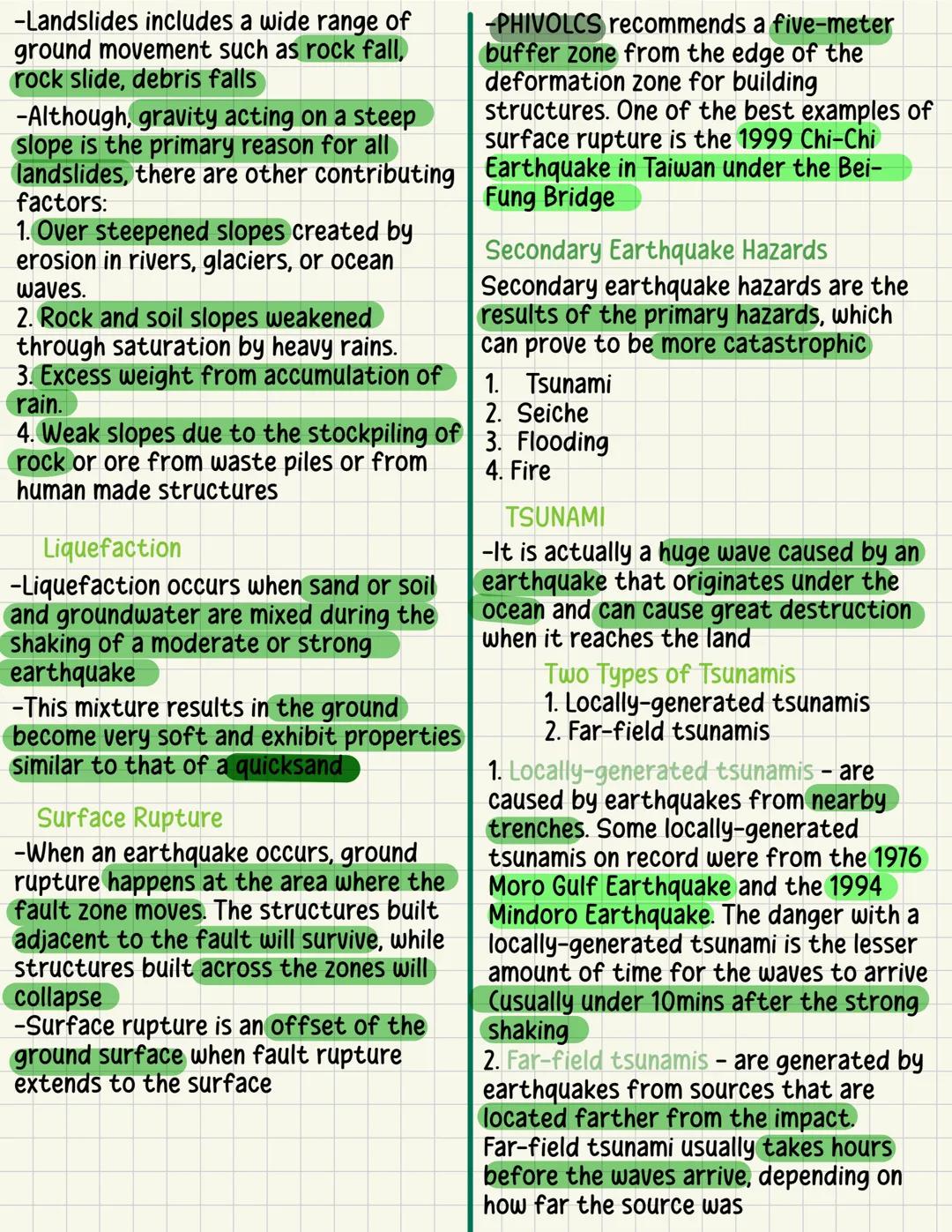
Secondary earthquake hazards result from primary hazards and can be more catastrophic than the initial earthquake. They include:
Tsunamis are huge waves caused by underwater earthquakes that can cause devastating destruction when they reach land. They come in two types:
Seiches are standing waves in enclosed or partially-enclosed bodies of water triggered by earthquake waves. They can affect:
Flooding can result from earthquakes in several ways:
Fire is a major secondary hazard following earthquakes:
💡 Tsunami safety tip: If you're near the coast and feel strong earthquake shaking, don't wait for official warnings—move immediately to higher ground or inland. Natural warning signs like unusual water recession should trigger immediate evacuation.
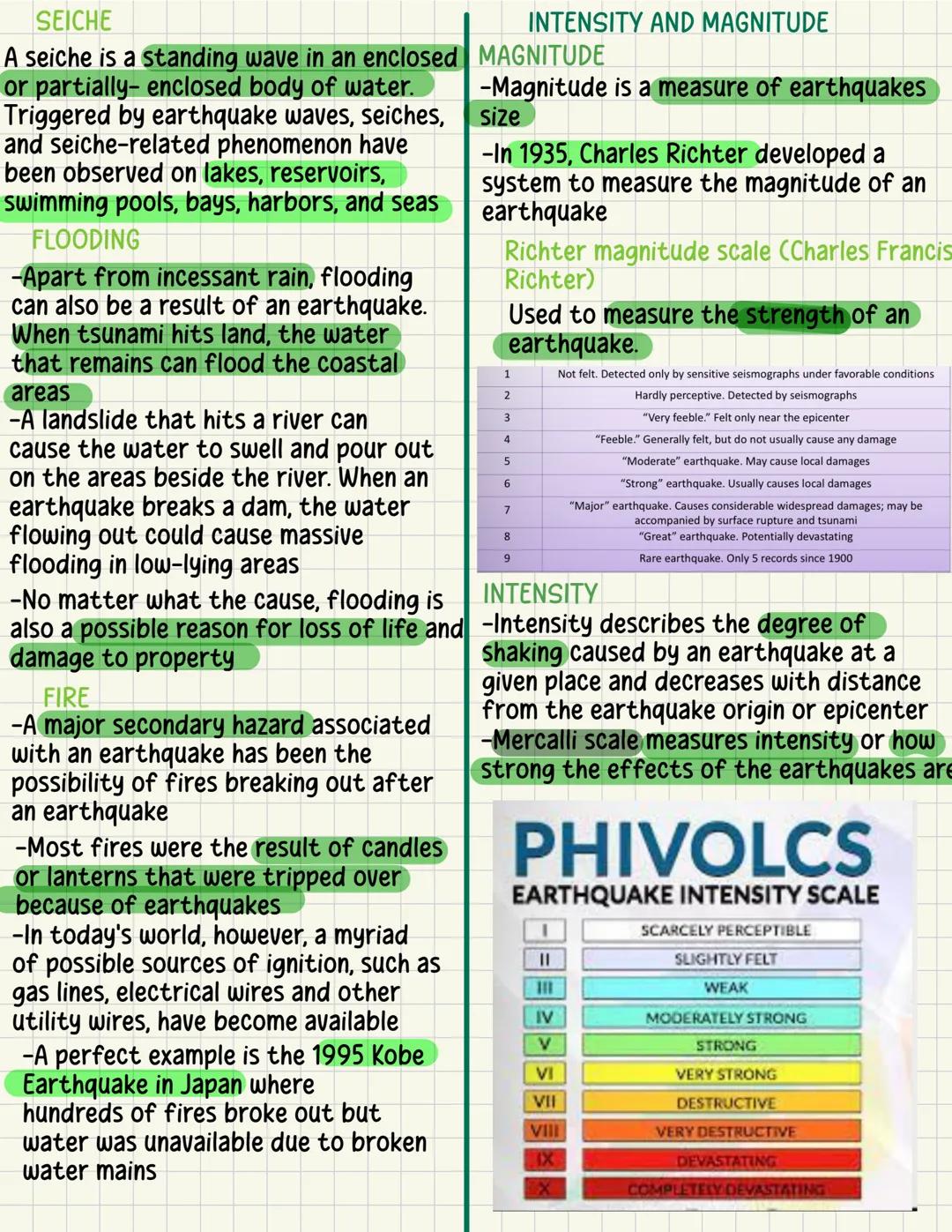
Magnitude measures an earthquake's size or energy release, while intensity describes the degree of shaking at a specific location. Understanding both helps assess earthquake impacts.
Magnitude (Richter Scale):
The Richter magnitude scale measures earthquakes from:
Intensity (PHIVOLCS Earthquake Intensity Scale):
Key intensity levels include:
💡 Understanding the difference: Think of magnitude as the size of the earthquake at its source (like wattage of a light bulb), while intensity is how strong the effects are where you are (how bright the light appears from different distances).



Ang aming AI Companion ay isang AI tool na nakatuon sa mga estudyante na nag-aalok ng higit pa sa mga sagot lang. Binuo mula sa milyong Knowunity resources, nagbibigay ito ng may-kaugnayang impormasyon, personalized na study plans, quizzes, at content direkta sa chat, na umaangkop sa iyong sariling learning journey.
Maaari mong i-download ang app mula sa Google Play Store at Apple App Store.
Tama 'yan! Mag-enjoy sa libreng access sa mga study content, makipag-connect sa kapwa mga estudyante, at kumuha ng instant na tulong – lahat nasa iyong daliri lang.
App Store
Google Play
Napakadaling gamitin at maganda ang disenyo ng app. Nahanap ko lahat ng hinahanap ko hanggang ngayon at natuto ako ng marami mula sa mga presentasyon! Tiyak na gagamitin ko ang app para sa isang takdang-aralin sa klase! At siyempre, nakakatulong din ito bilang inspirasyon.
Stefan S
gumagamit ng iOS
Sobrang ganda talaga ng app na ito. Maraming mga study notes at tulong [...]. Ang problemang subject ko ay Pranses, halimbawa, at ang app ay may maraming options para tumulong. Salamat sa app na ito, bumuti ang Pranses ko. Irerekumenda ko ito sa lahat.
Samantha Klich
Android user
Wow, talagang namangha ako. Sinubukan ko lang ang app dahil nakita ko itong ina-advertise nang maraming beses at sobrang nagulat ako. Ang app na ito ang TULONG na gusto mo para sa paaralan at higit sa lahat, nag-aalok ito ng maraming bagay, tulad ng workouts at fact sheets, na SOBRANG nakatulong sa akin.
Anna
iOS user
Pinakamagandang app sa mundo! walang masabi dahil sobrang ganda nito
Thomas R
iOS user
Napakaganda talaga. Nakakapag-review ako ng 10x mas mabuti, itong app ay mabilis na 10/10. Lubos kong inirerekomenda ito sa lahat. Pwede akong manood at maghanap ng notes. Pwede kong i-save ang mga ito sa subject folder. Pwede kong i-review anumang oras kapag bumalik ako. Kung hindi mo pa nasubukan ang app na ito, marami kang nawawala.
Basil
Android user
Ang app na ito ay nagpapalakas ng loob ko sa paghahanda sa exams, hindi lang dahil sa pagpapataas ng aking kumpiyansa sa sarili sa pamamagitan ng mga feature na nagpapahintulot sa iyo na makipag-connect sa iba at mabawasan ang pakiramdam na nag-iisa, kundi pati na rin sa paraan na nakatuon ang app sa pagpapagaan ng iyong pakiramdam. Madali itong i-navigate, masaya gamitin, at nakakatulong sa sinumang nahihirapan sa kahit anong paraan.
David K
iOS user
Sobrang galing ng app! Ilalagay ko lang ang paksa sa search bar at makakakuha na ako ng sagot kaagad. Hindi ko kailangang manood ng 10 YouTube videos para maintindihan ang isang bagay, kaya nakakatipid ako ng oras. Lubos na inirerekomenda!
Sudenaz Ocak
Android user
Sa paaralan, napakahina ko sa math pero salamat sa app, mas mahusay na ako ngayon. Lubos akong nagpapasalamat na ginawa niyo ang app na ito.
Greenlight Bonnie
Android user
napakareliable na app para tumulong at palawakin ang iyong mga ideya sa Math, English at iba pang mga related na paksa sa iyong mga gawain. gamitin mo ang app na ito kung nahihirapan ka sa mga area, susi ito para diyan. sana nag-review na ako dati. at libre rin ito kaya huwag mag-alala tungkol diyan.
Rohan U
Android user
Alam kong maraming apps gumagamit ng fake accounts para mapataas ang kanilang reviews pero ang app na ito ay deserve lahat ng papuri. Dati nakakakuha ako ng 4 sa aking English exams at ngayon nakakuha ako ng grade 7. Hindi ko pa alam ang app na ito tatlong araw bago ang exam at nakatulong ito ng SOBRA. Pakisuyong maniwala sa akin at gamitin ito dahil sigurado akong makikita mo rin ang mga pagbabago.
Xander S
iOS user
ANG MGA quiz AT flashcard SOBRANG HELPFUL AT I LOVE TALAGA SI Knowunity AI. PARANG CHATGPT LANG PERO MAS MATALINO!! NAKATULONG DIN SA MGA MASCARA PROBLEMS KO!! PATI NA RIN SA MGA TUNAY KONG subject! SYEMPRE 😍😁😲🤑💗✨🎀😮
Elisha
iOS user
Grabe talaga ang app na to. Sobrang nakakaboring sakin ang pagreview pero ginagawa ng app na to na sobrang dali mag-organize ng lahat at pwede mong tanungin ang libreng ai para subukin ang sarili mo kaya sobrang buti at madali mong ma-upload ang sarili mong mga bagay. highly recommend bilang isang taong nagte-take ng mocks ngayon
Paul T
iOS user
Napakadaling gamitin at maganda ang disenyo ng app. Nahanap ko lahat ng hinahanap ko hanggang ngayon at natuto ako ng marami mula sa mga presentasyon! Tiyak na gagamitin ko ang app para sa isang takdang-aralin sa klase! At siyempre, nakakatulong din ito bilang inspirasyon.
Stefan S
gumagamit ng iOS
Sobrang ganda talaga ng app na ito. Maraming mga study notes at tulong [...]. Ang problemang subject ko ay Pranses, halimbawa, at ang app ay may maraming options para tumulong. Salamat sa app na ito, bumuti ang Pranses ko. Irerekumenda ko ito sa lahat.
Samantha Klich
Android user
Wow, talagang namangha ako. Sinubukan ko lang ang app dahil nakita ko itong ina-advertise nang maraming beses at sobrang nagulat ako. Ang app na ito ang TULONG na gusto mo para sa paaralan at higit sa lahat, nag-aalok ito ng maraming bagay, tulad ng workouts at fact sheets, na SOBRANG nakatulong sa akin.
Anna
iOS user
Pinakamagandang app sa mundo! walang masabi dahil sobrang ganda nito
Thomas R
iOS user
Napakaganda talaga. Nakakapag-review ako ng 10x mas mabuti, itong app ay mabilis na 10/10. Lubos kong inirerekomenda ito sa lahat. Pwede akong manood at maghanap ng notes. Pwede kong i-save ang mga ito sa subject folder. Pwede kong i-review anumang oras kapag bumalik ako. Kung hindi mo pa nasubukan ang app na ito, marami kang nawawala.
Basil
Android user
Ang app na ito ay nagpapalakas ng loob ko sa paghahanda sa exams, hindi lang dahil sa pagpapataas ng aking kumpiyansa sa sarili sa pamamagitan ng mga feature na nagpapahintulot sa iyo na makipag-connect sa iba at mabawasan ang pakiramdam na nag-iisa, kundi pati na rin sa paraan na nakatuon ang app sa pagpapagaan ng iyong pakiramdam. Madali itong i-navigate, masaya gamitin, at nakakatulong sa sinumang nahihirapan sa kahit anong paraan.
David K
iOS user
Sobrang galing ng app! Ilalagay ko lang ang paksa sa search bar at makakakuha na ako ng sagot kaagad. Hindi ko kailangang manood ng 10 YouTube videos para maintindihan ang isang bagay, kaya nakakatipid ako ng oras. Lubos na inirerekomenda!
Sudenaz Ocak
Android user
Sa paaralan, napakahina ko sa math pero salamat sa app, mas mahusay na ako ngayon. Lubos akong nagpapasalamat na ginawa niyo ang app na ito.
Greenlight Bonnie
Android user
napakareliable na app para tumulong at palawakin ang iyong mga ideya sa Math, English at iba pang mga related na paksa sa iyong mga gawain. gamitin mo ang app na ito kung nahihirapan ka sa mga area, susi ito para diyan. sana nag-review na ako dati. at libre rin ito kaya huwag mag-alala tungkol diyan.
Rohan U
Android user
Alam kong maraming apps gumagamit ng fake accounts para mapataas ang kanilang reviews pero ang app na ito ay deserve lahat ng papuri. Dati nakakakuha ako ng 4 sa aking English exams at ngayon nakakuha ako ng grade 7. Hindi ko pa alam ang app na ito tatlong araw bago ang exam at nakatulong ito ng SOBRA. Pakisuyong maniwala sa akin at gamitin ito dahil sigurado akong makikita mo rin ang mga pagbabago.
Xander S
iOS user
ANG MGA quiz AT flashcard SOBRANG HELPFUL AT I LOVE TALAGA SI Knowunity AI. PARANG CHATGPT LANG PERO MAS MATALINO!! NAKATULONG DIN SA MGA MASCARA PROBLEMS KO!! PATI NA RIN SA MGA TUNAY KONG subject! SYEMPRE 😍😁😲🤑💗✨🎀😮
Elisha
iOS user
Grabe talaga ang app na to. Sobrang nakakaboring sakin ang pagreview pero ginagawa ng app na to na sobrang dali mag-organize ng lahat at pwede mong tanungin ang libreng ai para subukin ang sarili mo kaya sobrang buti at madali mong ma-upload ang sarili mong mga bagay. highly recommend bilang isang taong nagte-take ng mocks ngayon
Paul T
iOS user
Karen Gella
@cayennexxx
Disasters are serious disruptions that cause widespread human, material, and environmental losses beyond a community's ability to cope using its own resources. Understanding disaster risks and implementing preparedness strategies can significantly reduce impacts, which may include loss of lives, injuries,... Ipakita pa
Access sa lahat ng dokumento
Pagbutihin ang iyong mga grado
Sumali sa milyong mga estudyante
Disasters seriously disrupt communities by causing widespread losses that exceed a society's ability to cope using only its own resources. When disasters strike, they can impact everything from human health to economic stability and environmental wellbeing.
Disaster risk is the probability of harmful consequences resulting from interactions between natural or human-induced hazards and vulnerable conditions. The 2015 World Risk Report ranked the Philippines as the third highest country at risk to disasters globally, highlighting the urgency of understanding and preparing for potential threats.
Disasters can be classified into different categories based on their origin:
Natural disasters: Include geological events (earthquakes, volcanic eruptions, tsunamis), hydrometeorological events (typhoons, floods, storm surges), and biological threats (epidemics, insect infestations)
Human-induced (anthropogenic) disasters: Include technological failures, hazardous materials incidents, war, terrorism, and civil unrest
💡 Remember: Disaster Risk Reduction (DRR) uses a proactive approach where potential risks are identified, assessed, and managed before disasters happen rather than just responding after they occur.
Access sa lahat ng dokumento
Pagbutihin ang iyong mga grado
Sumali sa milyong mga estudyante
Natural disasters come in many forms and affect communities differently:
Human-induced disasters result from people's actions against humans, materials, and the environment:
The effects of disasters occur at different stages:
Disasters impact societies through multiple dimensions:
💡 Did you know? The Philippines ranks ninth for having the highest disaster risk worldwide out of 180 assessed countries according to the World Risk Report 2019.
Access sa lahat ng dokumento
Pagbutihin ang iyong mga grado
Sumali sa milyong mga estudyante
Exposure refers to the total value of elements at risk—the number of lives and property value potentially affected by disasters. As urban centers and economic activities expand into hazard-prone areas, exposure increases dramatically.
Countries with smaller economies and high fiscal deficits show greater vulnerability even when faced with small-scale disasters. To reduce exposure, communities should:
Psychological impacts of disasters are significant but often overlooked. Exposure to traumatic events results in generalized fear, anxiety, and depression. Many survivors suffer from post-traumatic stress disorder (PTSD) even after physical recovery.
Environmental degradation from disasters compounds existing problems. Global warming affects energy, agriculture, health, and marine resources. Extreme weather changes and rising carbon dioxide reduce agricultural harvests, threatening food security.
The economic impacts of disasters contribute to extreme poverty and inequality, slowing the implementation of Sustainable Development Goals (SDGs). After major disasters, recovery often takes years of concentrated effort.
💡 Success Story: Albay province was one of the first in the Philippines to adopt a comprehensive disaster risk management approach. By focusing on reducing disaster risk and exposure while improving vulnerable areas, they've significantly decreased disaster impacts in their region.
Access sa lahat ng dokumento
Pagbutihin ang iyong mga grado
Sumali sa milyong mga estudyante
Vulnerability refers to conditions that adversely affect a community's ability to prevent, mitigate, prepare for, and respond to hazards. It stems from various social, economic, physical, and environmental factors that make people susceptible to disasters.
The three main types of vulnerability are:
Physical and Environmental Vulnerability
Social Vulnerability
Economic Vulnerability
💡 Important fact: Your level of vulnerability to disasters depends not just on where you live, but also on your social status, economic resources, and access to information. Reducing vulnerability requires addressing all these dimensions.
Access sa lahat ng dokumento
Pagbutihin ang iyong mga grado
Sumali sa milyong mga estudyante
The Philippines ranks among the most disaster-prone countries in the world. Located along the Pacific Ring of Fire, the country is highly susceptible to seismic and volcanic risks. Additionally, about 19-20 typhoons enter the Philippine Area of Responsibility (PAR) annually, according to PAGASA.
Major disasters in recent Philippine history include:
Government agencies play crucial roles in disaster monitoring:
A hazard is a potentially damaging physical event, phenomenon, or human activity that may cause loss of life, injury, property damage, or environmental degradation. The Philippines faces multiple hazards due to:
💡 Remember: "Disasters affect all people; however, it is the poor and other vulnerable groups who suffer the most." This highlights why disaster preparation and education must be accessible to everyone.
Access sa lahat ng dokumento
Pagbutihin ang iyong mga grado
Sumali sa milyong mga estudyante
Hazards are classified into natural and human-induced categories, each with distinct characteristics and impacts.
Natural Hazards:
Geological Hazards occur within Earth's crust and pose threats to life and property, including:
Hydrometeorological Hazards are atmospheric, hydrological, or oceanographic events that can cause loss of life and damage:
Human-Induced Hazards:
Biological Hazards include threats from viruses, bacteria, medical wastes, and toxic chemicals of biological origin
Technological Hazards are industrial in origin, resulting from accidents, collapsed structures, and industrial explosions
Socio-natural Hazards result from interaction between natural hazards and overexploited environmental resources
While natural hazards generally can't be prevented but can be anticipated, human-made hazards can frequently be both prevented and anticipated. In all cases, the worst effects may be reduced or mitigated through proper planning.
Hazard analysis tools help communities understand and prepare for hazards:
💡 Pro tip: When analyzing a hazard in your community, remember to assess both its likelihood (how often it might occur) and its potential impact (how severe it could be). This helps prioritize which hazards need the most urgent attention.
Access sa lahat ng dokumento
Pagbutihin ang iyong mga grado
Sumali sa milyong mga estudyante
An earthquake is the sudden ground movement that releases elastic energy stored in rocks and generates seismic waves. Understanding earthquake basics can help you prepare for these unpredictable events.
Key earthquake terminology:
Earthquake hazards are physical phenomena associated with earthquakes that produce adverse effects on human activities. Essentially, anything that can move, fall, or topple when the ground shakes and cause harm is considered an earthquake hazard.
It's important to distinguish between hazards and risks:
Despite scientific advancements, no instrument can predict exactly when an earthquake will happen, making earthquake risk a real danger to those in vulnerable areas.
💡 Important distinction: A hazard is the natural event itself (like ground shaking), while risk involves the potential consequences to people and property. You can't stop an earthquake from happening, but you can reduce your risk through preparation and structural improvements.
Access sa lahat ng dokumento
Pagbutihin ang iyong mga grado
Sumali sa milyong mga estudyante
Primary earthquake hazards are the direct results of ground movement during an earthquake. Understanding these hazards helps you prepare for potential impacts.
Ground shaking is both a hazard itself and a trigger for other hazards:
Landslides become more likely during earthquakes:
Liquefaction occurs when soil and groundwater mix during moderate or strong earthquakes:
Surface rupture happens when fault movement reaches the surface:
💡 Safety tip: During an earthquake, remember to "Drop, Cover, and Hold On." Drop to the ground before the earthquake drops you, take cover under a sturdy desk or table, and hold on until the shaking stops.
Access sa lahat ng dokumento
Pagbutihin ang iyong mga grado
Sumali sa milyong mga estudyante
Secondary earthquake hazards result from primary hazards and can be more catastrophic than the initial earthquake. They include:
Tsunamis are huge waves caused by underwater earthquakes that can cause devastating destruction when they reach land. They come in two types:
Seiches are standing waves in enclosed or partially-enclosed bodies of water triggered by earthquake waves. They can affect:
Flooding can result from earthquakes in several ways:
Fire is a major secondary hazard following earthquakes:
💡 Tsunami safety tip: If you're near the coast and feel strong earthquake shaking, don't wait for official warnings—move immediately to higher ground or inland. Natural warning signs like unusual water recession should trigger immediate evacuation.
Access sa lahat ng dokumento
Pagbutihin ang iyong mga grado
Sumali sa milyong mga estudyante
Magnitude measures an earthquake's size or energy release, while intensity describes the degree of shaking at a specific location. Understanding both helps assess earthquake impacts.
Magnitude (Richter Scale):
The Richter magnitude scale measures earthquakes from:
Intensity (PHIVOLCS Earthquake Intensity Scale):
Key intensity levels include:
💡 Understanding the difference: Think of magnitude as the size of the earthquake at its source (like wattage of a light bulb), while intensity is how strong the effects are where you are (how bright the light appears from different distances).
Access sa lahat ng dokumento
Pagbutihin ang iyong mga grado
Sumali sa milyong mga estudyante
Access sa lahat ng dokumento
Pagbutihin ang iyong mga grado
Sumali sa milyong mga estudyante
Access sa lahat ng dokumento
Pagbutihin ang iyong mga grado
Sumali sa milyong mga estudyante
Access sa lahat ng dokumento
Pagbutihin ang iyong mga grado
Sumali sa milyong mga estudyante
Access sa lahat ng dokumento
Pagbutihin ang iyong mga grado
Sumali sa milyong mga estudyante
Access sa lahat ng dokumento
Pagbutihin ang iyong mga grado
Sumali sa milyong mga estudyante
Access sa lahat ng dokumento
Pagbutihin ang iyong mga grado
Sumali sa milyong mga estudyante
Access sa lahat ng dokumento
Pagbutihin ang iyong mga grado
Sumali sa milyong mga estudyante
Access sa lahat ng dokumento
Pagbutihin ang iyong mga grado
Sumali sa milyong mga estudyante
Access sa lahat ng dokumento
Pagbutihin ang iyong mga grado
Sumali sa milyong mga estudyante
Access sa lahat ng dokumento
Pagbutihin ang iyong mga grado
Sumali sa milyong mga estudyante
Access sa lahat ng dokumento
Pagbutihin ang iyong mga grado
Sumali sa milyong mga estudyante
Access sa lahat ng dokumento
Pagbutihin ang iyong mga grado
Sumali sa milyong mga estudyante
Access sa lahat ng dokumento
Pagbutihin ang iyong mga grado
Sumali sa milyong mga estudyante
Access sa lahat ng dokumento
Pagbutihin ang iyong mga grado
Sumali sa milyong mga estudyante
Access sa lahat ng dokumento
Pagbutihin ang iyong mga grado
Sumali sa milyong mga estudyante
Access sa lahat ng dokumento
Pagbutihin ang iyong mga grado
Sumali sa milyong mga estudyante
Access sa lahat ng dokumento
Pagbutihin ang iyong mga grado
Sumali sa milyong mga estudyante
Ang aming AI Companion ay isang AI tool na nakatuon sa mga estudyante na nag-aalok ng higit pa sa mga sagot lang. Binuo mula sa milyong Knowunity resources, nagbibigay ito ng may-kaugnayang impormasyon, personalized na study plans, quizzes, at content direkta sa chat, na umaangkop sa iyong sariling learning journey.
Maaari mong i-download ang app mula sa Google Play Store at Apple App Store.
Tama 'yan! Mag-enjoy sa libreng access sa mga study content, makipag-connect sa kapwa mga estudyante, at kumuha ng instant na tulong – lahat nasa iyong daliri lang.
5
Smart Tools NEW
I-transform ang note na ito sa: ✓ 50+ Practice Questions ✓ Interactive Flashcards ✓ Full Mock Exam ✓ Essay Outlines
App Store
Google Play
Napakadaling gamitin at maganda ang disenyo ng app. Nahanap ko lahat ng hinahanap ko hanggang ngayon at natuto ako ng marami mula sa mga presentasyon! Tiyak na gagamitin ko ang app para sa isang takdang-aralin sa klase! At siyempre, nakakatulong din ito bilang inspirasyon.
Stefan S
gumagamit ng iOS
Sobrang ganda talaga ng app na ito. Maraming mga study notes at tulong [...]. Ang problemang subject ko ay Pranses, halimbawa, at ang app ay may maraming options para tumulong. Salamat sa app na ito, bumuti ang Pranses ko. Irerekumenda ko ito sa lahat.
Samantha Klich
Android user
Wow, talagang namangha ako. Sinubukan ko lang ang app dahil nakita ko itong ina-advertise nang maraming beses at sobrang nagulat ako. Ang app na ito ang TULONG na gusto mo para sa paaralan at higit sa lahat, nag-aalok ito ng maraming bagay, tulad ng workouts at fact sheets, na SOBRANG nakatulong sa akin.
Anna
iOS user
Pinakamagandang app sa mundo! walang masabi dahil sobrang ganda nito
Thomas R
iOS user
Napakaganda talaga. Nakakapag-review ako ng 10x mas mabuti, itong app ay mabilis na 10/10. Lubos kong inirerekomenda ito sa lahat. Pwede akong manood at maghanap ng notes. Pwede kong i-save ang mga ito sa subject folder. Pwede kong i-review anumang oras kapag bumalik ako. Kung hindi mo pa nasubukan ang app na ito, marami kang nawawala.
Basil
Android user
Ang app na ito ay nagpapalakas ng loob ko sa paghahanda sa exams, hindi lang dahil sa pagpapataas ng aking kumpiyansa sa sarili sa pamamagitan ng mga feature na nagpapahintulot sa iyo na makipag-connect sa iba at mabawasan ang pakiramdam na nag-iisa, kundi pati na rin sa paraan na nakatuon ang app sa pagpapagaan ng iyong pakiramdam. Madali itong i-navigate, masaya gamitin, at nakakatulong sa sinumang nahihirapan sa kahit anong paraan.
David K
iOS user
Sobrang galing ng app! Ilalagay ko lang ang paksa sa search bar at makakakuha na ako ng sagot kaagad. Hindi ko kailangang manood ng 10 YouTube videos para maintindihan ang isang bagay, kaya nakakatipid ako ng oras. Lubos na inirerekomenda!
Sudenaz Ocak
Android user
Sa paaralan, napakahina ko sa math pero salamat sa app, mas mahusay na ako ngayon. Lubos akong nagpapasalamat na ginawa niyo ang app na ito.
Greenlight Bonnie
Android user
napakareliable na app para tumulong at palawakin ang iyong mga ideya sa Math, English at iba pang mga related na paksa sa iyong mga gawain. gamitin mo ang app na ito kung nahihirapan ka sa mga area, susi ito para diyan. sana nag-review na ako dati. at libre rin ito kaya huwag mag-alala tungkol diyan.
Rohan U
Android user
Alam kong maraming apps gumagamit ng fake accounts para mapataas ang kanilang reviews pero ang app na ito ay deserve lahat ng papuri. Dati nakakakuha ako ng 4 sa aking English exams at ngayon nakakuha ako ng grade 7. Hindi ko pa alam ang app na ito tatlong araw bago ang exam at nakatulong ito ng SOBRA. Pakisuyong maniwala sa akin at gamitin ito dahil sigurado akong makikita mo rin ang mga pagbabago.
Xander S
iOS user
ANG MGA quiz AT flashcard SOBRANG HELPFUL AT I LOVE TALAGA SI Knowunity AI. PARANG CHATGPT LANG PERO MAS MATALINO!! NAKATULONG DIN SA MGA MASCARA PROBLEMS KO!! PATI NA RIN SA MGA TUNAY KONG subject! SYEMPRE 😍😁😲🤑💗✨🎀😮
Elisha
iOS user
Grabe talaga ang app na to. Sobrang nakakaboring sakin ang pagreview pero ginagawa ng app na to na sobrang dali mag-organize ng lahat at pwede mong tanungin ang libreng ai para subukin ang sarili mo kaya sobrang buti at madali mong ma-upload ang sarili mong mga bagay. highly recommend bilang isang taong nagte-take ng mocks ngayon
Paul T
iOS user
Napakadaling gamitin at maganda ang disenyo ng app. Nahanap ko lahat ng hinahanap ko hanggang ngayon at natuto ako ng marami mula sa mga presentasyon! Tiyak na gagamitin ko ang app para sa isang takdang-aralin sa klase! At siyempre, nakakatulong din ito bilang inspirasyon.
Stefan S
gumagamit ng iOS
Sobrang ganda talaga ng app na ito. Maraming mga study notes at tulong [...]. Ang problemang subject ko ay Pranses, halimbawa, at ang app ay may maraming options para tumulong. Salamat sa app na ito, bumuti ang Pranses ko. Irerekumenda ko ito sa lahat.
Samantha Klich
Android user
Wow, talagang namangha ako. Sinubukan ko lang ang app dahil nakita ko itong ina-advertise nang maraming beses at sobrang nagulat ako. Ang app na ito ang TULONG na gusto mo para sa paaralan at higit sa lahat, nag-aalok ito ng maraming bagay, tulad ng workouts at fact sheets, na SOBRANG nakatulong sa akin.
Anna
iOS user
Pinakamagandang app sa mundo! walang masabi dahil sobrang ganda nito
Thomas R
iOS user
Napakaganda talaga. Nakakapag-review ako ng 10x mas mabuti, itong app ay mabilis na 10/10. Lubos kong inirerekomenda ito sa lahat. Pwede akong manood at maghanap ng notes. Pwede kong i-save ang mga ito sa subject folder. Pwede kong i-review anumang oras kapag bumalik ako. Kung hindi mo pa nasubukan ang app na ito, marami kang nawawala.
Basil
Android user
Ang app na ito ay nagpapalakas ng loob ko sa paghahanda sa exams, hindi lang dahil sa pagpapataas ng aking kumpiyansa sa sarili sa pamamagitan ng mga feature na nagpapahintulot sa iyo na makipag-connect sa iba at mabawasan ang pakiramdam na nag-iisa, kundi pati na rin sa paraan na nakatuon ang app sa pagpapagaan ng iyong pakiramdam. Madali itong i-navigate, masaya gamitin, at nakakatulong sa sinumang nahihirapan sa kahit anong paraan.
David K
iOS user
Sobrang galing ng app! Ilalagay ko lang ang paksa sa search bar at makakakuha na ako ng sagot kaagad. Hindi ko kailangang manood ng 10 YouTube videos para maintindihan ang isang bagay, kaya nakakatipid ako ng oras. Lubos na inirerekomenda!
Sudenaz Ocak
Android user
Sa paaralan, napakahina ko sa math pero salamat sa app, mas mahusay na ako ngayon. Lubos akong nagpapasalamat na ginawa niyo ang app na ito.
Greenlight Bonnie
Android user
napakareliable na app para tumulong at palawakin ang iyong mga ideya sa Math, English at iba pang mga related na paksa sa iyong mga gawain. gamitin mo ang app na ito kung nahihirapan ka sa mga area, susi ito para diyan. sana nag-review na ako dati. at libre rin ito kaya huwag mag-alala tungkol diyan.
Rohan U
Android user
Alam kong maraming apps gumagamit ng fake accounts para mapataas ang kanilang reviews pero ang app na ito ay deserve lahat ng papuri. Dati nakakakuha ako ng 4 sa aking English exams at ngayon nakakuha ako ng grade 7. Hindi ko pa alam ang app na ito tatlong araw bago ang exam at nakatulong ito ng SOBRA. Pakisuyong maniwala sa akin at gamitin ito dahil sigurado akong makikita mo rin ang mga pagbabago.
Xander S
iOS user
ANG MGA quiz AT flashcard SOBRANG HELPFUL AT I LOVE TALAGA SI Knowunity AI. PARANG CHATGPT LANG PERO MAS MATALINO!! NAKATULONG DIN SA MGA MASCARA PROBLEMS KO!! PATI NA RIN SA MGA TUNAY KONG subject! SYEMPRE 😍😁😲🤑💗✨🎀😮
Elisha
iOS user
Grabe talaga ang app na to. Sobrang nakakaboring sakin ang pagreview pero ginagawa ng app na to na sobrang dali mag-organize ng lahat at pwede mong tanungin ang libreng ai para subukin ang sarili mo kaya sobrang buti at madali mong ma-upload ang sarili mong mga bagay. highly recommend bilang isang taong nagte-take ng mocks ngayon
Paul T
iOS user