
Ever wondered what actually makes something alive? It's trickier than... Ipakita pa
 Biology8 views·Na-update Jun 14, 2026·7 mga pahina
The Key Characteristics of Living Things
1 / 7
1
of 7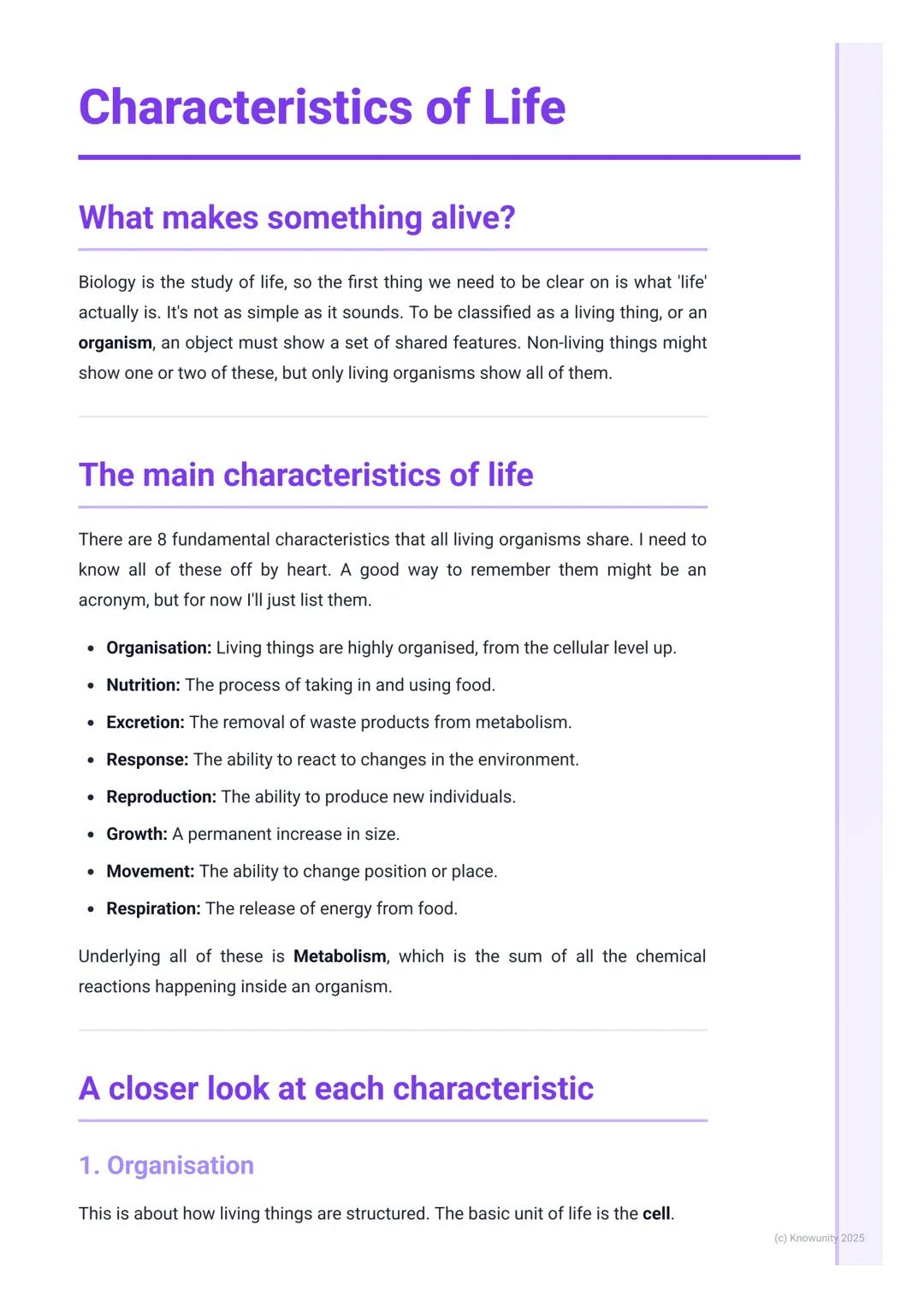
What Makes Something Alive?
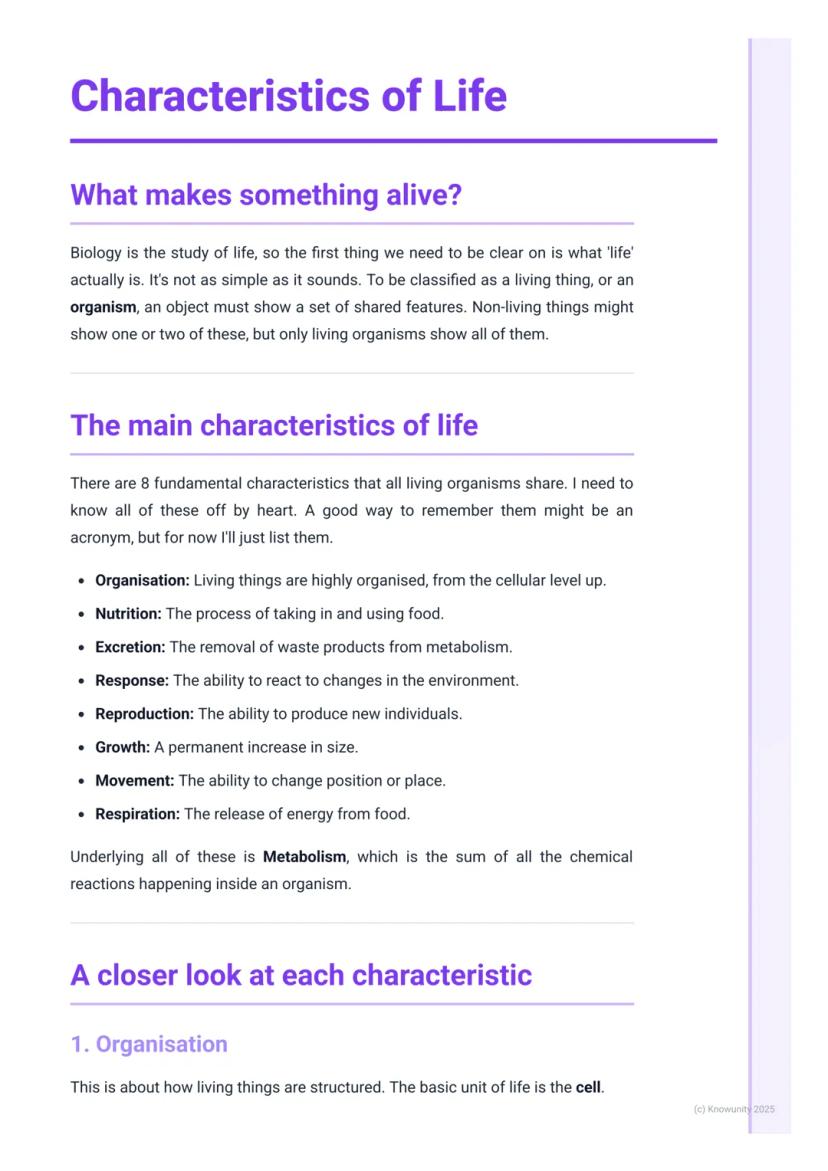
You might think it's obvious what's alive and what isn't, but biology has strict rules about this. To be classified as a living organism, something must show all 8 fundamental characteristics - not just one or two.
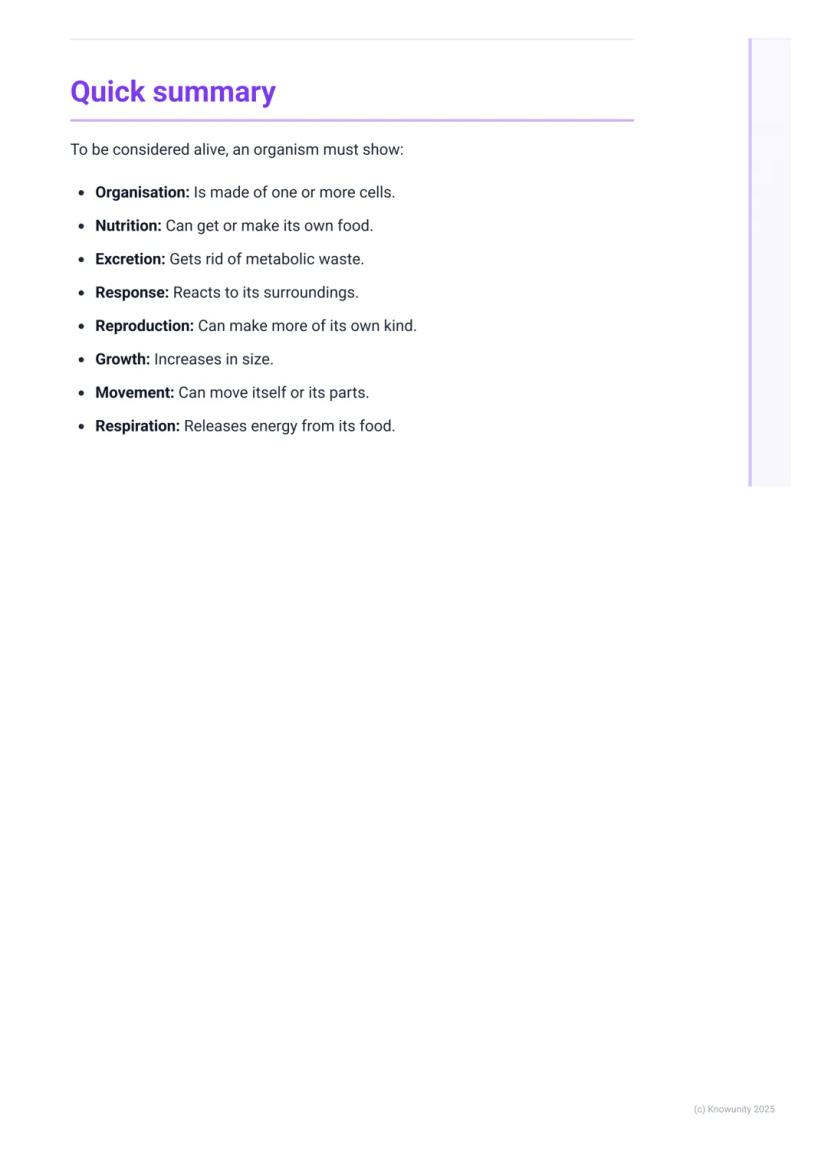
Here's the complete list you need to memorise: Organisation, Nutrition, Excretion, Response, Reproduction, Growth, Movement, and Respiration. Think of these as biology's checklist for life.
Metabolism underlies all of these - it's basically the sum of all chemical reactions happening inside an organism. Without metabolism, none of the other characteristics work properly.
Quick Tip: Create your own acronym using the first letters to help remember all eight characteristics!
2
of 7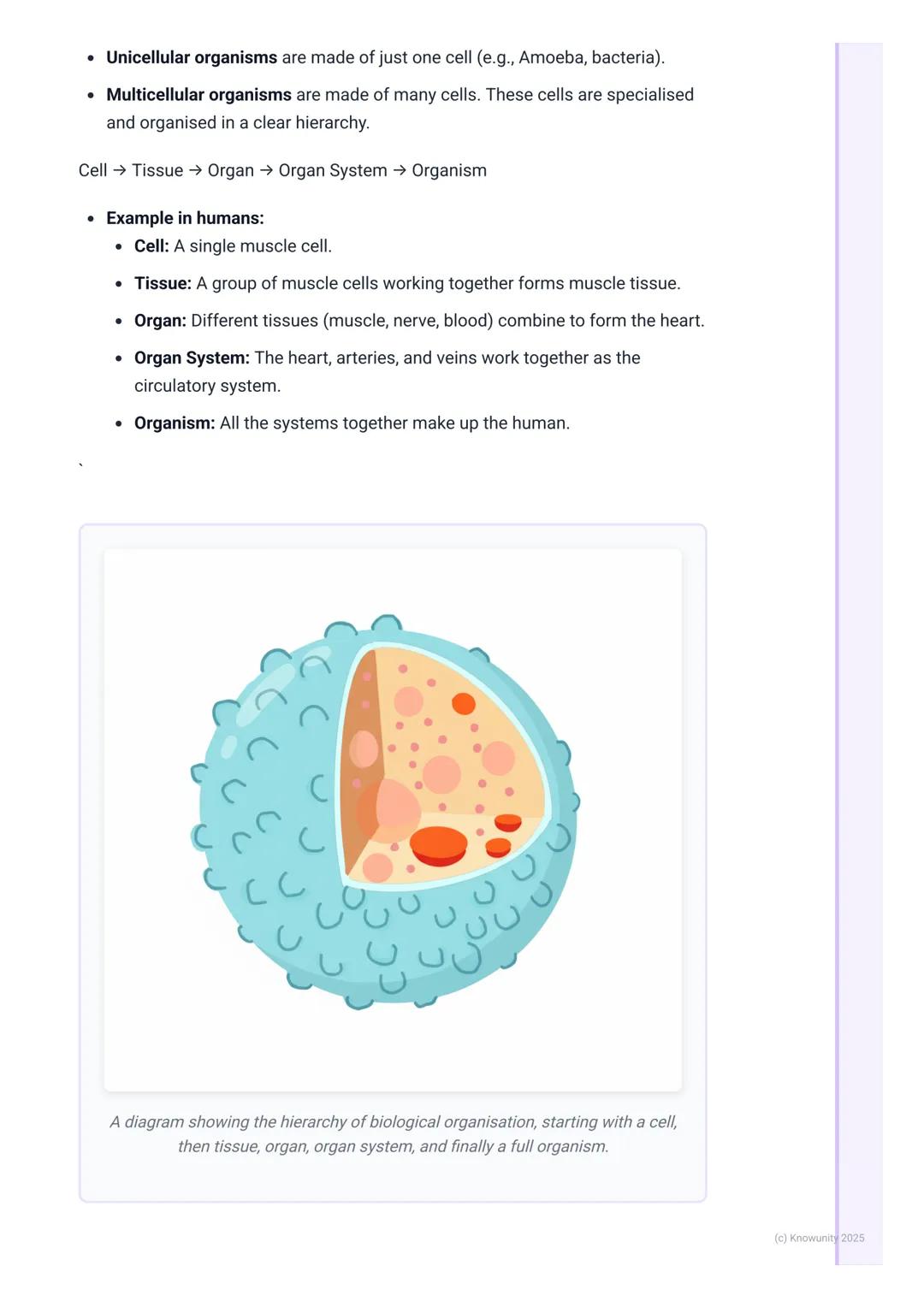
Organisation: How Life is Structured
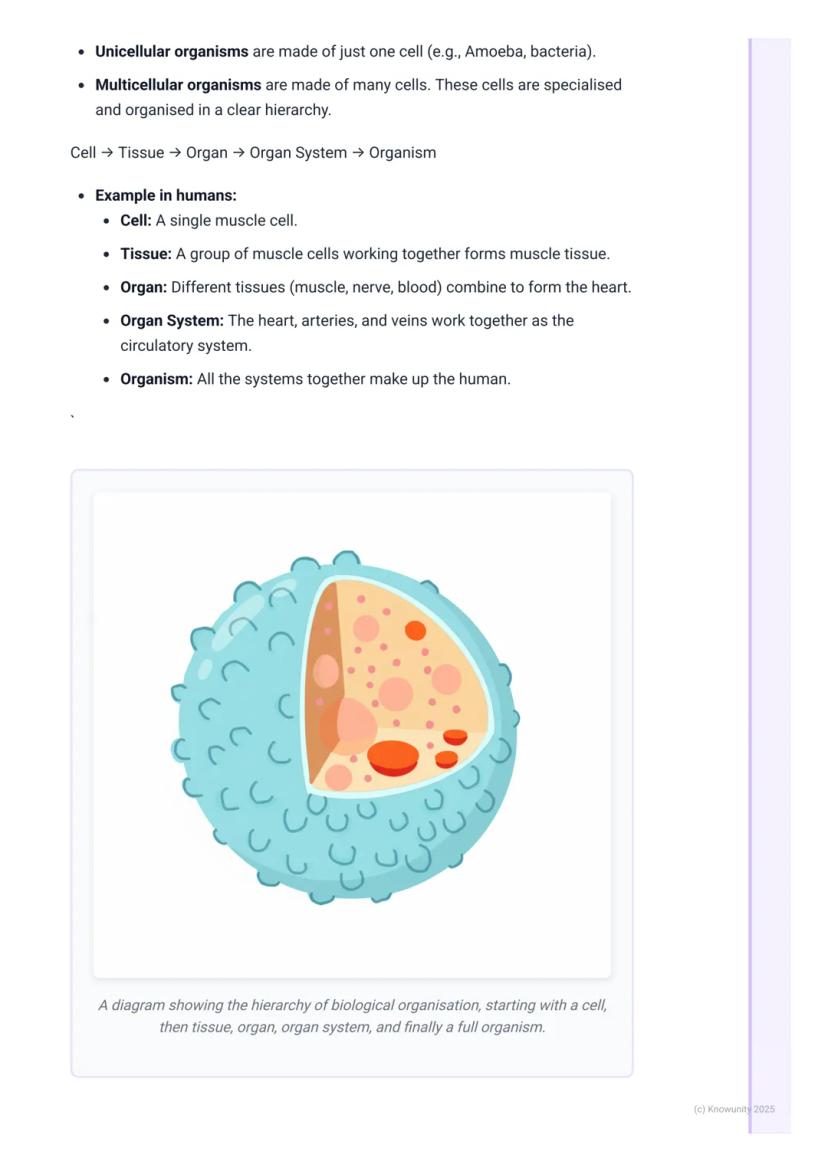
Living things aren't just random collections of stuff - they're incredibly organised. The cell is the basic unit of all life, and from there, things get more complex.
Unicellular organisms (like bacteria) are made of just one cell that does everything. Multicellular organisms (like you!) are made of millions of specialised cells organised in a clear hierarchy.
The hierarchy goes: Cell → Tissue → Organ → Organ System → Organism. Think of it like this: your individual muscle cells group together to form muscle tissue, which combines with other tissues to create your heart, which works with blood vessels to form your circulatory system.
Real-World Connection: Your body is like a perfectly organised city where every cell has a specific job and knows exactly where it belongs!
3
of 7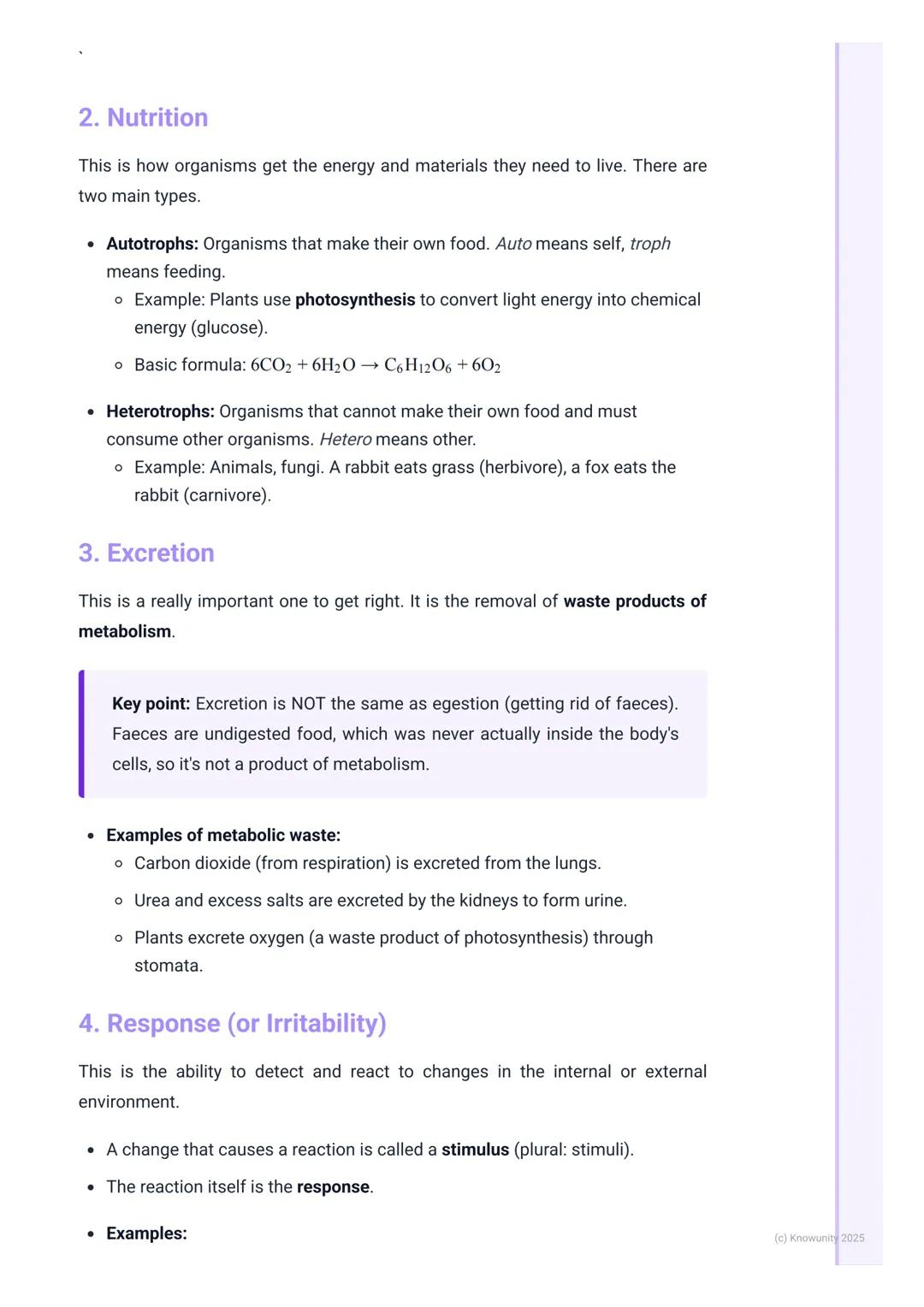
Nutrition: Getting Energy to Survive
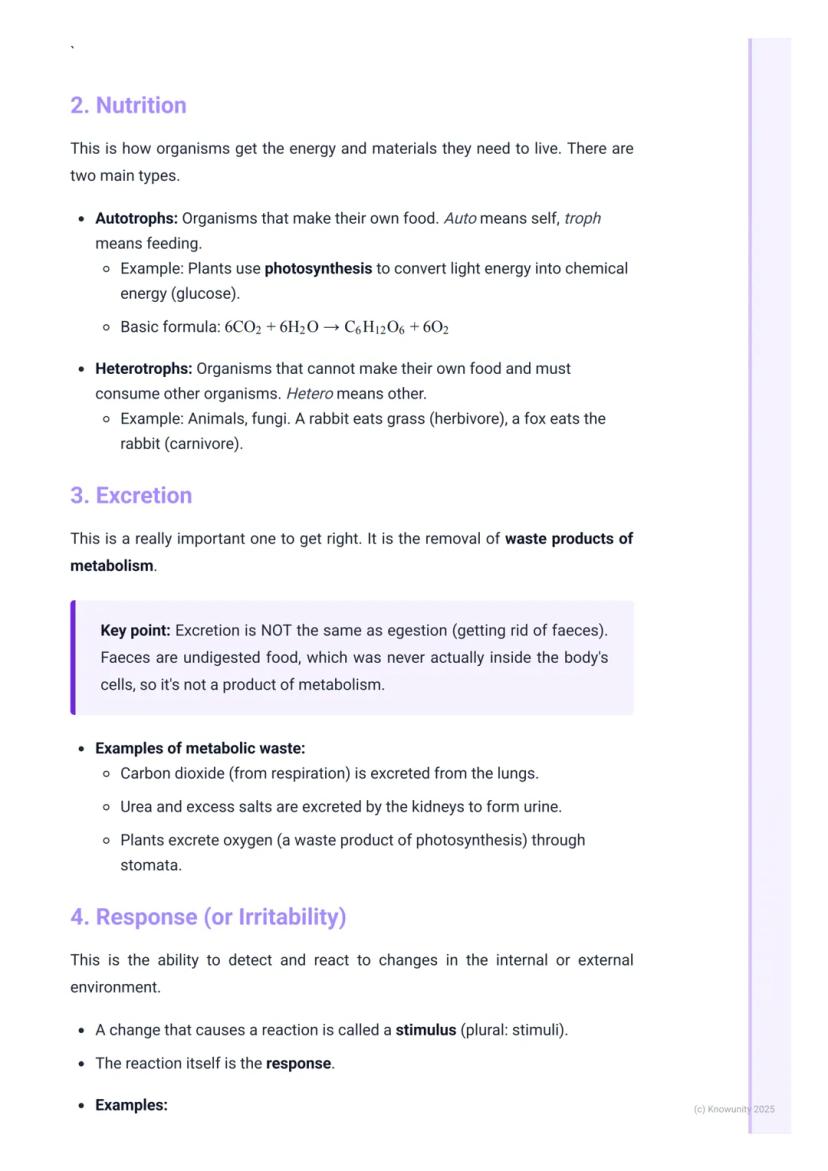
All living things need energy and materials to keep going, but they get them in different ways. Autotrophs (like plants) are the ultimate self-sufficient organisms - they make their own food through photosynthesis.
Heterotrophs (like animals and fungi) can't make their own food, so they have to consume other organisms. That rabbit munching grass? It's a heterotroph getting energy from an autotroph.
The basic photosynthesis equation you need to know is: 6CO₂ + 6H₂O → C₆H₁₂O₆ + 6O₂. Plants literally turn carbon dioxide and water into sugar using sunlight - pretty amazing stuff!
Exam Tip: Remember "auto" means self and "hetero" means other - this makes the terms much easier to remember!
4
of 7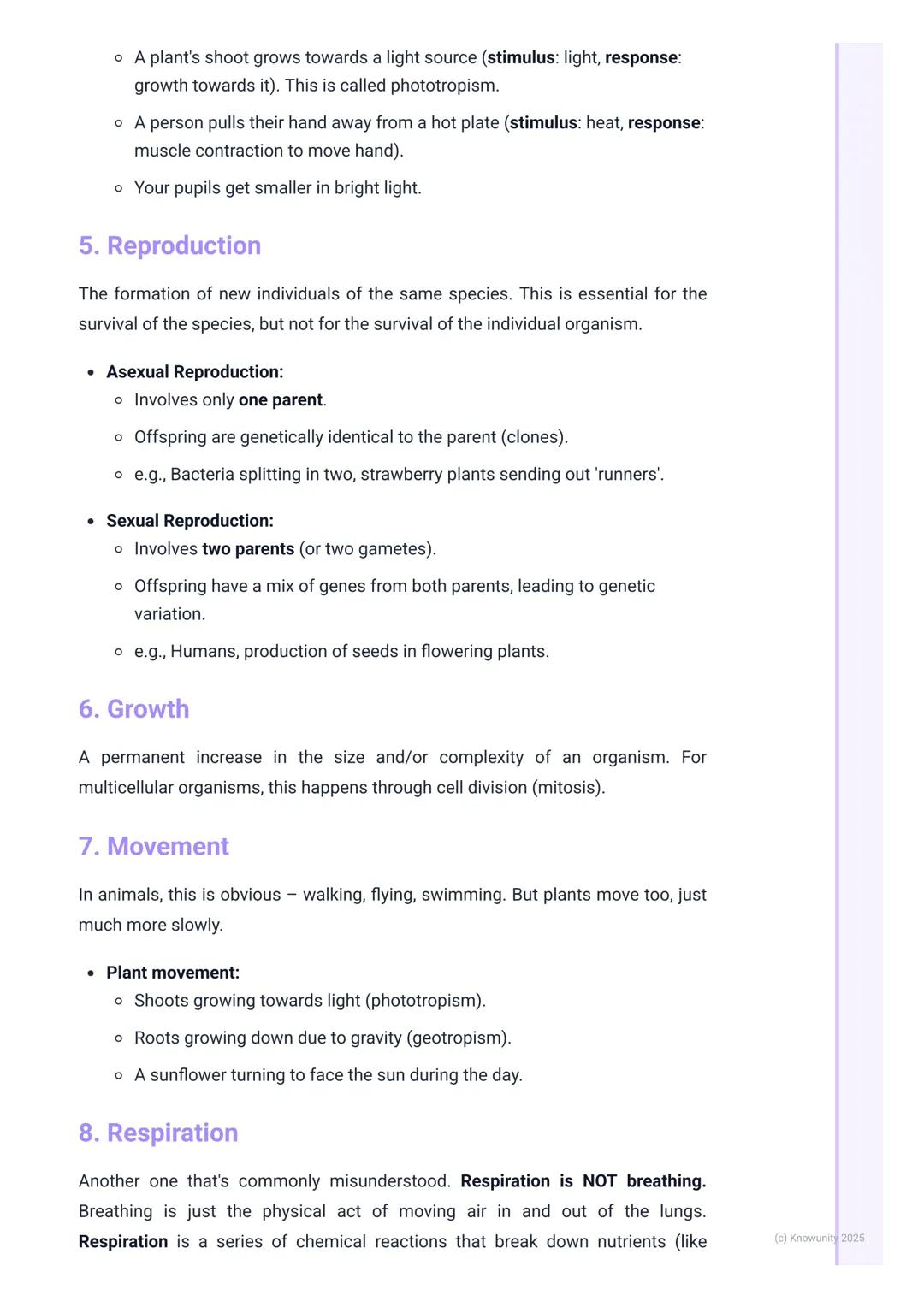
Excretion: Getting Rid of Waste
Here's where loads of students get confused - excretion is NOT the same as egestion. Excretion is removing waste products that come from metabolism inside your cells.
When you breathe out carbon dioxide or wee out urea, that's excretion - these are actual waste products from chemical reactions in your body. But when you go to the toilet to get rid of undigested food, that's egestion, not excretion.
Plants excrete too! They get rid of oxygen (a waste product of photosynthesis) through their stomata. One organism's waste is often another's treasure.
Don't Get Caught: Never say faeces are an example of excretion - that's egestion and will lose you marks!
5
of 7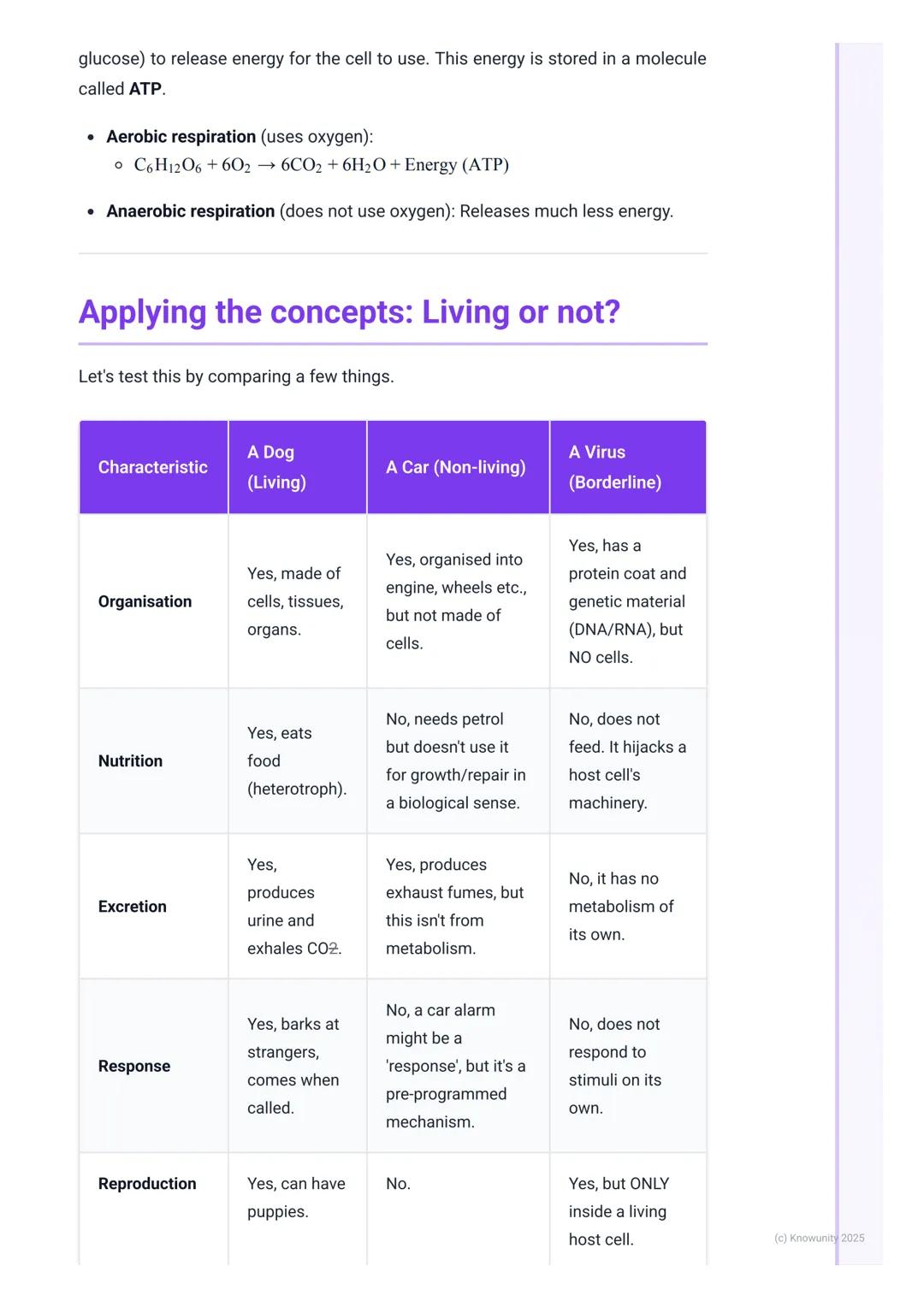
Response and Reproduction: Reacting and Creating
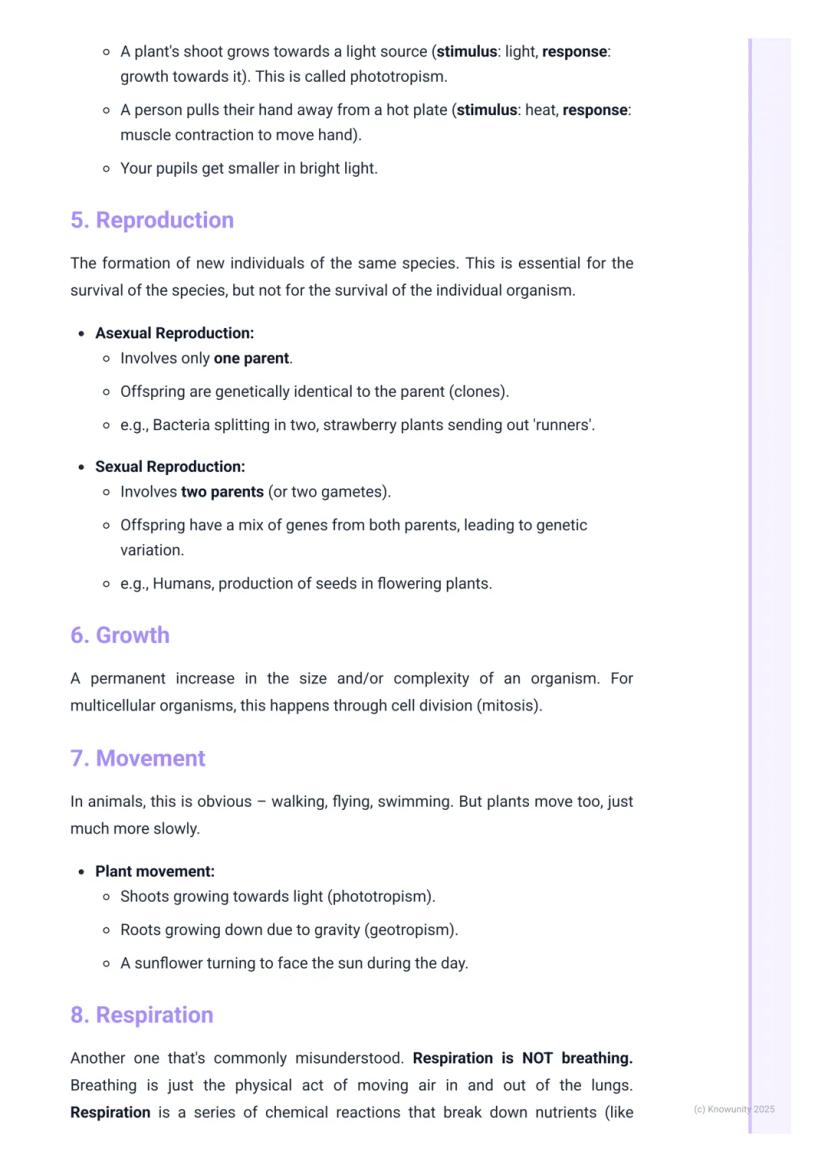
Response (also called irritability) is how organisms detect and react to changes. A stimulus causes a response - like how your pupils shrink in bright light or how plants grow towards sunlight (phototropism).
Reproduction keeps species alive by creating new individuals. Asexual reproduction involves one parent making identical copies (clones), like bacteria splitting in two. Sexual reproduction involves two parents, creating offspring with mixed genes and variation.
Both types have advantages: asexual is quick and efficient, while sexual creates genetic diversity that helps species adapt to changes.
Memory Hack: Think of sexual reproduction as "mixing genes for survival" and asexual as "quick copying when conditions are good"!
6
of 7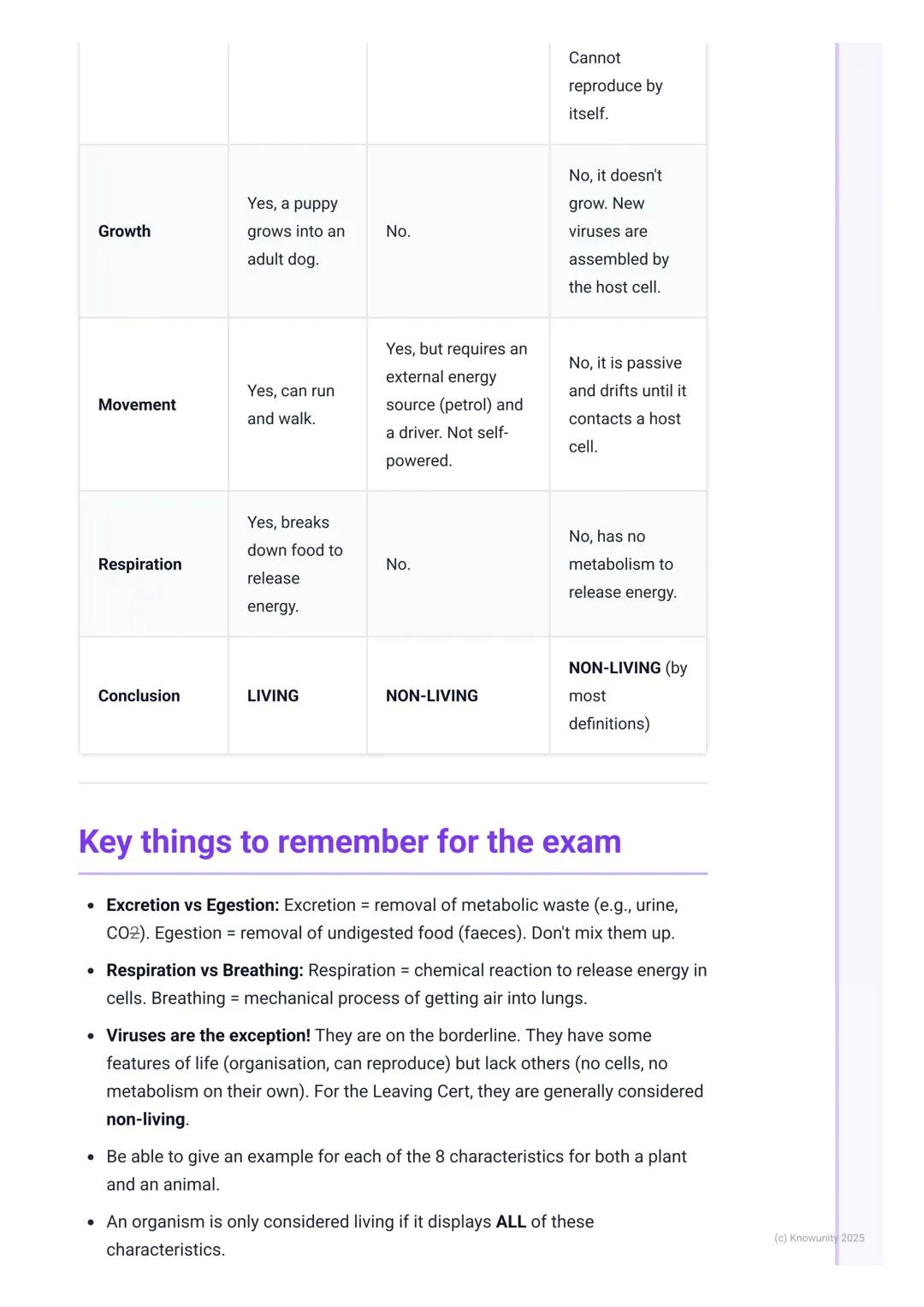
Growth, Movement, and Respiration: The Final Three
Growth means a permanent increase in size or complexity through cell division (mitosis). It's not just getting bigger - it's becoming more complex too.
Movement isn't just running around - plants move by growing towards light (phototropism) or having their roots grow downwards due to gravity (geotropism). Even sunflowers track the sun across the sky!
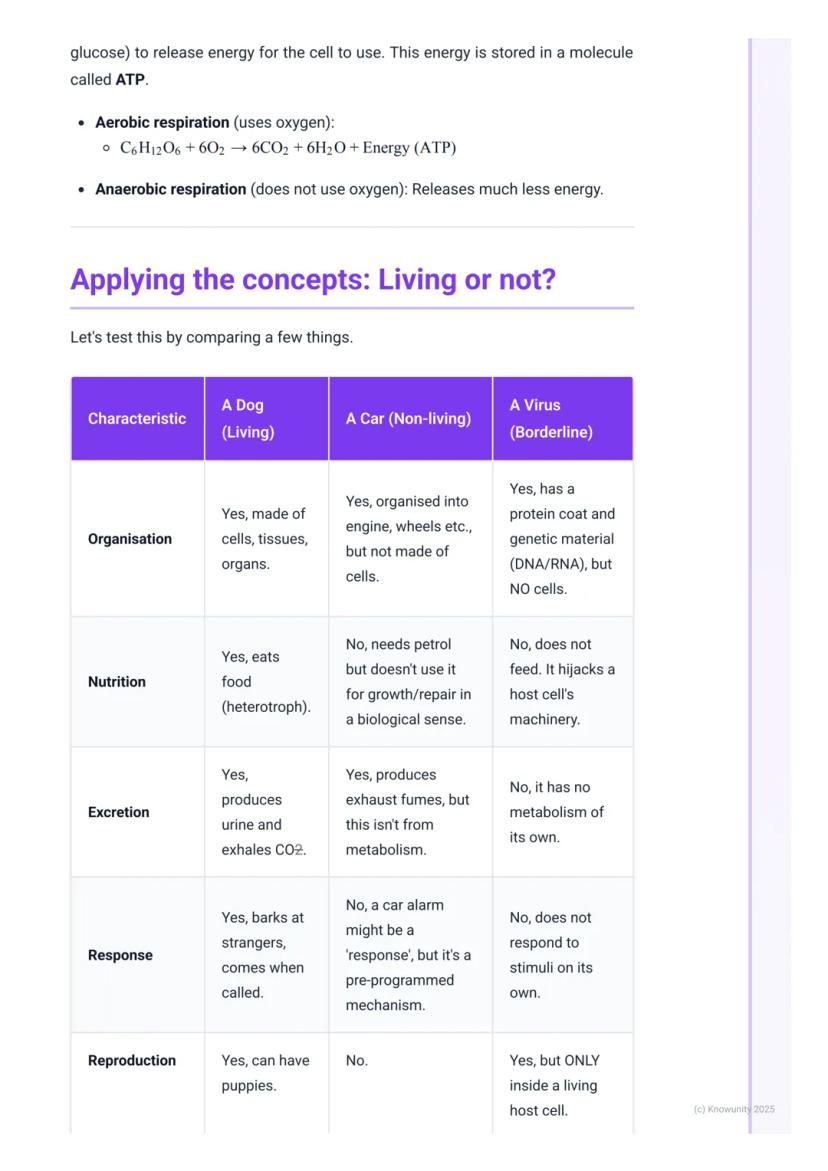
Respiration is the big one students mess up. It's NOT breathing! Respiration is the chemical reaction that breaks down glucose to release energy (ATP) for cells. Breathing just gets oxygen to your cells so respiration can happen.
Exam Alert: Aerobic respiration uses oxygen and releases lots of energy. Anaerobic respiration doesn't use oxygen but releases much less energy.
7
of 7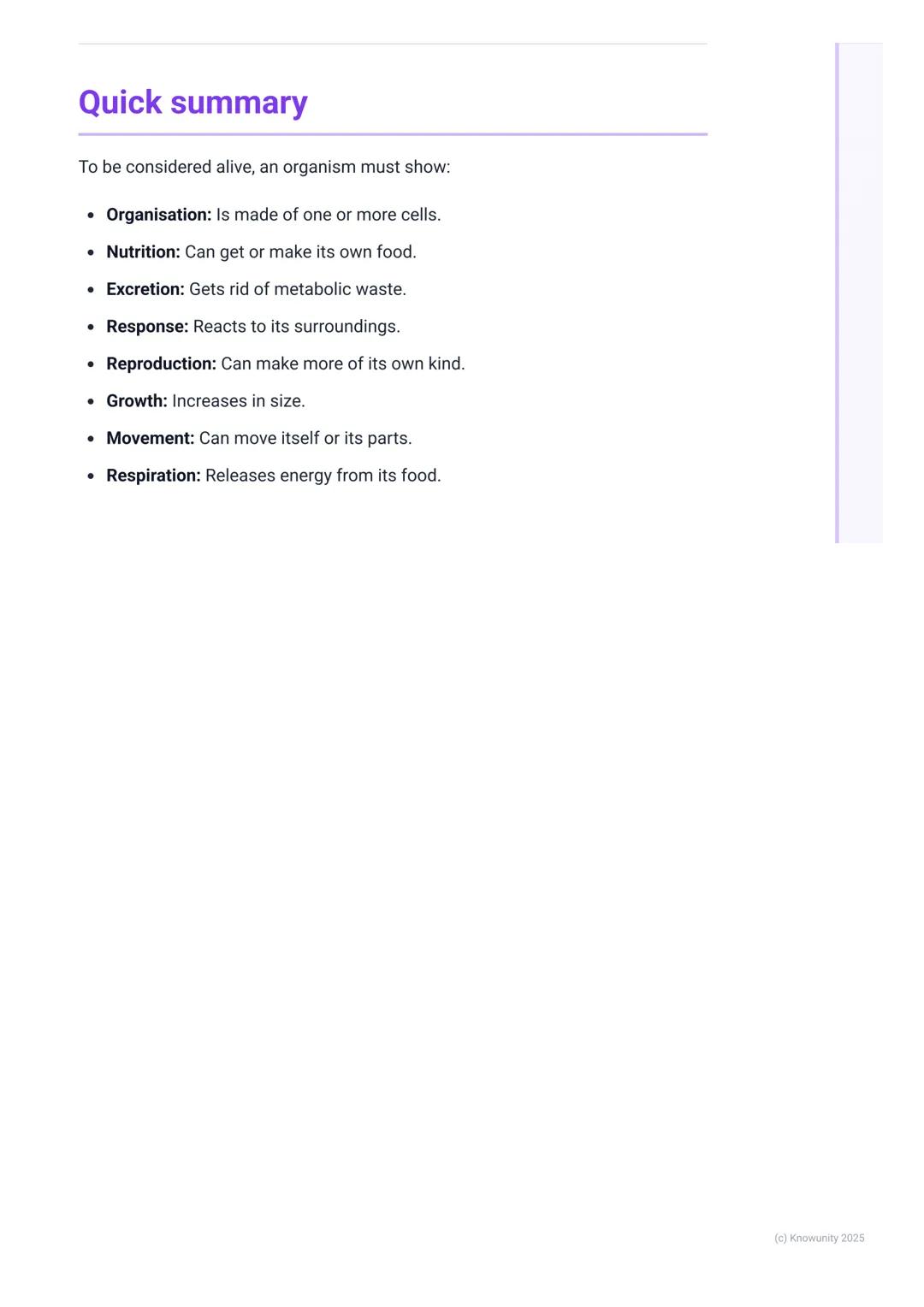
Putting It All Together: What Counts as Life?
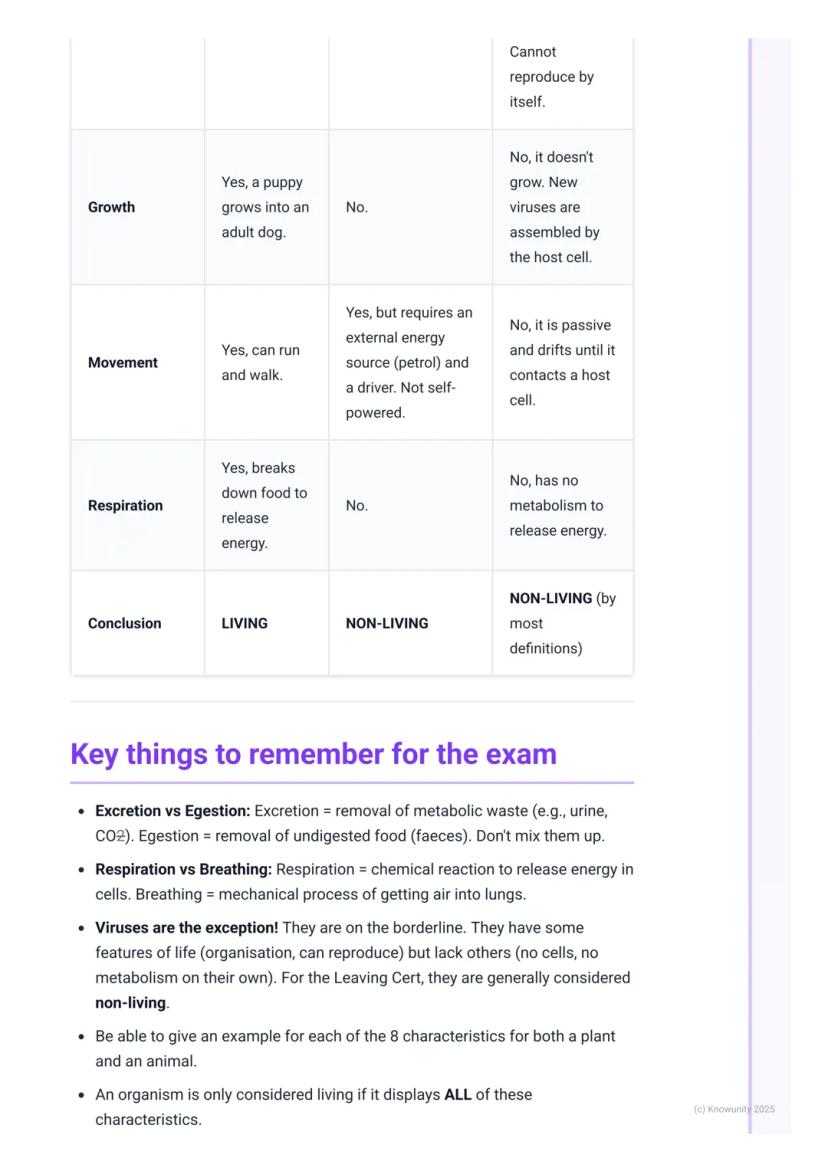
Now you can use these characteristics to determine what's actually alive. A dog shows all eight characteristics - it's definitely living. A car might seem organised and move, but it doesn't have cells, doesn't reproduce, and doesn't respire.
Viruses are the tricky ones - they're on the borderline. They have organisation and can reproduce, but only inside host cells. They don't have their own metabolism or cells, so for your exams, they're considered non-living.
Remember: an organism must show ALL eight characteristics to be considered truly alive. Miss even one, and it doesn't make the cut.
Final Reminder: Know examples of each characteristic for both plants and animals - this is guaranteed exam material!
Akala namin hindi mo na itatanong...
Ano ang Knowunity AI companion?
Ang aming AI Companion ay isang AI tool na nakatuon sa mga estudyante na nag-aalok ng higit pa sa mga sagot lang. Binuo mula sa milyong Knowunity resources, nagbibigay ito ng may-kaugnayang impormasyon, personalized na study plans, quizzes, at content direkta sa chat, na umaangkop sa iyong sariling learning journey.
Saan ko mada-download ang Knowunity app?
Maaari mong i-download ang app mula sa Google Play Store at Apple App Store.
Talaga bang libre ang Knowunity?
Tama 'yan! Mag-enjoy sa libreng access sa mga study content, makipag-connect sa kapwa mga estudyante, at kumuha ng instant na tulong – lahat nasa iyong daliri lang.
Pinaka-sikat na nilalaman sa Biology
8BiologyEcology introduction notes!
Start of the leaving cert ecology chapter
6th Year131
BiologyDNA & RNA
All notes on DNA & RNA including protein synthesis which is a HL topic
5th Year250
BiologyVertebrates and Invertebrates
Students will distinguish between animals that have a backbone (vertebrates) and those that do not (invertebrates), identifying examples of each.
2nd Year240
BiologyBiomolecules: chapter 8
Summary and easily understandable notes to revise chapter 8 biomolecules. Includes good labelled diagrams for visual learners
5th Year210
BiologyCirculatory System
Students will learn about the heart, blood, and blood vessels, and how this system transports oxygen, nutrients, and waste products around the body.
3rd Year140
BiologyRespiration
All respiration notes including simple diagrams and glycolysis and the Krebs cycle
5th Year120
BiologyPhotosynthesis : Biology
Photosynthesis
6th Year371
BiologyPlant Cells
Learning about the unique structures found in plant cells, such as the cell wall, chloroplasts, and large vacuole, and how they differ from animal cells.
1st Year80
Pinaka-sikat na nilalaman
9 Irish
IrishIrish oral questions and answers
Questions and answers for the leaving cert oral
5th Year4264
 English
Key Quotes : Sive
Key Quotes and explanations: Sive
6th Year2842
IrishIrish oral questions
Outline of oral questions
5th Year2055
IrishIníon- le hÁine Durkin
Aine Durkin’s poem, Iníon: Themes & summary
5th Year850
IrishIrish poetry 2027
Iníon + Dínit an Bhróin
5th Year1133
IrishLC HL notes- Iníon (poem)
Includes poem in English and Irish, theme, key words & phrases
5th Year2284
EnglishCultural Context : Shawshank Redemption : Sive : Small Things Like These
Comparative Study : Cultural Context : Shawshank Redemption, Sive and Small Things Like These
6th Year1430
IrishMo Ghrá-sa (Idir Lúibíní)
Notes on mo ghrá-sa
5th Year380
IrishAn Gaeilge Aiste
Irish Language essay
6th Year1320
Hindi mo mahanap ang hinahanap mo? Tuklasin ang iba pang mga asignatura.
Gustong-gusto kami ng mga estudyante — at magiging ganoon ka rin.
4.6/5App Store
4.7/5Google Play
Napakadaling gamitin at maganda ang disenyo ng app. Nahanap ko lahat ng hinahanap ko hanggang ngayon at natuto ako ng marami mula sa mga presentasyon! Tiyak na gagamitin ko ang app para sa isang takdang-aralin sa klase! At siyempre, nakakatulong din ito bilang inspirasyon.
Stefan Sgumagamit ng iOS
Sobrang ganda talaga ng app na ito. Maraming mga study notes at tulong [...]. Ang problemang subject ko ay Pranses, halimbawa, at ang app ay may maraming options para tumulong. Salamat sa app na ito, bumuti ang Pranses ko. Irerekumenda ko ito sa lahat.
Samantha KlichAndroid user
Wow, talagang namangha ako. Sinubukan ko lang ang app dahil nakita ko itong ina-advertise nang maraming beses at sobrang nagulat ako. Ang app na ito ang TULONG na gusto mo para sa paaralan at higit sa lahat, nag-aalok ito ng maraming bagay, tulad ng workouts at fact sheets, na SOBRANG nakatulong sa akin.
AnnaiOS user
Biology8 views·Na-update Jun 14, 2026·7 mga pahinaThe Key Characteristics of Living Things
Ever wondered what actually makes something alive? It's trickier than you might think! Biology is all about studying life, but first we need to nail down exactly what counts as "living" - and there are 8 specific characteristics that every... Ipakita pa
1
of 7Mag-sign up para makita ang content. Libre ito!
- Access sa lahat ng dokumento
- Pagbutihin ang iyong mga grado
- Sumali sa milyong mga estudyante
What Makes Something Alive?
You might think it's obvious what's alive and what isn't, but biology has strict rules about this. To be classified as a living organism, something must show all 8 fundamental characteristics - not just one or two.
Here's the complete list you need to memorise: Organisation, Nutrition, Excretion, Response, Reproduction, Growth, Movement, and Respiration. Think of these as biology's checklist for life.
Metabolism underlies all of these - it's basically the sum of all chemical reactions happening inside an organism. Without metabolism, none of the other characteristics work properly.
Quick Tip: Create your own acronym using the first letters to help remember all eight characteristics!
2
of 7Mag-sign up para makita ang content. Libre ito!
- Access sa lahat ng dokumento
- Pagbutihin ang iyong mga grado
- Sumali sa milyong mga estudyante
Organisation: How Life is Structured
Living things aren't just random collections of stuff - they're incredibly organised. The cell is the basic unit of all life, and from there, things get more complex.
Unicellular organisms (like bacteria) are made of just one cell that does everything. Multicellular organisms (like you!) are made of millions of specialised cells organised in a clear hierarchy.
The hierarchy goes: Cell → Tissue → Organ → Organ System → Organism. Think of it like this: your individual muscle cells group together to form muscle tissue, which combines with other tissues to create your heart, which works with blood vessels to form your circulatory system.
Real-World Connection: Your body is like a perfectly organised city where every cell has a specific job and knows exactly where it belongs!
3
of 7Mag-sign up para makita ang content. Libre ito!
- Access sa lahat ng dokumento
- Pagbutihin ang iyong mga grado
- Sumali sa milyong mga estudyante
Nutrition: Getting Energy to Survive
All living things need energy and materials to keep going, but they get them in different ways. Autotrophs (like plants) are the ultimate self-sufficient organisms - they make their own food through photosynthesis.
Heterotrophs (like animals and fungi) can't make their own food, so they have to consume other organisms. That rabbit munching grass? It's a heterotroph getting energy from an autotroph.
The basic photosynthesis equation you need to know is: 6CO₂ + 6H₂O → C₆H₁₂O₆ + 6O₂. Plants literally turn carbon dioxide and water into sugar using sunlight - pretty amazing stuff!
Exam Tip: Remember "auto" means self and "hetero" means other - this makes the terms much easier to remember!
4
of 7Mag-sign up para makita ang content. Libre ito!
- Access sa lahat ng dokumento
- Pagbutihin ang iyong mga grado
- Sumali sa milyong mga estudyante
Excretion: Getting Rid of Waste
Here's where loads of students get confused - excretion is NOT the same as egestion. Excretion is removing waste products that come from metabolism inside your cells.
When you breathe out carbon dioxide or wee out urea, that's excretion - these are actual waste products from chemical reactions in your body. But when you go to the toilet to get rid of undigested food, that's egestion, not excretion.
Plants excrete too! They get rid of oxygen (a waste product of photosynthesis) through their stomata. One organism's waste is often another's treasure.
Don't Get Caught: Never say faeces are an example of excretion - that's egestion and will lose you marks!
5
of 7Mag-sign up para makita ang content. Libre ito!
- Access sa lahat ng dokumento
- Pagbutihin ang iyong mga grado
- Sumali sa milyong mga estudyante
Response and Reproduction: Reacting and Creating
Response (also called irritability) is how organisms detect and react to changes. A stimulus causes a response - like how your pupils shrink in bright light or how plants grow towards sunlight (phototropism).
Reproduction keeps species alive by creating new individuals. Asexual reproduction involves one parent making identical copies (clones), like bacteria splitting in two. Sexual reproduction involves two parents, creating offspring with mixed genes and variation.
Both types have advantages: asexual is quick and efficient, while sexual creates genetic diversity that helps species adapt to changes.
Memory Hack: Think of sexual reproduction as "mixing genes for survival" and asexual as "quick copying when conditions are good"!
6
of 7Mag-sign up para makita ang content. Libre ito!
- Access sa lahat ng dokumento
- Pagbutihin ang iyong mga grado
- Sumali sa milyong mga estudyante
Growth, Movement, and Respiration: The Final Three
Growth means a permanent increase in size or complexity through cell division (mitosis). It's not just getting bigger - it's becoming more complex too.
Movement isn't just running around - plants move by growing towards light (phototropism) or having their roots grow downwards due to gravity (geotropism). Even sunflowers track the sun across the sky!
Respiration is the big one students mess up. It's NOT breathing! Respiration is the chemical reaction that breaks down glucose to release energy (ATP) for cells. Breathing just gets oxygen to your cells so respiration can happen.
Exam Alert: Aerobic respiration uses oxygen and releases lots of energy. Anaerobic respiration doesn't use oxygen but releases much less energy.
7
of 7Mag-sign up para makita ang content. Libre ito!
- Access sa lahat ng dokumento
- Pagbutihin ang iyong mga grado
- Sumali sa milyong mga estudyante
Putting It All Together: What Counts as Life?
Now you can use these characteristics to determine what's actually alive. A dog shows all eight characteristics - it's definitely living. A car might seem organised and move, but it doesn't have cells, doesn't reproduce, and doesn't respire.
Viruses are the tricky ones - they're on the borderline. They have organisation and can reproduce, but only inside host cells. They don't have their own metabolism or cells, so for your exams, they're considered non-living.
Remember: an organism must show ALL eight characteristics to be considered truly alive. Miss even one, and it doesn't make the cut.
Final Reminder: Know examples of each characteristic for both plants and animals - this is guaranteed exam material!
Akala namin hindi mo na itatanong...
Ano ang Knowunity AI companion?
Ang aming AI Companion ay isang AI tool na nakatuon sa mga estudyante na nag-aalok ng higit pa sa mga sagot lang. Binuo mula sa milyong Knowunity resources, nagbibigay ito ng may-kaugnayang impormasyon, personalized na study plans, quizzes, at content direkta sa chat, na umaangkop sa iyong sariling learning journey.
Saan ko mada-download ang Knowunity app?
Maaari mong i-download ang app mula sa Google Play Store at Apple App Store.
Talaga bang libre ang Knowunity?
Tama 'yan! Mag-enjoy sa libreng access sa mga study content, makipag-connect sa kapwa mga estudyante, at kumuha ng instant na tulong – lahat nasa iyong daliri lang.
Pinaka-sikat na nilalaman sa Biology
8BiologyEcology introduction notes!
Start of the leaving cert ecology chapter
6th Year131
BiologyDNA & RNA
All notes on DNA & RNA including protein synthesis which is a HL topic
5th Year250
BiologyVertebrates and Invertebrates
Students will distinguish between animals that have a backbone (vertebrates) and those that do not (invertebrates), identifying examples of each.
2nd Year240
BiologyBiomolecules: chapter 8
Summary and easily understandable notes to revise chapter 8 biomolecules. Includes good labelled diagrams for visual learners
5th Year210
BiologyCirculatory System
Students will learn about the heart, blood, and blood vessels, and how this system transports oxygen, nutrients, and waste products around the body.
3rd Year140
BiologyRespiration
All respiration notes including simple diagrams and glycolysis and the Krebs cycle
5th Year120
BiologyPhotosynthesis : Biology
Photosynthesis
6th Year371
BiologyPlant Cells
Learning about the unique structures found in plant cells, such as the cell wall, chloroplasts, and large vacuole, and how they differ from animal cells.
1st Year80
Pinaka-sikat na nilalaman
9IrishIrish oral questions and answers
Questions and answers for the leaving cert oral
5th Year4264
EnglishKey Quotes : Sive
Key Quotes and explanations: Sive
6th Year2842
IrishIrish oral questions
Outline of oral questions
5th Year2055
IrishIníon- le hÁine Durkin
Aine Durkin’s poem, Iníon: Themes & summary
5th Year850
IrishIrish poetry 2027
Iníon + Dínit an Bhróin
5th Year1133
IrishLC HL notes- Iníon (poem)
Includes poem in English and Irish, theme, key words & phrases
5th Year2284
EnglishCultural Context : Shawshank Redemption : Sive : Small Things Like These
Comparative Study : Cultural Context : Shawshank Redemption, Sive and Small Things Like These
6th Year1430
IrishMo Ghrá-sa (Idir Lúibíní)
Notes on mo ghrá-sa
5th Year380
IrishAn Gaeilge Aiste
Irish Language essay
6th Year1320
Hindi mo mahanap ang hinahanap mo? Tuklasin ang iba pang mga asignatura.
Gustong-gusto kami ng mga estudyante — at magiging ganoon ka rin.
4.6/5App Store
4.7/5Google Play
Napakadaling gamitin at maganda ang disenyo ng app. Nahanap ko lahat ng hinahanap ko hanggang ngayon at natuto ako ng marami mula sa mga presentasyon! Tiyak na gagamitin ko ang app para sa isang takdang-aralin sa klase! At siyempre, nakakatulong din ito bilang inspirasyon.
Stefan Sgumagamit ng iOS
Sobrang ganda talaga ng app na ito. Maraming mga study notes at tulong [...]. Ang problemang subject ko ay Pranses, halimbawa, at ang app ay may maraming options para tumulong. Salamat sa app na ito, bumuti ang Pranses ko. Irerekumenda ko ito sa lahat.
Samantha KlichAndroid user
Wow, talagang namangha ako. Sinubukan ko lang ang app dahil nakita ko itong ina-advertise nang maraming beses at sobrang nagulat ako. Ang app na ito ang TULONG na gusto mo para sa paaralan at higit sa lahat, nag-aalok ito ng maraming bagay, tulad ng workouts at fact sheets, na SOBRANG nakatulong sa akin.
AnnaiOS user