
Ever wondered what makes you sick or helps make your...
 Biology6 views·Na-update Jun 10, 2026·7 mga pahina
Understanding Bacteria: Structure, Growth, and Their Role in Life
1 / 7
1
of 7
Introduction to Bacteria
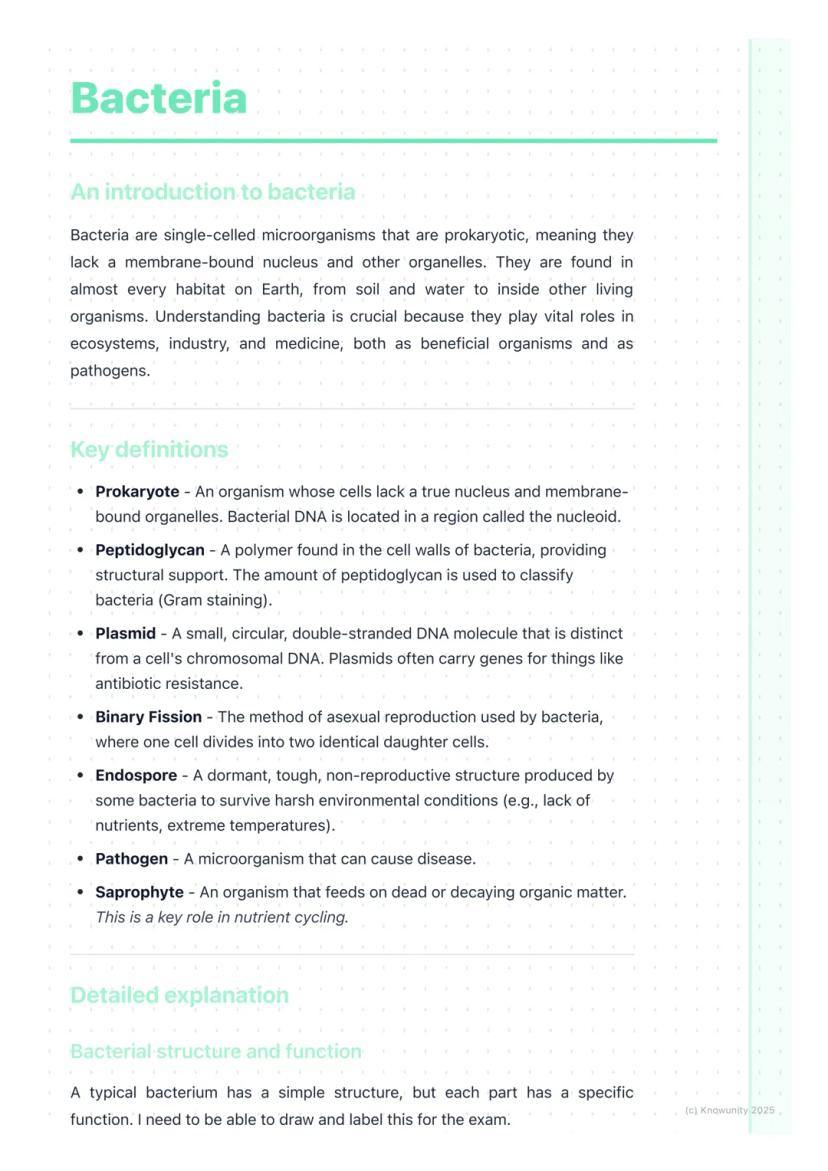
You're surrounded by billions of bacteria right now, and that's actually a good thing! Bacteria are prokaryotic organisms, which means their DNA floats freely in the cell rather than being locked away in a nucleus like ours is.
These microscopic powerhouses are found absolutely everywhere - in soil, water, inside your gut, and even in extreme environments like hot springs. Don't worry though, most bacteria are either harmless or actually helpful to us.
Understanding bacteria is essential for your exams because they're involved in so many biological processes. From making food to causing infections, bacteria are key players you need to know about.
Quick Tip: Remember that prokaryotic = no nucleus. This is a classic exam comparison question between bacterial and human cells!
2
of 7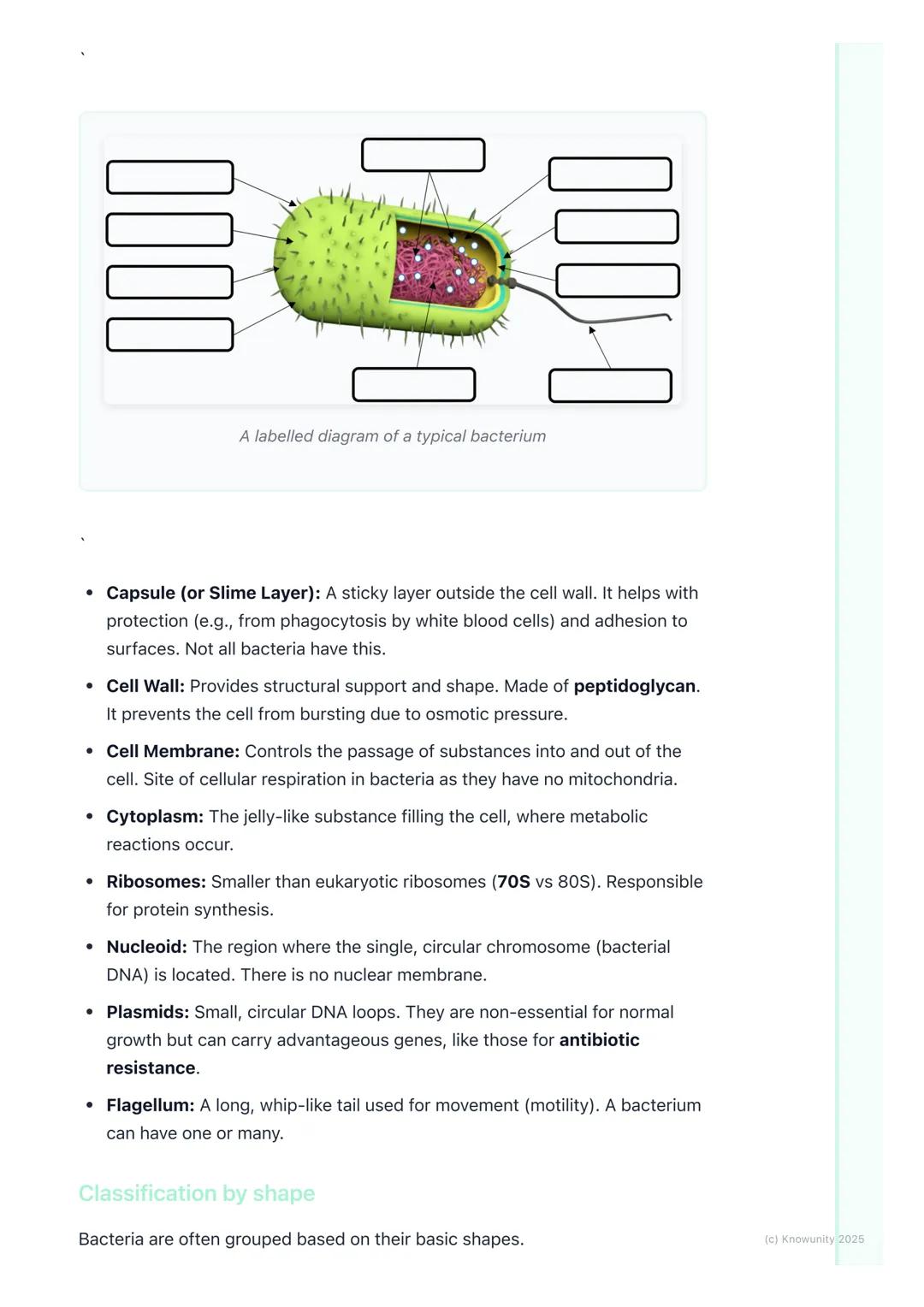
Bacterial Structure
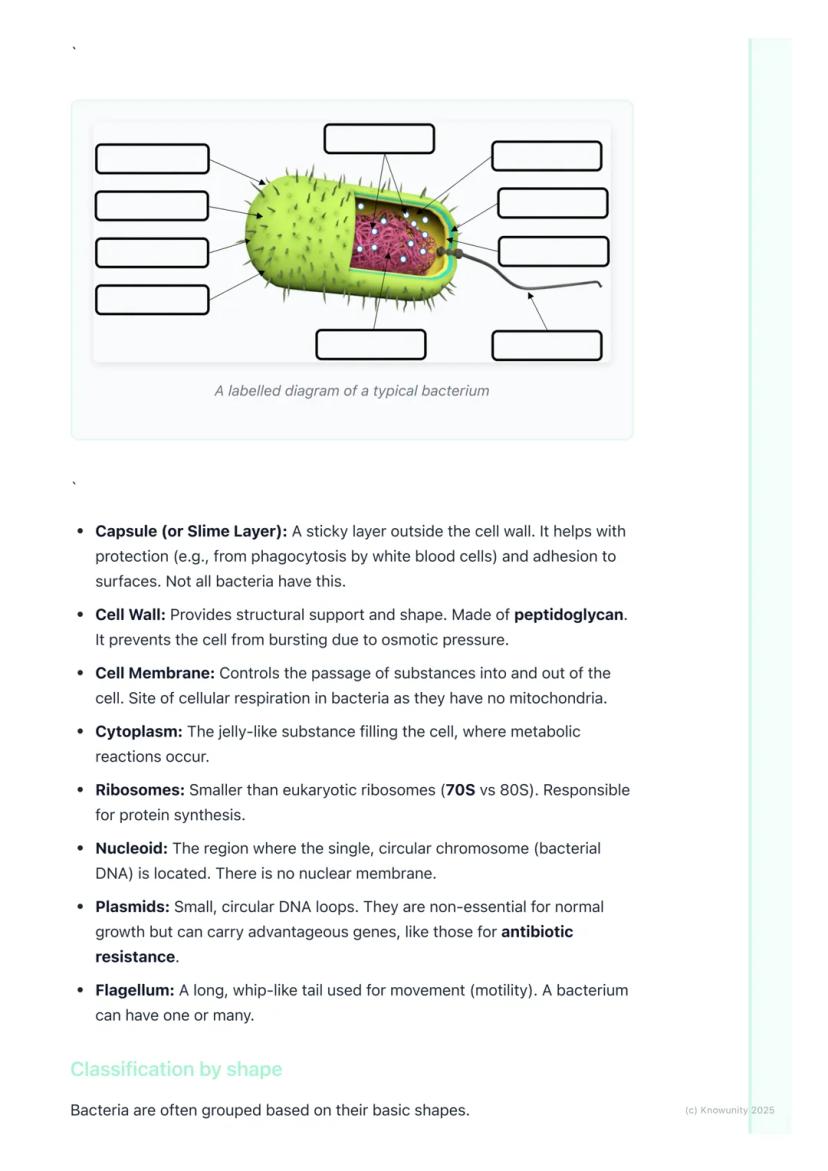
Think of a bacterial cell as a simple but efficient machine. You'll need to draw and label this structure in your exams, so let's break down each part and what it does.
The cell wall made of peptidoglycan is like the bacterium's armour - it prevents the cell from bursting and gives it shape. Inside, the cytoplasm is where all the chemical reactions happen, whilst 70S ribosomes (smaller than ours) make proteins.
The nucleoid contains the main circular chromosome, whilst plasmids are like bonus DNA circles that often carry useful genes like antibiotic resistance. Some bacteria also have a flagellum for swimming around and a capsule for extra protection.
Exam Alert: The differences between prokaryotic and eukaryotic cells (no nucleus, 70S vs 80S ribosomes, peptidoglycan cell walls) are exam favourites!
3
of 7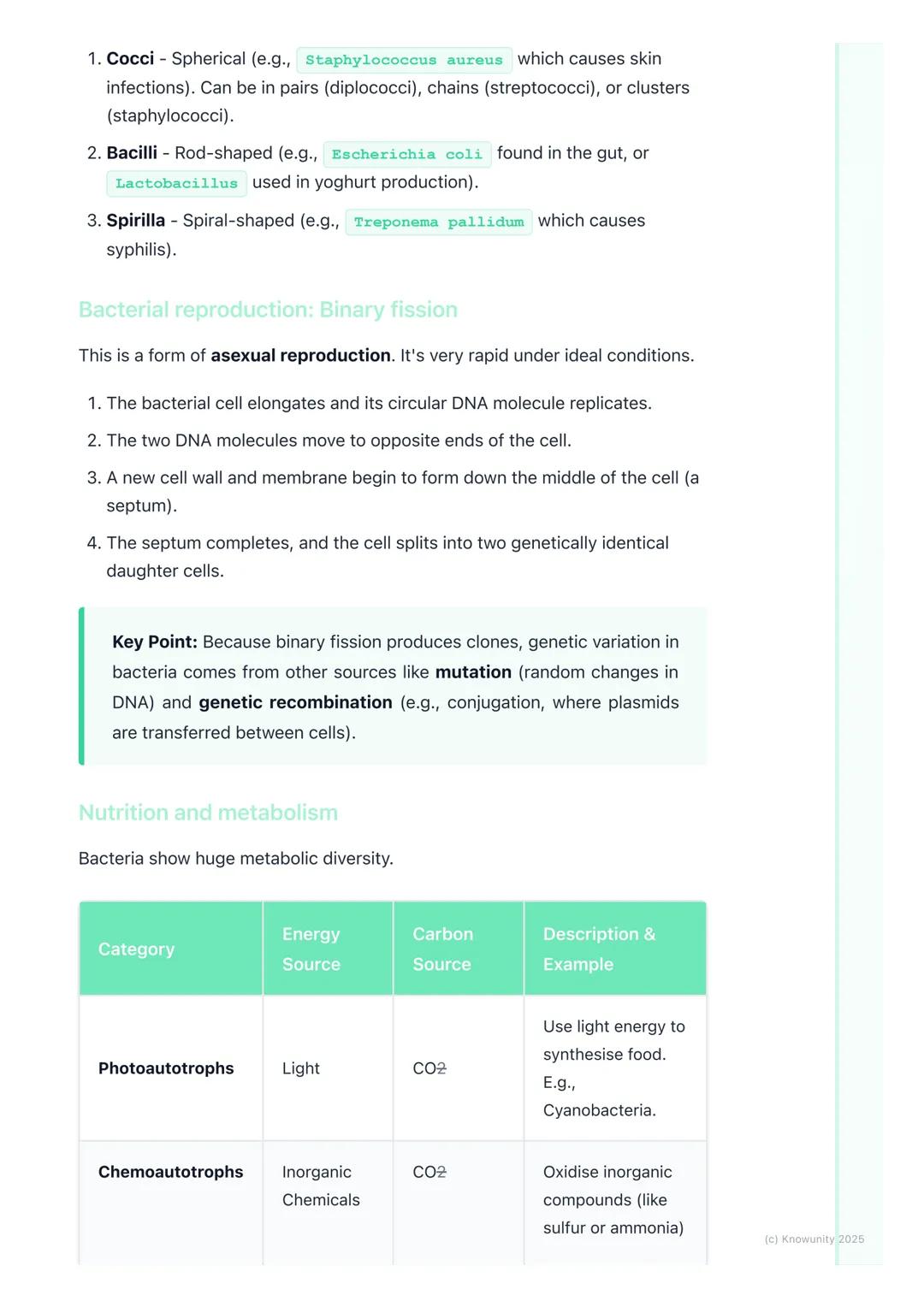
Bacterial Shapes and Reproduction
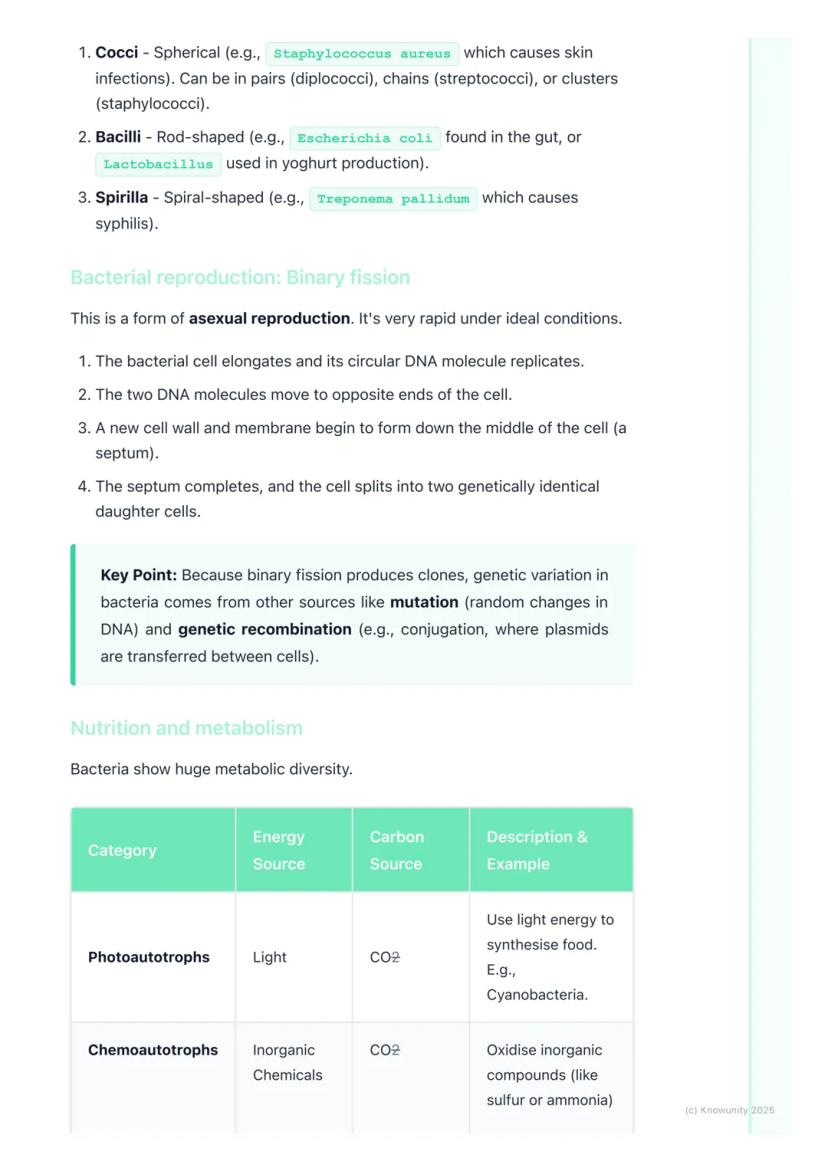
Bacteria come in three basic shapes that you need to recognise. Cocci are spherical (like Staphylococcus aureus that causes skin infections), bacilli are rod-shaped (like E. coli in your gut), and spirilla are spiral-shaped.
Binary fission is how bacteria reproduce - it's much simpler than the mitosis you've studied. The bacterial DNA copies itself, moves to opposite ends of the cell, and then the cell simply splits in two. Job done!
This process is incredibly fast under the right conditions. Because it produces identical clones, any genetic variation in bacteria comes from mutations or when they swap plasmids with each other.
Don't Confuse: Binary fission (simple bacterial reproduction) is completely different from mitosis (complex eukaryotic cell division).
4
of 7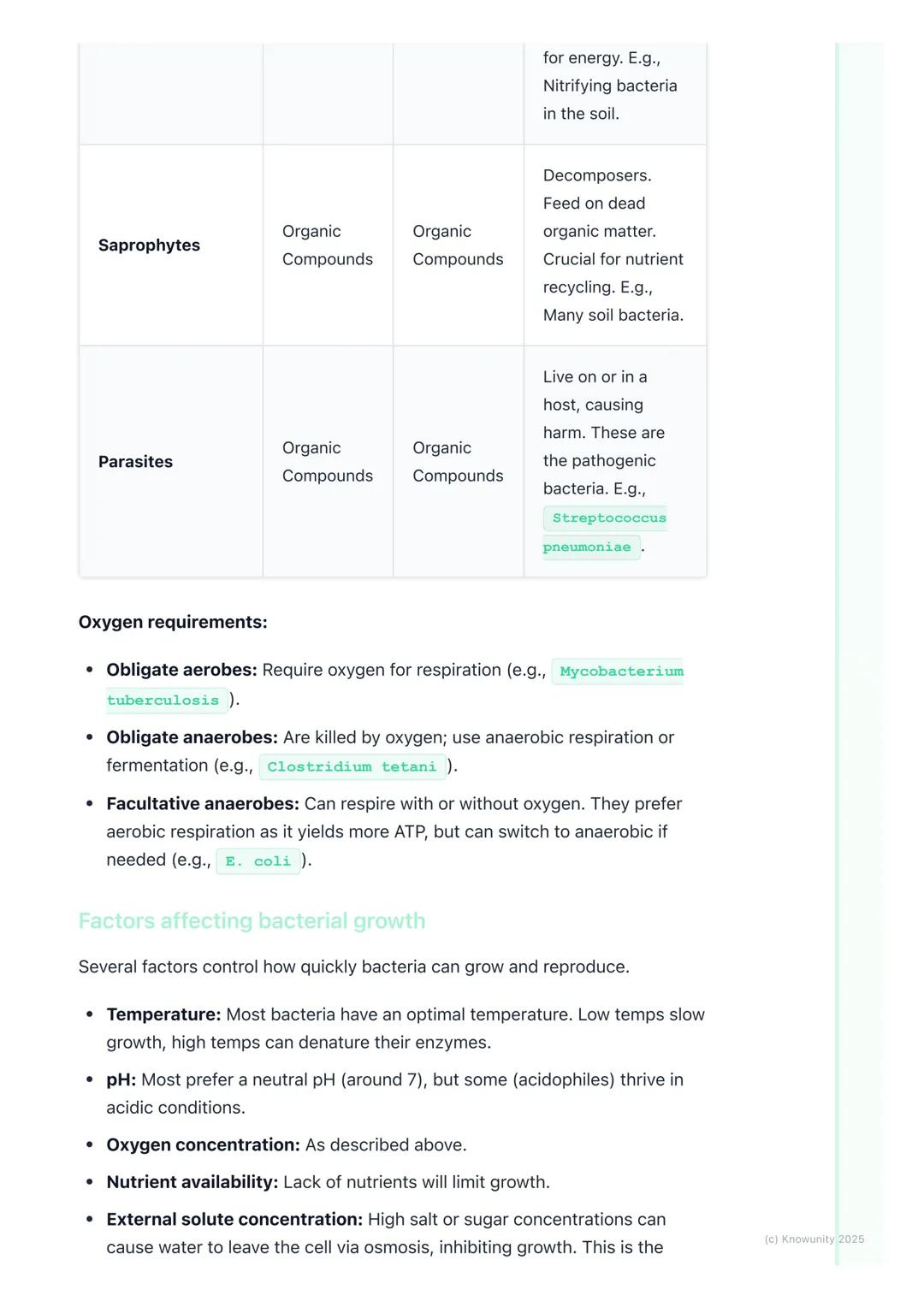
Bacterial Nutrition and Growth Requirements
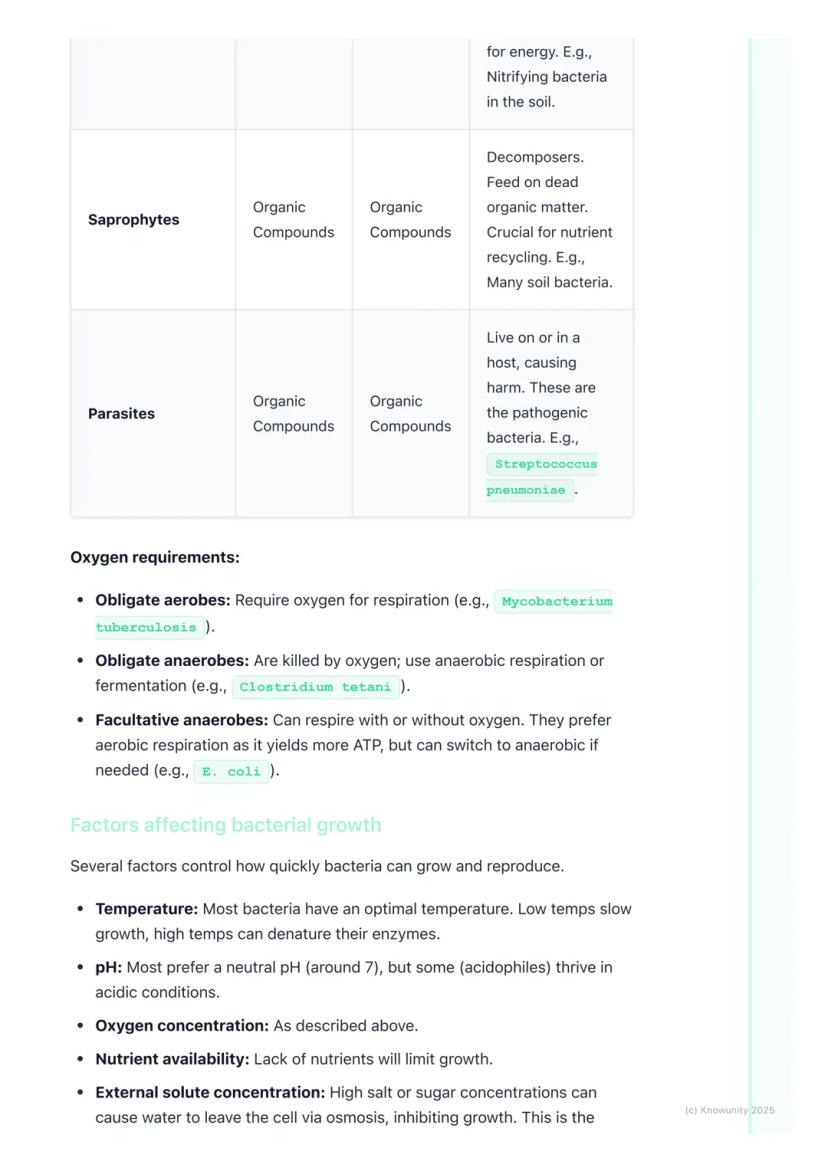
Bacteria are incredibly diverse in how they get their energy and food. Photoautotrophs use sunlight like plants do, whilst chemoautotrophs get energy from chemicals like ammonia. Saprophytes are the recyclers - they break down dead organic matter.
Parasitic bacteria are the troublemakers that cause disease by living off their hosts. Different bacteria also have varying oxygen needs - some require it, others are killed by it, and some can take it or leave it.
Several factors affect how quickly bacteria grow: temperature, pH, oxygen levels, and nutrient availability. High salt or sugar concentrations can actually preserve food by stopping bacterial growth through osmosis.
Food for Thought: The principle behind preserving food with salt or sugar is that it dehydrates bacteria, stopping their growth!
5
of 7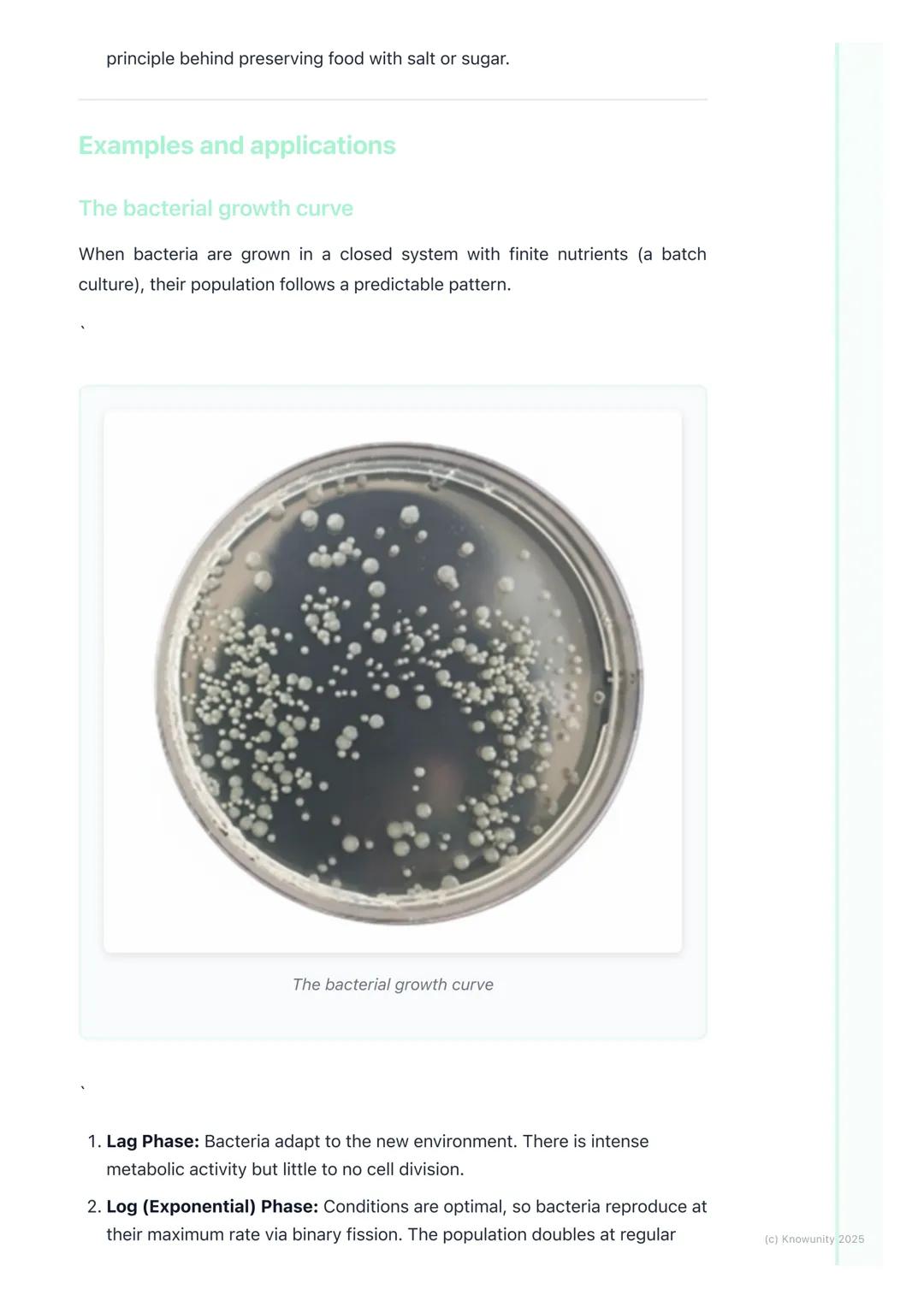
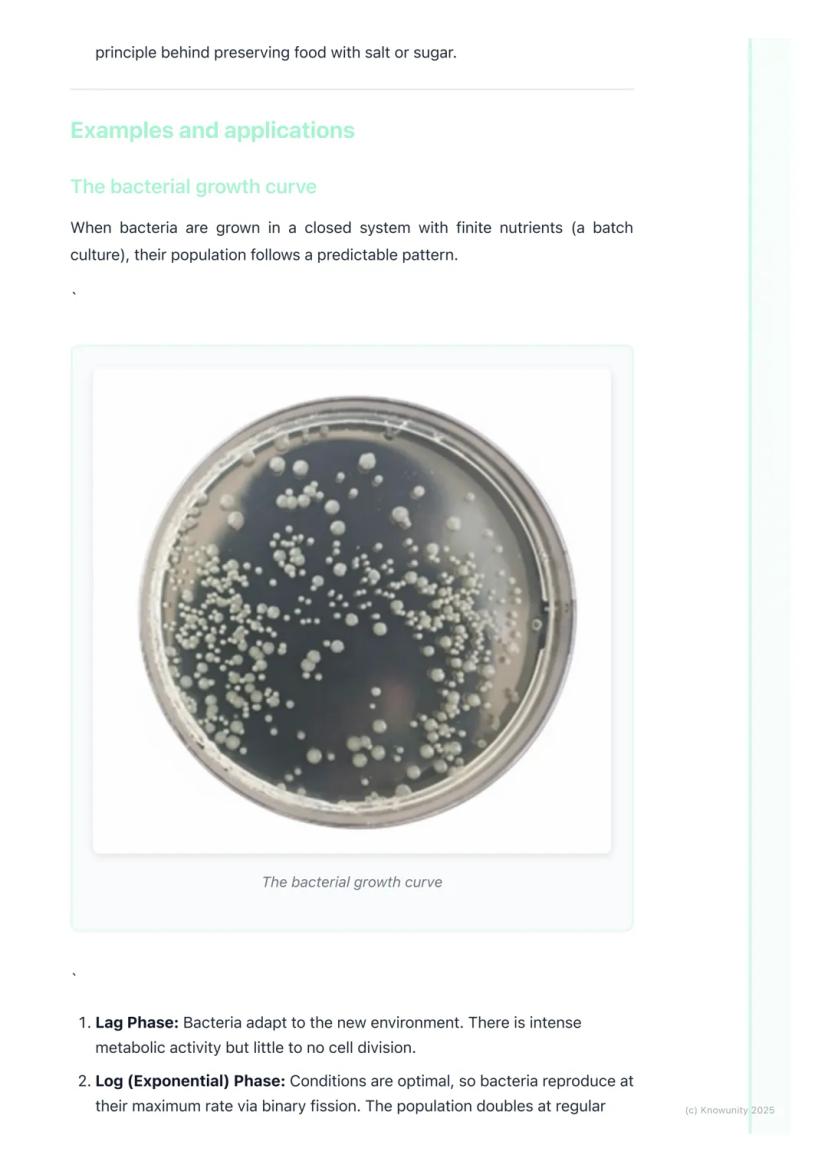
The Bacterial Growth Curve
When bacteria are grown in a lab with limited nutrients, their population follows a predictable pattern that you need to understand for exams.
The lag phase is like bacteria getting settled in - lots of metabolic activity but no reproduction yet. Then comes the log phase where conditions are perfect and the population doubles at regular intervals through rapid binary fission.
The stationary phase occurs when growth rate equals death rate due to nutrient depletion and waste build-up. Finally, the decline phase sees more bacteria dying than being born as conditions become increasingly harsh.
Exam Tip: Be ready to explain why each phase occurs - stationary phase happens because nutrients run out and toxic waste accumulates!
6
of 7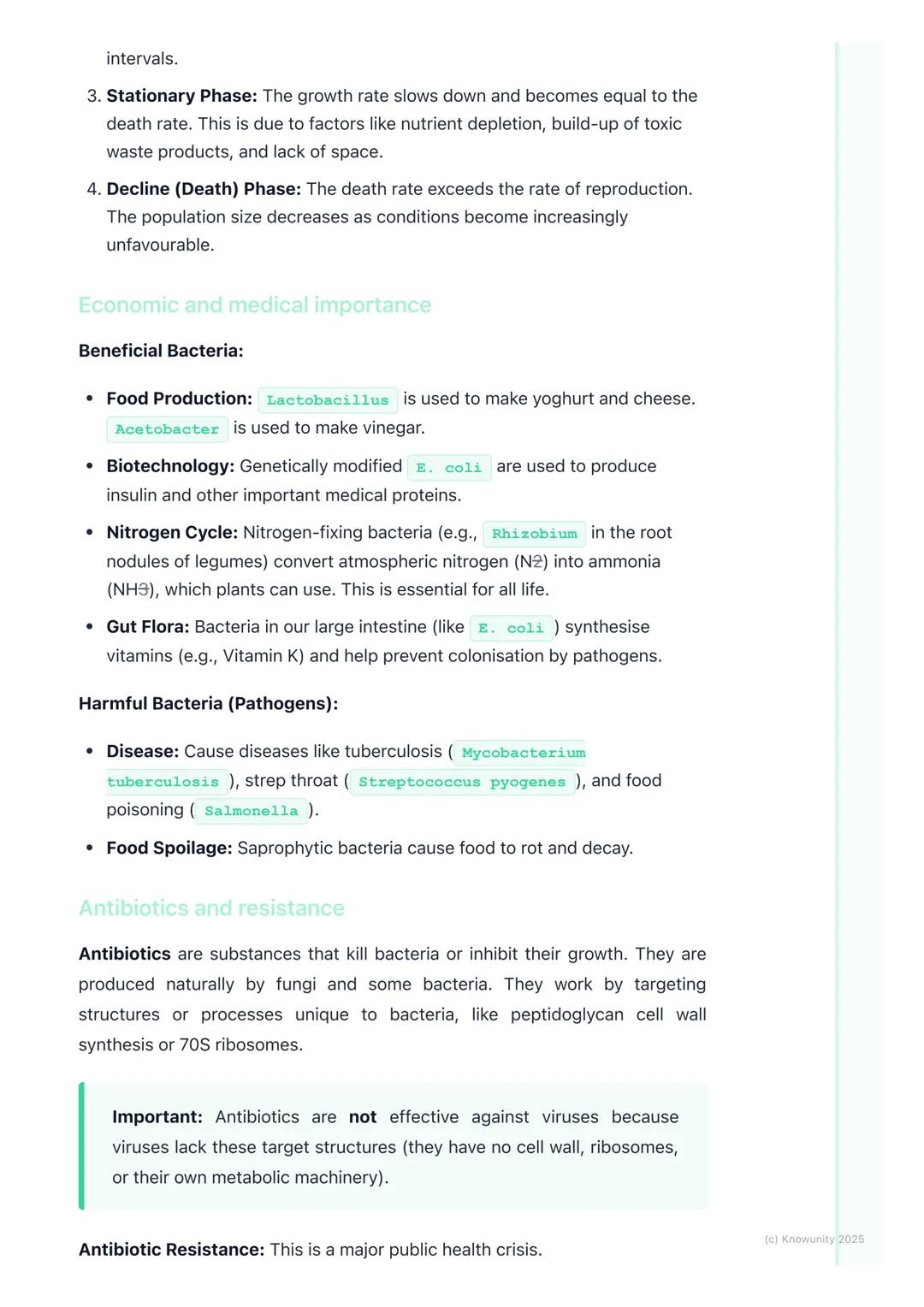
Importance of Bacteria
Bacteria are both heroes and villains in our world. On the good side, Lactobacillus makes your yoghurt and cheese, genetically modified E. coli produce insulin for diabetics, and nitrogen-fixing bacteria help plants grow by converting atmospheric nitrogen.
Your gut bacteria are particularly important - they make vitamins like Vitamin K and help prevent harmful bacteria from taking over. Without bacteria, nutrient cycling would stop and life on Earth would collapse.
However, pathogenic bacteria cause serious diseases like tuberculosis, strep throat, and food poisoning. They also cause food spoilage, which is why we need preservation methods.
Remember: Bacteria are essential for life on Earth - they're not all bad guys trying to make you sick!
7
of 7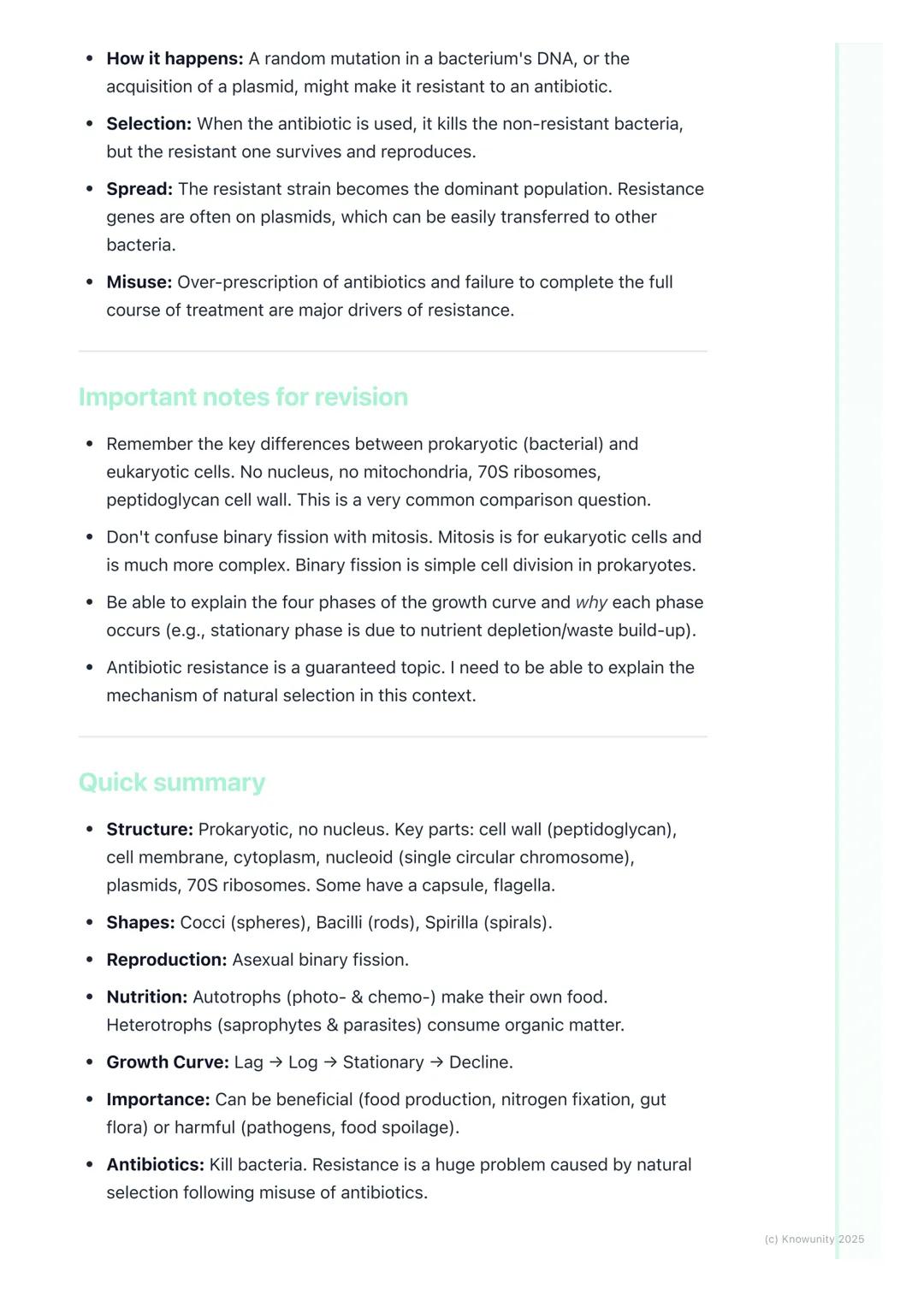
Antibiotics and Resistance
Antibiotics are substances that kill bacteria or stop their growth by targeting structures unique to bacteria, like their peptidoglycan cell walls or 70S ribosomes. Crucially, they don't work against viruses because viruses lack these targets.
Antibiotic resistance is one of the biggest health crises facing us today. Here's how it develops: a random mutation might make one bacterium resistant to an antibiotic. When the antibiotic is used, it kills all the non-resistant bacteria but the resistant one survives and reproduces.
This is natural selection in action - the resistant strain becomes dominant and can pass resistance genes to other bacteria through plasmids. Misuse of antibiotics, like not finishing prescribed courses, makes this problem worse.
Critical Point: Antibiotic resistance demonstrates natural selection perfectly - it's a guaranteed exam topic you need to understand thoroughly!
Akala namin hindi mo na itatanong...
Ano ang Knowunity AI companion?
Ang aming AI Companion ay isang AI tool na nakatuon sa mga estudyante na nag-aalok ng higit pa sa mga sagot lang. Binuo mula sa milyong Knowunity resources, nagbibigay ito ng may-kaugnayang impormasyon, personalized na study plans, quizzes, at content direkta sa chat, na umaangkop sa iyong sariling learning journey.
Saan ko mada-download ang Knowunity app?
Maaari mong i-download ang app mula sa Google Play Store at Apple App Store.
Talaga bang libre ang Knowunity?
Tama 'yan! Mag-enjoy sa libreng access sa mga study content, makipag-connect sa kapwa mga estudyante, at kumuha ng instant na tulong – lahat nasa iyong daliri lang.
Pinaka-sikat na nilalaman sa Biology
8BiologyEcology introduction notes!
Start of the leaving cert ecology chapter
6th Year131
BiologyDNA & RNA
All notes on DNA & RNA including protein synthesis which is a HL topic
5th Year250
BiologyVertebrates and Invertebrates
Students will distinguish between animals that have a backbone (vertebrates) and those that do not (invertebrates), identifying examples of each.
2nd Year240
BiologyBiomolecules: chapter 8
Summary and easily understandable notes to revise chapter 8 biomolecules. Includes good labelled diagrams for visual learners
5th Year210
BiologyCirculatory System
Students will learn about the heart, blood, and blood vessels, and how this system transports oxygen, nutrients, and waste products around the body.
3rd Year140
BiologyRespiration
All respiration notes including simple diagrams and glycolysis and the Krebs cycle
5th Year120
BiologyPhotosynthesis : Biology
Photosynthesis
6th Year371
BiologyPlant Cells
Learning about the unique structures found in plant cells, such as the cell wall, chloroplasts, and large vacuole, and how they differ from animal cells.
1st Year80
Pinaka-sikat na nilalaman
9 Irish
IrishIrish oral questions and answers
Questions and answers for the leaving cert oral
5th Year4264
 English
Key Quotes : Sive
Key Quotes and explanations: Sive
6th Year2842
IrishIrish oral questions
Outline of oral questions
5th Year2055
IrishIníon- le hÁine Durkin
Aine Durkin’s poem, Iníon: Themes & summary
5th Year850
IrishIrish poetry 2027
Iníon + Dínit an Bhróin
5th Year1133
IrishLC HL notes- Iníon (poem)
Includes poem in English and Irish, theme, key words & phrases
5th Year2284
EnglishCultural Context : Shawshank Redemption : Sive : Small Things Like These
Comparative Study : Cultural Context : Shawshank Redemption, Sive and Small Things Like These
6th Year1430
IrishMo Ghrá-sa (Idir Lúibíní)
Notes on mo ghrá-sa
5th Year380
IrishAn Gaeilge Aiste
Irish Language essay
6th Year1320
Hindi mo mahanap ang hinahanap mo? Tuklasin ang iba pang mga asignatura.
Gustong-gusto kami ng mga estudyante — at magiging ganoon ka rin.
4.6/5App Store
4.7/5Google Play
Napakadaling gamitin at maganda ang disenyo ng app. Nahanap ko lahat ng hinahanap ko hanggang ngayon at natuto ako ng marami mula sa mga presentasyon! Tiyak na gagamitin ko ang app para sa isang takdang-aralin sa klase! At siyempre, nakakatulong din ito bilang inspirasyon.
Stefan Sgumagamit ng iOS
Sobrang ganda talaga ng app na ito. Maraming mga study notes at tulong [...]. Ang problemang subject ko ay Pranses, halimbawa, at ang app ay may maraming options para tumulong. Salamat sa app na ito, bumuti ang Pranses ko. Irerekumenda ko ito sa lahat.
Samantha KlichAndroid user
Wow, talagang namangha ako. Sinubukan ko lang ang app dahil nakita ko itong ina-advertise nang maraming beses at sobrang nagulat ako. Ang app na ito ang TULONG na gusto mo para sa paaralan at higit sa lahat, nag-aalok ito ng maraming bagay, tulad ng workouts at fact sheets, na SOBRANG nakatulong sa akin.
AnnaiOS user
Biology6 views·Na-update Jun 10, 2026·7 mga pahinaUnderstanding Bacteria: Structure, Growth, and Their Role in Life
Ever wondered what makes you sick or helps make your yoghurt? Bacteria are everywhere - literally! These tiny single-celled organisms are some of the most important life forms on Earth, playing crucial roles in everything from keeping you healthy to...
1
of 7
Mag-sign up para makita ang content. Libre ito!
- Access sa lahat ng dokumento
- Pagbutihin ang iyong mga grado
- Sumali sa milyong mga estudyante
Introduction to Bacteria
You're surrounded by billions of bacteria right now, and that's actually a good thing! Bacteria are prokaryotic organisms, which means their DNA floats freely in the cell rather than being locked away in a nucleus like ours is.
These microscopic powerhouses are found absolutely everywhere - in soil, water, inside your gut, and even in extreme environments like hot springs. Don't worry though, most bacteria are either harmless or actually helpful to us.
Understanding bacteria is essential for your exams because they're involved in so many biological processes. From making food to causing infections, bacteria are key players you need to know about.
Quick Tip: Remember that prokaryotic = no nucleus. This is a classic exam comparison question between bacterial and human cells!
2
of 7Mag-sign up para makita ang content. Libre ito!
- Access sa lahat ng dokumento
- Pagbutihin ang iyong mga grado
- Sumali sa milyong mga estudyante
Bacterial Structure
Think of a bacterial cell as a simple but efficient machine. You'll need to draw and label this structure in your exams, so let's break down each part and what it does.
The cell wall made of peptidoglycan is like the bacterium's armour - it prevents the cell from bursting and gives it shape. Inside, the cytoplasm is where all the chemical reactions happen, whilst 70S ribosomes (smaller than ours) make proteins.
The nucleoid contains the main circular chromosome, whilst plasmids are like bonus DNA circles that often carry useful genes like antibiotic resistance. Some bacteria also have a flagellum for swimming around and a capsule for extra protection.
Exam Alert: The differences between prokaryotic and eukaryotic cells (no nucleus, 70S vs 80S ribosomes, peptidoglycan cell walls) are exam favourites!
3
of 7Mag-sign up para makita ang content. Libre ito!
- Access sa lahat ng dokumento
- Pagbutihin ang iyong mga grado
- Sumali sa milyong mga estudyante
Bacterial Shapes and Reproduction
Bacteria come in three basic shapes that you need to recognise. Cocci are spherical (like Staphylococcus aureus that causes skin infections), bacilli are rod-shaped (like E. coli in your gut), and spirilla are spiral-shaped.
Binary fission is how bacteria reproduce - it's much simpler than the mitosis you've studied. The bacterial DNA copies itself, moves to opposite ends of the cell, and then the cell simply splits in two. Job done!
This process is incredibly fast under the right conditions. Because it produces identical clones, any genetic variation in bacteria comes from mutations or when they swap plasmids with each other.
Don't Confuse: Binary fission (simple bacterial reproduction) is completely different from mitosis (complex eukaryotic cell division).
4
of 7Mag-sign up para makita ang content. Libre ito!
- Access sa lahat ng dokumento
- Pagbutihin ang iyong mga grado
- Sumali sa milyong mga estudyante
Bacterial Nutrition and Growth Requirements
Bacteria are incredibly diverse in how they get their energy and food. Photoautotrophs use sunlight like plants do, whilst chemoautotrophs get energy from chemicals like ammonia. Saprophytes are the recyclers - they break down dead organic matter.
Parasitic bacteria are the troublemakers that cause disease by living off their hosts. Different bacteria also have varying oxygen needs - some require it, others are killed by it, and some can take it or leave it.
Several factors affect how quickly bacteria grow: temperature, pH, oxygen levels, and nutrient availability. High salt or sugar concentrations can actually preserve food by stopping bacterial growth through osmosis.
Food for Thought: The principle behind preserving food with salt or sugar is that it dehydrates bacteria, stopping their growth!
5
of 7Mag-sign up para makita ang content. Libre ito!
- Access sa lahat ng dokumento
- Pagbutihin ang iyong mga grado
- Sumali sa milyong mga estudyante
The Bacterial Growth Curve
When bacteria are grown in a lab with limited nutrients, their population follows a predictable pattern that you need to understand for exams.
The lag phase is like bacteria getting settled in - lots of metabolic activity but no reproduction yet. Then comes the log phase where conditions are perfect and the population doubles at regular intervals through rapid binary fission.
The stationary phase occurs when growth rate equals death rate due to nutrient depletion and waste build-up. Finally, the decline phase sees more bacteria dying than being born as conditions become increasingly harsh.
Exam Tip: Be ready to explain why each phase occurs - stationary phase happens because nutrients run out and toxic waste accumulates!
6
of 7Mag-sign up para makita ang content. Libre ito!
- Access sa lahat ng dokumento
- Pagbutihin ang iyong mga grado
- Sumali sa milyong mga estudyante
Importance of Bacteria
Bacteria are both heroes and villains in our world. On the good side, Lactobacillus makes your yoghurt and cheese, genetically modified E. coli produce insulin for diabetics, and nitrogen-fixing bacteria help plants grow by converting atmospheric nitrogen.
Your gut bacteria are particularly important - they make vitamins like Vitamin K and help prevent harmful bacteria from taking over. Without bacteria, nutrient cycling would stop and life on Earth would collapse.
However, pathogenic bacteria cause serious diseases like tuberculosis, strep throat, and food poisoning. They also cause food spoilage, which is why we need preservation methods.
Remember: Bacteria are essential for life on Earth - they're not all bad guys trying to make you sick!
7
of 7Mag-sign up para makita ang content. Libre ito!
- Access sa lahat ng dokumento
- Pagbutihin ang iyong mga grado
- Sumali sa milyong mga estudyante
Antibiotics and Resistance
Antibiotics are substances that kill bacteria or stop their growth by targeting structures unique to bacteria, like their peptidoglycan cell walls or 70S ribosomes. Crucially, they don't work against viruses because viruses lack these targets.
Antibiotic resistance is one of the biggest health crises facing us today. Here's how it develops: a random mutation might make one bacterium resistant to an antibiotic. When the antibiotic is used, it kills all the non-resistant bacteria but the resistant one survives and reproduces.
This is natural selection in action - the resistant strain becomes dominant and can pass resistance genes to other bacteria through plasmids. Misuse of antibiotics, like not finishing prescribed courses, makes this problem worse.
Critical Point: Antibiotic resistance demonstrates natural selection perfectly - it's a guaranteed exam topic you need to understand thoroughly!
Akala namin hindi mo na itatanong...
Ano ang Knowunity AI companion?
Ang aming AI Companion ay isang AI tool na nakatuon sa mga estudyante na nag-aalok ng higit pa sa mga sagot lang. Binuo mula sa milyong Knowunity resources, nagbibigay ito ng may-kaugnayang impormasyon, personalized na study plans, quizzes, at content direkta sa chat, na umaangkop sa iyong sariling learning journey.
Saan ko mada-download ang Knowunity app?
Maaari mong i-download ang app mula sa Google Play Store at Apple App Store.
Talaga bang libre ang Knowunity?
Tama 'yan! Mag-enjoy sa libreng access sa mga study content, makipag-connect sa kapwa mga estudyante, at kumuha ng instant na tulong – lahat nasa iyong daliri lang.
Pinaka-sikat na nilalaman sa Biology
8BiologyEcology introduction notes!
Start of the leaving cert ecology chapter
6th Year131
BiologyDNA & RNA
All notes on DNA & RNA including protein synthesis which is a HL topic
5th Year250
BiologyVertebrates and Invertebrates
Students will distinguish between animals that have a backbone (vertebrates) and those that do not (invertebrates), identifying examples of each.
2nd Year240
BiologyBiomolecules: chapter 8
Summary and easily understandable notes to revise chapter 8 biomolecules. Includes good labelled diagrams for visual learners
5th Year210
BiologyCirculatory System
Students will learn about the heart, blood, and blood vessels, and how this system transports oxygen, nutrients, and waste products around the body.
3rd Year140
BiologyRespiration
All respiration notes including simple diagrams and glycolysis and the Krebs cycle
5th Year120
BiologyPhotosynthesis : Biology
Photosynthesis
6th Year371
BiologyPlant Cells
Learning about the unique structures found in plant cells, such as the cell wall, chloroplasts, and large vacuole, and how they differ from animal cells.
1st Year80
Pinaka-sikat na nilalaman
9IrishIrish oral questions and answers
Questions and answers for the leaving cert oral
5th Year4264
EnglishKey Quotes : Sive
Key Quotes and explanations: Sive
6th Year2842
IrishIrish oral questions
Outline of oral questions
5th Year2055
IrishIníon- le hÁine Durkin
Aine Durkin’s poem, Iníon: Themes & summary
5th Year850
IrishIrish poetry 2027
Iníon + Dínit an Bhróin
5th Year1133
IrishLC HL notes- Iníon (poem)
Includes poem in English and Irish, theme, key words & phrases
5th Year2284
EnglishCultural Context : Shawshank Redemption : Sive : Small Things Like These
Comparative Study : Cultural Context : Shawshank Redemption, Sive and Small Things Like These
6th Year1430
IrishMo Ghrá-sa (Idir Lúibíní)
Notes on mo ghrá-sa
5th Year380
IrishAn Gaeilge Aiste
Irish Language essay
6th Year1320
Hindi mo mahanap ang hinahanap mo? Tuklasin ang iba pang mga asignatura.
Gustong-gusto kami ng mga estudyante — at magiging ganoon ka rin.
4.6/5App Store
4.7/5Google Play
Napakadaling gamitin at maganda ang disenyo ng app. Nahanap ko lahat ng hinahanap ko hanggang ngayon at natuto ako ng marami mula sa mga presentasyon! Tiyak na gagamitin ko ang app para sa isang takdang-aralin sa klase! At siyempre, nakakatulong din ito bilang inspirasyon.
Stefan Sgumagamit ng iOS
Sobrang ganda talaga ng app na ito. Maraming mga study notes at tulong [...]. Ang problemang subject ko ay Pranses, halimbawa, at ang app ay may maraming options para tumulong. Salamat sa app na ito, bumuti ang Pranses ko. Irerekumenda ko ito sa lahat.
Samantha KlichAndroid user
Wow, talagang namangha ako. Sinubukan ko lang ang app dahil nakita ko itong ina-advertise nang maraming beses at sobrang nagulat ako. Ang app na ito ang TULONG na gusto mo para sa paaralan at higit sa lahat, nag-aalok ito ng maraming bagay, tulad ng workouts at fact sheets, na SOBRANG nakatulong sa akin.
AnnaiOS user