Mga Pangunahing Trigonometric Functions sa Unit Circle
Ang Unit Circle ay isang powerful tool sa trigonometry na... Ipakita pa
1 / 8
Trigonometry at Unit Circle: Mga Trigonometric Functions
Ready ka na ba para sa exciting world ng trigonometry gamit ang unit circle? Sa topic na ito, aalamin natin kung paano kumakatawan ang mga punto sa unit circle sa trigonometric values.
Sa unit circle approach, mas madali nating makukuha ang exact values ng sine, cosine, at tangent sa iba't ibang angles. Hindi lang ito theoretical knowledge - gagamitin mo ito sa physics, engineering, at iba pang real-world applications!
Pagkatapos ng lesson na ito, kaya mo nang i-identify ang special angles, gamitin ang reference angles, at i-solve ang mga complex problems gamit ang unit circle. Trust me, kapag na-master mo ito, mas magiging madali ang iyong journey sa trigonometry.
Pro Tip: Visualize the unit circle as a tool that connects angles with coordinates - kapag nakita mo ang pattern, everything will click!
Panimula sa Unit Circle
Imagine a perfect circle with radius 1 sa gitna ng coordinate plane - yan ang unit circle! It's like a map na nagko-connect ng angles at trigonometric values sa isang elegant way.
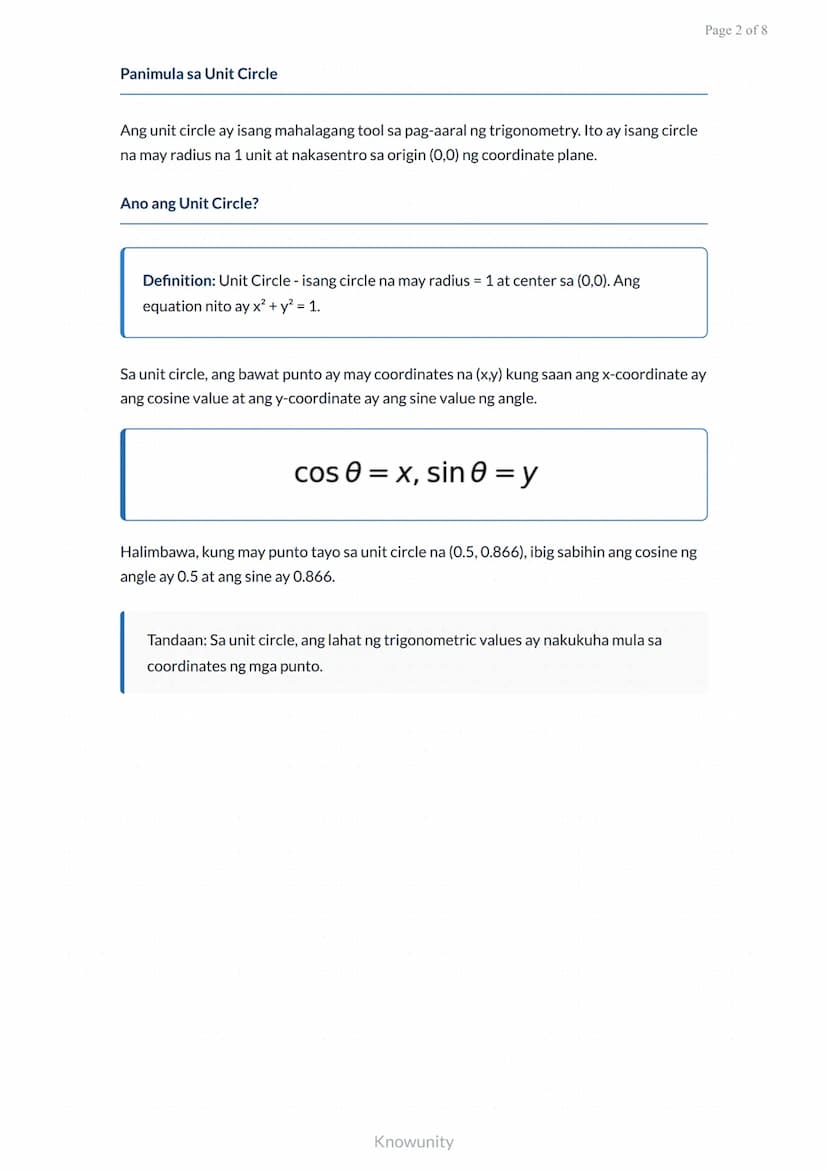
Ang unit circle ay may equation na x2+y2=1 at ang center nito ay nasa origin (0,0). Ang magic dito ay ang connection between coordinates at trig values: cosθ=x at sinθ=y. This means kapag alam mo ang coordinates ng isang point sa circle, alam mo na rin ang sine at cosine ng angle!
Halimbawa, kung may punto sa unit circle na (0.5, 0.866), ang cosine ng angle ay 0.5 at ang sine ay 0.866. Napakasimple diba? Sa approach na ito, nako-convert natin ang abstract concept ng trigonometry into simple coordinates na madaling makita at maintindihan.
Remember: Sa unit circle, lahat ng trigonometric values ay nakukuha mula sa coordinates ng mga punto - making it easier to visualize what these values actually represent!
Mga Quadrants at Signs ng Trigonometric Functions
Ang values ng sine, cosine, at tangent ay nagbabago ng sign depende sa quadrant kung saan ang angle ay nakaturo. Understanding this pattern will save you loads of time!
Sa Quadrant I (0° hanggang 90°), lahat ay positive - sine, cosine, at tangent! It's the happy quadrant where everything works nicely. Ang x at y coordinates dito ay parehong positive.
Sa Quadrant II (90° hanggang 180°), sine lang ang positive, while cosine at tangent ay negative. Dito, positive ang y-coordinate pero negative na ang x-coordinate.
Sa Quadrant III (180° hanggang 270°), tangent lang ang positive, while sine at cosine ay negative. Both x and y coordinates are negative in this quadrant.
Sa Quadrant IV (270° hanggang 360°), cosine lang ang positive, while sine at tangent ay negative. Dito, positive ang x-coordinate pero negative ang y-coordinate.
Memory Hack: Remember "All Students Take Calculus" - All trig functions positive in Q1, Sine positive in Q2, Tangent positive in Q3, Cosine positive in Q4!
Mga Special Angles sa Unit Circle
Ang special angles (0°, 30°, 45°, 60°, 90°) at kanilang multiples ay super important dahil may exact values sila na paulit-ulit na gagamitin mo.
Sa 0° (0 radians), ang punto sa unit circle ay (1, 0), kaya cos 0° = 1, sin 0° = 0, at tan 0° = 0. Visualize this as starting at the rightmost point of the circle.
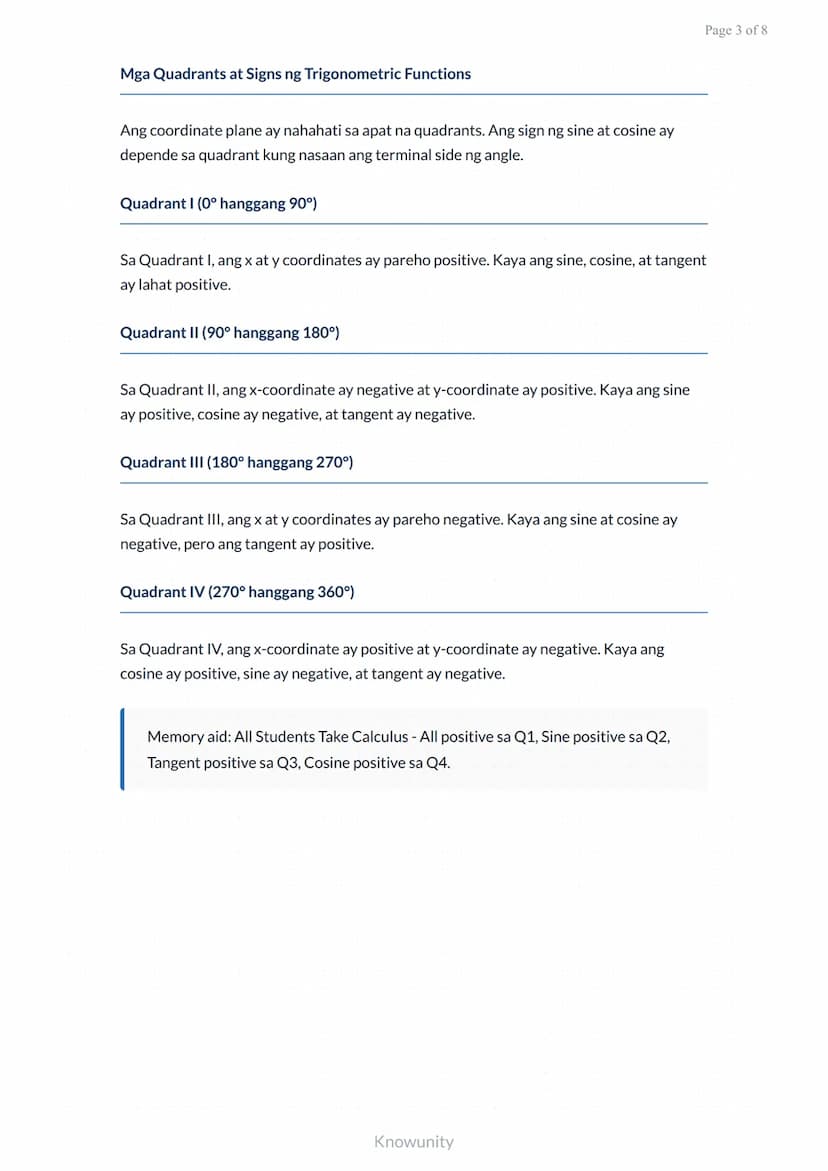
Sa 30° π/6radians, ang exact values ay cos 30° = 23, sin 30° = 21, at tan 30° = 31. These fractional values will appear constantly in your problems!
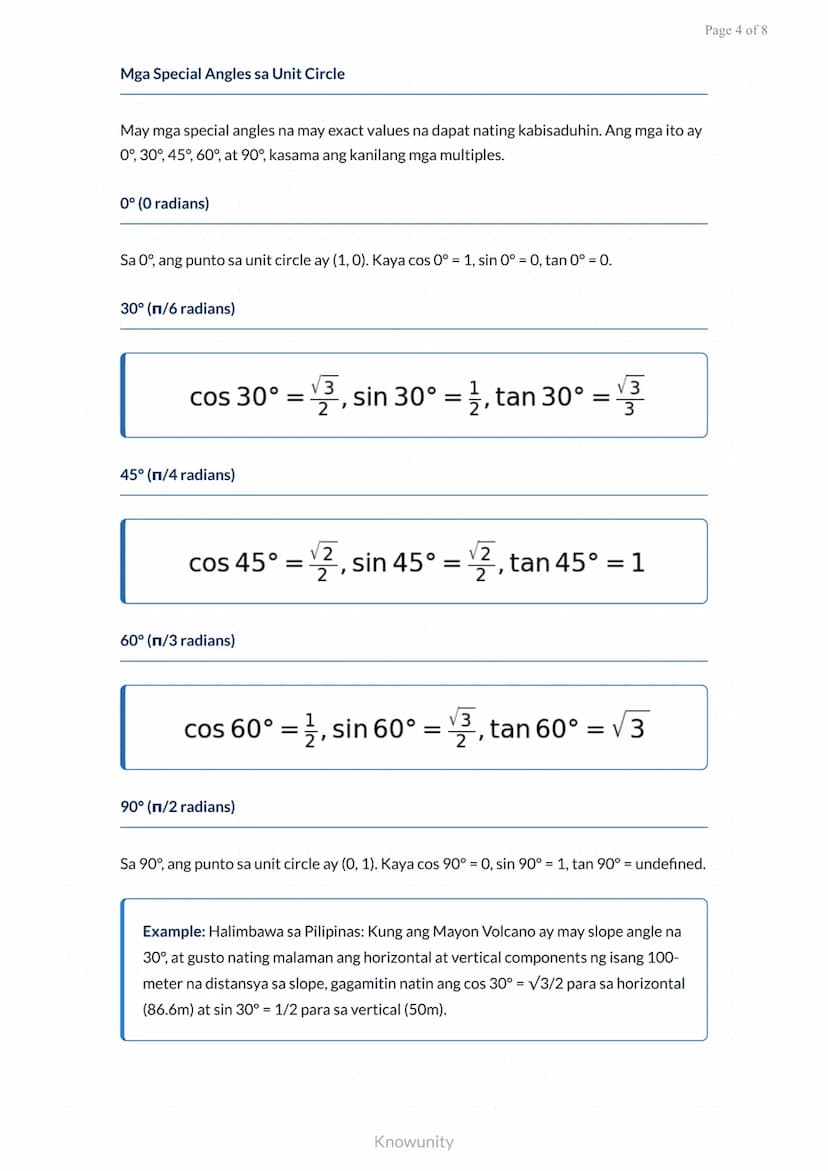
Sa 45° π/4radians, ang punto ay $\frac{\sqrt{2}}{2}$, $\frac{\sqrt{2}}{2}$, giving us cos 45° = sin 45° = 22 at tan 45° = 1. Notice how at 45°, sine equals cosine!
Sa 60° π/3radians, we have cos 60° = 21, sin 60° = 23, at tan 60° = 3. Notice how the sine and cosine values are flipped from 30°!
Real-Life Application: Kung nagtatatayo ka ng bahay sa slope na 30°, at kailangan mong i-calculate ang horizontal distance, gamitin mo ang cosine! Para sa 100-meter na slope distance, ang horizontal distance ay 100 × cos 30° = 100 × 23 ≈ 86.6 meters.
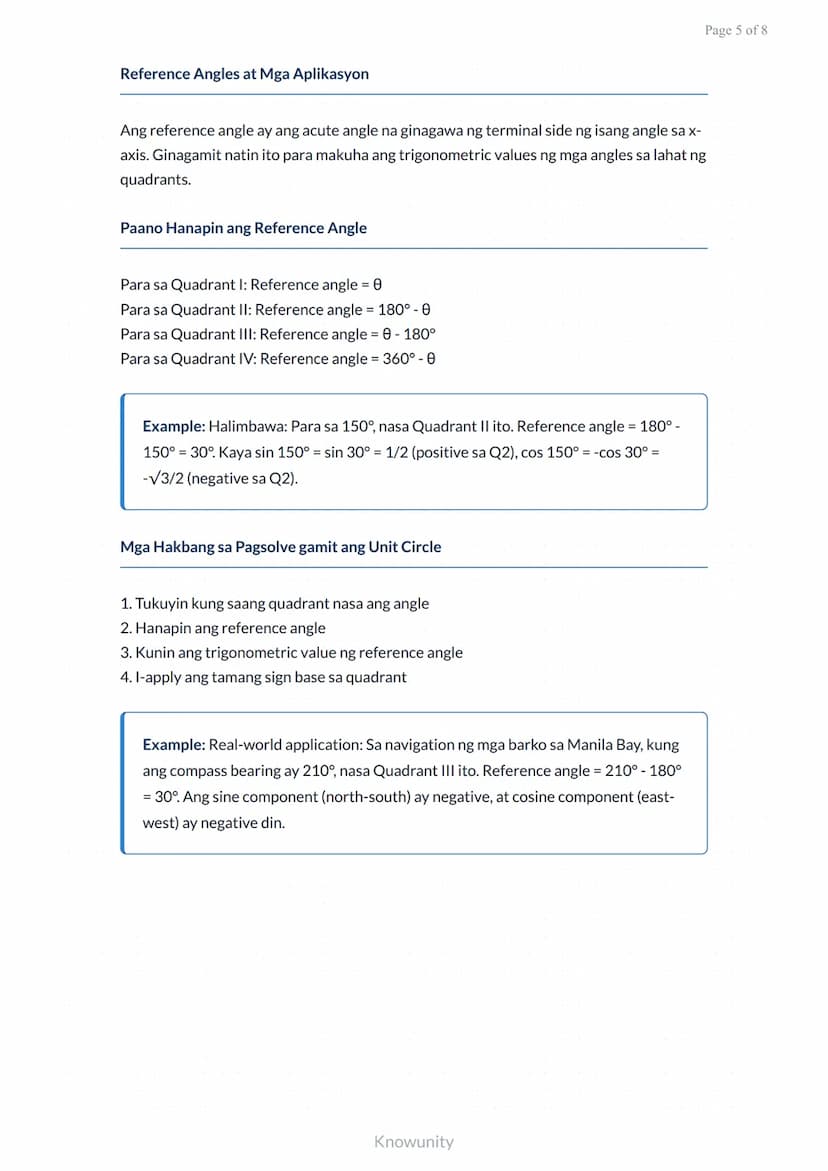
Reference Angles at Mga Aplikasyon
Paano kung hindi special angle ang binigay sa iyo? No worries! Reference angles will save you by connecting any angle to its equivalent special angle.
Ang reference angle ay ang positive acute angle na formed between the terminal side of an angle at ang x-axis. It's your shortcut to finding trig values for any angle!
Para sa Quadrant I, ang reference angle ay equal lang sa angle θ (simplest case).
Para sa Quadrant II, ang reference angle ay 180° - θ. For example, for 150°, the reference angle is 180° - 150° = 30°.
Para sa Quadrant III, ang formula ay θ - 180°. For 210°, that's 210° - 180° = 30°.
Para sa Quadrant IV, gamitin ang 360° - θ. So for 315°, we get 360° - 315° = 45°.
Once you have the reference angle, get the trig value for that reference angle, then apply the appropriate sign based on the quadrant. For example, sin 150° = sin 30° = 1/2 (positive in Q2), while cos 150° = -cos 30° = -√3/2 (negative in Q2).
Real-World Connection: When navigating ships or planes, directions are given in degrees from 0° to 360°. Using reference angles helps pilots and navigators quickly calculate their true position relative to their destination!
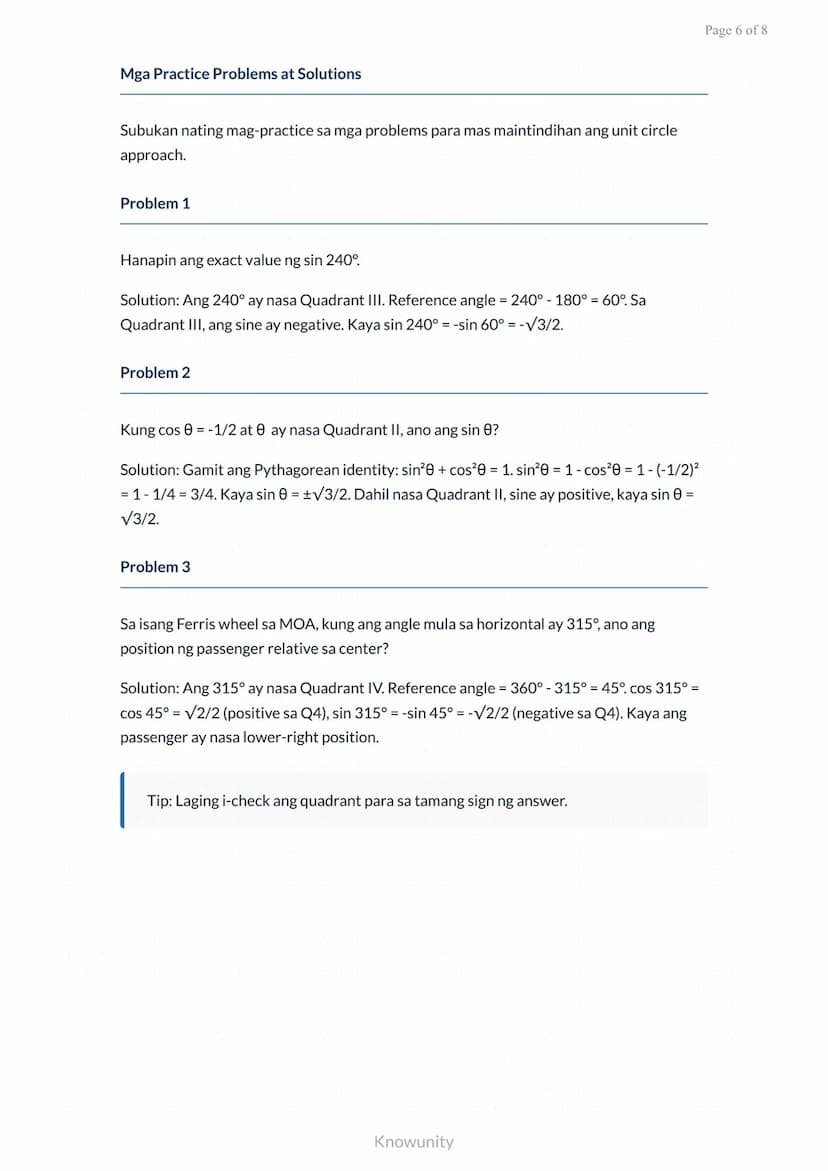
Mga Practice Problems at Solutions
Let's put your unit circle knowledge to work with some practice problems. Don't worry if you find these challenging at first - practice makes perfect!
Problem 1: Hanapin ang exact value ng sin 240°.
Step 1: Identify quadrant - 240° is in Quadrant III
Step 2: Find reference angle = 240° - 180° = 60°
Step 3: In Quadrant III, sine is negative
Step 4: sin 240° = -sin 60° = -23
Problem 2: Kung cos θ = -1/2 at θ ay nasa Quadrant II, ano ang sin θ?
Using the Pythagorean identity: sin²θ + cos²θ = 1
sin²θ = 1 - cos²θ = 1 - (-1/2)² = 1 - 1/4 = 3/4
sin θ = ±3/4 = ±23
Since θ is in Quadrant II, sine is positive, so sin θ = 23
Problem 3: Sa isang Ferris wheel, kung ang angle mula sa horizontal ay 315°, ano ang position ng passenger relative sa center?
The angle 315° is in Quadrant IV with reference angle 45°
cos 315° = cos 45° = 22 (positive in Q4)
sin 315° = -sin 45° = -22 (negative in Q4)
So the passenger is in the lower-right position!
Remember: Always check which quadrant the angle is in to get the correct sign. Most errors happen when students forget this crucial step!
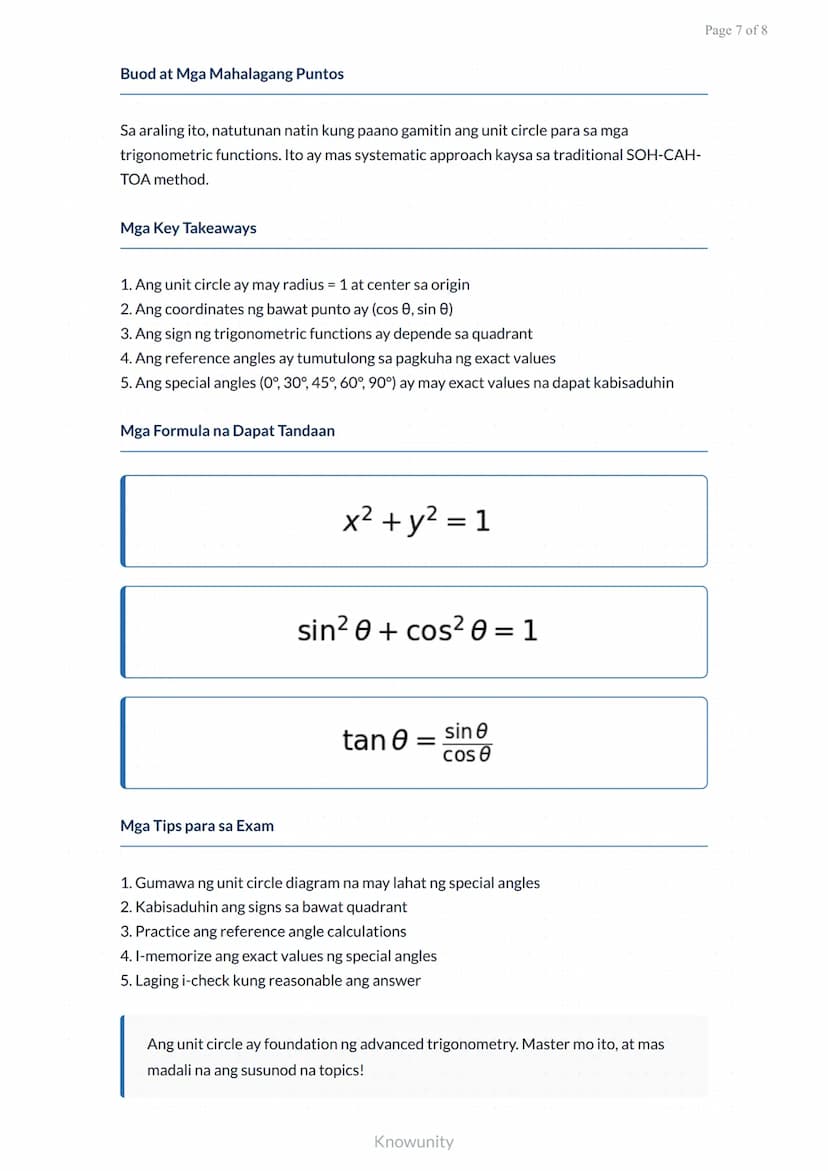
Buod at Mga Mahalagang Puntos
Congrats! You've completed your journey through the unit circle. Let's review what you've learned and how you can apply it.
The unit circle approach gives us a visual, geometric understanding of trigonometric functions. It's more intuitive than memorizing formulas and works for all angles, not just those in standard position.
Remember these key concepts:
The unit circle has radius 1 and center at (0,0)
For any point (x,y) on the circle, x = cos θ and y = sin θ
The sign of trig functions depends on the quadrant
Reference angles connect any angle to a special angle
Special angles (0°, 30°, 45°, 60°, 90°) have exact values you should memorize
The most important formulas to remember are:
x2+y2=1 (equation of unit circle)
sin2θ+cos2θ=1 (Pythagorean identity)
tanθ=cosθsinθ (relationship between tangent, sine and cosine)
Exam Success Tip: Create your own unit circle diagram with all special angles marked. Practice drawing it from memory until you can recreate it quickly during exams - it will be your secret weapon!
Akala namin hindi mo na itatanong...
Ano ang Knowunity AI companion?
Ang aming AI Companion ay isang AI tool na nakatuon sa mga estudyante na nag-aalok ng higit pa sa mga sagot lang. Binuo mula sa milyong Knowunity resources, nagbibigay ito ng may-kaugnayang impormasyon, personalized na study plans, quizzes, at content direkta sa chat, na umaangkop sa iyong sariling learning journey.
Saan ko mada-download ang Knowunity app?
Maaari mong i-download ang app mula sa Google Play Store at Apple App Store.
Talaga bang libre ang Knowunity?
Tama 'yan! Mag-enjoy sa libreng access sa mga study content, makipag-connect sa kapwa mga estudyante, at kumuha ng instant na tulong – lahat nasa iyong daliri lang.
Hindi mo mahanap ang hinahanap mo? Tuklasin ang iba pang mga asignatura.
Gustong-gusto kami ng mga estudyante — at magiging ganoon ka rin.
4.6/5
App Store
4.7/5
Google Play
Napakadaling gamitin at maganda ang disenyo ng app. Nahanap ko lahat ng hinahanap ko hanggang ngayon at natuto ako ng marami mula sa mga presentasyon! Tiyak na gagamitin ko ang app para sa isang takdang-aralin sa klase! At siyempre, nakakatulong din ito bilang inspirasyon.
Stefan S
gumagamit ng iOS
Sobrang ganda talaga ng app na ito. Maraming mga study notes at tulong [...]. Ang problemang subject ko ay Pranses, halimbawa, at ang app ay may maraming options para tumulong. Salamat sa app na ito, bumuti ang Pranses ko. Irerekumenda ko ito sa lahat.
Samantha Klich
Android user
Wow, talagang namangha ako. Sinubukan ko lang ang app dahil nakita ko itong ina-advertise nang maraming beses at sobrang nagulat ako. Ang app na ito ang TULONG na gusto mo para sa paaralan at higit sa lahat, nag-aalok ito ng maraming bagay, tulad ng workouts at fact sheets, na SOBRANG nakatulong sa akin.
Anna
iOS user
Pinakamagandang app sa mundo! walang masabi dahil sobrang ganda nito
Thomas R
iOS user
Napakaganda talaga. Nakakapag-review ako ng 10x mas mabuti, itong app ay mabilis na 10/10. Lubos kong inirerekomenda ito sa lahat. Pwede akong manood at maghanap ng notes. Pwede kong i-save ang mga ito sa subject folder. Pwede kong i-review anumang oras kapag bumalik ako. Kung hindi mo pa nasubukan ang app na ito, marami kang nawawala.
Basil
Android user
Ang app na ito ay nagpapalakas ng loob ko sa paghahanda sa exams, hindi lang dahil sa pagpapataas ng aking kumpiyansa sa sarili sa pamamagitan ng mga feature na nagpapahintulot sa iyo na makipag-connect sa iba at mabawasan ang pakiramdam na nag-iisa, kundi pati na rin sa paraan na nakatuon ang app sa pagpapagaan ng iyong pakiramdam. Madali itong i-navigate, masaya gamitin, at nakakatulong sa sinumang nahihirapan sa kahit anong paraan.
David K
iOS user
Sobrang galing ng app! Ilalagay ko lang ang paksa sa search bar at makakakuha na ako ng sagot kaagad. Hindi ko kailangang manood ng 10 YouTube videos para maintindihan ang isang bagay, kaya nakakatipid ako ng oras. Lubos na inirerekomenda!
Sudenaz Ocak
Android user
Sa paaralan, napakahina ko sa math pero salamat sa app, mas mahusay na ako ngayon. Lubos akong nagpapasalamat na ginawa niyo ang app na ito.
Greenlight Bonnie
Android user
napakareliable na app para tumulong at palawakin ang iyong mga ideya sa Math, English at iba pang mga related na paksa sa iyong mga gawain. gamitin mo ang app na ito kung nahihirapan ka sa mga area, susi ito para diyan. sana nag-review na ako dati. at libre rin ito kaya huwag mag-alala tungkol diyan.
Rohan U
Android user
Alam kong maraming apps gumagamit ng fake accounts para mapataas ang kanilang reviews pero ang app na ito ay deserve lahat ng papuri. Dati nakakakuha ako ng 4 sa aking English exams at ngayon nakakuha ako ng grade 7. Hindi ko pa alam ang app na ito tatlong araw bago ang exam at nakatulong ito ng SOBRA. Pakisuyong maniwala sa akin at gamitin ito dahil sigurado akong makikita mo rin ang mga pagbabago.
Xander S
iOS user
ANG MGA quiz AT flashcard SOBRANG HELPFUL AT I LOVE TALAGA SI Knowunity AI. PARANG CHATGPT LANG PERO MAS MATALINO!! NAKATULONG DIN SA MGA MASCARA PROBLEMS KO!! PATI NA RIN SA MGA TUNAY KONG subject! SYEMPRE 😍😁😲🤑💗✨🎀😮
Elisha
iOS user
Grabe talaga ang app na to. Sobrang nakakaboring sakin ang pagreview pero ginagawa ng app na to na sobrang dali mag-organize ng lahat at pwede mong tanungin ang libreng ai para subukin ang sarili mo kaya sobrang buti at madali mong ma-upload ang sarili mong mga bagay. highly recommend bilang isang taong nagte-take ng mocks ngayon
Paul T
iOS user
Napakadaling gamitin at maganda ang disenyo ng app. Nahanap ko lahat ng hinahanap ko hanggang ngayon at natuto ako ng marami mula sa mga presentasyon! Tiyak na gagamitin ko ang app para sa isang takdang-aralin sa klase! At siyempre, nakakatulong din ito bilang inspirasyon.
Stefan S
gumagamit ng iOS
Sobrang ganda talaga ng app na ito. Maraming mga study notes at tulong [...]. Ang problemang subject ko ay Pranses, halimbawa, at ang app ay may maraming options para tumulong. Salamat sa app na ito, bumuti ang Pranses ko. Irerekumenda ko ito sa lahat.
Samantha Klich
Android user
Wow, talagang namangha ako. Sinubukan ko lang ang app dahil nakita ko itong ina-advertise nang maraming beses at sobrang nagulat ako. Ang app na ito ang TULONG na gusto mo para sa paaralan at higit sa lahat, nag-aalok ito ng maraming bagay, tulad ng workouts at fact sheets, na SOBRANG nakatulong sa akin.
Anna
iOS user
Pinakamagandang app sa mundo! walang masabi dahil sobrang ganda nito
Thomas R
iOS user
Napakaganda talaga. Nakakapag-review ako ng 10x mas mabuti, itong app ay mabilis na 10/10. Lubos kong inirerekomenda ito sa lahat. Pwede akong manood at maghanap ng notes. Pwede kong i-save ang mga ito sa subject folder. Pwede kong i-review anumang oras kapag bumalik ako. Kung hindi mo pa nasubukan ang app na ito, marami kang nawawala.
Basil
Android user
Ang app na ito ay nagpapalakas ng loob ko sa paghahanda sa exams, hindi lang dahil sa pagpapataas ng aking kumpiyansa sa sarili sa pamamagitan ng mga feature na nagpapahintulot sa iyo na makipag-connect sa iba at mabawasan ang pakiramdam na nag-iisa, kundi pati na rin sa paraan na nakatuon ang app sa pagpapagaan ng iyong pakiramdam. Madali itong i-navigate, masaya gamitin, at nakakatulong sa sinumang nahihirapan sa kahit anong paraan.
David K
iOS user
Sobrang galing ng app! Ilalagay ko lang ang paksa sa search bar at makakakuha na ako ng sagot kaagad. Hindi ko kailangang manood ng 10 YouTube videos para maintindihan ang isang bagay, kaya nakakatipid ako ng oras. Lubos na inirerekomenda!
Sudenaz Ocak
Android user
Sa paaralan, napakahina ko sa math pero salamat sa app, mas mahusay na ako ngayon. Lubos akong nagpapasalamat na ginawa niyo ang app na ito.
Greenlight Bonnie
Android user
napakareliable na app para tumulong at palawakin ang iyong mga ideya sa Math, English at iba pang mga related na paksa sa iyong mga gawain. gamitin mo ang app na ito kung nahihirapan ka sa mga area, susi ito para diyan. sana nag-review na ako dati. at libre rin ito kaya huwag mag-alala tungkol diyan.
Rohan U
Android user
Alam kong maraming apps gumagamit ng fake accounts para mapataas ang kanilang reviews pero ang app na ito ay deserve lahat ng papuri. Dati nakakakuha ako ng 4 sa aking English exams at ngayon nakakuha ako ng grade 7. Hindi ko pa alam ang app na ito tatlong araw bago ang exam at nakatulong ito ng SOBRA. Pakisuyong maniwala sa akin at gamitin ito dahil sigurado akong makikita mo rin ang mga pagbabago.
Xander S
iOS user
ANG MGA quiz AT flashcard SOBRANG HELPFUL AT I LOVE TALAGA SI Knowunity AI. PARANG CHATGPT LANG PERO MAS MATALINO!! NAKATULONG DIN SA MGA MASCARA PROBLEMS KO!! PATI NA RIN SA MGA TUNAY KONG subject! SYEMPRE 😍😁😲🤑💗✨🎀😮
Elisha
iOS user
Grabe talaga ang app na to. Sobrang nakakaboring sakin ang pagreview pero ginagawa ng app na to na sobrang dali mag-organize ng lahat at pwede mong tanungin ang libreng ai para subukin ang sarili mo kaya sobrang buti at madali mong ma-upload ang sarili mong mga bagay. highly recommend bilang isang taong nagte-take ng mocks ngayon
Mga Pangunahing Trigonometric Functions sa Unit Circle
Ang Unit Circle ay isang powerful tool sa trigonometry na nagco-connect ng geometry at algebra. Sa circle na may radius na 1 at center sa (0,0), makikita natin kung paano nakukuha ang sine, cosine, at tangent values para sa lahat... Ipakita pa
Trigonometry at Unit Circle: Mga Trigonometric Functions
Ready ka na ba para sa exciting world ng trigonometry gamit ang unit circle? Sa topic na ito, aalamin natin kung paano kumakatawan ang mga punto sa unit circle sa trigonometric values.
Sa unit circle approach, mas madali nating makukuha ang exact values ng sine, cosine, at tangent sa iba't ibang angles. Hindi lang ito theoretical knowledge - gagamitin mo ito sa physics, engineering, at iba pang real-world applications!
Pagkatapos ng lesson na ito, kaya mo nang i-identify ang special angles, gamitin ang reference angles, at i-solve ang mga complex problems gamit ang unit circle. Trust me, kapag na-master mo ito, mas magiging madali ang iyong journey sa trigonometry.
Pro Tip: Visualize the unit circle as a tool that connects angles with coordinates - kapag nakita mo ang pattern, everything will click!
Imagine a perfect circle with radius 1 sa gitna ng coordinate plane - yan ang unit circle! It's like a map na nagko-connect ng angles at trigonometric values sa isang elegant way.
Ang unit circle ay may equation na x2+y2=1 at ang center nito ay nasa origin (0,0). Ang magic dito ay ang connection between coordinates at trig values: cosθ=x at sinθ=y. This means kapag alam mo ang coordinates ng isang point sa circle, alam mo na rin ang sine at cosine ng angle!
Halimbawa, kung may punto sa unit circle na (0.5, 0.866), ang cosine ng angle ay 0.5 at ang sine ay 0.866. Napakasimple diba? Sa approach na ito, nako-convert natin ang abstract concept ng trigonometry into simple coordinates na madaling makita at maintindihan.
Remember: Sa unit circle, lahat ng trigonometric values ay nakukuha mula sa coordinates ng mga punto - making it easier to visualize what these values actually represent!
Ang values ng sine, cosine, at tangent ay nagbabago ng sign depende sa quadrant kung saan ang angle ay nakaturo. Understanding this pattern will save you loads of time!
Sa Quadrant I (0° hanggang 90°), lahat ay positive - sine, cosine, at tangent! It's the happy quadrant where everything works nicely. Ang x at y coordinates dito ay parehong positive.
Sa Quadrant II (90° hanggang 180°), sine lang ang positive, while cosine at tangent ay negative. Dito, positive ang y-coordinate pero negative na ang x-coordinate.
Sa Quadrant III (180° hanggang 270°), tangent lang ang positive, while sine at cosine ay negative. Both x and y coordinates are negative in this quadrant.
Sa Quadrant IV (270° hanggang 360°), cosine lang ang positive, while sine at tangent ay negative. Dito, positive ang x-coordinate pero negative ang y-coordinate.
Memory Hack: Remember "All Students Take Calculus" - All trig functions positive in Q1, Sine positive in Q2, Tangent positive in Q3, Cosine positive in Q4!
Ang special angles (0°, 30°, 45°, 60°, 90°) at kanilang multiples ay super important dahil may exact values sila na paulit-ulit na gagamitin mo.
Sa 0° (0 radians), ang punto sa unit circle ay (1, 0), kaya cos 0° = 1, sin 0° = 0, at tan 0° = 0. Visualize this as starting at the rightmost point of the circle.
Sa 30° π/6radians, ang exact values ay cos 30° = 23, sin 30° = 21, at tan 30° = 31. These fractional values will appear constantly in your problems!
Sa 45° π/4radians, ang punto ay $\frac{\sqrt{2}}{2}$, $\frac{\sqrt{2}}{2}$, giving us cos 45° = sin 45° = 22 at tan 45° = 1. Notice how at 45°, sine equals cosine!
Sa 60° π/3radians, we have cos 60° = 21, sin 60° = 23, at tan 60° = 3. Notice how the sine and cosine values are flipped from 30°!
Real-Life Application: Kung nagtatatayo ka ng bahay sa slope na 30°, at kailangan mong i-calculate ang horizontal distance, gamitin mo ang cosine! Para sa 100-meter na slope distance, ang horizontal distance ay 100 × cos 30° = 100 × 23 ≈ 86.6 meters.
Paano kung hindi special angle ang binigay sa iyo? No worries! Reference angles will save you by connecting any angle to its equivalent special angle.
Ang reference angle ay ang positive acute angle na formed between the terminal side of an angle at ang x-axis. It's your shortcut to finding trig values for any angle!
Para sa Quadrant I, ang reference angle ay equal lang sa angle θ (simplest case).
Para sa Quadrant II, ang reference angle ay 180° - θ. For example, for 150°, the reference angle is 180° - 150° = 30°.
Para sa Quadrant III, ang formula ay θ - 180°. For 210°, that's 210° - 180° = 30°.
Para sa Quadrant IV, gamitin ang 360° - θ. So for 315°, we get 360° - 315° = 45°.
Once you have the reference angle, get the trig value for that reference angle, then apply the appropriate sign based on the quadrant. For example, sin 150° = sin 30° = 1/2 (positive in Q2), while cos 150° = -cos 30° = -√3/2 (negative in Q2).
Real-World Connection: When navigating ships or planes, directions are given in degrees from 0° to 360°. Using reference angles helps pilots and navigators quickly calculate their true position relative to their destination!
Let's put your unit circle knowledge to work with some practice problems. Don't worry if you find these challenging at first - practice makes perfect!
Problem 1: Hanapin ang exact value ng sin 240°.
Step 1: Identify quadrant - 240° is in Quadrant III
Step 2: Find reference angle = 240° - 180° = 60°
Step 3: In Quadrant III, sine is negative
Step 4: sin 240° = -sin 60° = -23
Problem 2: Kung cos θ = -1/2 at θ ay nasa Quadrant II, ano ang sin θ?
Using the Pythagorean identity: sin²θ + cos²θ = 1
sin²θ = 1 - cos²θ = 1 - (-1/2)² = 1 - 1/4 = 3/4
sin θ = ±3/4 = ±23
Since θ is in Quadrant II, sine is positive, so sin θ = 23
Problem 3: Sa isang Ferris wheel, kung ang angle mula sa horizontal ay 315°, ano ang position ng passenger relative sa center?
The angle 315° is in Quadrant IV with reference angle 45°
cos 315° = cos 45° = 22 (positive in Q4)
sin 315° = -sin 45° = -22 (negative in Q4)
So the passenger is in the lower-right position!
Remember: Always check which quadrant the angle is in to get the correct sign. Most errors happen when students forget this crucial step!
Congrats! You've completed your journey through the unit circle. Let's review what you've learned and how you can apply it.
The unit circle approach gives us a visual, geometric understanding of trigonometric functions. It's more intuitive than memorizing formulas and works for all angles, not just those in standard position.
Remember these key concepts:
The unit circle has radius 1 and center at (0,0)
For any point (x,y) on the circle, x = cos θ and y = sin θ
The sign of trig functions depends on the quadrant
Reference angles connect any angle to a special angle
Special angles (0°, 30°, 45°, 60°, 90°) have exact values you should memorize
The most important formulas to remember are:
x2+y2=1 (equation of unit circle)
sin2θ+cos2θ=1 (Pythagorean identity)
tanθ=cosθsinθ (relationship between tangent, sine and cosine)
Exam Success Tip: Create your own unit circle diagram with all special angles marked. Practice drawing it from memory until you can recreate it quickly during exams - it will be your secret weapon!
Ang aming AI Companion ay isang AI tool na nakatuon sa mga estudyante na nag-aalok ng higit pa sa mga sagot lang. Binuo mula sa milyong Knowunity resources, nagbibigay ito ng may-kaugnayang impormasyon, personalized na study plans, quizzes, at content direkta sa chat, na umaangkop sa iyong sariling learning journey.
Saan ko mada-download ang Knowunity app?
Maaari mong i-download ang app mula sa Google Play Store at Apple App Store.
Talaga bang libre ang Knowunity?
Tama 'yan! Mag-enjoy sa libreng access sa mga study content, makipag-connect sa kapwa mga estudyante, at kumuha ng instant na tulong – lahat nasa iyong daliri lang.
0
Smart Tools NEW
I-transform ang note na ito sa: ✓ 50+ Practice Questions✓ Interactive Flashcards✓ Full Mock Exam✓ Essay Outlines
Hindi mo mahanap ang hinahanap mo? Tuklasin ang iba pang mga asignatura.
Gustong-gusto kami ng mga estudyante — at magiging ganoon ka rin.
4.6/5
App Store
4.7/5
Google Play
Napakadaling gamitin at maganda ang disenyo ng app. Nahanap ko lahat ng hinahanap ko hanggang ngayon at natuto ako ng marami mula sa mga presentasyon! Tiyak na gagamitin ko ang app para sa isang takdang-aralin sa klase! At siyempre, nakakatulong din ito bilang inspirasyon.
Stefan S
gumagamit ng iOS
Sobrang ganda talaga ng app na ito. Maraming mga study notes at tulong [...]. Ang problemang subject ko ay Pranses, halimbawa, at ang app ay may maraming options para tumulong. Salamat sa app na ito, bumuti ang Pranses ko. Irerekumenda ko ito sa lahat.
Samantha Klich
Android user
Wow, talagang namangha ako. Sinubukan ko lang ang app dahil nakita ko itong ina-advertise nang maraming beses at sobrang nagulat ako. Ang app na ito ang TULONG na gusto mo para sa paaralan at higit sa lahat, nag-aalok ito ng maraming bagay, tulad ng workouts at fact sheets, na SOBRANG nakatulong sa akin.
Anna
iOS user
Pinakamagandang app sa mundo! walang masabi dahil sobrang ganda nito
Thomas R
iOS user
Napakaganda talaga. Nakakapag-review ako ng 10x mas mabuti, itong app ay mabilis na 10/10. Lubos kong inirerekomenda ito sa lahat. Pwede akong manood at maghanap ng notes. Pwede kong i-save ang mga ito sa subject folder. Pwede kong i-review anumang oras kapag bumalik ako. Kung hindi mo pa nasubukan ang app na ito, marami kang nawawala.
Basil
Android user
Ang app na ito ay nagpapalakas ng loob ko sa paghahanda sa exams, hindi lang dahil sa pagpapataas ng aking kumpiyansa sa sarili sa pamamagitan ng mga feature na nagpapahintulot sa iyo na makipag-connect sa iba at mabawasan ang pakiramdam na nag-iisa, kundi pati na rin sa paraan na nakatuon ang app sa pagpapagaan ng iyong pakiramdam. Madali itong i-navigate, masaya gamitin, at nakakatulong sa sinumang nahihirapan sa kahit anong paraan.
David K
iOS user
Sobrang galing ng app! Ilalagay ko lang ang paksa sa search bar at makakakuha na ako ng sagot kaagad. Hindi ko kailangang manood ng 10 YouTube videos para maintindihan ang isang bagay, kaya nakakatipid ako ng oras. Lubos na inirerekomenda!
Sudenaz Ocak
Android user
Sa paaralan, napakahina ko sa math pero salamat sa app, mas mahusay na ako ngayon. Lubos akong nagpapasalamat na ginawa niyo ang app na ito.
Greenlight Bonnie
Android user
napakareliable na app para tumulong at palawakin ang iyong mga ideya sa Math, English at iba pang mga related na paksa sa iyong mga gawain. gamitin mo ang app na ito kung nahihirapan ka sa mga area, susi ito para diyan. sana nag-review na ako dati. at libre rin ito kaya huwag mag-alala tungkol diyan.
Rohan U
Android user
Alam kong maraming apps gumagamit ng fake accounts para mapataas ang kanilang reviews pero ang app na ito ay deserve lahat ng papuri. Dati nakakakuha ako ng 4 sa aking English exams at ngayon nakakuha ako ng grade 7. Hindi ko pa alam ang app na ito tatlong araw bago ang exam at nakatulong ito ng SOBRA. Pakisuyong maniwala sa akin at gamitin ito dahil sigurado akong makikita mo rin ang mga pagbabago.
Xander S
iOS user
ANG MGA quiz AT flashcard SOBRANG HELPFUL AT I LOVE TALAGA SI Knowunity AI. PARANG CHATGPT LANG PERO MAS MATALINO!! NAKATULONG DIN SA MGA MASCARA PROBLEMS KO!! PATI NA RIN SA MGA TUNAY KONG subject! SYEMPRE 😍😁😲🤑💗✨🎀😮
Elisha
iOS user
Grabe talaga ang app na to. Sobrang nakakaboring sakin ang pagreview pero ginagawa ng app na to na sobrang dali mag-organize ng lahat at pwede mong tanungin ang libreng ai para subukin ang sarili mo kaya sobrang buti at madali mong ma-upload ang sarili mong mga bagay. highly recommend bilang isang taong nagte-take ng mocks ngayon
Paul T
iOS user
Napakadaling gamitin at maganda ang disenyo ng app. Nahanap ko lahat ng hinahanap ko hanggang ngayon at natuto ako ng marami mula sa mga presentasyon! Tiyak na gagamitin ko ang app para sa isang takdang-aralin sa klase! At siyempre, nakakatulong din ito bilang inspirasyon.
Stefan S
gumagamit ng iOS
Sobrang ganda talaga ng app na ito. Maraming mga study notes at tulong [...]. Ang problemang subject ko ay Pranses, halimbawa, at ang app ay may maraming options para tumulong. Salamat sa app na ito, bumuti ang Pranses ko. Irerekumenda ko ito sa lahat.
Samantha Klich
Android user
Wow, talagang namangha ako. Sinubukan ko lang ang app dahil nakita ko itong ina-advertise nang maraming beses at sobrang nagulat ako. Ang app na ito ang TULONG na gusto mo para sa paaralan at higit sa lahat, nag-aalok ito ng maraming bagay, tulad ng workouts at fact sheets, na SOBRANG nakatulong sa akin.
Anna
iOS user
Pinakamagandang app sa mundo! walang masabi dahil sobrang ganda nito
Thomas R
iOS user
Napakaganda talaga. Nakakapag-review ako ng 10x mas mabuti, itong app ay mabilis na 10/10. Lubos kong inirerekomenda ito sa lahat. Pwede akong manood at maghanap ng notes. Pwede kong i-save ang mga ito sa subject folder. Pwede kong i-review anumang oras kapag bumalik ako. Kung hindi mo pa nasubukan ang app na ito, marami kang nawawala.
Basil
Android user
Ang app na ito ay nagpapalakas ng loob ko sa paghahanda sa exams, hindi lang dahil sa pagpapataas ng aking kumpiyansa sa sarili sa pamamagitan ng mga feature na nagpapahintulot sa iyo na makipag-connect sa iba at mabawasan ang pakiramdam na nag-iisa, kundi pati na rin sa paraan na nakatuon ang app sa pagpapagaan ng iyong pakiramdam. Madali itong i-navigate, masaya gamitin, at nakakatulong sa sinumang nahihirapan sa kahit anong paraan.
David K
iOS user
Sobrang galing ng app! Ilalagay ko lang ang paksa sa search bar at makakakuha na ako ng sagot kaagad. Hindi ko kailangang manood ng 10 YouTube videos para maintindihan ang isang bagay, kaya nakakatipid ako ng oras. Lubos na inirerekomenda!
Sudenaz Ocak
Android user
Sa paaralan, napakahina ko sa math pero salamat sa app, mas mahusay na ako ngayon. Lubos akong nagpapasalamat na ginawa niyo ang app na ito.
Greenlight Bonnie
Android user
napakareliable na app para tumulong at palawakin ang iyong mga ideya sa Math, English at iba pang mga related na paksa sa iyong mga gawain. gamitin mo ang app na ito kung nahihirapan ka sa mga area, susi ito para diyan. sana nag-review na ako dati. at libre rin ito kaya huwag mag-alala tungkol diyan.
Rohan U
Android user
Alam kong maraming apps gumagamit ng fake accounts para mapataas ang kanilang reviews pero ang app na ito ay deserve lahat ng papuri. Dati nakakakuha ako ng 4 sa aking English exams at ngayon nakakuha ako ng grade 7. Hindi ko pa alam ang app na ito tatlong araw bago ang exam at nakatulong ito ng SOBRA. Pakisuyong maniwala sa akin at gamitin ito dahil sigurado akong makikita mo rin ang mga pagbabago.
Xander S
iOS user
ANG MGA quiz AT flashcard SOBRANG HELPFUL AT I LOVE TALAGA SI Knowunity AI. PARANG CHATGPT LANG PERO MAS MATALINO!! NAKATULONG DIN SA MGA MASCARA PROBLEMS KO!! PATI NA RIN SA MGA TUNAY KONG subject! SYEMPRE 😍😁😲🤑💗✨🎀😮
Elisha
iOS user
Grabe talaga ang app na to. Sobrang nakakaboring sakin ang pagreview pero ginagawa ng app na to na sobrang dali mag-organize ng lahat at pwede mong tanungin ang libreng ai para subukin ang sarili mo kaya sobrang buti at madali mong ma-upload ang sarili mong mga bagay. highly recommend bilang isang taong nagte-take ng mocks ngayon


 Science
 Econ
Econ Iba pa
 Filipino
 Social Studies