Trigonometry connects the angles and sides of triangles, creating powerful...
Mga Pundasyon ng Trigonometry: Degrees, Radians, at Functions


Mga Trigonometric Functions at Angles: Degrees at Radians
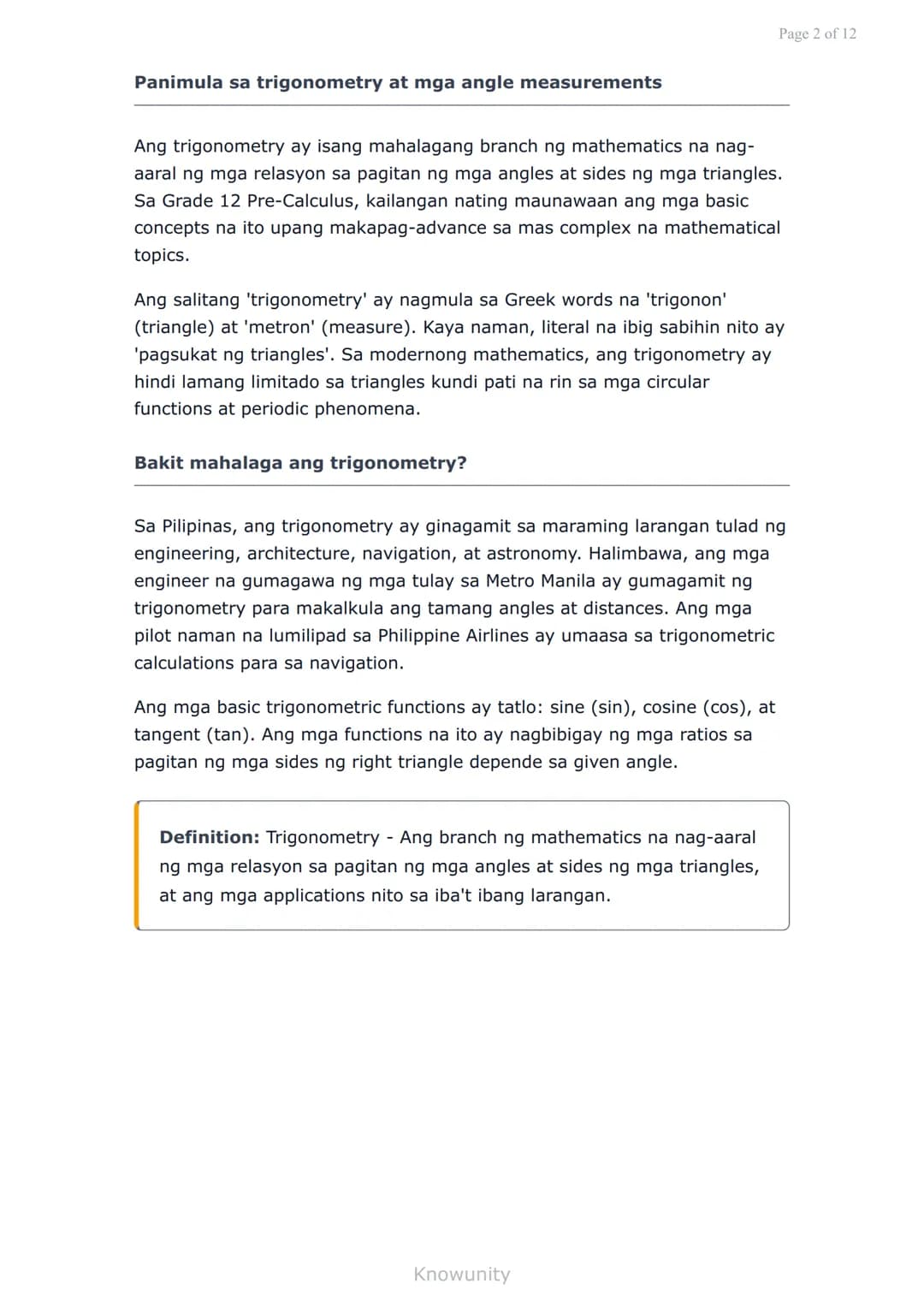
Trigonometry literally means "triangle measurement," originating from Greek words "trigonon" (triangle) and "metron" (measure). Though it began with triangles, modern trigonometry extends to circular functions and periodic phenomena.
In the Philippines, trigonometry has practical applications in engineering, architecture, navigation, and astronomy. Engineers designing bridges in Metro Manila use trigonometric calculations for precise angles and distances, while Philippine Airlines pilots rely on these principles for navigation.
The three basic trigonometric functions are sine (sin), cosine (cos), and tangent (tan). These functions express ratios between the sides of a right triangle based on a given angle.
Fun Fact: The mathematical concepts we're learning today help solve real problems throughout the Philippines - from building structures that can withstand typhoons to navigating ships through our archipelago!

Mga Basic Trigonometric Functions
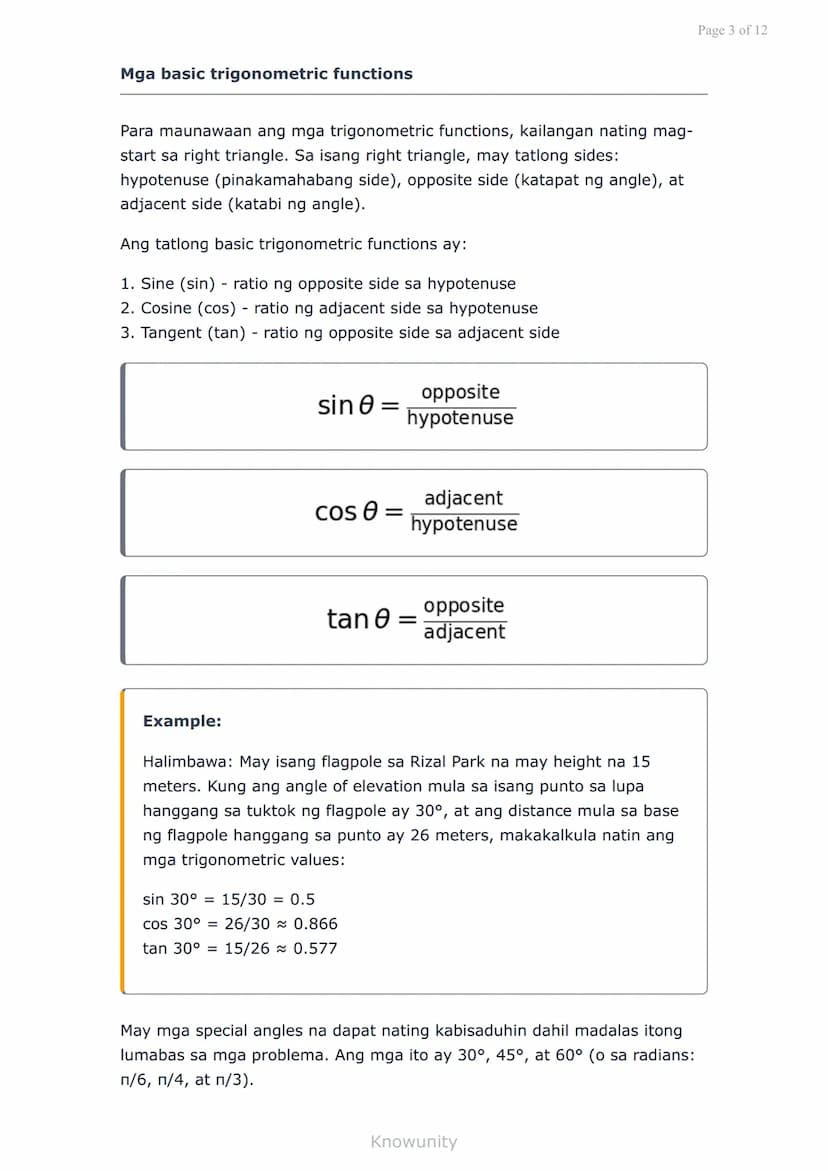
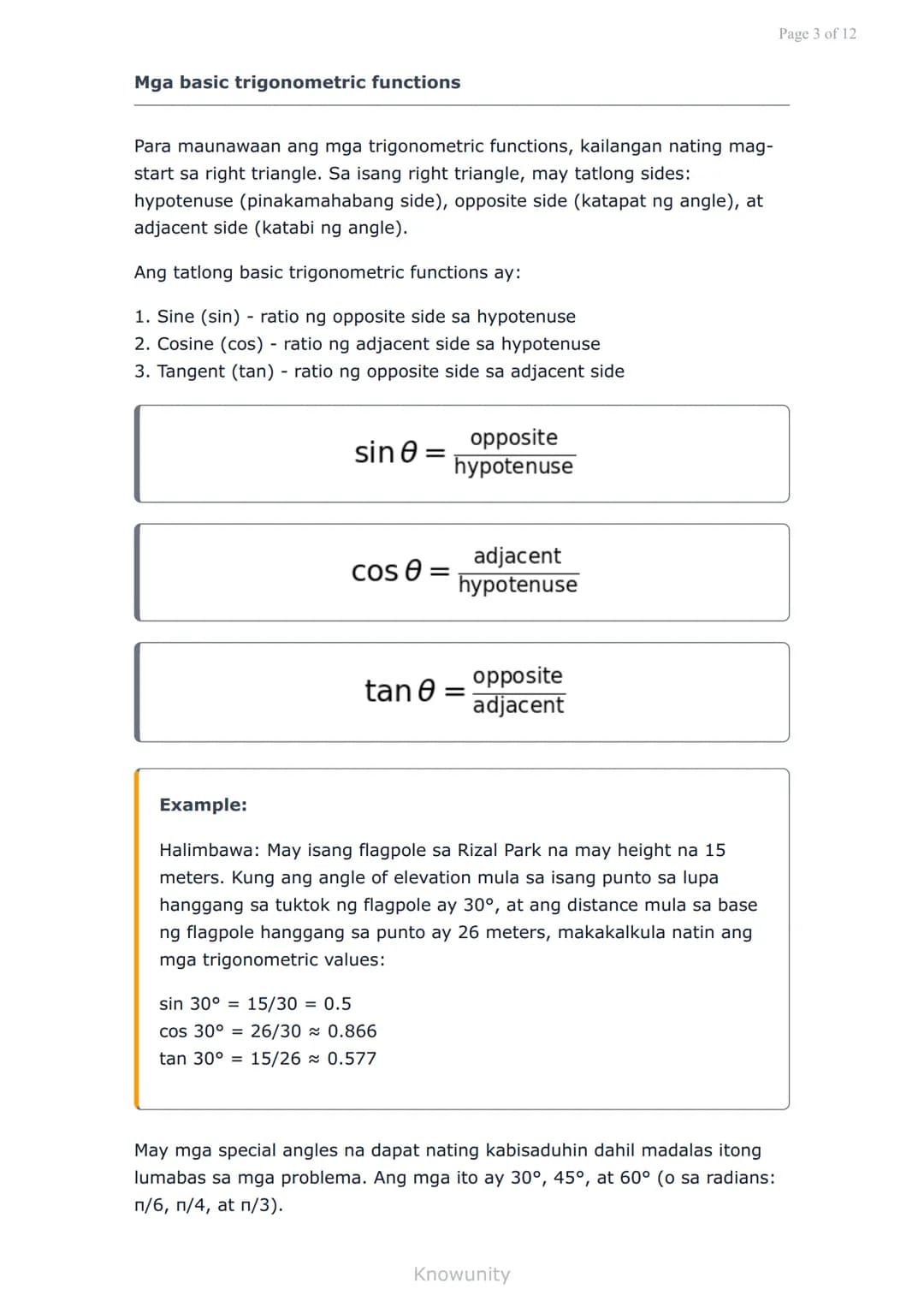
In a right triangle, we identify three sides: the hypotenuse (longest side), the opposite side (across from the angle), and the adjacent side (next to the angle). The three fundamental trigonometric functions represent ratios between these sides:
- Sine (sin) = opposite ÷ hypotenuse
- Cosine (cos) = adjacent ÷ hypotenuse
- Tangent (tan) = opposite ÷ adjacent
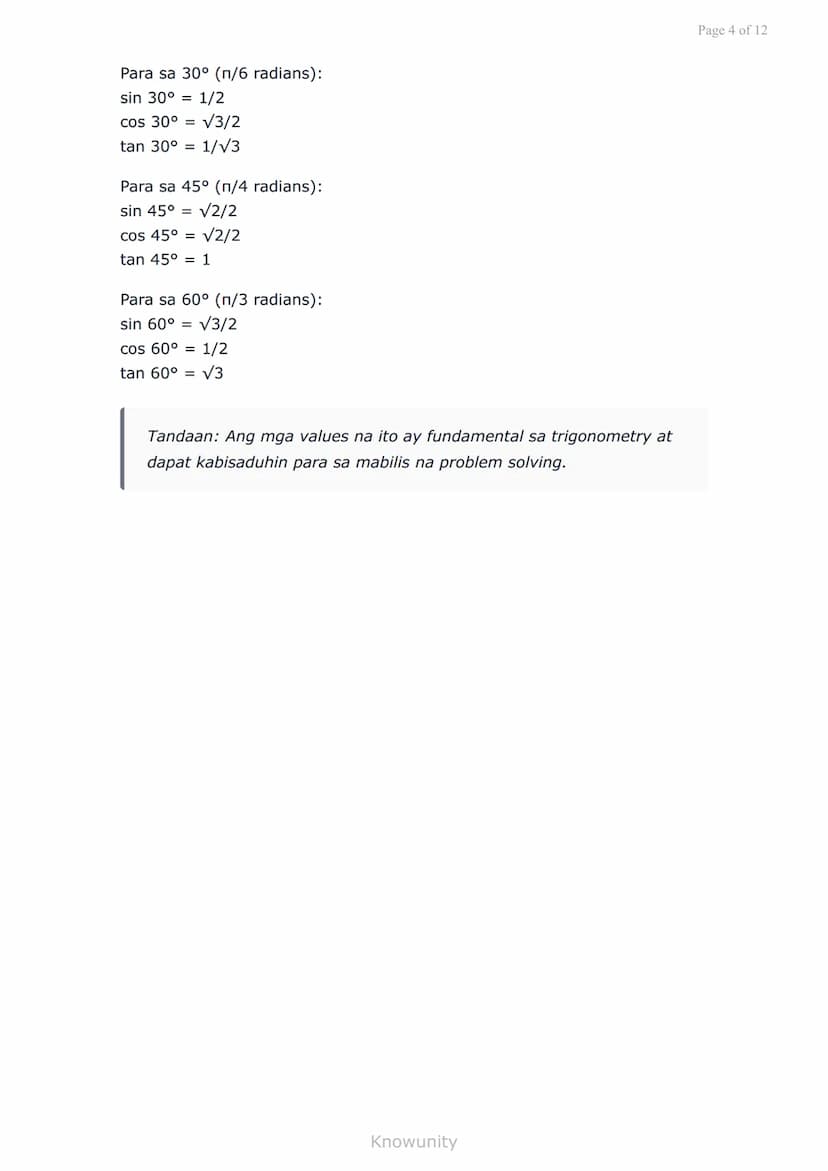
Let's apply this to a real example: A 15-meter flagpole at Rizal Park creates a 30° angle of elevation when viewed from 26 meters away. We can calculate that sin 30° = 0.5, cos 30° ≈ 0.866, and tan 30° ≈ 0.577.
Some angles appear frequently in problems and should be memorized: 30°, 45°, and 60° (or π/6, π/4, and π/3 in radians).
Pro Tip: Memorizing the values for special angles (30°, 45°, 60°) will save you time during exams and make problem-solving much faster!

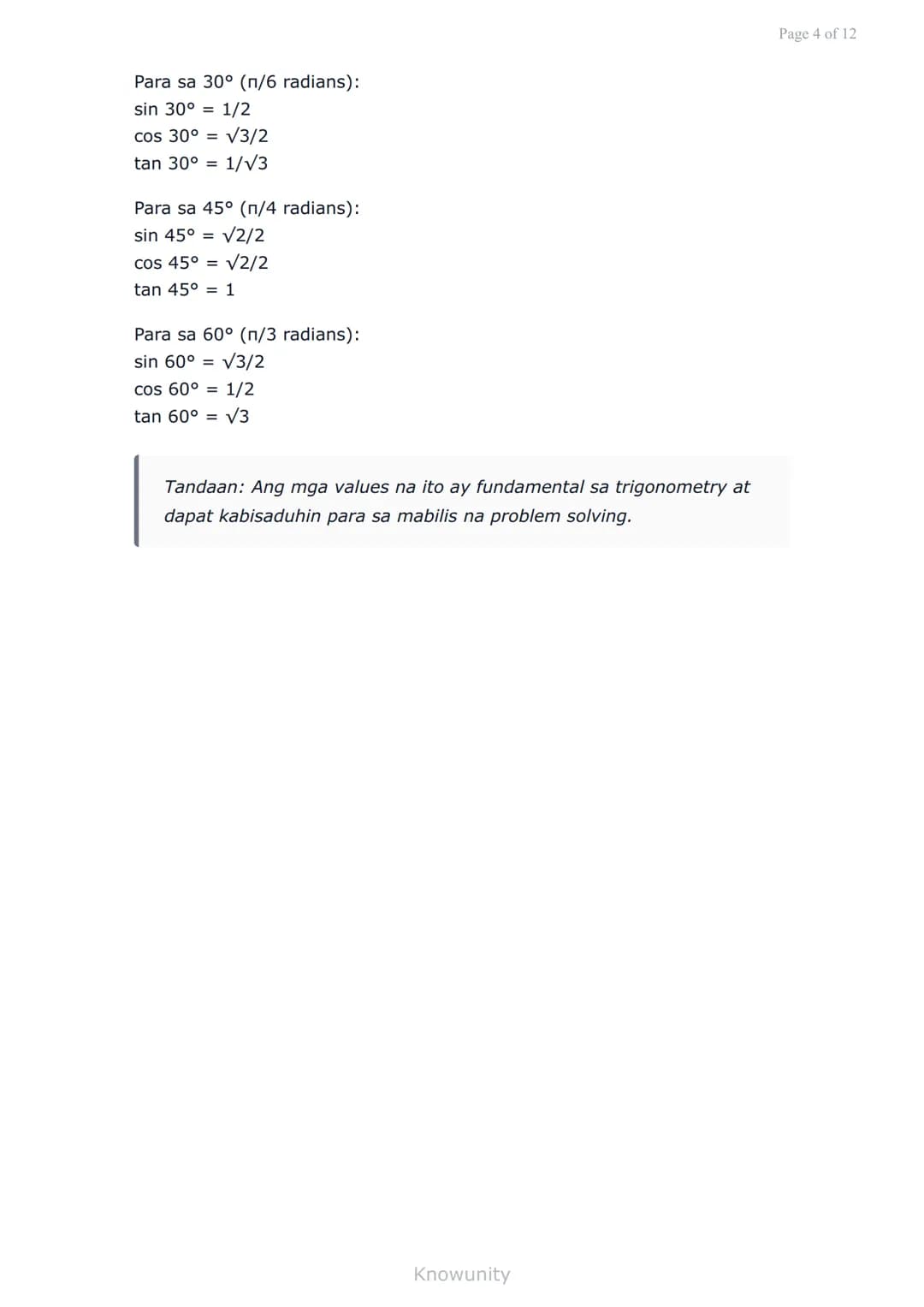
Special Angle Values
For 30° (π/6 radians):
- sin 30° = 1/2
- cos 30° = √3/2
- tan 30° = 1/√3
For 45° (π/4 radians):
- sin 45° = √2/2
- cos 45° = √2/2
- tan 45° = 1
For 60° (π/3 radians):
- sin 60° = √3/2
- cos 60° = 1/2
- tan 60° = √3
These special angle values form the foundation of trigonometric problem-solving. You'll use them repeatedly in various applications, from calculating heights and distances to solving complex physics problems.
Remember: These values aren't just random numbers to memorize - they're precise mathematical relationships derived from geometric principles. Understanding where they come from helps you remember them better!

Degrees at Radians: Mga Angle Measurements
In trigonometry, we measure angles in two main ways: degrees and radians. While degrees are more familiar in everyday life, radians are preferred in advanced mathematics.
The degree system divides a complete rotation into 360° - a convention from ancient Babylonians who used a base-60 number system. A radian, meanwhile, is a more natural unit directly related to circle properties. It's defined as the angle made by an arc with length equal to the radius.
Since a circle's circumference is 2πr, a complete rotation equals 2π radians. This gives us important equivalences:
- 360° = 2π radians
- 180° = π radians
- 90° = π/2 radians
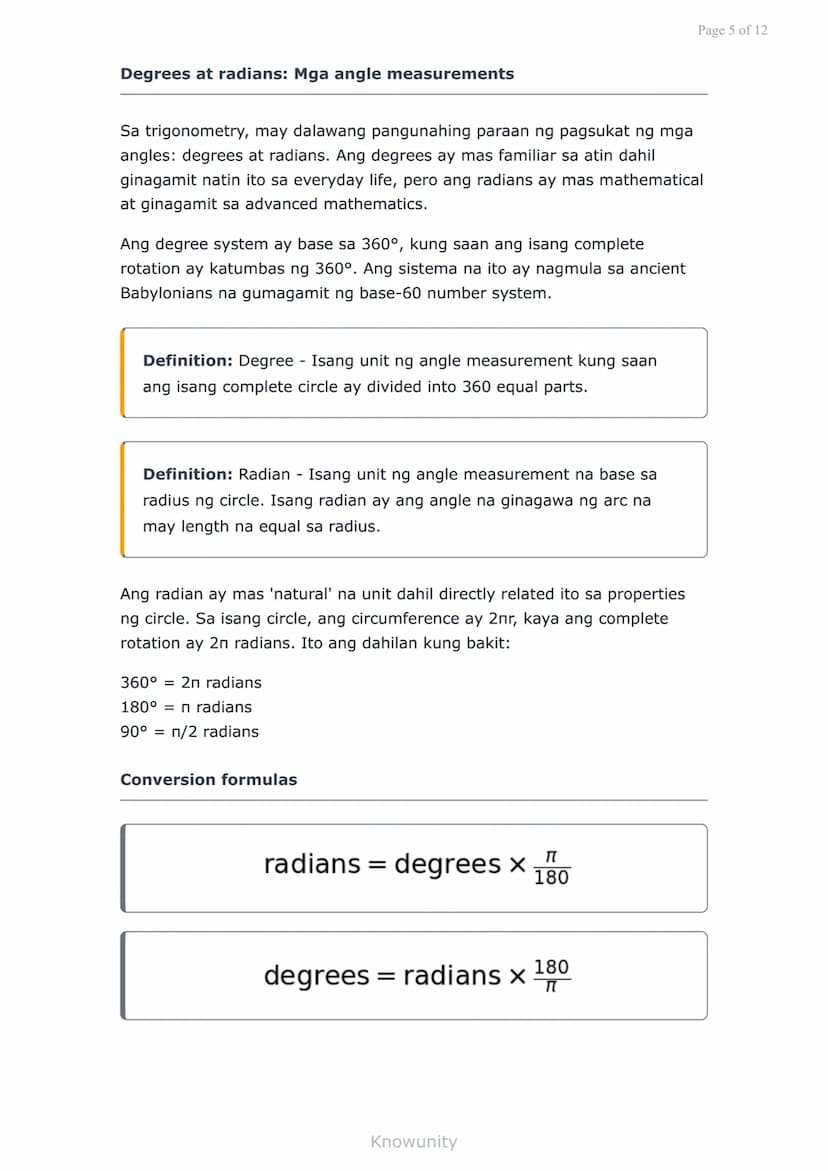
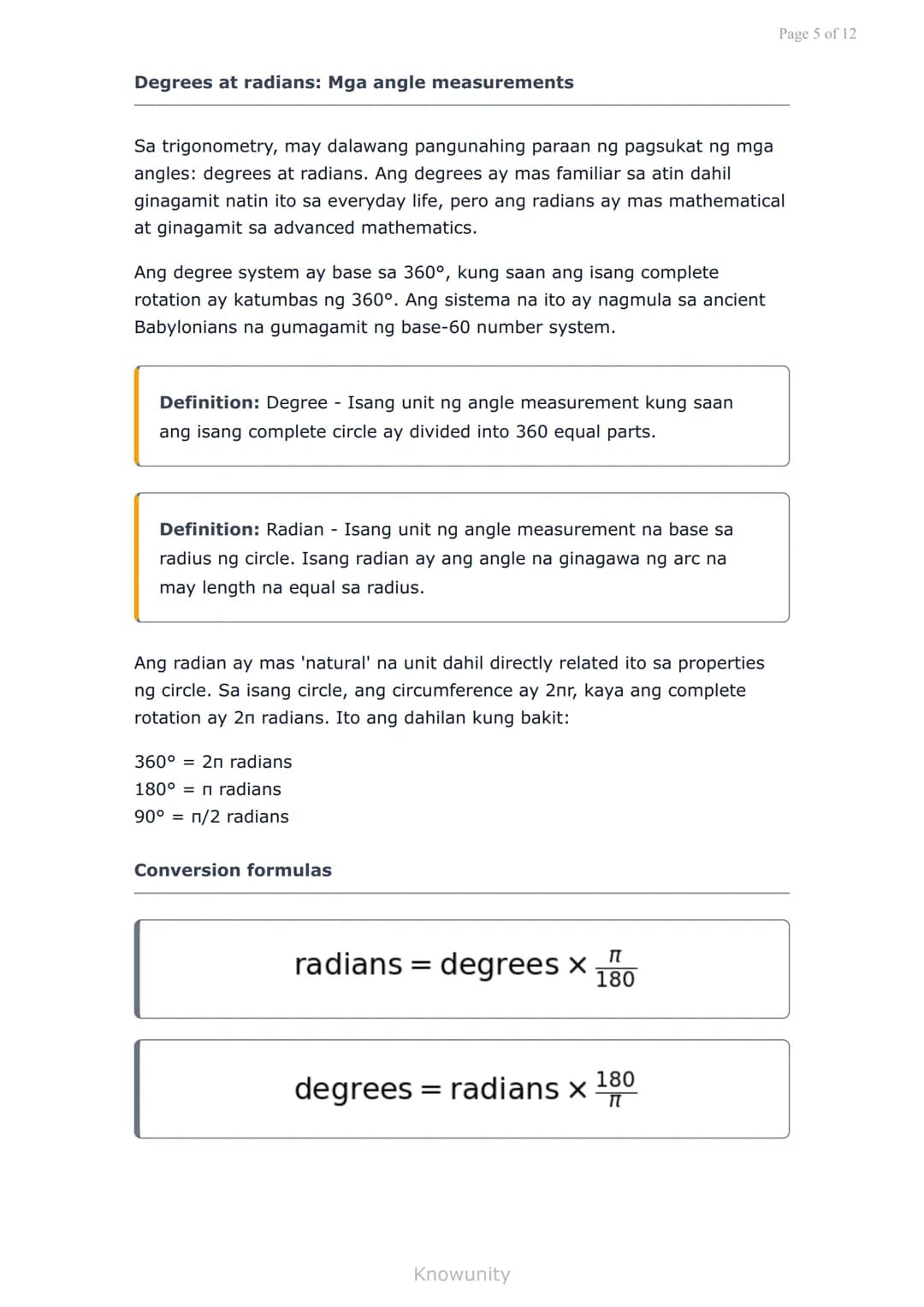
To convert between the two systems, use these formulas:
- radians = degrees ×
- degrees = radians ×
Calculator Tip: Always check if your calculator is in the correct mode (degree or radian) before computing trigonometric functions!

Conversion Examples
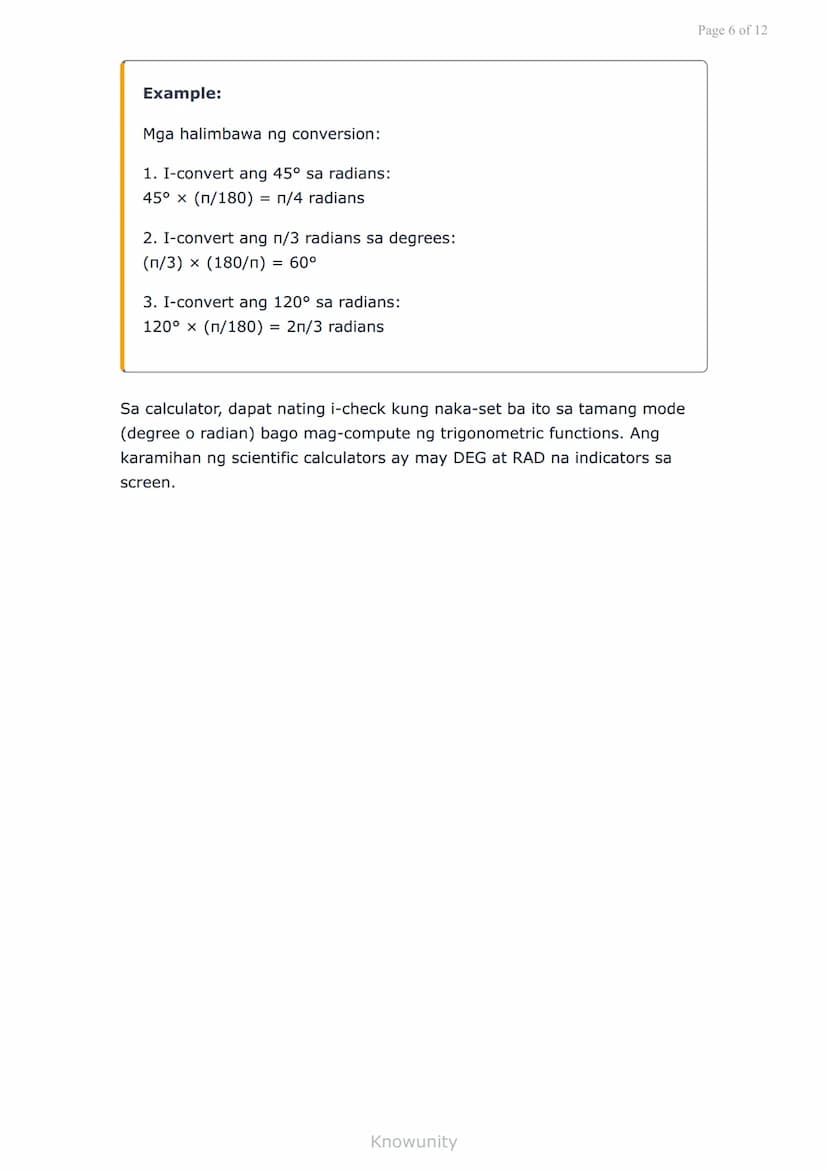
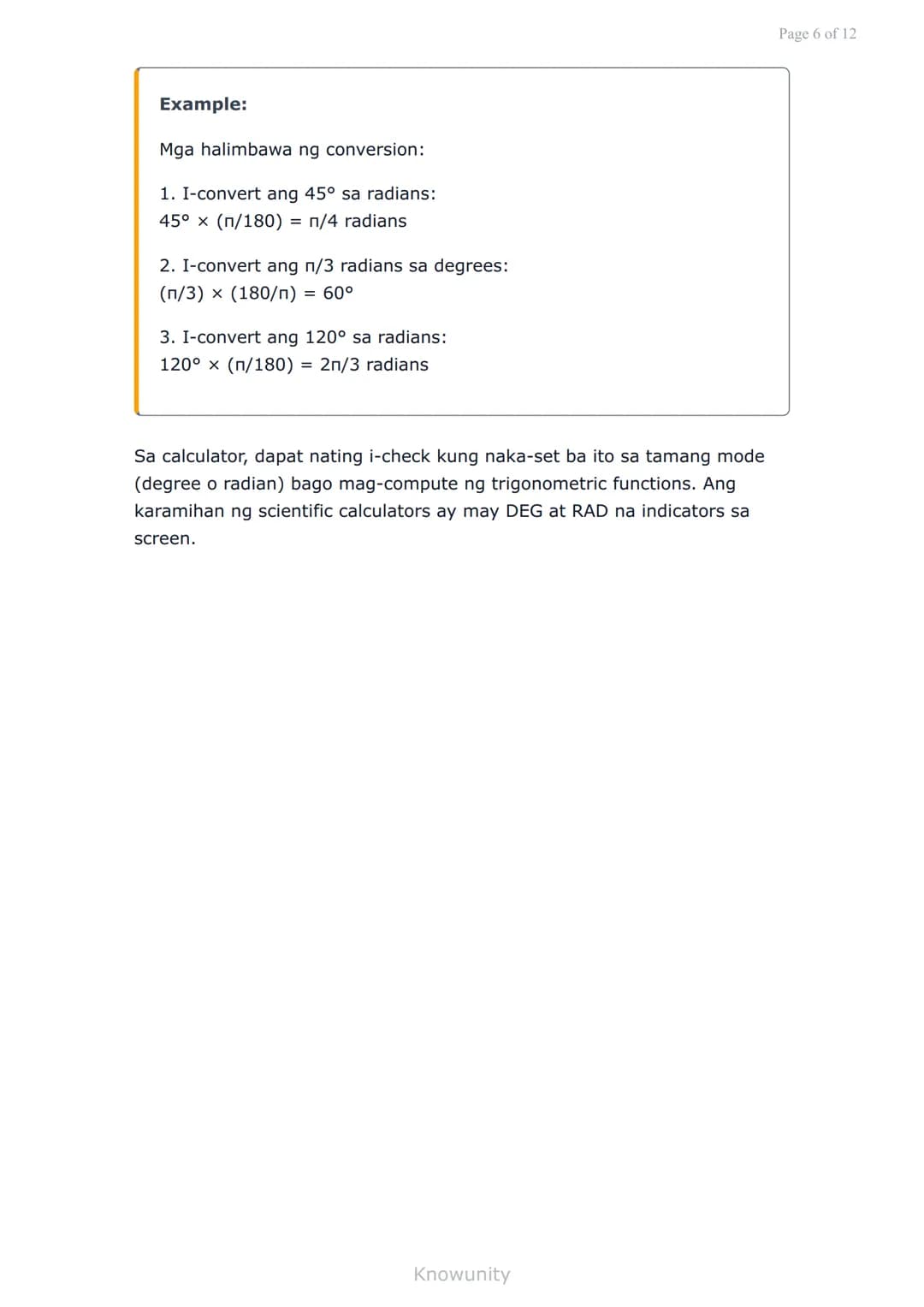
Converting between degrees and radians is straightforward with practice. Here are some examples:
-
Converting 45° to radians: 45° × = π/4 radians
-
Converting π/3 radians to degrees: × = 60°
-
Converting 120° to radians: 120° × = 2π/3 radians
These conversions are essential when working with different formulas or when your calculator uses a different unit than your problem. Many scientific calculators show DEG or RAD indicators on screen to help you keep track of which mode you're using.
Practical Advice: When in doubt about which unit to use, radians are generally preferred for calculus and theoretical work, while degrees are often better for practical applications and visualization.

Unit Circle at Trigonometric Values
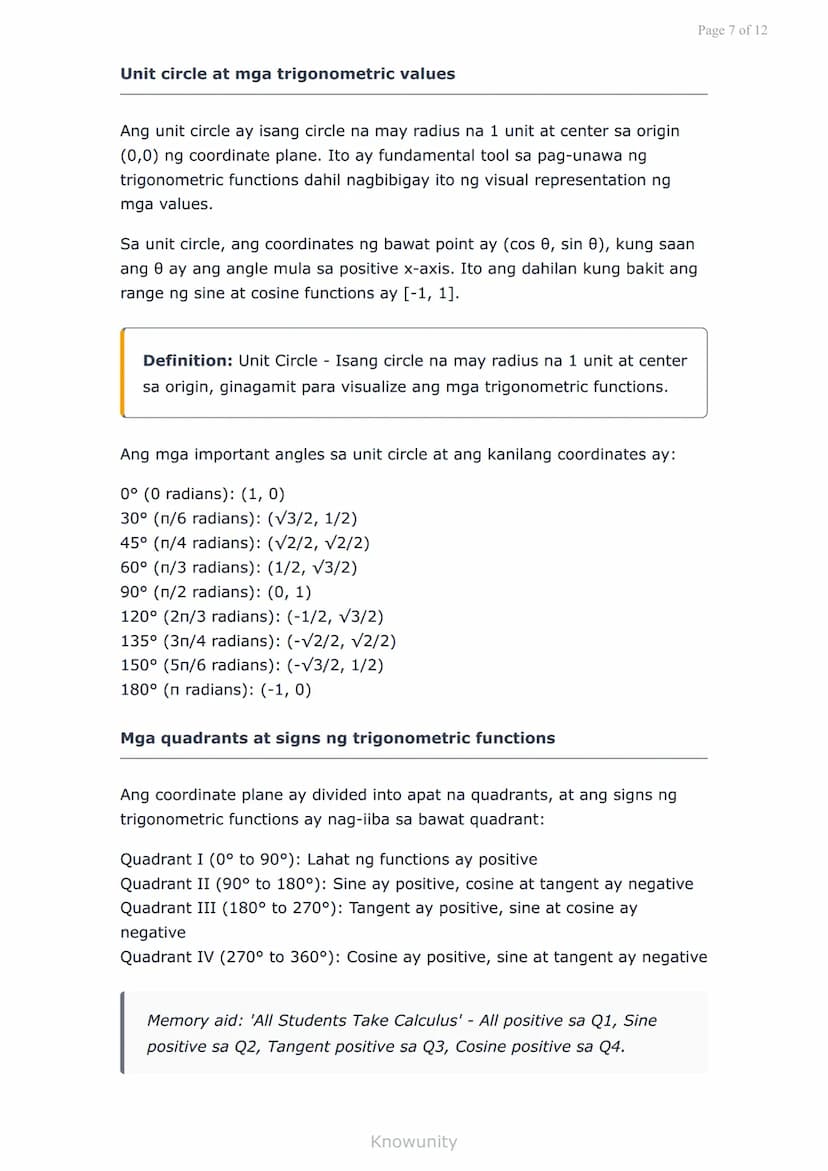
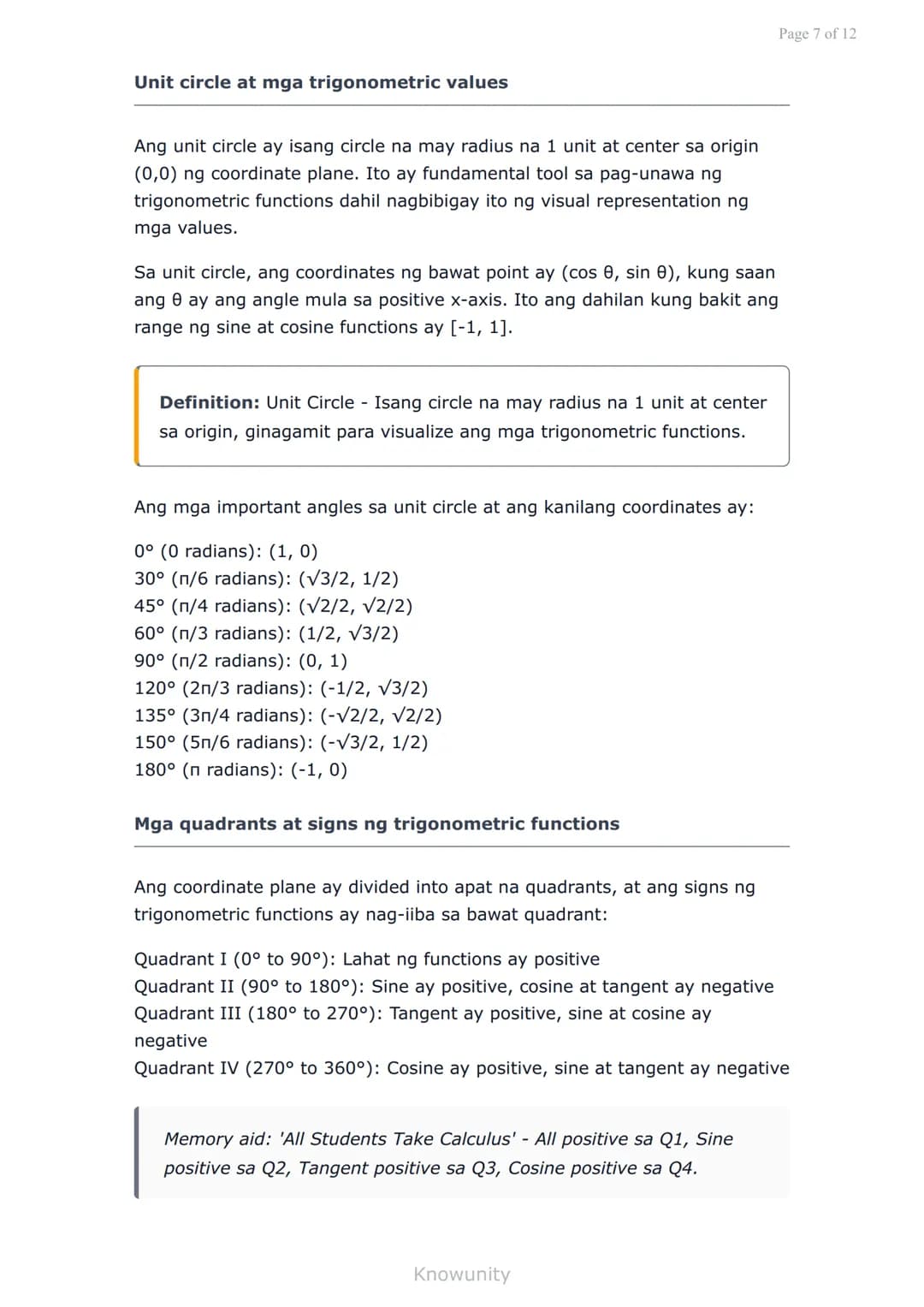
The unit circle is a circle with radius 1 centered at the origin (0,0) of the coordinate plane. It's a powerful visual tool for understanding trigonometric functions.
On the unit circle, the coordinates of any point are (cos θ, sin θ), where θ is the angle from the positive x-axis. This explains why sine and cosine always have values between -1 and 1.
Important angles on the unit circle and their coordinates include:
- 0° (0 radians): (1, 0)
- 30° (π/6 radians):
- 45° (π/4 radians):
- 90° (π/2 radians): (0, 1)
- 180° (π radians):
The coordinate plane is divided into four quadrants, and the signs of trigonometric functions change in each:
- Quadrant I: All functions positive
- Quadrant II: Only sine positive
- Quadrant III: Only tangent positive
- Quadrant IV: Only cosine positive
Memory Aid: "All Students Take Calculus" can help you remember which functions are positive in each quadrant!

Finding Exact Values Using Quadrants
Understanding how trigonometric functions behave in different quadrants helps us find exact values for any angle. Let's look at an example:
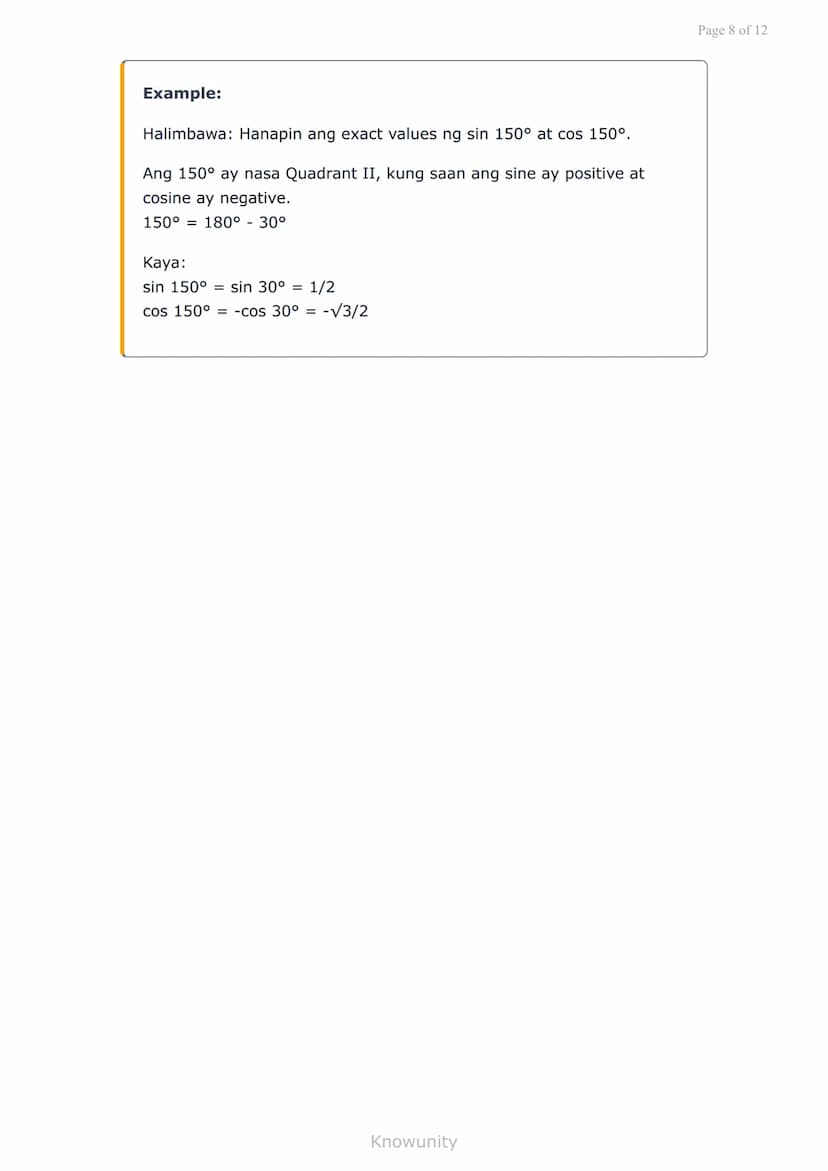
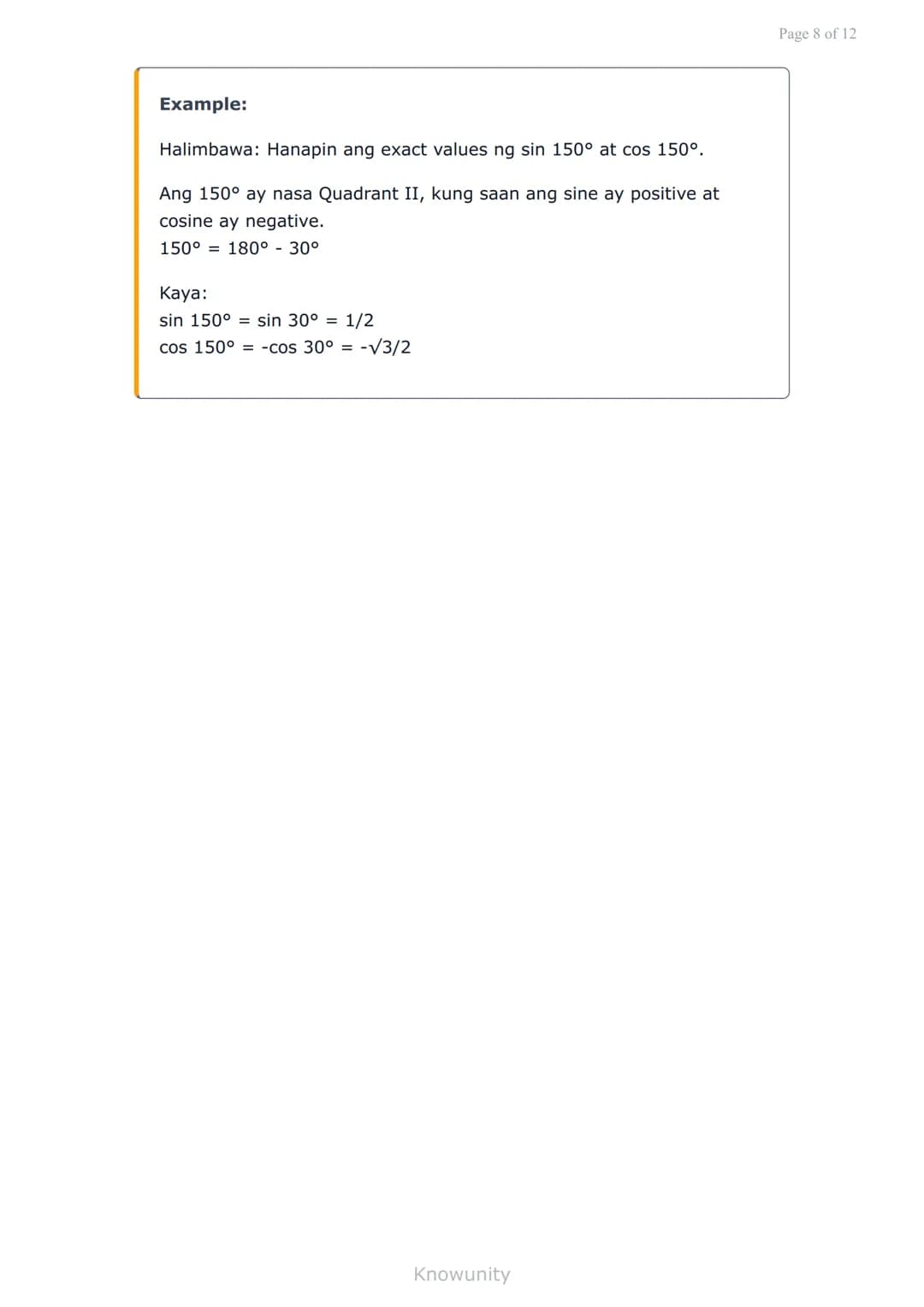
To find sin 150° and cos 150°:
- Identify that 150° is in Quadrant II, where sine is positive and cosine is negative
- Recognize that 150° = 180° - 30°
- Use reference angle: sin 150° = sin 30° = 1/2
- Use reference angle with correct sign: cos 150° = -cos 30° = -√3/2
This approach works for any angle. First, identify the quadrant, then find the reference angle (the acute angle formed with the x-axis), and finally apply the correct sign based on the quadrant.
Visualization Tip: Drawing a quick sketch of the unit circle can help you determine the correct signs and values for any angle.

Mga Aplikasyon sa Real-World Problems
Trigonometry has numerous practical applications, especially relevant in the Philippine archipelago. Let's explore how trigonometric functions solve real problems.
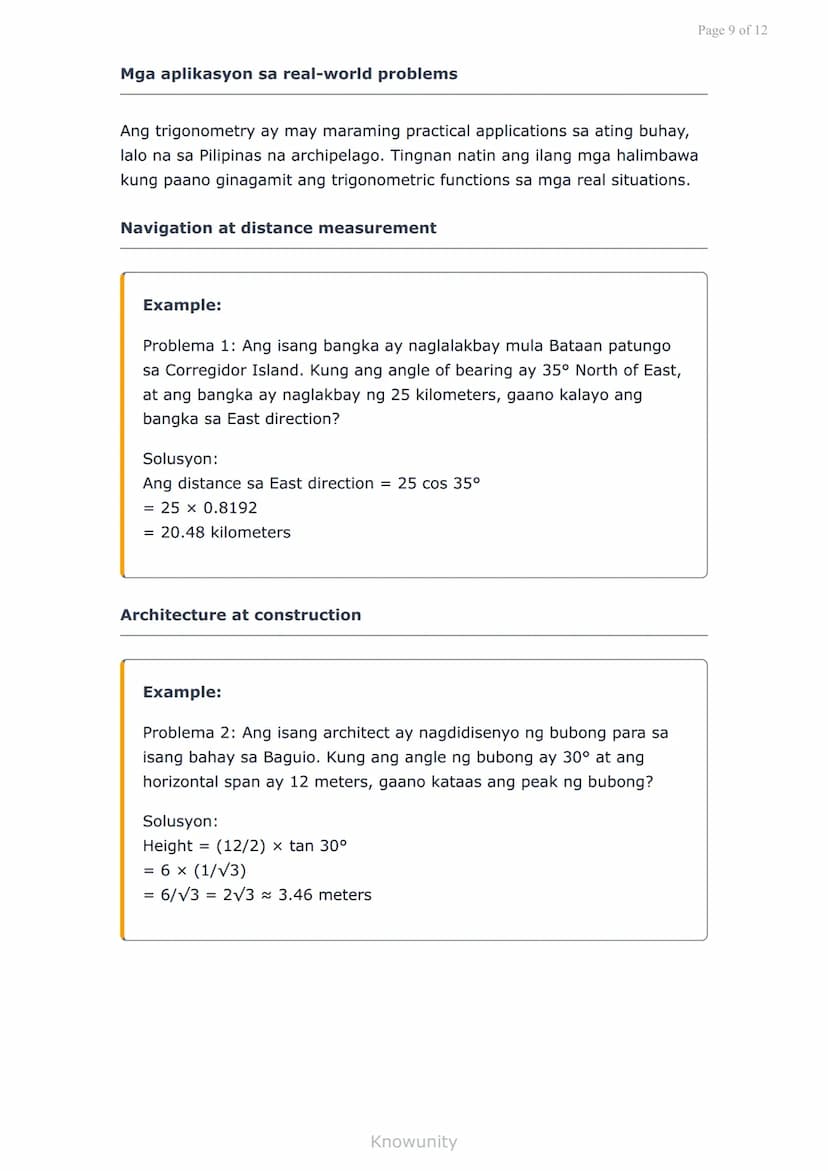
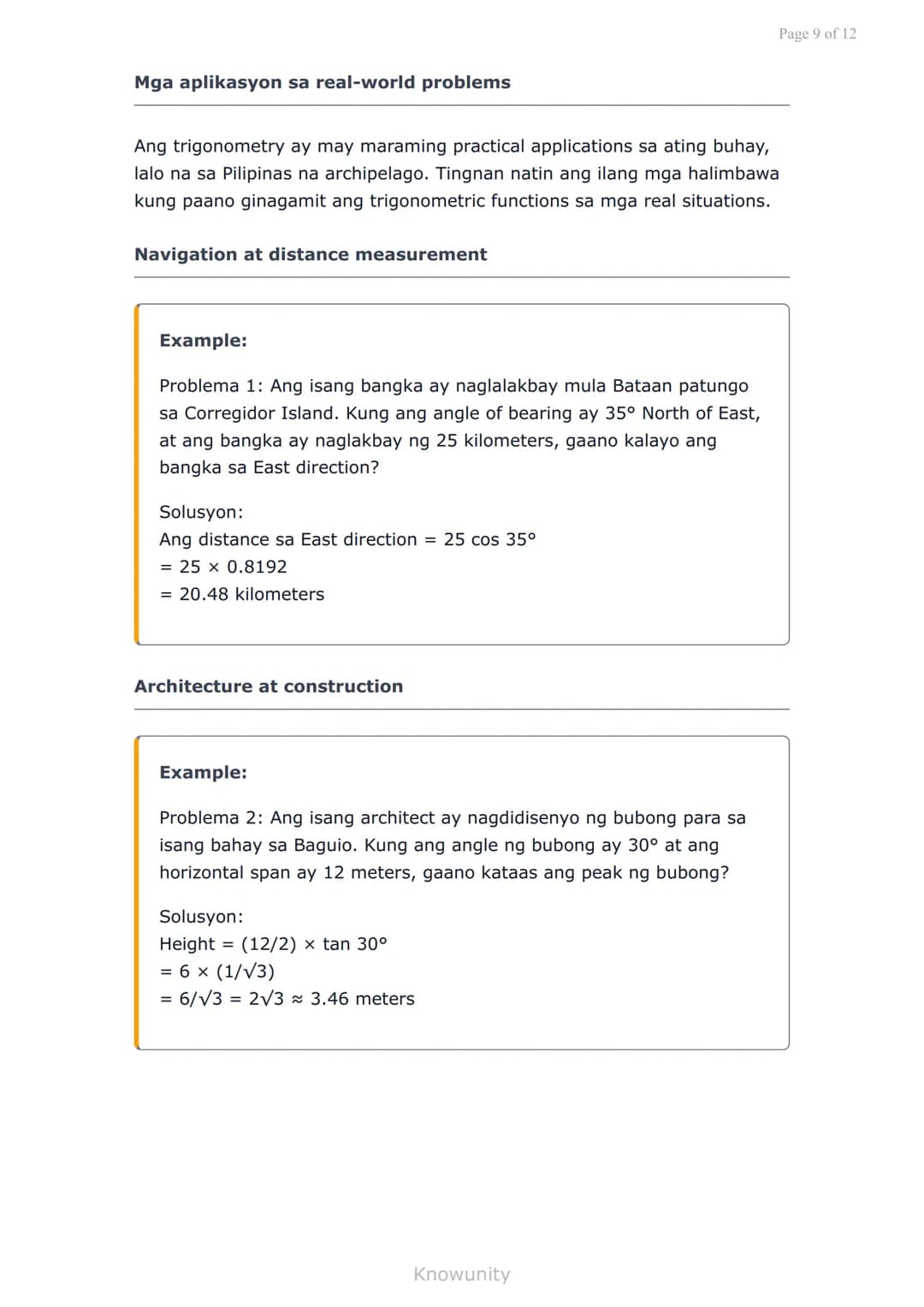
For navigation and distance measurement, consider a boat traveling from Bataan to Corregidor Island at 35° North of East for 25 kilometers. To find how far east it traveled, we calculate: distance east = 25 × cos 35° = 20.48 kilometers.
In architecture and construction, an architect designing a roof in Baguio with a 30° angle and 12-meter horizontal span would calculate the height as: height = × tan 30° = 3.46 meters.
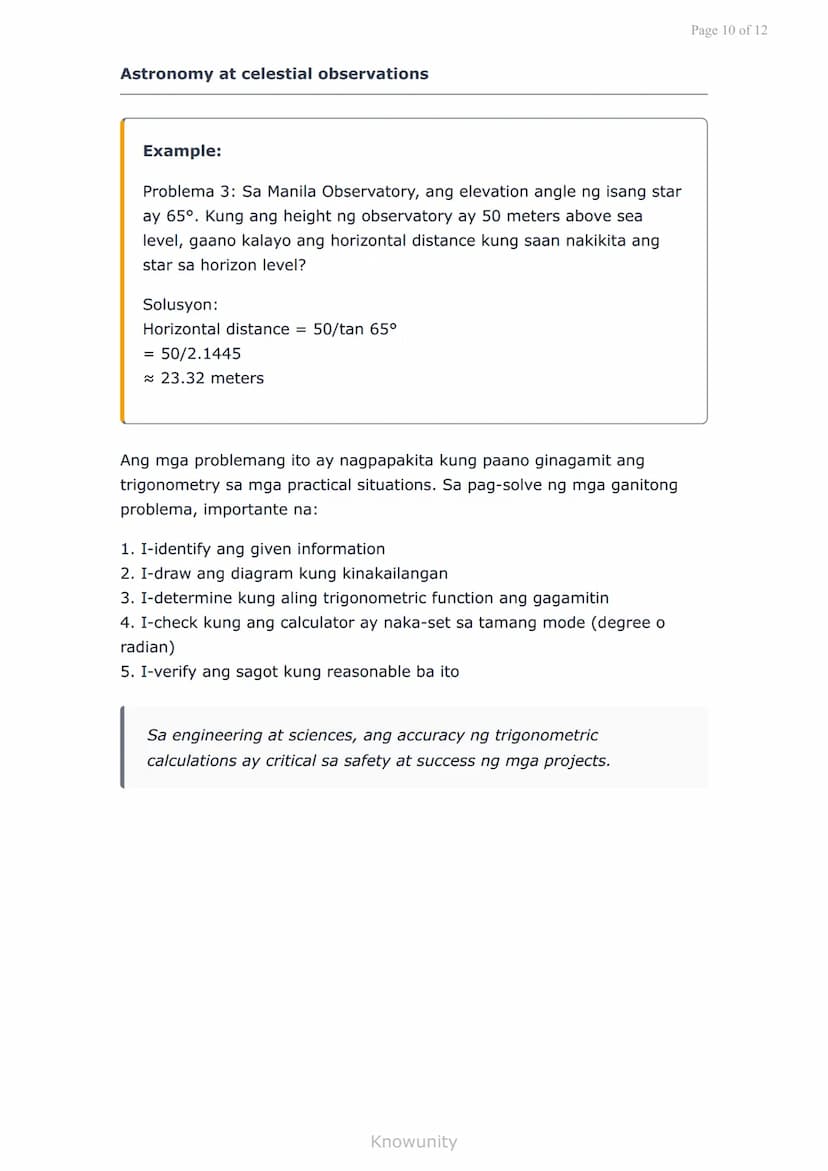
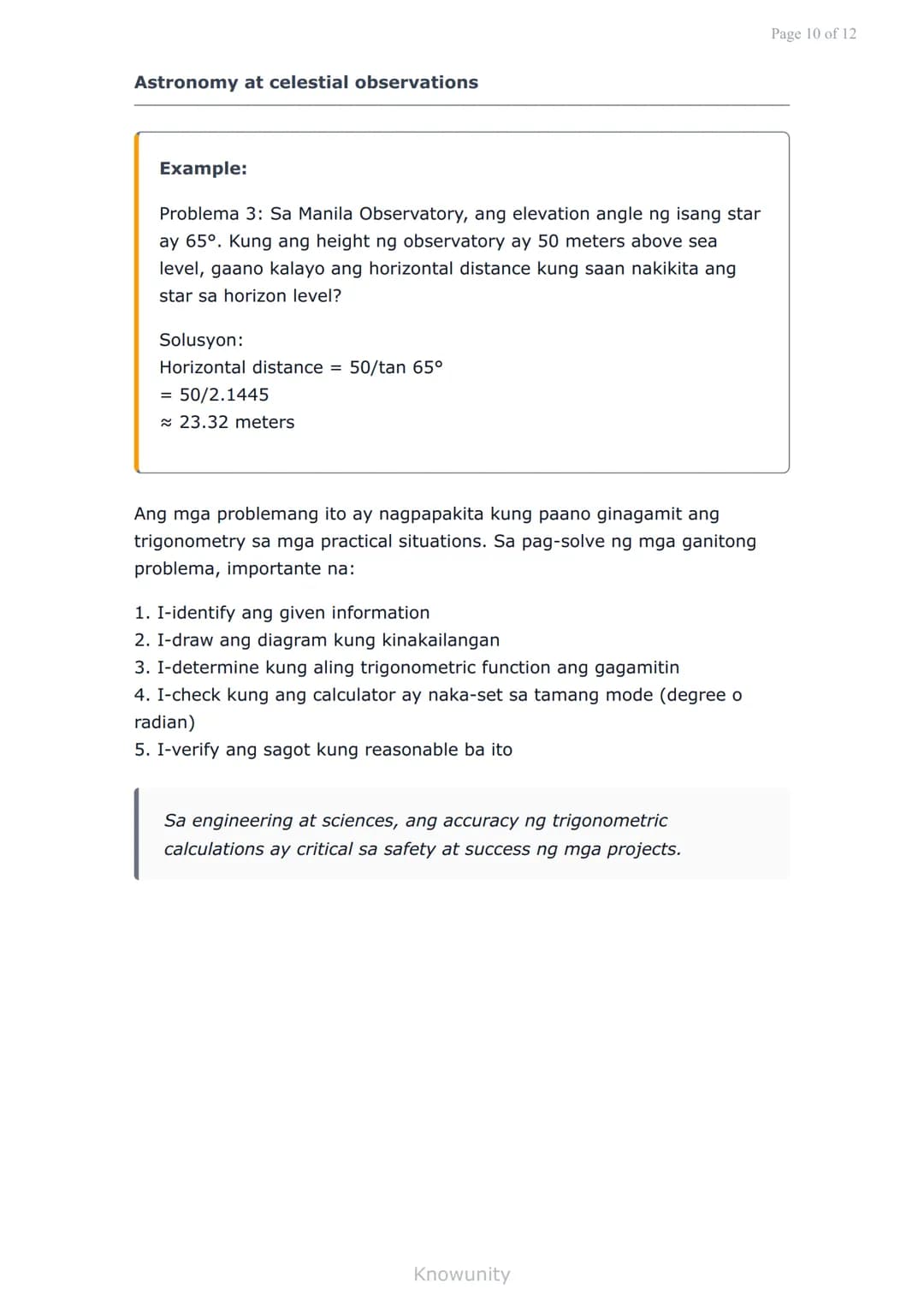
For astronomy, if a star is observed at a 65° elevation angle from the Manila Observatory (50 meters above sea level), the horizontal distance to where the star appears at horizon level would be: horizontal distance = 50/tan 65° ≈ 23.32 meters.
Problem-Solving Strategy: When tackling real-world problems, always draw a diagram first to visualize the situation and identify which trigonometric function applies!

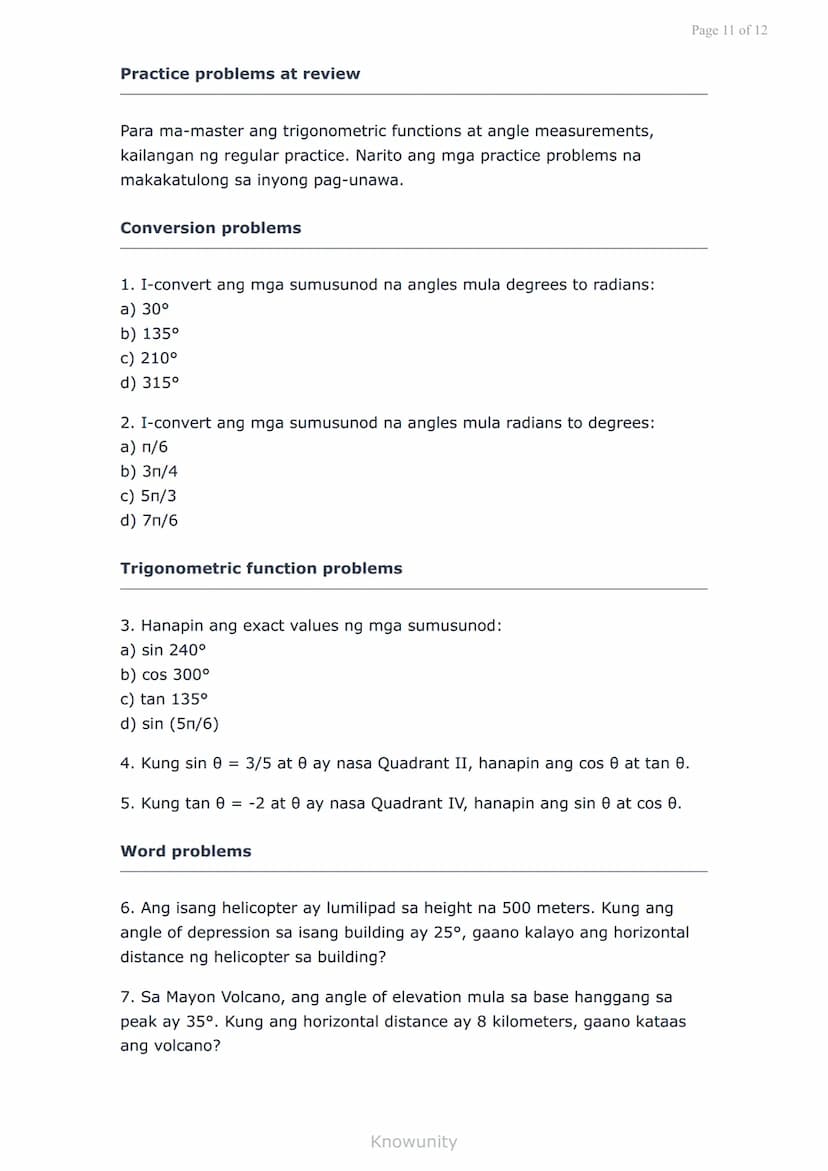
Practice Problems at Review
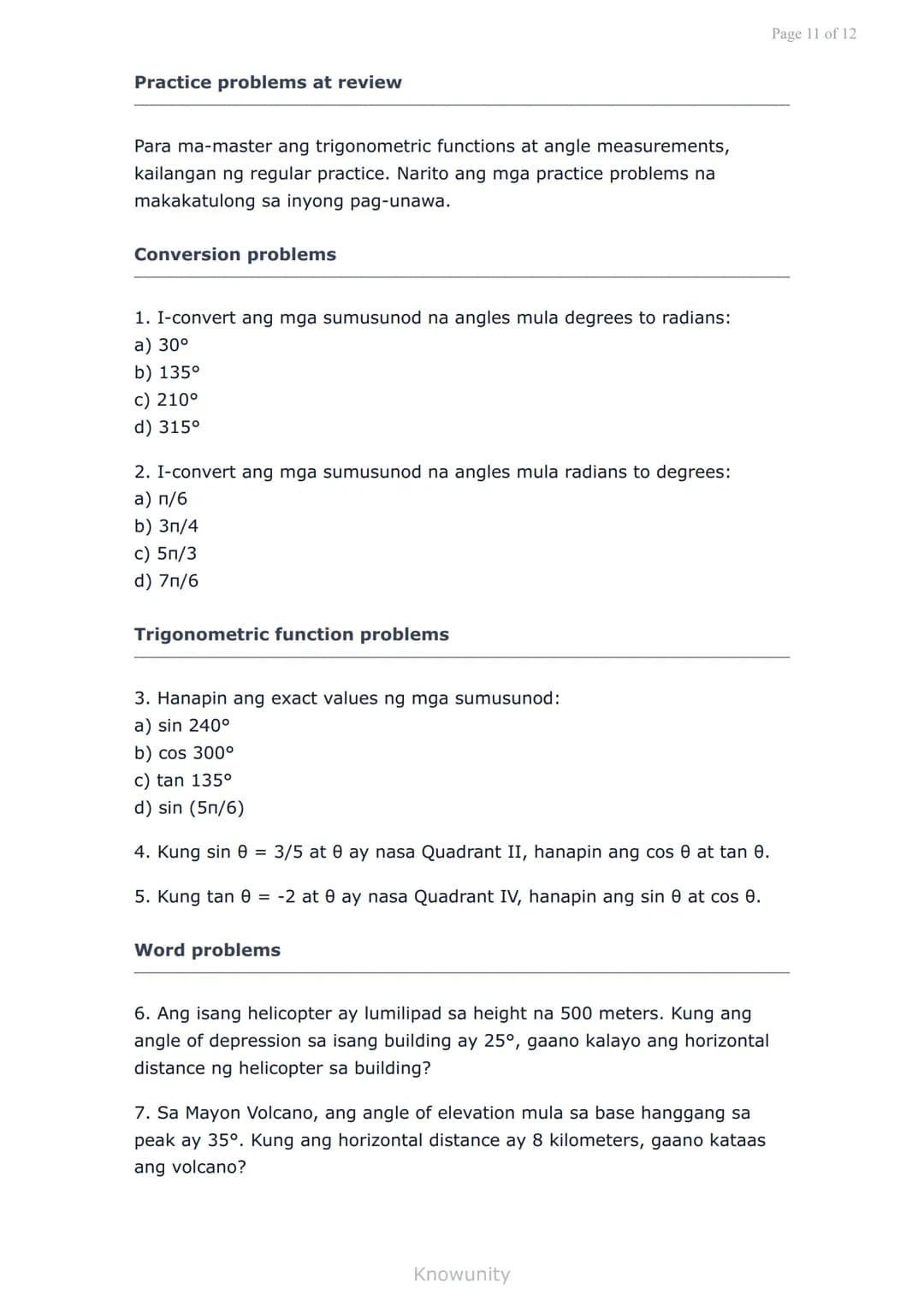
Regular practice is essential for mastering trigonometric concepts. Here are some problems to strengthen your understanding:
Conversion Problems:
-
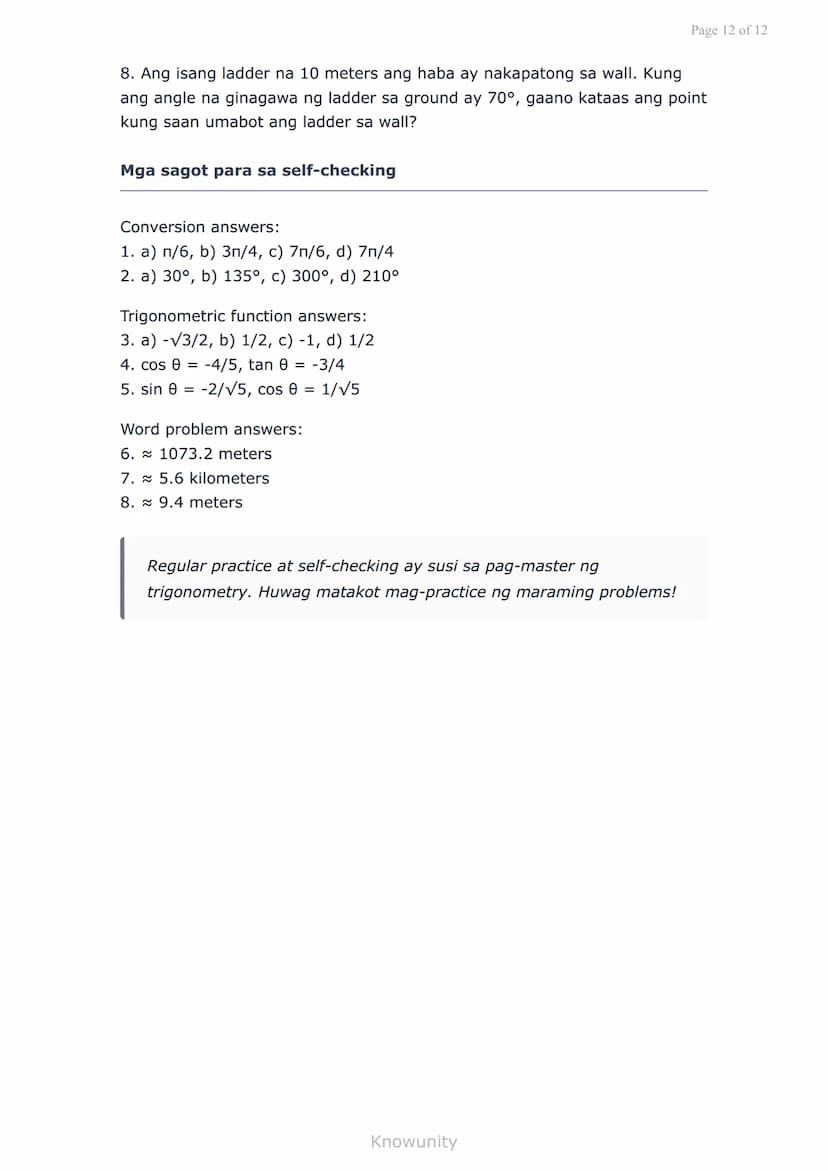
Convert from degrees to radians: a) 30° = π/6 radians b) 135° = 3π/4 radians
-
Convert from radians to degrees: a) π/6 = 30° b) 3π/4 = 135°
Trigonometric Function Problems: 3. Find exact values: a) sin 240° = -√3/2 b) cos 300° = 1/2
- If sin θ = 3/5 and θ is in Quadrant II: cos θ = -4/5, tan θ = -3/4
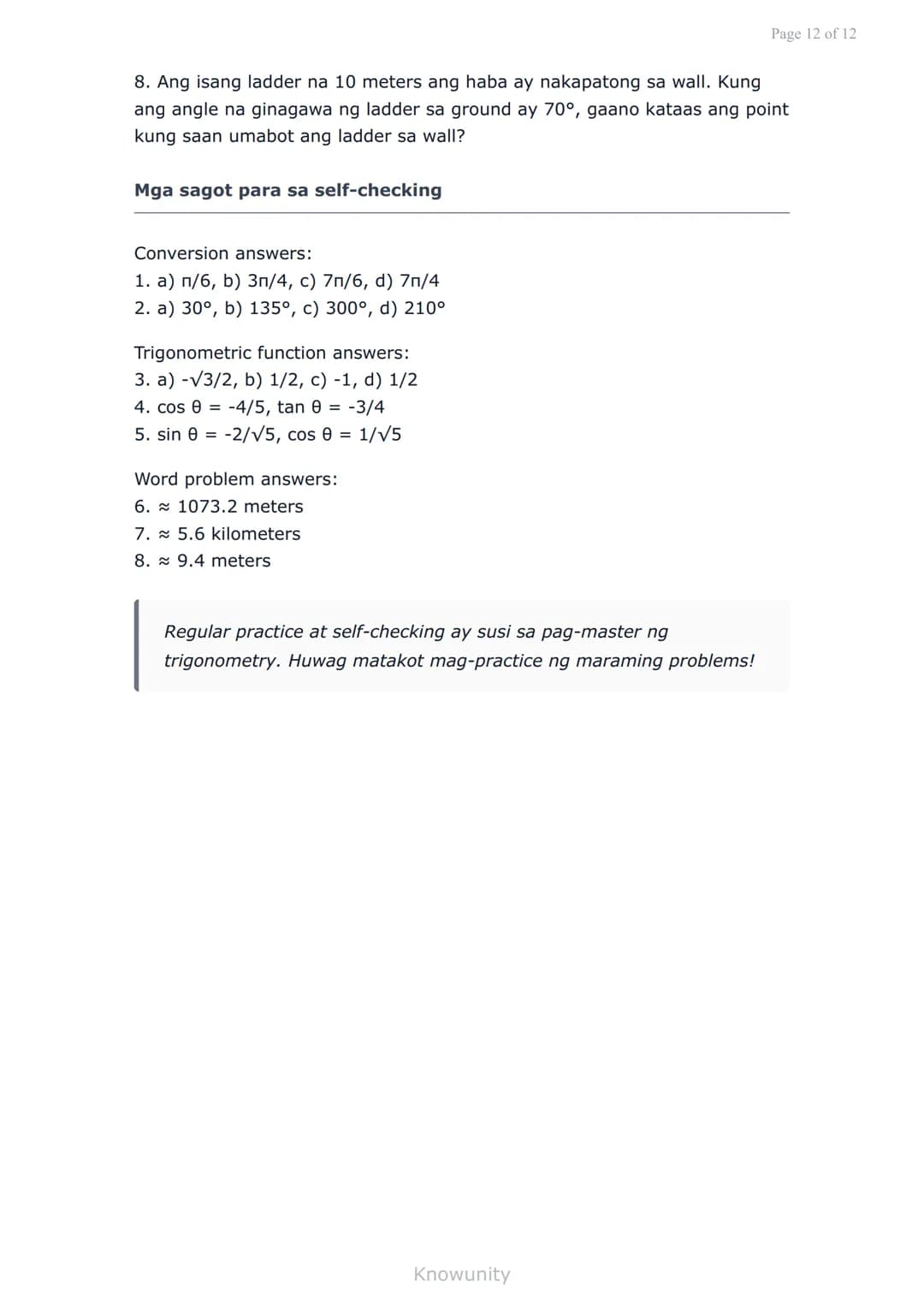
Word Problems: 5. A helicopter flying 500 meters high observes a building at a 25° angle of depression. The horizontal distance is approximately 1073.2 meters.
Success Tip: Don't just check your answers - try to understand why you made mistakes. Regular practice and self-assessment are key to mastering trigonometry!


Akala namin hindi mo na itatanong...
Pinaka-sikat na nilalaman sa Pre-Cal
4UPCAT Reviewer: Mathematics
general coverage of the mathematics section for UPCAT
TRIGONOMETRY COMPLETE REVIEWER
COMPLETE AND ORGANIZED REVIEWER IN TRIGONOMETRY
BASIC CALCULUS (SHS 11-STEM)
BASIC CALCULUS FOR SHS 11-STEM
PreCal Q3
Pre-Calculus Reviewer for Exam
Pinaka-sikat na nilalaman
9El Filibusterismo (FILIPINO 10)
Kilalanin ang mga karakter at alamin ang mga pangyayari mula Kabanata 1 hanggang 39.
UPCAT Reviewer: Mathematics
general coverage of the mathematics section for UPCAT
Mathematics in the Modern World
It explores mathematics as the study of relationships among numbers, quantities, and shapes. It covers math anxiety, patterns in nature (spirals, symmetries, mosaics), and problem-solving strategies like guessing, acting it out, drawing, and listing.
Introduction to Philosophy - 1st Semester, Grade 12
A summarized notes for Grade 12 students. Easier learning for the 1st semester’s Philosophy subject.
Introduction to Philosophy
Philosophy encourages reflection and reasoning about life’s big questions.
General Physics 1, First Sem
Units of Measurement, Vectors, and Kinematics. All with formulas
General Biology 1, 1st Sem
Topics: Cells, Organelles, Prokaryotes & Eukaryotes, Specialized Cells, Cell Modification, Cell Cycle, Mitosis, Meiosis, Chromosomal Abnormalities, Cell Membrane, Transport Mechanism
General Biology FIRST SEMEMSTER NOTES ABOUT CELL THEORY PART 1
The file provides a comprehensive overview of cell biology, encompassing cell theory, cell structure, types of cells, and specialized cells.
The Human Digestive System
Science Grade 8 1st Quarter Lesson
Gustong-gusto kami ng mga estudyante, at magiging ganoon ka rin.
Napakadaling gamitin at maganda ang disenyo ng app. Nahanap ko lahat ng hinahanap ko hanggang ngayon at natuto ako ng marami mula sa mga presentasyon! Tiyak na gagamitin ko ang app para sa isang takdang-aralin sa klase! At siyempre, nakakatulong din ito bilang inspirasyon.
Sobrang ganda talaga ng app na ito. Maraming mga study notes at tulong [...]. Ang problemang subject ko ay Pranses, halimbawa, at ang app ay may maraming options para tumulong. Salamat sa app na ito, bumuti ang Pranses ko. Irerekumenda ko ito sa lahat.
Wow, talagang namangha ako. Sinubukan ko lang ang app dahil nakita ko itong ina-advertise nang maraming beses at sobrang nagulat ako. Ang app na ito ang TULONG na gusto mo para sa paaralan at higit sa lahat, nag-aalok ito ng maraming bagay, tulad ng workouts at fact sheets, na SOBRANG nakatulong sa akin.
Mga Pundasyon ng Trigonometry: Degrees, Radians, at Functions
Trigonometry connects the angles and sides of triangles, creating powerful tools for solving real-world problems. This branch of mathematics uses special functions and angle measurements that are essential for Grade 12 students to master before tackling more advanced topics in...

Mga Trigonometric Functions at Angles: Degrees at Radians
Trigonometry literally means "triangle measurement," originating from Greek words "trigonon" (triangle) and "metron" (measure). Though it began with triangles, modern trigonometry extends to circular functions and periodic phenomena.
In the Philippines, trigonometry has practical applications in engineering, architecture, navigation, and astronomy. Engineers designing bridges in Metro Manila use trigonometric calculations for precise angles and distances, while Philippine Airlines pilots rely on these principles for navigation.
The three basic trigonometric functions are sine (sin), cosine (cos), and tangent (tan). These functions express ratios between the sides of a right triangle based on a given angle.
Fun Fact: The mathematical concepts we're learning today help solve real problems throughout the Philippines - from building structures that can withstand typhoons to navigating ships through our archipelago!

Mga Basic Trigonometric Functions
In a right triangle, we identify three sides: the hypotenuse (longest side), the opposite side (across from the angle), and the adjacent side (next to the angle). The three fundamental trigonometric functions represent ratios between these sides:
- Sine (sin) = opposite ÷ hypotenuse
- Cosine (cos) = adjacent ÷ hypotenuse
- Tangent (tan) = opposite ÷ adjacent
Let's apply this to a real example: A 15-meter flagpole at Rizal Park creates a 30° angle of elevation when viewed from 26 meters away. We can calculate that sin 30° = 0.5, cos 30° ≈ 0.866, and tan 30° ≈ 0.577.
Some angles appear frequently in problems and should be memorized: 30°, 45°, and 60° (or π/6, π/4, and π/3 in radians).
Pro Tip: Memorizing the values for special angles (30°, 45°, 60°) will save you time during exams and make problem-solving much faster!
Special Angle Values
For 30° (π/6 radians):
- sin 30° = 1/2
- cos 30° = √3/2
- tan 30° = 1/√3
For 45° (π/4 radians):
- sin 45° = √2/2
- cos 45° = √2/2
- tan 45° = 1
For 60° (π/3 radians):
- sin 60° = √3/2
- cos 60° = 1/2
- tan 60° = √3
These special angle values form the foundation of trigonometric problem-solving. You'll use them repeatedly in various applications, from calculating heights and distances to solving complex physics problems.
Remember: These values aren't just random numbers to memorize - they're precise mathematical relationships derived from geometric principles. Understanding where they come from helps you remember them better!

Degrees at Radians: Mga Angle Measurements
In trigonometry, we measure angles in two main ways: degrees and radians. While degrees are more familiar in everyday life, radians are preferred in advanced mathematics.
The degree system divides a complete rotation into 360° - a convention from ancient Babylonians who used a base-60 number system. A radian, meanwhile, is a more natural unit directly related to circle properties. It's defined as the angle made by an arc with length equal to the radius.
Since a circle's circumference is 2πr, a complete rotation equals 2π radians. This gives us important equivalences:
- 360° = 2π radians
- 180° = π radians
- 90° = π/2 radians
To convert between the two systems, use these formulas:
- radians = degrees ×
- degrees = radians ×
Calculator Tip: Always check if your calculator is in the correct mode (degree or radian) before computing trigonometric functions!

Conversion Examples
Converting between degrees and radians is straightforward with practice. Here are some examples:
-
Converting 45° to radians: 45° × = π/4 radians
-
Converting π/3 radians to degrees: × = 60°
-
Converting 120° to radians: 120° × = 2π/3 radians
These conversions are essential when working with different formulas or when your calculator uses a different unit than your problem. Many scientific calculators show DEG or RAD indicators on screen to help you keep track of which mode you're using.
Practical Advice: When in doubt about which unit to use, radians are generally preferred for calculus and theoretical work, while degrees are often better for practical applications and visualization.

Unit Circle at Trigonometric Values
The unit circle is a circle with radius 1 centered at the origin (0,0) of the coordinate plane. It's a powerful visual tool for understanding trigonometric functions.
On the unit circle, the coordinates of any point are (cos θ, sin θ), where θ is the angle from the positive x-axis. This explains why sine and cosine always have values between -1 and 1.
Important angles on the unit circle and their coordinates include:
- 0° (0 radians): (1, 0)
- 30° (π/6 radians):
- 45° (π/4 radians):
- 90° (π/2 radians): (0, 1)
- 180° (π radians):
The coordinate plane is divided into four quadrants, and the signs of trigonometric functions change in each:
- Quadrant I: All functions positive
- Quadrant II: Only sine positive
- Quadrant III: Only tangent positive
- Quadrant IV: Only cosine positive
Memory Aid: "All Students Take Calculus" can help you remember which functions are positive in each quadrant!

Finding Exact Values Using Quadrants
Understanding how trigonometric functions behave in different quadrants helps us find exact values for any angle. Let's look at an example:
To find sin 150° and cos 150°:
- Identify that 150° is in Quadrant II, where sine is positive and cosine is negative
- Recognize that 150° = 180° - 30°
- Use reference angle: sin 150° = sin 30° = 1/2
- Use reference angle with correct sign: cos 150° = -cos 30° = -√3/2
This approach works for any angle. First, identify the quadrant, then find the reference angle (the acute angle formed with the x-axis), and finally apply the correct sign based on the quadrant.
Visualization Tip: Drawing a quick sketch of the unit circle can help you determine the correct signs and values for any angle.

Mga Aplikasyon sa Real-World Problems
Trigonometry has numerous practical applications, especially relevant in the Philippine archipelago. Let's explore how trigonometric functions solve real problems.
For navigation and distance measurement, consider a boat traveling from Bataan to Corregidor Island at 35° North of East for 25 kilometers. To find how far east it traveled, we calculate: distance east = 25 × cos 35° = 20.48 kilometers.
In architecture and construction, an architect designing a roof in Baguio with a 30° angle and 12-meter horizontal span would calculate the height as: height = × tan 30° = 3.46 meters.
For astronomy, if a star is observed at a 65° elevation angle from the Manila Observatory (50 meters above sea level), the horizontal distance to where the star appears at horizon level would be: horizontal distance = 50/tan 65° ≈ 23.32 meters.
Problem-Solving Strategy: When tackling real-world problems, always draw a diagram first to visualize the situation and identify which trigonometric function applies!

Practice Problems at Review
Regular practice is essential for mastering trigonometric concepts. Here are some problems to strengthen your understanding:
Conversion Problems:
-
Convert from degrees to radians: a) 30° = π/6 radians b) 135° = 3π/4 radians
-
Convert from radians to degrees: a) π/6 = 30° b) 3π/4 = 135°
Trigonometric Function Problems: 3. Find exact values: a) sin 240° = -√3/2 b) cos 300° = 1/2
- If sin θ = 3/5 and θ is in Quadrant II: cos θ = -4/5, tan θ = -3/4
Word Problems: 5. A helicopter flying 500 meters high observes a building at a 25° angle of depression. The horizontal distance is approximately 1073.2 meters.
Success Tip: Don't just check your answers - try to understand why you made mistakes. Regular practice and self-assessment are key to mastering trigonometry!


Akala namin hindi mo na itatanong...
Pinaka-sikat na nilalaman sa Pre-Cal
4UPCAT Reviewer: Mathematics
general coverage of the mathematics section for UPCAT
TRIGONOMETRY COMPLETE REVIEWER
COMPLETE AND ORGANIZED REVIEWER IN TRIGONOMETRY
BASIC CALCULUS (SHS 11-STEM)
BASIC CALCULUS FOR SHS 11-STEM
PreCal Q3
Pre-Calculus Reviewer for Exam
Pinaka-sikat na nilalaman
9El Filibusterismo (FILIPINO 10)
Kilalanin ang mga karakter at alamin ang mga pangyayari mula Kabanata 1 hanggang 39.
UPCAT Reviewer: Mathematics
general coverage of the mathematics section for UPCAT
Mathematics in the Modern World
It explores mathematics as the study of relationships among numbers, quantities, and shapes. It covers math anxiety, patterns in nature (spirals, symmetries, mosaics), and problem-solving strategies like guessing, acting it out, drawing, and listing.
Introduction to Philosophy - 1st Semester, Grade 12
A summarized notes for Grade 12 students. Easier learning for the 1st semester’s Philosophy subject.
Introduction to Philosophy
Philosophy encourages reflection and reasoning about life’s big questions.
General Physics 1, First Sem
Units of Measurement, Vectors, and Kinematics. All with formulas
General Biology 1, 1st Sem
Topics: Cells, Organelles, Prokaryotes & Eukaryotes, Specialized Cells, Cell Modification, Cell Cycle, Mitosis, Meiosis, Chromosomal Abnormalities, Cell Membrane, Transport Mechanism
General Biology FIRST SEMEMSTER NOTES ABOUT CELL THEORY PART 1
The file provides a comprehensive overview of cell biology, encompassing cell theory, cell structure, types of cells, and specialized cells.
The Human Digestive System
Science Grade 8 1st Quarter Lesson
Gustong-gusto kami ng mga estudyante, at magiging ganoon ka rin.
Napakadaling gamitin at maganda ang disenyo ng app. Nahanap ko lahat ng hinahanap ko hanggang ngayon at natuto ako ng marami mula sa mga presentasyon! Tiyak na gagamitin ko ang app para sa isang takdang-aralin sa klase! At siyempre, nakakatulong din ito bilang inspirasyon.
Sobrang ganda talaga ng app na ito. Maraming mga study notes at tulong [...]. Ang problemang subject ko ay Pranses, halimbawa, at ang app ay may maraming options para tumulong. Salamat sa app na ito, bumuti ang Pranses ko. Irerekumenda ko ito sa lahat.
Wow, talagang namangha ako. Sinubukan ko lang ang app dahil nakita ko itong ina-advertise nang maraming beses at sobrang nagulat ako. Ang app na ito ang TULONG na gusto mo para sa paaralan at higit sa lahat, nag-aalok ito ng maraming bagay, tulad ng workouts at fact sheets, na SOBRANG nakatulong sa akin.