Calculating Resultant Vectors
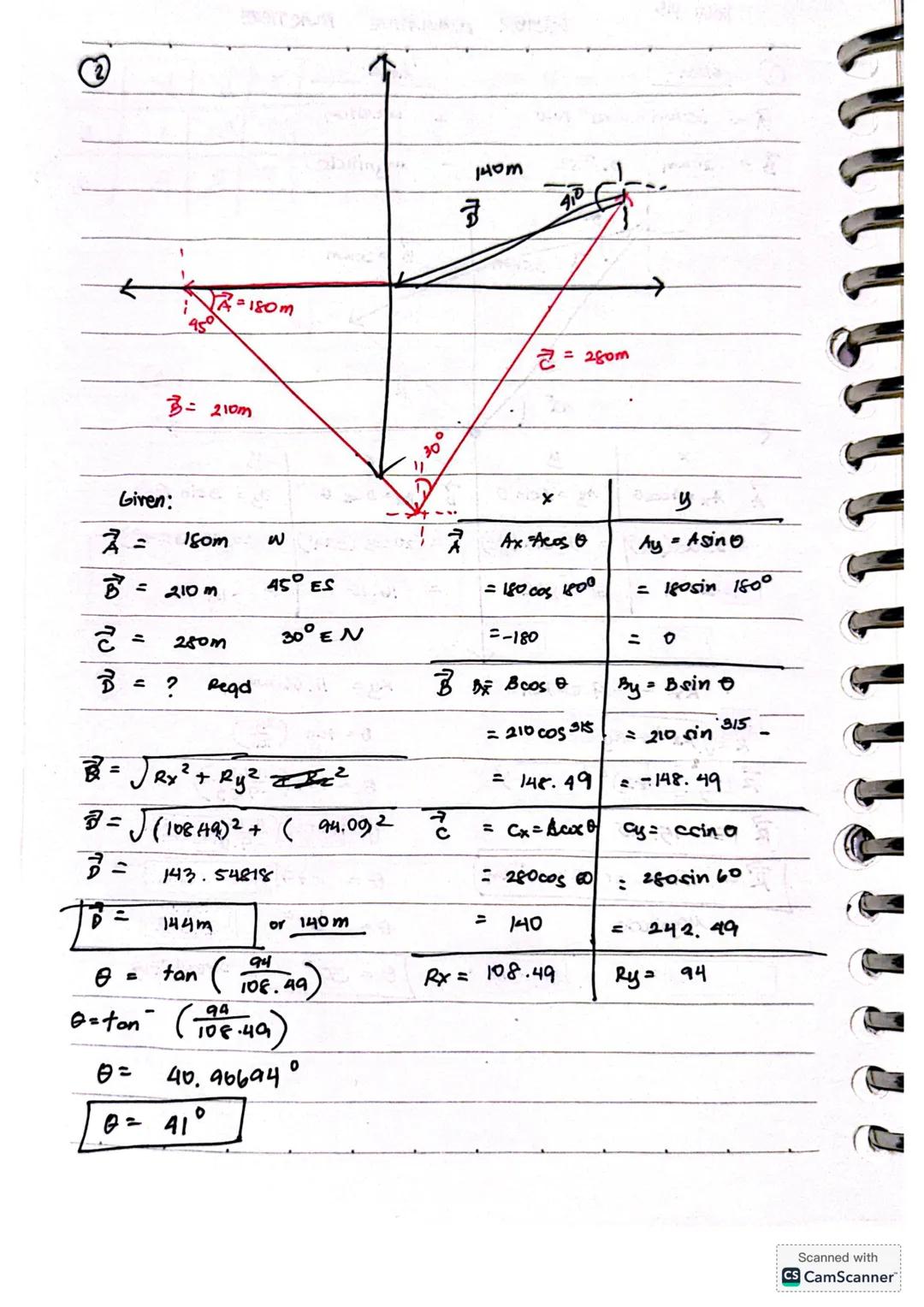
When adding multiple vectors, we need to establish a coordinate system first. In this example, we're working with three vectors: A = 180m west, B = 210m at 45° east of south, and C = 280m at 30° east of north.
For each vector, we calculate x and y components based on their angles. For instance, a westward vector has a negative x-component and zero y-component. After finding each component, we add them together to get the resultant components Rx and Ry.
The resultant vector's magnitude equals √Rx2+Ry2, giving us 144m (or 140m rounded). To find the direction, we calculate θ = tan⁻¹Ry/Rx, which equals 41°.
Pro tip: Always double-check your angle conversions. Remember that standard position begins with 0° pointing east, and angles increase counterclockwise.



 Science
 Araling Panlipunan (AP)
 Iba pa
 Practical Research
 DISS
DISS