
Ever wondered how our universe and solar system came to... Ipakita pa
 Earth Science
 GenMath
 Filipino
 Iba pa
 Econ
Econ Araling Panlipunan (AP)
Mag-sign up para makita ang contentLibre ito!
Access sa lahat ng dokumento
Pagbutihin ang iyong mga grado
Sumali sa milyong mga estudyante
Knowunity AI
Higit pa
Mga Asignatura
Triangle Congruence and Similarity Theorems
Triangle Properties and Classification
Linear Equations and Graphs
Geometric Angle Relationships
Trigonometric Functions and Identities
Equation Solving Techniques
Circle Geometry Fundamentals
Division Operations and Methods
Basic Differentiation Rules
Exponent and Logarithm Properties
Ipakita lahat ng paksa
Human Organ Systems
Reproductive Cell Cycles
Biological Sciences Subdisciplines
Cellular Energy Metabolism
Autotrophic Energy Processes
Inheritance Patterns and Principles
Biomolecular Structure and Organization
Cell Cycle and Division Mechanics
Cellular Organization and Development
Biological Structural Organization
Ipakita lahat ng paksa
Chemical Sciences and Applications
Atomic Structure and Composition
Molecular Electron Structure Representation
Atomic Electron Behavior
Matter Properties and Water
Mole Concept and Calculations
Gas Laws and Behavior
Periodic Table Organization
Chemical Thermodynamics Fundamentals
Chemical Bond Types and Properties
Ipakita lahat ng paksa
European Renaissance and Enlightenment
European Cultural Movements 800-1920
American Revolution Era 1763-1797
American Civil War 1861-1865
Global Imperial Systems
Mongol and Chinese Dynasties
U.S. Presidents and World Leaders
Historical Sources and Documentation
World Wars Era and Impact
World Religious Systems
Ipakita lahat ng paksa
Classic and Contemporary Novels
Literary Character Analysis
Rhetorical Theory and Practice
Classic Literary Narratives
Reading Analysis and Interpretation
Narrative Structure and Techniques
English Language Components
Influential English-Language Authors
Basic Sentence Structure
Narrative Voice and Perspective
Ipakita lahat ng paksa
54
•
Na-update Apr 30, 2026
•

aya
@ayash
Ever wondered how our universe and solar system came to... Ipakita pa
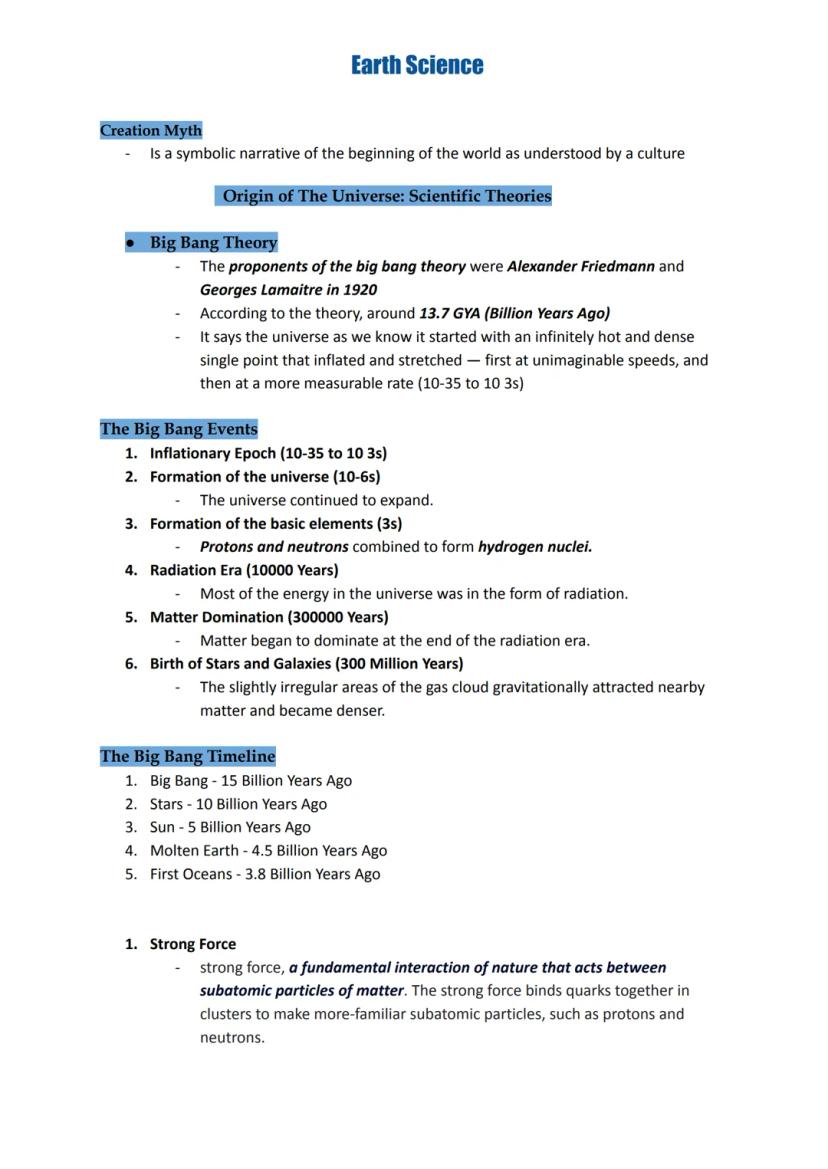
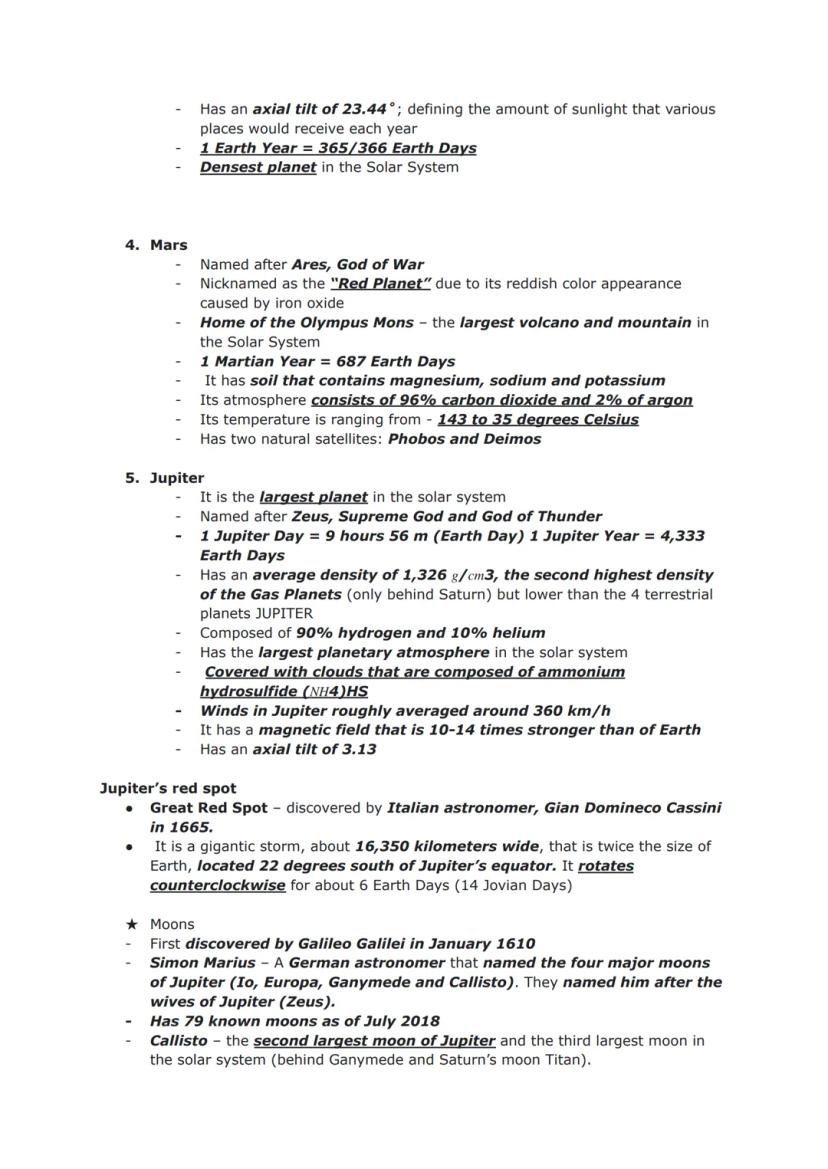
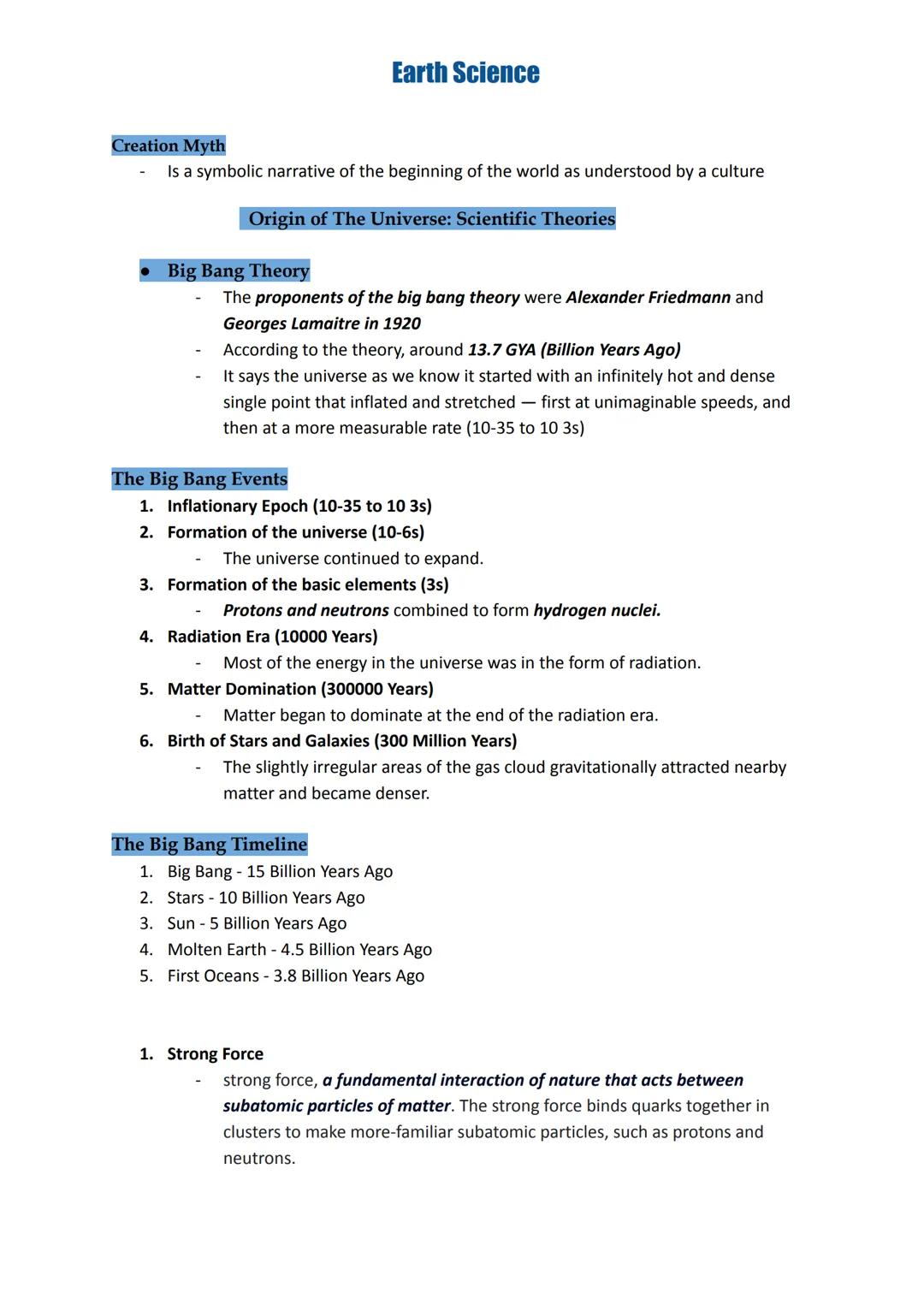
The Big Bang Theory, proposed by Alexander Friedmann and Georges Lamaitre in the 1920s, is our best explanation for how the universe began. According to this theory, approximately 13.7 billion years ago, the entire universe started as an infinitely hot and dense single point that suddenly expanded at unimaginable speeds.
The expansion unfolded in several key stages. First came the Inflationary Epoch , when the universe expanded incredibly rapidly. During the next few stages, basic elements formed as protons and neutrons combined to create hydrogen nuclei. After about 300,000 years, matter began to dominate the universe, and by 300 million years after the Big Bang, stars and galaxies were forming.
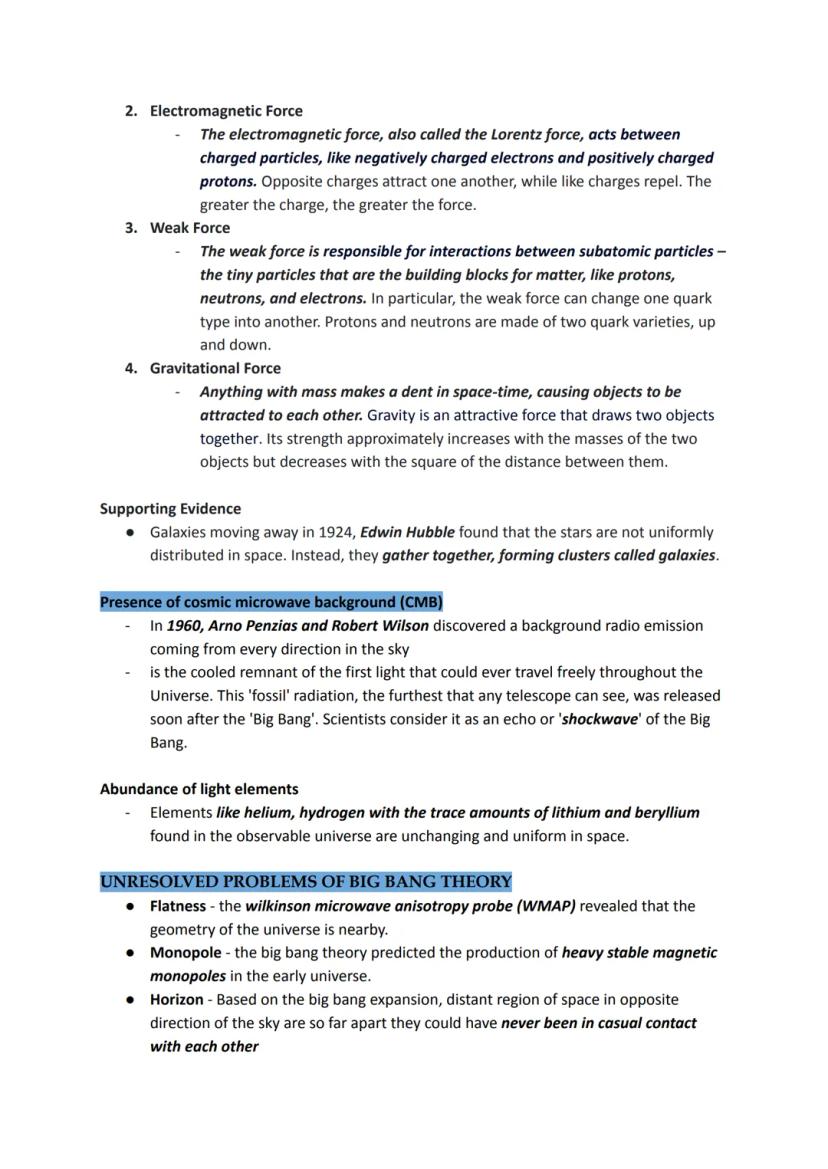
Four fundamental forces govern how everything in our universe works. The strong force binds quarks together to make particles like protons and neutrons. The electromagnetic force acts between charged particles, making opposite charges attract and like charges repel. The weak force can change one quark type into another, while gravitational force attracts objects with mass to each other.
💡 The timeline from the Big Bang to Earth is mind-boggling: The Big Bang occurred 15 billion years ago, stars formed 10 billion years ago, our Sun 5 billion years ago, and Earth about 4.5 billion years ago.
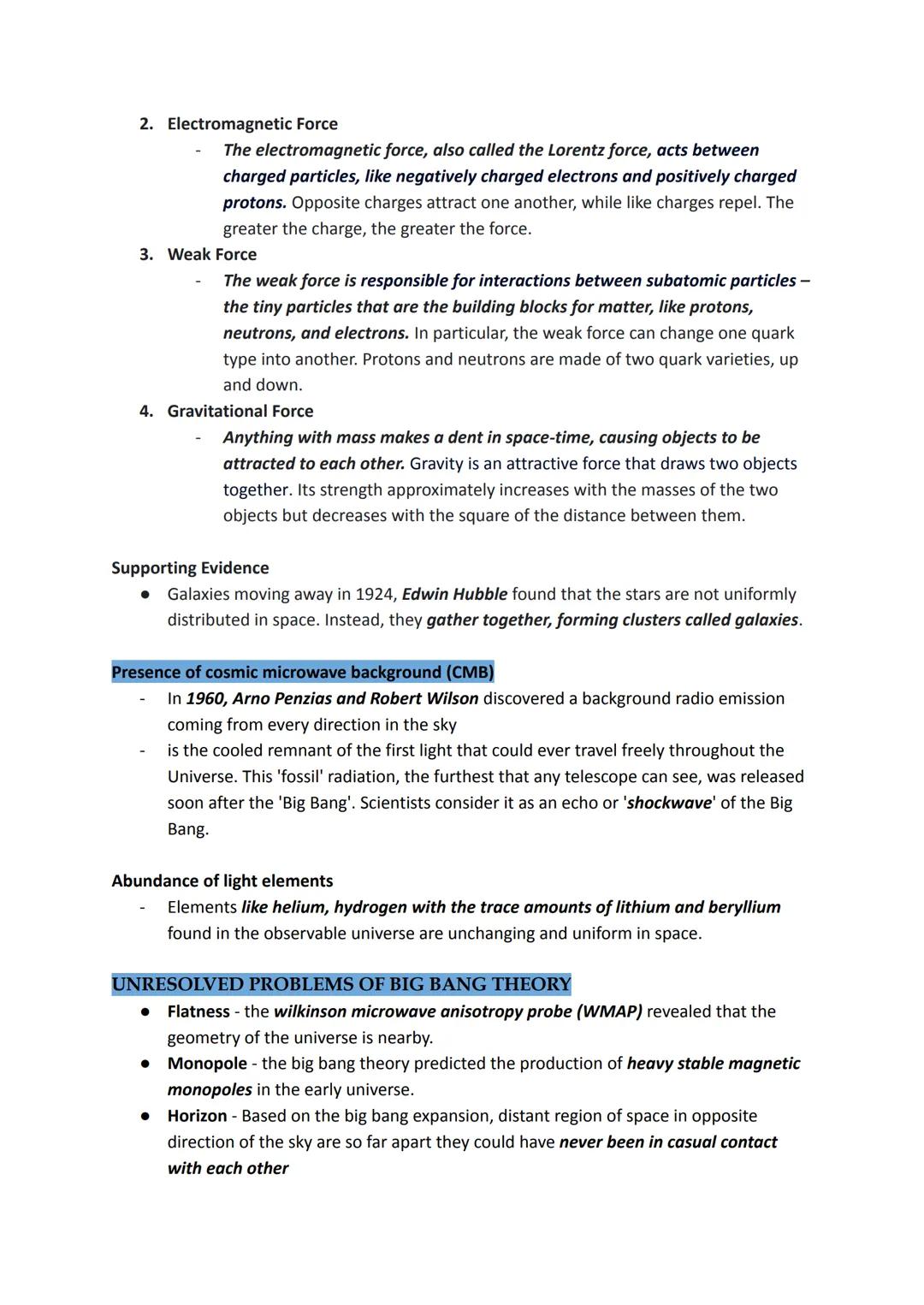
Scientists have found compelling evidence supporting the Big Bang Theory. In 1924, Edwin Hubble discovered that galaxies are moving away from each other, suggesting an expanding universe. Another major discovery came in 1960 when Arno Penzias and Robert Wilson detected cosmic microwave background radiation (CMB) coming from every direction in the sky. This "fossil radiation" is considered the echo of the Big Bang.
The abundance of light elements like hydrogen and helium throughout the universe also supports the Big Bang Theory. These elements appear in consistent proportions everywhere we look, exactly as the theory predicts.
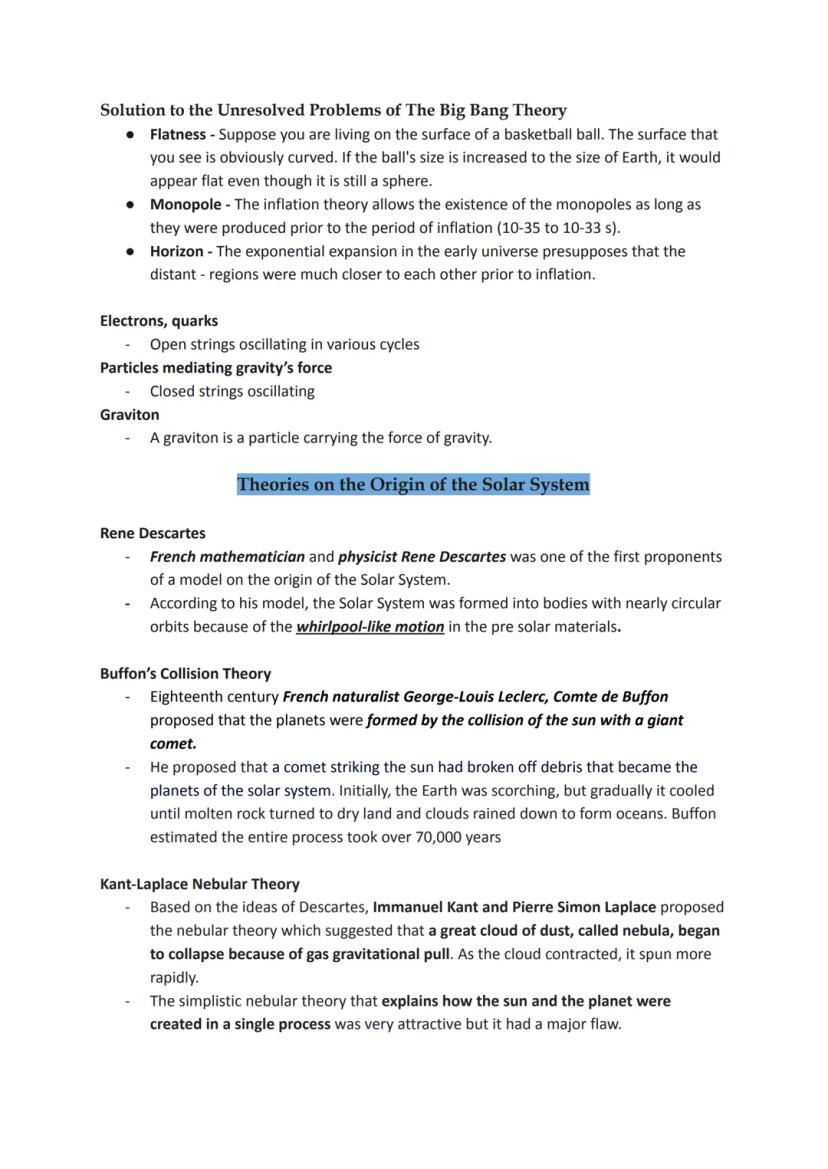
Despite its strengths, the Big Bang Theory faces some unresolved problems. The "flatness problem" questions why the universe's geometry is so precisely balanced. The "monopole problem" asks why we don't see the magnetic monopoles the theory predicted. The "horizon problem" wonders how regions of space so far apart could have such similar properties if they could never have been in contact.
🔍 The cosmic microwave background radiation is essentially the afterglow of the Big Bang, and it's the furthest back in time that any telescope can see!
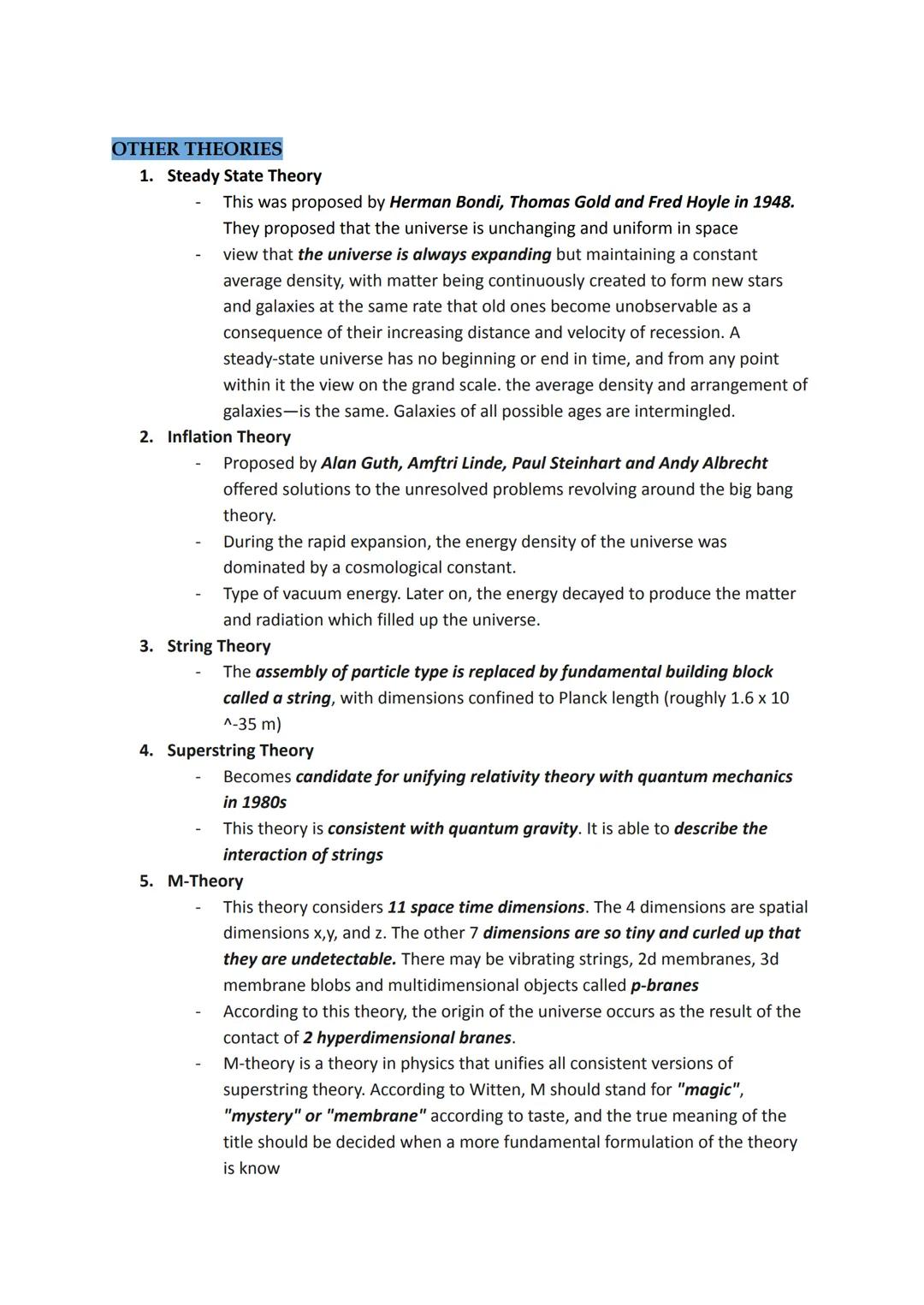
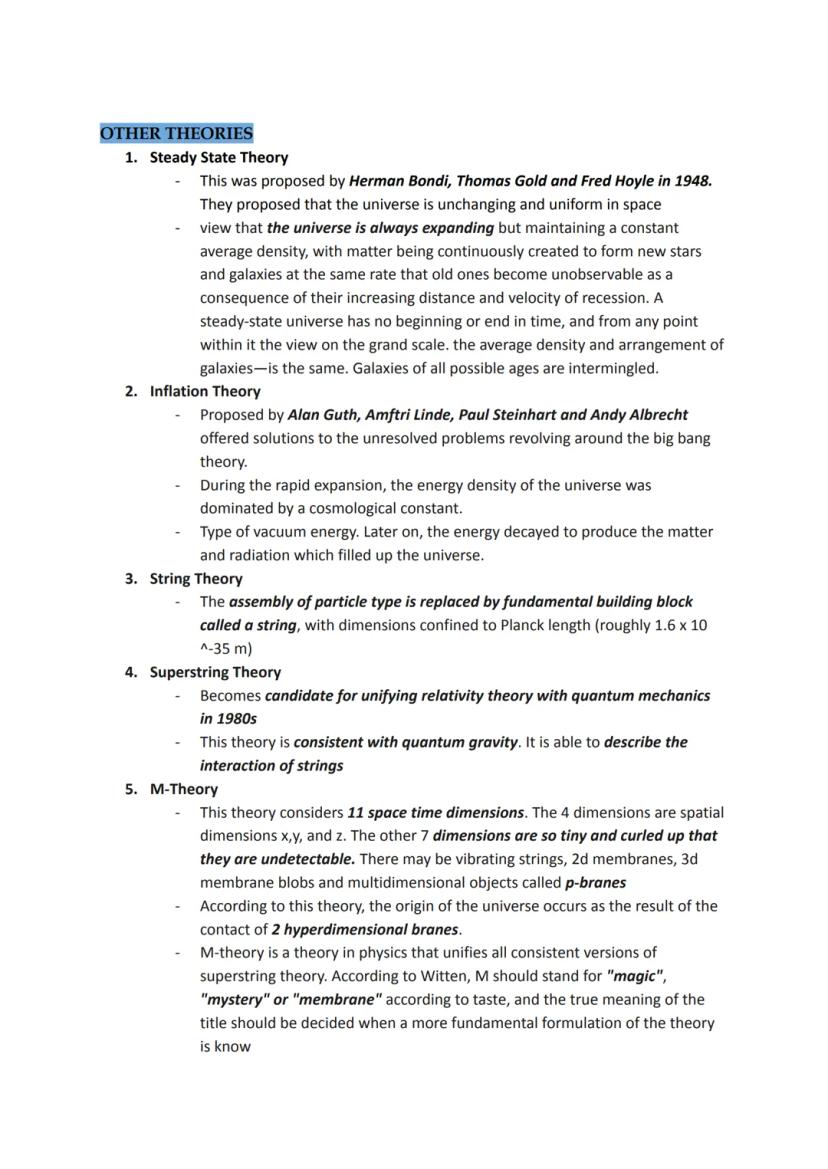
The Steady State Theory, proposed in 1948 by Bondi, Gold, and Hoyle, offered a different view of the universe. This theory suggested that the universe has always existed, with no beginning or end, maintaining a constant average density as it expands. New matter continuously forms to create new stars and galaxies at the same rate older ones move beyond our view.
The Inflation Theory addressed many of the Big Bang's unresolved problems. It proposed that during the universe's rapid early expansion, energy density was dominated by a cosmological constant (a type of vacuum energy) that later decayed to produce matter and radiation.
More recent theories take different approaches. String Theory replaces fundamental particles with tiny vibrating strings at the Planck length scale . Superstring Theory became a candidate for unifying relativity with quantum mechanics in the 1980s by describing string interactions consistently with gravity.
M-Theory considers 11 spacetime dimensions—our familiar 4 dimensions (3 spatial plus time) plus 7 additional dimensions that are too tiny and curled up to detect. This theory suggests the universe began when two hyperdimensional "branes" collided.
🌌 The "M" in M-Theory has no official meaning—physicists suggest it could stand for "magic," "mystery," or "membrane," with the true meaning to be decided when we better understand the theory!
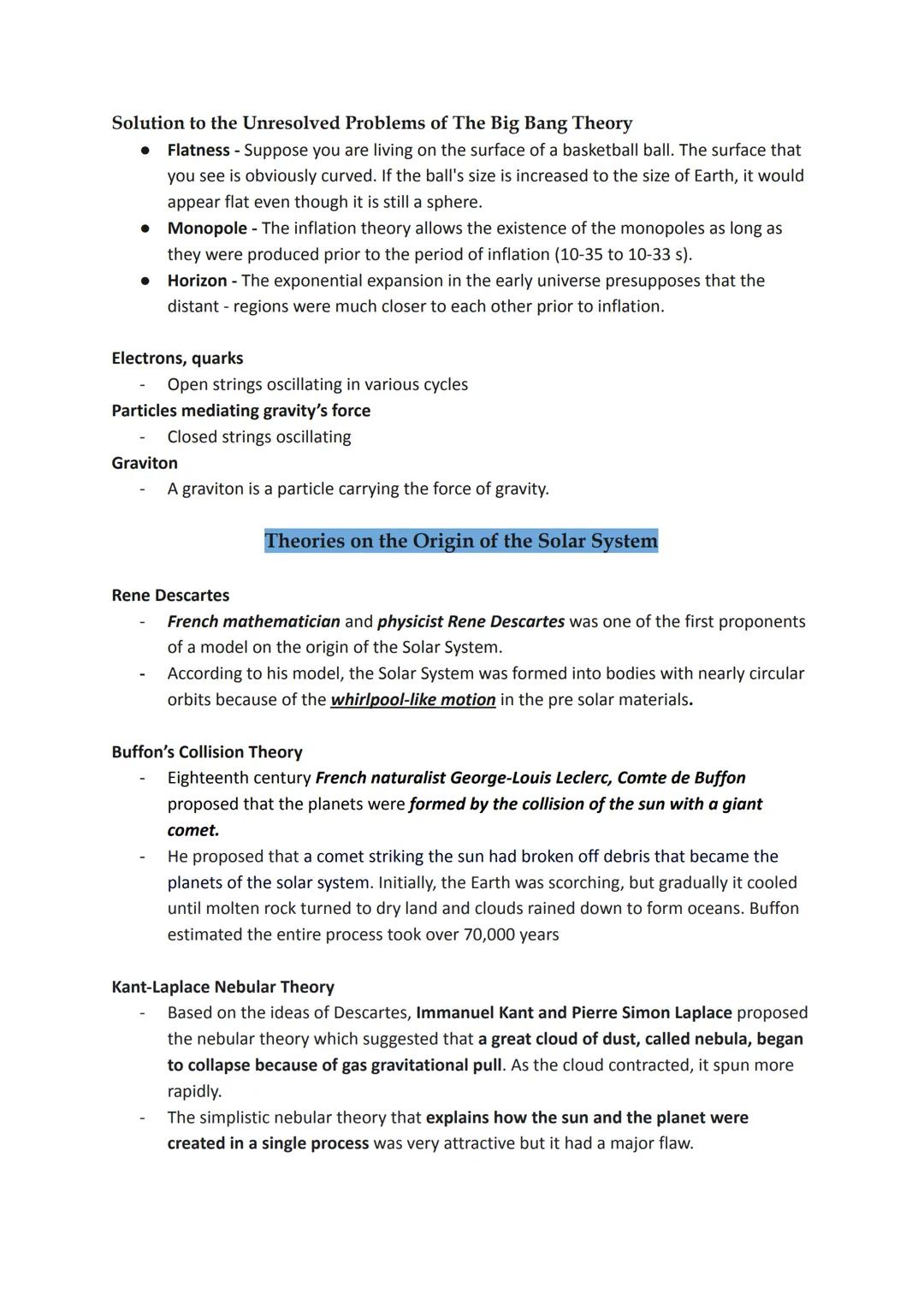
Scientists have proposed several theories to explain how our solar system formed. René Descartes was among the first, suggesting that whirlpool-like motion in pre-solar materials formed bodies with nearly circular orbits. Later, the Comte de Buffon proposed his Collision Theory, which claimed that planets formed from debris created when a comet struck the sun.
Building on Descartes' ideas, Immanuel Kant and Pierre Simon Laplace proposed the Nebular Theory. They suggested that a great cloud of dust (nebula) collapsed due to gravitational pull and began spinning more rapidly as it contracted. Though attractive for its simplicity, this theory had major flaws.
The modern Solar Nebular Theory suggests our solar system formed from condensing hydrogen gas and dust. A supernova explosion might have triggered this cloud to collapse, forming the sun and planets. As the cloud rotated, it formed a disk-shaped solar nebula. Small particles accreted into planetesimals , which eventually coalesced into protoplanets and finally planets.
🌠 After the solar system's initial formation, a powerful solar wind blasted away remaining gas and dust, leaving behind the solid planetary bodies and gas giants we see today.
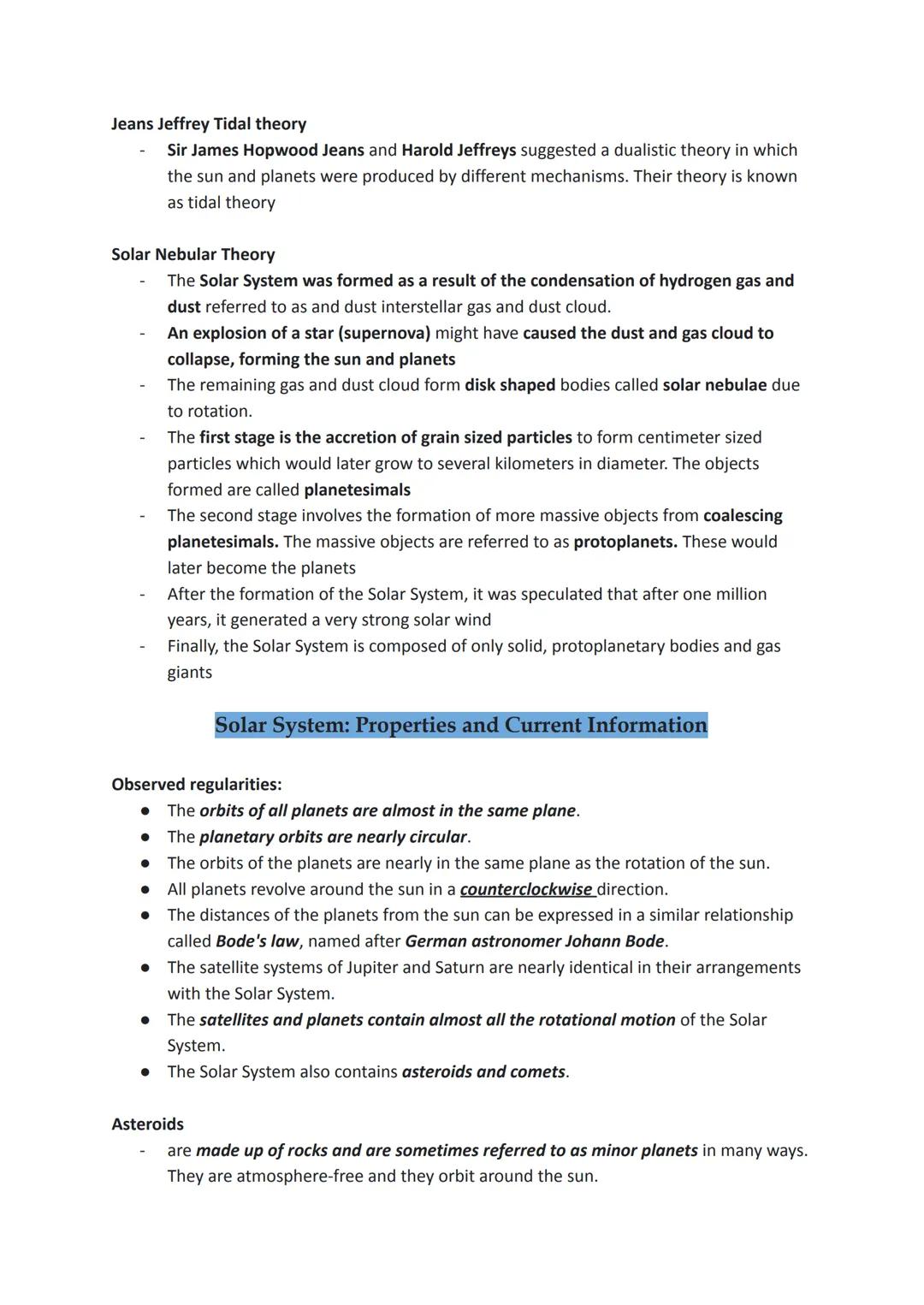
Our solar system follows several consistent patterns. All planets orbit the sun in nearly the same plane with almost circular orbits. They all revolve in a counterclockwise direction, and their distances from the sun follow a relationship called Bode's law. Interestingly, the satellite systems of Jupiter and Saturn mirror these arrangements.
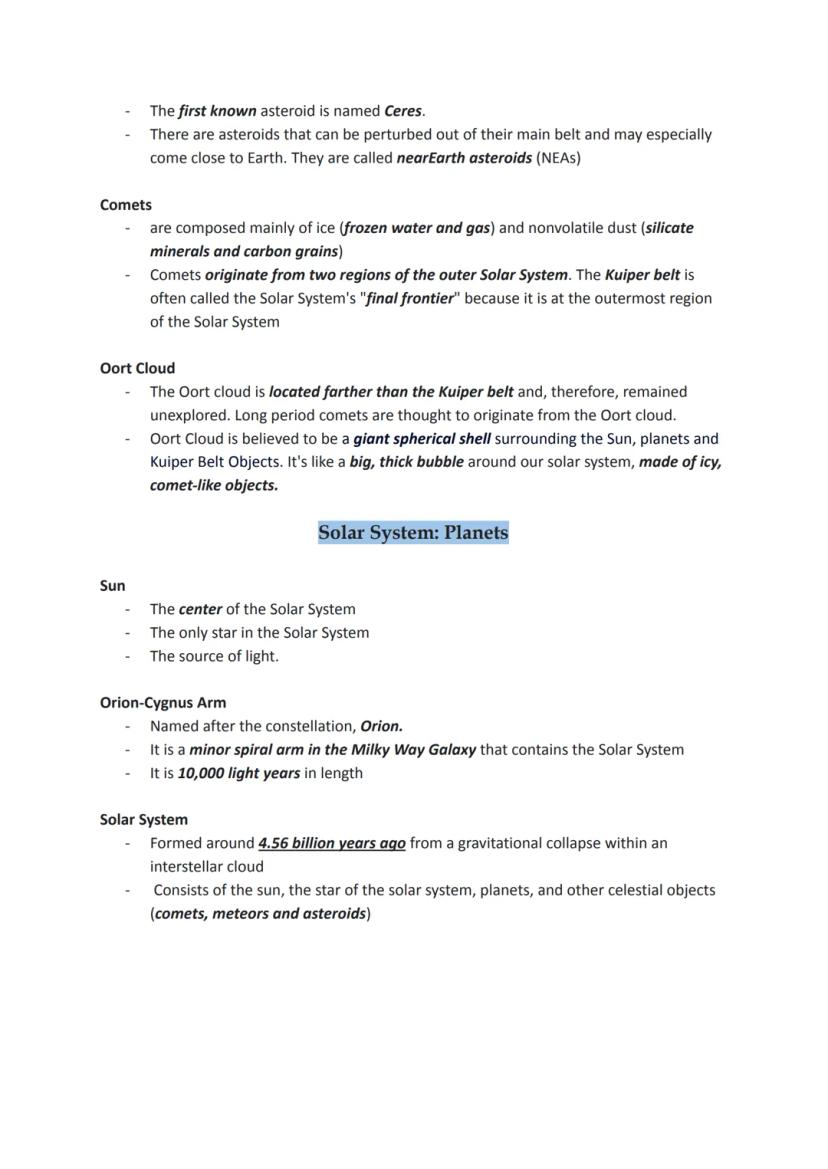
Beyond the planets, our solar system contains fascinating objects like asteroids—rock formations sometimes called minor planets. The first discovered asteroid, Ceres, orbits in the asteroid belt between Mars and Jupiter. Some asteroids, called near-Earth asteroids (NEAs), can be pulled out of the main belt and pass close to Earth.
Comets are another interesting feature of our solar system. Unlike rocky asteroids, comets are mostly composed of ice (frozen water and gases) and nonvolatile dust (silicate minerals and carbon grains). They originate from two distant regions: the Kuiper Belt, which lies beyond Neptune, and the even more distant Oort Cloud.
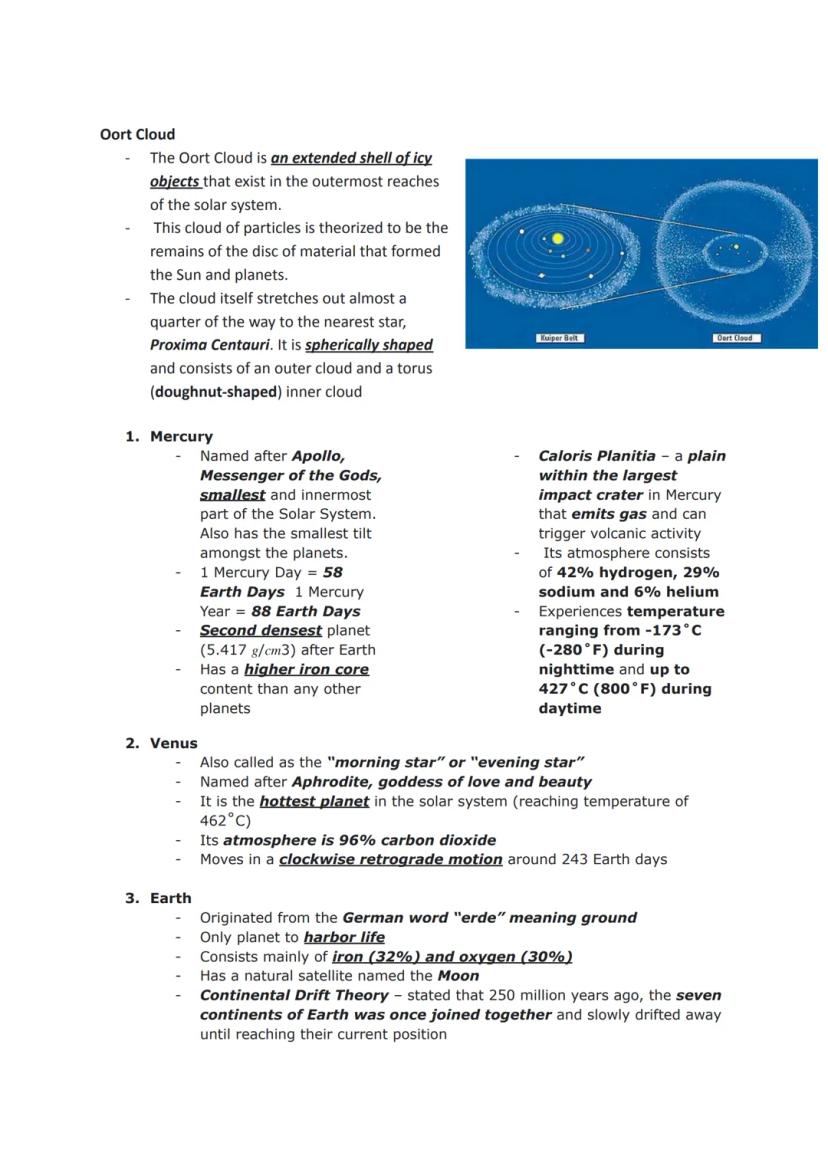
The Oort Cloud forms a giant spherical shell surrounding our entire solar system. It's like a thick bubble made of icy, comet-like objects that extends almost a quarter of the way to the nearest star. Long-period comets are thought to come from this mysterious region.
☄️ The Oort Cloud is believed to contain trillions of icy objects, but it's so far away that we've never directly observed it—we only know it exists because of the comets that occasionally visit our inner solar system!
At the center of our solar system lies the Sun—the only star in our system and the source of light and energy that makes life possible. Our solar system formed approximately 4.56 billion years ago from the gravitational collapse of an interstellar cloud. Beyond the sun and planets, our system contains comets, meteors, and asteroids.
Our solar system is located in a spiral arm of the Milky Way Galaxy called the Orion-Cygnus Arm, named after the constellation Orion. This minor spiral arm stretches about 10,000 light-years in length and contains our entire solar system.
The International Astronomical Union (IAU), founded in 1919 in Brussels, Belgium, is responsible for naming celestial bodies and educating people about astronomy. In 2006, the IAU famously reclassified Pluto as a dwarf planet rather than a full planet.
Planets in our solar system are divided into two main categories. The Terrestrial Planets (Mercury, Venus, Earth, and Mars) are close to the sun, small in mass and radius, and have high density. The Jovian Planets (Jupiter, Saturn, Uranus, and Neptune) are far from the sun, large in mass and radius, and have low density.
🔭 The Asteroid Belt, which divides the terrestrial and Jovian planets, contains millions of irregularly shaped bodies ranging from tiny pebbles to objects hundreds of kilometers across!
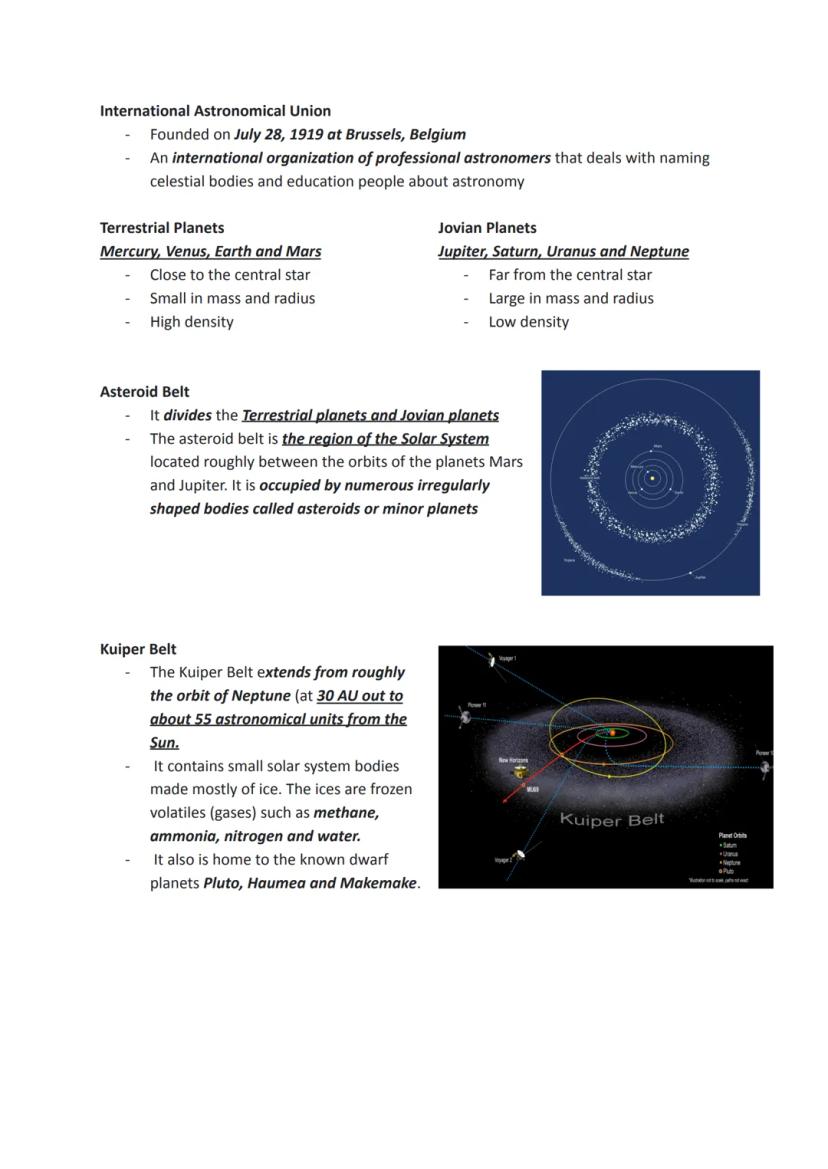
Beyond Neptune lies the Kuiper Belt, extending from about 30 to 55 astronomical units from the Sun. This region contains small icy bodies made mostly of frozen gases like methane, ammonia, nitrogen, and water. The Kuiper Belt is also home to the dwarf planets Pluto, Haumea, and Makemake.
Even farther out is the mysterious Oort Cloud, an extended shell of icy objects that marks the outermost reaches of our solar system. Scientists believe this cloud consists of remnant material from the formation of the Sun and planets. The Oort Cloud stretches almost a quarter of the way to the nearest star, Proxima Centauri, and has both an outer spherical section and an inner donut-shaped section.
These distant regions are like cosmic freezers, preserving ancient materials from the solar system's formation. Objects in the Kuiper Belt and Oort Cloud occasionally get disturbed by gravitational forces and travel inward toward the Sun, becoming comets that we can observe from Earth.
❄️ Think of the Kuiper Belt and Oort Cloud as time capsules from the birth of our solar system—they contain icy bodies that have remained largely unchanged for billions of years!
Mercury, named after the messenger of the gods, is the smallest and innermost planet in our solar system. A day on Mercury lasts 58 Earth days, while its year is only 88 Earth days. With the second-highest density of any planet , Mercury has a proportionally larger iron core than any other planet. Its surface experiences extreme temperature variations, from -173°C during the night to 427°C during the day.
Venus, named after the goddess of love and beauty, is often called the "morning star" or "evening star" because it's visible at dawn and dusk. It's the hottest planet in the solar system, reaching a scorching 462°C due to its atmosphere being 96% carbon dioxide that traps heat. Venus rotates clockwise (retrograde motion), taking 243 Earth days to complete one rotation.
Earth, whose name comes from the German word "erde" meaning ground, is the only known planet to harbor life. It consists mainly of iron (32%) and oxygen (30%) and has one natural satellite, the Moon. Earth is the densest planet in the solar system and completes one rotation in 24 hours and one orbit around the Sun in 365/366 days. Its 23.44° axial tilt creates our seasons by affecting how much sunlight different regions receive throughout the year.
🌍 The Continental Drift Theory proposes that 250 million years ago, Earth's seven continents were joined as a single landmass before slowly drifting apart to their current positions!
Mars, named after the god of war, is nicknamed the "Red Planet" due to iron oxide (rust) giving its surface a reddish appearance. Home to Olympus Mons, the largest volcano and mountain in the solar system, Mars takes 687 Earth days to orbit the Sun. Its atmosphere is 96% carbon dioxide and 2% argon, with temperatures ranging from -143°C to 35°C. Mars has two small moons: Phobos and Deimos.
Jupiter, the largest planet in our solar system, is named after Zeus, the supreme god. A Jupiter day lasts just 9 hours and 56 minutes, while its year equals 4,333 Earth days. Composed of 90% hydrogen and 10% helium, Jupiter has the largest planetary atmosphere in the solar system and is covered with clouds of ammonium hydrosulfide. Its winds average around 360 km/h, and its magnetic field is 10-14 times stronger than Earth's.
Jupiter's most famous feature is the Great Red Spot, discovered in 1665 by Gian Domineco Cassini. This enormous storm, about 16,350 kilometers wide (twice Earth's size), rotates counterclockwise and completes one rotation every 6 Earth days. Jupiter has an impressive 79 known moons, with the four largest (Io, Europa, Ganymede, and Callisto) first discovered by Galileo Galilei in 1610 and named after Zeus's lovers by astronomer Simon Marius.
🔴 Jupiter's Great Red Spot has been raging for at least 350 years, making it one of the longest-lasting storms we know of in the solar system!
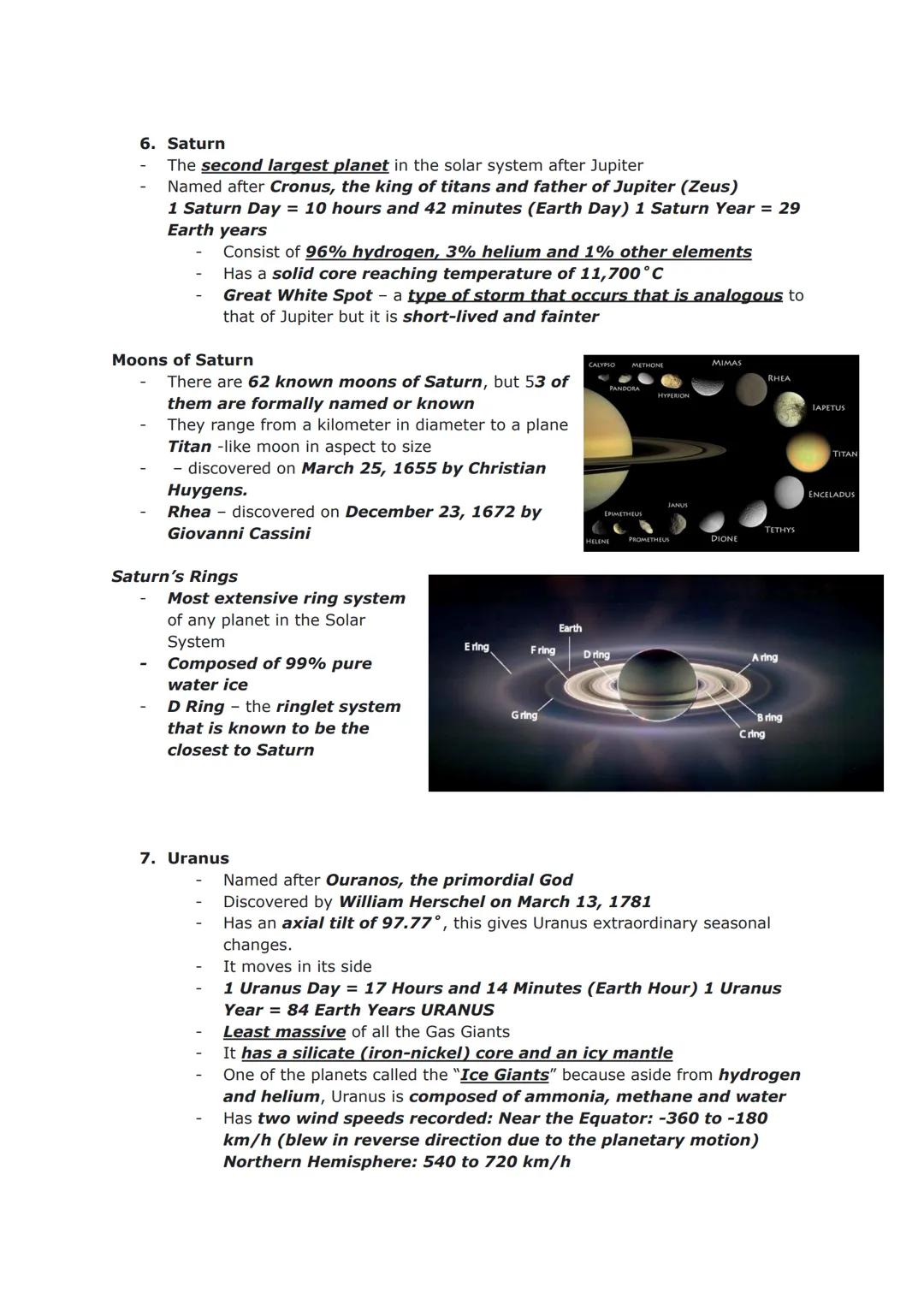
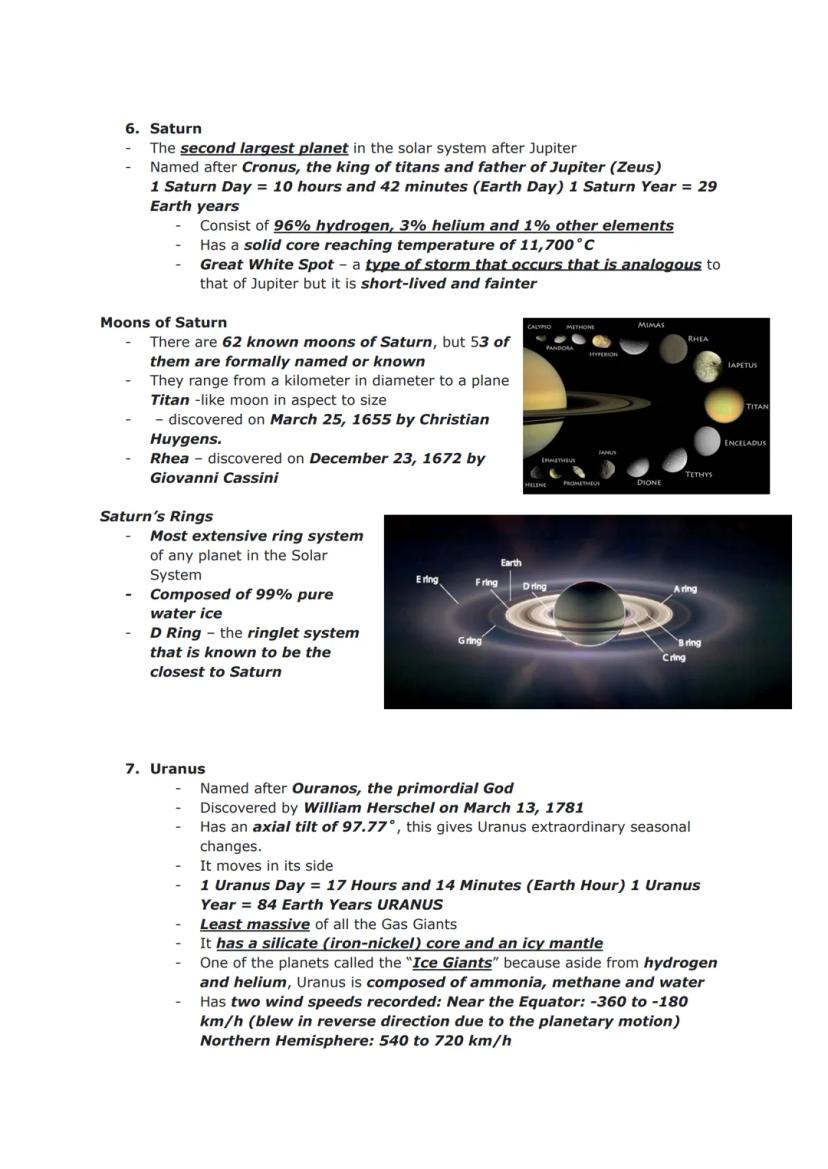
Saturn, the second-largest planet after Jupiter, is named after Cronus, the king of titans. A Saturn day equals 10 hours and 42 minutes, while one orbit around the Sun takes 29 Earth years. Saturn consists of 96% hydrogen, 3% helium, and 1% other elements, with a solid core reaching temperatures of 11,700°C. Occasionally, Saturn experiences the "Great White Spot," a storm similar to Jupiter's Great Red Spot but shorter-lived and fainter.
Saturn's most distinctive feature is its extensive ring system, the most elaborate of any planet. These rings are composed of 99% pure water ice, with the D Ring being closest to the planet. Saturn has 62 known moons, with 53 officially named. Its largest moon, Titan, was discovered in 1655 by Christian Huygens, while Rhea was discovered by Giovanni Cassini in 1672.
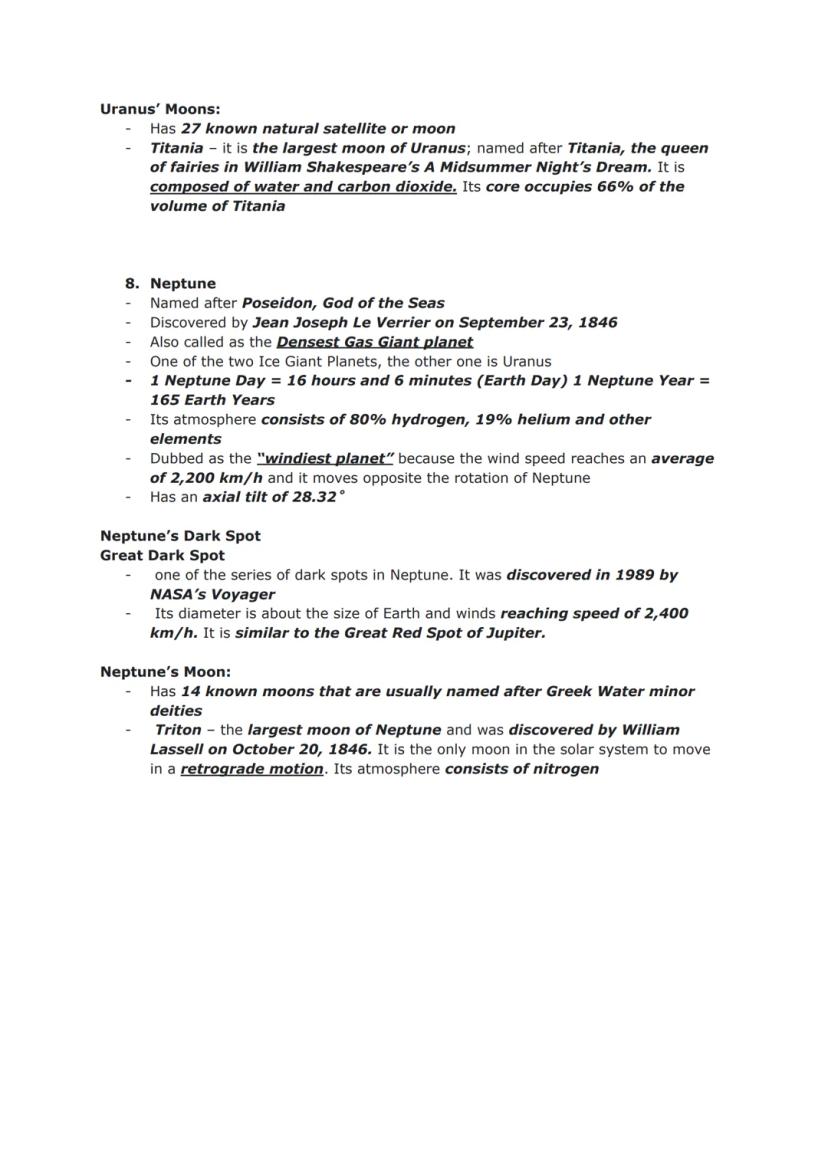
Uranus, named after the primordial god Ouranos, was discovered by William Herschel in 1781. With an extreme axial tilt of 97.77°, Uranus essentially rotates on its side, creating extraordinary seasonal changes. A day on Uranus lasts 17 hours and 14 minutes, while its year equals 84 Earth years. As one of the "Ice Giants," Uranus contains not only hydrogen and helium but also significant amounts of ammonia, methane, and water. Its winds reach speeds of up to 720 km/h in the northern hemisphere.
💍 If you could place Saturn in a giant bathtub, it would float! With an average density less than water, Saturn is the only planet in our solar system that would float in water.
Ang aming AI Companion ay isang AI tool na nakatuon sa mga estudyante na nag-aalok ng higit pa sa mga sagot lang. Binuo mula sa milyong Knowunity resources, nagbibigay ito ng may-kaugnayang impormasyon, personalized na study plans, quizzes, at content direkta sa chat, na umaangkop sa iyong sariling learning journey.
Maaari mong i-download ang app mula sa Google Play Store at Apple App Store.
Tama 'yan! Mag-enjoy sa libreng access sa mga study content, makipag-connect sa kapwa mga estudyante, at kumuha ng instant na tulong – lahat nasa iyong daliri lang.
App Store
Google Play
Napakadaling gamitin at maganda ang disenyo ng app. Nahanap ko lahat ng hinahanap ko hanggang ngayon at natuto ako ng marami mula sa mga presentasyon! Tiyak na gagamitin ko ang app para sa isang takdang-aralin sa klase! At siyempre, nakakatulong din ito bilang inspirasyon.
Stefan S
gumagamit ng iOS
Sobrang ganda talaga ng app na ito. Maraming mga study notes at tulong [...]. Ang problemang subject ko ay Pranses, halimbawa, at ang app ay may maraming options para tumulong. Salamat sa app na ito, bumuti ang Pranses ko. Irerekumenda ko ito sa lahat.
Samantha Klich
Android user
Wow, talagang namangha ako. Sinubukan ko lang ang app dahil nakita ko itong ina-advertise nang maraming beses at sobrang nagulat ako. Ang app na ito ang TULONG na gusto mo para sa paaralan at higit sa lahat, nag-aalok ito ng maraming bagay, tulad ng workouts at fact sheets, na SOBRANG nakatulong sa akin.
Anna
iOS user
Pinakamagandang app sa mundo! walang masabi dahil sobrang ganda nito
Thomas R
iOS user
Napakaganda talaga. Nakakapag-review ako ng 10x mas mabuti, itong app ay mabilis na 10/10. Lubos kong inirerekomenda ito sa lahat. Pwede akong manood at maghanap ng notes. Pwede kong i-save ang mga ito sa subject folder. Pwede kong i-review anumang oras kapag bumalik ako. Kung hindi mo pa nasubukan ang app na ito, marami kang nawawala.
Basil
Android user
Ang app na ito ay nagpapalakas ng loob ko sa paghahanda sa exams, hindi lang dahil sa pagpapataas ng aking kumpiyansa sa sarili sa pamamagitan ng mga feature na nagpapahintulot sa iyo na makipag-connect sa iba at mabawasan ang pakiramdam na nag-iisa, kundi pati na rin sa paraan na nakatuon ang app sa pagpapagaan ng iyong pakiramdam. Madali itong i-navigate, masaya gamitin, at nakakatulong sa sinumang nahihirapan sa kahit anong paraan.
David K
iOS user
Sobrang galing ng app! Ilalagay ko lang ang paksa sa search bar at makakakuha na ako ng sagot kaagad. Hindi ko kailangang manood ng 10 YouTube videos para maintindihan ang isang bagay, kaya nakakatipid ako ng oras. Lubos na inirerekomenda!
Sudenaz Ocak
Android user
Sa paaralan, napakahina ko sa math pero salamat sa app, mas mahusay na ako ngayon. Lubos akong nagpapasalamat na ginawa niyo ang app na ito.
Greenlight Bonnie
Android user
napakareliable na app para tumulong at palawakin ang iyong mga ideya sa Math, English at iba pang mga related na paksa sa iyong mga gawain. gamitin mo ang app na ito kung nahihirapan ka sa mga area, susi ito para diyan. sana nag-review na ako dati. at libre rin ito kaya huwag mag-alala tungkol diyan.
Rohan U
Android user
Alam kong maraming apps gumagamit ng fake accounts para mapataas ang kanilang reviews pero ang app na ito ay deserve lahat ng papuri. Dati nakakakuha ako ng 4 sa aking English exams at ngayon nakakuha ako ng grade 7. Hindi ko pa alam ang app na ito tatlong araw bago ang exam at nakatulong ito ng SOBRA. Pakisuyong maniwala sa akin at gamitin ito dahil sigurado akong makikita mo rin ang mga pagbabago.
Xander S
iOS user
ANG MGA quiz AT flashcard SOBRANG HELPFUL AT I LOVE TALAGA SI Knowunity AI. PARANG CHATGPT LANG PERO MAS MATALINO!! NAKATULONG DIN SA MGA MASCARA PROBLEMS KO!! PATI NA RIN SA MGA TUNAY KONG subject! SYEMPRE 😍😁😲🤑💗✨🎀😮
Elisha
iOS user
Grabe talaga ang app na to. Sobrang nakakaboring sakin ang pagreview pero ginagawa ng app na to na sobrang dali mag-organize ng lahat at pwede mong tanungin ang libreng ai para subukin ang sarili mo kaya sobrang buti at madali mong ma-upload ang sarili mong mga bagay. highly recommend bilang isang taong nagte-take ng mocks ngayon
Paul T
iOS user
Napakadaling gamitin at maganda ang disenyo ng app. Nahanap ko lahat ng hinahanap ko hanggang ngayon at natuto ako ng marami mula sa mga presentasyon! Tiyak na gagamitin ko ang app para sa isang takdang-aralin sa klase! At siyempre, nakakatulong din ito bilang inspirasyon.
Stefan S
gumagamit ng iOS
Sobrang ganda talaga ng app na ito. Maraming mga study notes at tulong [...]. Ang problemang subject ko ay Pranses, halimbawa, at ang app ay may maraming options para tumulong. Salamat sa app na ito, bumuti ang Pranses ko. Irerekumenda ko ito sa lahat.
Samantha Klich
Android user
Wow, talagang namangha ako. Sinubukan ko lang ang app dahil nakita ko itong ina-advertise nang maraming beses at sobrang nagulat ako. Ang app na ito ang TULONG na gusto mo para sa paaralan at higit sa lahat, nag-aalok ito ng maraming bagay, tulad ng workouts at fact sheets, na SOBRANG nakatulong sa akin.
Anna
iOS user
Pinakamagandang app sa mundo! walang masabi dahil sobrang ganda nito
Thomas R
iOS user
Napakaganda talaga. Nakakapag-review ako ng 10x mas mabuti, itong app ay mabilis na 10/10. Lubos kong inirerekomenda ito sa lahat. Pwede akong manood at maghanap ng notes. Pwede kong i-save ang mga ito sa subject folder. Pwede kong i-review anumang oras kapag bumalik ako. Kung hindi mo pa nasubukan ang app na ito, marami kang nawawala.
Basil
Android user
Ang app na ito ay nagpapalakas ng loob ko sa paghahanda sa exams, hindi lang dahil sa pagpapataas ng aking kumpiyansa sa sarili sa pamamagitan ng mga feature na nagpapahintulot sa iyo na makipag-connect sa iba at mabawasan ang pakiramdam na nag-iisa, kundi pati na rin sa paraan na nakatuon ang app sa pagpapagaan ng iyong pakiramdam. Madali itong i-navigate, masaya gamitin, at nakakatulong sa sinumang nahihirapan sa kahit anong paraan.
David K
iOS user
Sobrang galing ng app! Ilalagay ko lang ang paksa sa search bar at makakakuha na ako ng sagot kaagad. Hindi ko kailangang manood ng 10 YouTube videos para maintindihan ang isang bagay, kaya nakakatipid ako ng oras. Lubos na inirerekomenda!
Sudenaz Ocak
Android user
Sa paaralan, napakahina ko sa math pero salamat sa app, mas mahusay na ako ngayon. Lubos akong nagpapasalamat na ginawa niyo ang app na ito.
Greenlight Bonnie
Android user
napakareliable na app para tumulong at palawakin ang iyong mga ideya sa Math, English at iba pang mga related na paksa sa iyong mga gawain. gamitin mo ang app na ito kung nahihirapan ka sa mga area, susi ito para diyan. sana nag-review na ako dati. at libre rin ito kaya huwag mag-alala tungkol diyan.
Rohan U
Android user
Alam kong maraming apps gumagamit ng fake accounts para mapataas ang kanilang reviews pero ang app na ito ay deserve lahat ng papuri. Dati nakakakuha ako ng 4 sa aking English exams at ngayon nakakuha ako ng grade 7. Hindi ko pa alam ang app na ito tatlong araw bago ang exam at nakatulong ito ng SOBRA. Pakisuyong maniwala sa akin at gamitin ito dahil sigurado akong makikita mo rin ang mga pagbabago.
Xander S
iOS user
ANG MGA quiz AT flashcard SOBRANG HELPFUL AT I LOVE TALAGA SI Knowunity AI. PARANG CHATGPT LANG PERO MAS MATALINO!! NAKATULONG DIN SA MGA MASCARA PROBLEMS KO!! PATI NA RIN SA MGA TUNAY KONG subject! SYEMPRE 😍😁😲🤑💗✨🎀😮
Elisha
iOS user
Grabe talaga ang app na to. Sobrang nakakaboring sakin ang pagreview pero ginagawa ng app na to na sobrang dali mag-organize ng lahat at pwede mong tanungin ang libreng ai para subukin ang sarili mo kaya sobrang buti at madali mong ma-upload ang sarili mong mga bagay. highly recommend bilang isang taong nagte-take ng mocks ngayon
Paul T
iOS user
aya
@ayash
Ever wondered how our universe and solar system came to be? Earth Science explores both ancient creation myths and scientific theories about the beginning of everything. Let's dive into the fascinating theories that explain our cosmic origins and discover what... Ipakita pa
Access sa lahat ng dokumento
Pagbutihin ang iyong mga grado
Sumali sa milyong mga estudyante
The Big Bang Theory, proposed by Alexander Friedmann and Georges Lamaitre in the 1920s, is our best explanation for how the universe began. According to this theory, approximately 13.7 billion years ago, the entire universe started as an infinitely hot and dense single point that suddenly expanded at unimaginable speeds.
The expansion unfolded in several key stages. First came the Inflationary Epoch , when the universe expanded incredibly rapidly. During the next few stages, basic elements formed as protons and neutrons combined to create hydrogen nuclei. After about 300,000 years, matter began to dominate the universe, and by 300 million years after the Big Bang, stars and galaxies were forming.
Four fundamental forces govern how everything in our universe works. The strong force binds quarks together to make particles like protons and neutrons. The electromagnetic force acts between charged particles, making opposite charges attract and like charges repel. The weak force can change one quark type into another, while gravitational force attracts objects with mass to each other.
💡 The timeline from the Big Bang to Earth is mind-boggling: The Big Bang occurred 15 billion years ago, stars formed 10 billion years ago, our Sun 5 billion years ago, and Earth about 4.5 billion years ago.
Access sa lahat ng dokumento
Pagbutihin ang iyong mga grado
Sumali sa milyong mga estudyante
Scientists have found compelling evidence supporting the Big Bang Theory. In 1924, Edwin Hubble discovered that galaxies are moving away from each other, suggesting an expanding universe. Another major discovery came in 1960 when Arno Penzias and Robert Wilson detected cosmic microwave background radiation (CMB) coming from every direction in the sky. This "fossil radiation" is considered the echo of the Big Bang.
The abundance of light elements like hydrogen and helium throughout the universe also supports the Big Bang Theory. These elements appear in consistent proportions everywhere we look, exactly as the theory predicts.
Despite its strengths, the Big Bang Theory faces some unresolved problems. The "flatness problem" questions why the universe's geometry is so precisely balanced. The "monopole problem" asks why we don't see the magnetic monopoles the theory predicted. The "horizon problem" wonders how regions of space so far apart could have such similar properties if they could never have been in contact.
🔍 The cosmic microwave background radiation is essentially the afterglow of the Big Bang, and it's the furthest back in time that any telescope can see!
Access sa lahat ng dokumento
Pagbutihin ang iyong mga grado
Sumali sa milyong mga estudyante
The Steady State Theory, proposed in 1948 by Bondi, Gold, and Hoyle, offered a different view of the universe. This theory suggested that the universe has always existed, with no beginning or end, maintaining a constant average density as it expands. New matter continuously forms to create new stars and galaxies at the same rate older ones move beyond our view.
The Inflation Theory addressed many of the Big Bang's unresolved problems. It proposed that during the universe's rapid early expansion, energy density was dominated by a cosmological constant (a type of vacuum energy) that later decayed to produce matter and radiation.
More recent theories take different approaches. String Theory replaces fundamental particles with tiny vibrating strings at the Planck length scale . Superstring Theory became a candidate for unifying relativity with quantum mechanics in the 1980s by describing string interactions consistently with gravity.
M-Theory considers 11 spacetime dimensions—our familiar 4 dimensions (3 spatial plus time) plus 7 additional dimensions that are too tiny and curled up to detect. This theory suggests the universe began when two hyperdimensional "branes" collided.
🌌 The "M" in M-Theory has no official meaning—physicists suggest it could stand for "magic," "mystery," or "membrane," with the true meaning to be decided when we better understand the theory!
Access sa lahat ng dokumento
Pagbutihin ang iyong mga grado
Sumali sa milyong mga estudyante
Scientists have proposed several theories to explain how our solar system formed. René Descartes was among the first, suggesting that whirlpool-like motion in pre-solar materials formed bodies with nearly circular orbits. Later, the Comte de Buffon proposed his Collision Theory, which claimed that planets formed from debris created when a comet struck the sun.
Building on Descartes' ideas, Immanuel Kant and Pierre Simon Laplace proposed the Nebular Theory. They suggested that a great cloud of dust (nebula) collapsed due to gravitational pull and began spinning more rapidly as it contracted. Though attractive for its simplicity, this theory had major flaws.
The modern Solar Nebular Theory suggests our solar system formed from condensing hydrogen gas and dust. A supernova explosion might have triggered this cloud to collapse, forming the sun and planets. As the cloud rotated, it formed a disk-shaped solar nebula. Small particles accreted into planetesimals , which eventually coalesced into protoplanets and finally planets.
🌠 After the solar system's initial formation, a powerful solar wind blasted away remaining gas and dust, leaving behind the solid planetary bodies and gas giants we see today.
Access sa lahat ng dokumento
Pagbutihin ang iyong mga grado
Sumali sa milyong mga estudyante
Our solar system follows several consistent patterns. All planets orbit the sun in nearly the same plane with almost circular orbits. They all revolve in a counterclockwise direction, and their distances from the sun follow a relationship called Bode's law. Interestingly, the satellite systems of Jupiter and Saturn mirror these arrangements.
Beyond the planets, our solar system contains fascinating objects like asteroids—rock formations sometimes called minor planets. The first discovered asteroid, Ceres, orbits in the asteroid belt between Mars and Jupiter. Some asteroids, called near-Earth asteroids (NEAs), can be pulled out of the main belt and pass close to Earth.
Comets are another interesting feature of our solar system. Unlike rocky asteroids, comets are mostly composed of ice (frozen water and gases) and nonvolatile dust (silicate minerals and carbon grains). They originate from two distant regions: the Kuiper Belt, which lies beyond Neptune, and the even more distant Oort Cloud.
The Oort Cloud forms a giant spherical shell surrounding our entire solar system. It's like a thick bubble made of icy, comet-like objects that extends almost a quarter of the way to the nearest star. Long-period comets are thought to come from this mysterious region.
☄️ The Oort Cloud is believed to contain trillions of icy objects, but it's so far away that we've never directly observed it—we only know it exists because of the comets that occasionally visit our inner solar system!
Access sa lahat ng dokumento
Pagbutihin ang iyong mga grado
Sumali sa milyong mga estudyante
At the center of our solar system lies the Sun—the only star in our system and the source of light and energy that makes life possible. Our solar system formed approximately 4.56 billion years ago from the gravitational collapse of an interstellar cloud. Beyond the sun and planets, our system contains comets, meteors, and asteroids.
Our solar system is located in a spiral arm of the Milky Way Galaxy called the Orion-Cygnus Arm, named after the constellation Orion. This minor spiral arm stretches about 10,000 light-years in length and contains our entire solar system.
The International Astronomical Union (IAU), founded in 1919 in Brussels, Belgium, is responsible for naming celestial bodies and educating people about astronomy. In 2006, the IAU famously reclassified Pluto as a dwarf planet rather than a full planet.
Planets in our solar system are divided into two main categories. The Terrestrial Planets (Mercury, Venus, Earth, and Mars) are close to the sun, small in mass and radius, and have high density. The Jovian Planets (Jupiter, Saturn, Uranus, and Neptune) are far from the sun, large in mass and radius, and have low density.
🔭 The Asteroid Belt, which divides the terrestrial and Jovian planets, contains millions of irregularly shaped bodies ranging from tiny pebbles to objects hundreds of kilometers across!
Access sa lahat ng dokumento
Pagbutihin ang iyong mga grado
Sumali sa milyong mga estudyante
Beyond Neptune lies the Kuiper Belt, extending from about 30 to 55 astronomical units from the Sun. This region contains small icy bodies made mostly of frozen gases like methane, ammonia, nitrogen, and water. The Kuiper Belt is also home to the dwarf planets Pluto, Haumea, and Makemake.
Even farther out is the mysterious Oort Cloud, an extended shell of icy objects that marks the outermost reaches of our solar system. Scientists believe this cloud consists of remnant material from the formation of the Sun and planets. The Oort Cloud stretches almost a quarter of the way to the nearest star, Proxima Centauri, and has both an outer spherical section and an inner donut-shaped section.
These distant regions are like cosmic freezers, preserving ancient materials from the solar system's formation. Objects in the Kuiper Belt and Oort Cloud occasionally get disturbed by gravitational forces and travel inward toward the Sun, becoming comets that we can observe from Earth.
❄️ Think of the Kuiper Belt and Oort Cloud as time capsules from the birth of our solar system—they contain icy bodies that have remained largely unchanged for billions of years!
Access sa lahat ng dokumento
Pagbutihin ang iyong mga grado
Sumali sa milyong mga estudyante
Mercury, named after the messenger of the gods, is the smallest and innermost planet in our solar system. A day on Mercury lasts 58 Earth days, while its year is only 88 Earth days. With the second-highest density of any planet , Mercury has a proportionally larger iron core than any other planet. Its surface experiences extreme temperature variations, from -173°C during the night to 427°C during the day.
Venus, named after the goddess of love and beauty, is often called the "morning star" or "evening star" because it's visible at dawn and dusk. It's the hottest planet in the solar system, reaching a scorching 462°C due to its atmosphere being 96% carbon dioxide that traps heat. Venus rotates clockwise (retrograde motion), taking 243 Earth days to complete one rotation.
Earth, whose name comes from the German word "erde" meaning ground, is the only known planet to harbor life. It consists mainly of iron (32%) and oxygen (30%) and has one natural satellite, the Moon. Earth is the densest planet in the solar system and completes one rotation in 24 hours and one orbit around the Sun in 365/366 days. Its 23.44° axial tilt creates our seasons by affecting how much sunlight different regions receive throughout the year.
🌍 The Continental Drift Theory proposes that 250 million years ago, Earth's seven continents were joined as a single landmass before slowly drifting apart to their current positions!
Access sa lahat ng dokumento
Pagbutihin ang iyong mga grado
Sumali sa milyong mga estudyante
Mars, named after the god of war, is nicknamed the "Red Planet" due to iron oxide (rust) giving its surface a reddish appearance. Home to Olympus Mons, the largest volcano and mountain in the solar system, Mars takes 687 Earth days to orbit the Sun. Its atmosphere is 96% carbon dioxide and 2% argon, with temperatures ranging from -143°C to 35°C. Mars has two small moons: Phobos and Deimos.
Jupiter, the largest planet in our solar system, is named after Zeus, the supreme god. A Jupiter day lasts just 9 hours and 56 minutes, while its year equals 4,333 Earth days. Composed of 90% hydrogen and 10% helium, Jupiter has the largest planetary atmosphere in the solar system and is covered with clouds of ammonium hydrosulfide. Its winds average around 360 km/h, and its magnetic field is 10-14 times stronger than Earth's.
Jupiter's most famous feature is the Great Red Spot, discovered in 1665 by Gian Domineco Cassini. This enormous storm, about 16,350 kilometers wide (twice Earth's size), rotates counterclockwise and completes one rotation every 6 Earth days. Jupiter has an impressive 79 known moons, with the four largest (Io, Europa, Ganymede, and Callisto) first discovered by Galileo Galilei in 1610 and named after Zeus's lovers by astronomer Simon Marius.
🔴 Jupiter's Great Red Spot has been raging for at least 350 years, making it one of the longest-lasting storms we know of in the solar system!
Access sa lahat ng dokumento
Pagbutihin ang iyong mga grado
Sumali sa milyong mga estudyante
Saturn, the second-largest planet after Jupiter, is named after Cronus, the king of titans. A Saturn day equals 10 hours and 42 minutes, while one orbit around the Sun takes 29 Earth years. Saturn consists of 96% hydrogen, 3% helium, and 1% other elements, with a solid core reaching temperatures of 11,700°C. Occasionally, Saturn experiences the "Great White Spot," a storm similar to Jupiter's Great Red Spot but shorter-lived and fainter.
Saturn's most distinctive feature is its extensive ring system, the most elaborate of any planet. These rings are composed of 99% pure water ice, with the D Ring being closest to the planet. Saturn has 62 known moons, with 53 officially named. Its largest moon, Titan, was discovered in 1655 by Christian Huygens, while Rhea was discovered by Giovanni Cassini in 1672.
Uranus, named after the primordial god Ouranos, was discovered by William Herschel in 1781. With an extreme axial tilt of 97.77°, Uranus essentially rotates on its side, creating extraordinary seasonal changes. A day on Uranus lasts 17 hours and 14 minutes, while its year equals 84 Earth years. As one of the "Ice Giants," Uranus contains not only hydrogen and helium but also significant amounts of ammonia, methane, and water. Its winds reach speeds of up to 720 km/h in the northern hemisphere.
💍 If you could place Saturn in a giant bathtub, it would float! With an average density less than water, Saturn is the only planet in our solar system that would float in water.
Access sa lahat ng dokumento
Pagbutihin ang iyong mga grado
Sumali sa milyong mga estudyante
Ang aming AI Companion ay isang AI tool na nakatuon sa mga estudyante na nag-aalok ng higit pa sa mga sagot lang. Binuo mula sa milyong Knowunity resources, nagbibigay ito ng may-kaugnayang impormasyon, personalized na study plans, quizzes, at content direkta sa chat, na umaangkop sa iyong sariling learning journey.
Maaari mong i-download ang app mula sa Google Play Store at Apple App Store.
Tama 'yan! Mag-enjoy sa libreng access sa mga study content, makipag-connect sa kapwa mga estudyante, at kumuha ng instant na tulong – lahat nasa iyong daliri lang.
0
Smart Tools NEW
I-transform ang note na ito sa: ✓ 50+ Practice Questions ✓ Interactive Flashcards ✓ Full Mock Exam ✓ Essay Outlines
App Store
Google Play
Napakadaling gamitin at maganda ang disenyo ng app. Nahanap ko lahat ng hinahanap ko hanggang ngayon at natuto ako ng marami mula sa mga presentasyon! Tiyak na gagamitin ko ang app para sa isang takdang-aralin sa klase! At siyempre, nakakatulong din ito bilang inspirasyon.
Stefan S
gumagamit ng iOS
Sobrang ganda talaga ng app na ito. Maraming mga study notes at tulong [...]. Ang problemang subject ko ay Pranses, halimbawa, at ang app ay may maraming options para tumulong. Salamat sa app na ito, bumuti ang Pranses ko. Irerekumenda ko ito sa lahat.
Samantha Klich
Android user
Wow, talagang namangha ako. Sinubukan ko lang ang app dahil nakita ko itong ina-advertise nang maraming beses at sobrang nagulat ako. Ang app na ito ang TULONG na gusto mo para sa paaralan at higit sa lahat, nag-aalok ito ng maraming bagay, tulad ng workouts at fact sheets, na SOBRANG nakatulong sa akin.
Anna
iOS user
Pinakamagandang app sa mundo! walang masabi dahil sobrang ganda nito
Thomas R
iOS user
Napakaganda talaga. Nakakapag-review ako ng 10x mas mabuti, itong app ay mabilis na 10/10. Lubos kong inirerekomenda ito sa lahat. Pwede akong manood at maghanap ng notes. Pwede kong i-save ang mga ito sa subject folder. Pwede kong i-review anumang oras kapag bumalik ako. Kung hindi mo pa nasubukan ang app na ito, marami kang nawawala.
Basil
Android user
Ang app na ito ay nagpapalakas ng loob ko sa paghahanda sa exams, hindi lang dahil sa pagpapataas ng aking kumpiyansa sa sarili sa pamamagitan ng mga feature na nagpapahintulot sa iyo na makipag-connect sa iba at mabawasan ang pakiramdam na nag-iisa, kundi pati na rin sa paraan na nakatuon ang app sa pagpapagaan ng iyong pakiramdam. Madali itong i-navigate, masaya gamitin, at nakakatulong sa sinumang nahihirapan sa kahit anong paraan.
David K
iOS user
Sobrang galing ng app! Ilalagay ko lang ang paksa sa search bar at makakakuha na ako ng sagot kaagad. Hindi ko kailangang manood ng 10 YouTube videos para maintindihan ang isang bagay, kaya nakakatipid ako ng oras. Lubos na inirerekomenda!
Sudenaz Ocak
Android user
Sa paaralan, napakahina ko sa math pero salamat sa app, mas mahusay na ako ngayon. Lubos akong nagpapasalamat na ginawa niyo ang app na ito.
Greenlight Bonnie
Android user
napakareliable na app para tumulong at palawakin ang iyong mga ideya sa Math, English at iba pang mga related na paksa sa iyong mga gawain. gamitin mo ang app na ito kung nahihirapan ka sa mga area, susi ito para diyan. sana nag-review na ako dati. at libre rin ito kaya huwag mag-alala tungkol diyan.
Rohan U
Android user
Alam kong maraming apps gumagamit ng fake accounts para mapataas ang kanilang reviews pero ang app na ito ay deserve lahat ng papuri. Dati nakakakuha ako ng 4 sa aking English exams at ngayon nakakuha ako ng grade 7. Hindi ko pa alam ang app na ito tatlong araw bago ang exam at nakatulong ito ng SOBRA. Pakisuyong maniwala sa akin at gamitin ito dahil sigurado akong makikita mo rin ang mga pagbabago.
Xander S
iOS user
ANG MGA quiz AT flashcard SOBRANG HELPFUL AT I LOVE TALAGA SI Knowunity AI. PARANG CHATGPT LANG PERO MAS MATALINO!! NAKATULONG DIN SA MGA MASCARA PROBLEMS KO!! PATI NA RIN SA MGA TUNAY KONG subject! SYEMPRE 😍😁😲🤑💗✨🎀😮
Elisha
iOS user
Grabe talaga ang app na to. Sobrang nakakaboring sakin ang pagreview pero ginagawa ng app na to na sobrang dali mag-organize ng lahat at pwede mong tanungin ang libreng ai para subukin ang sarili mo kaya sobrang buti at madali mong ma-upload ang sarili mong mga bagay. highly recommend bilang isang taong nagte-take ng mocks ngayon
Paul T
iOS user
Napakadaling gamitin at maganda ang disenyo ng app. Nahanap ko lahat ng hinahanap ko hanggang ngayon at natuto ako ng marami mula sa mga presentasyon! Tiyak na gagamitin ko ang app para sa isang takdang-aralin sa klase! At siyempre, nakakatulong din ito bilang inspirasyon.
Stefan S
gumagamit ng iOS
Sobrang ganda talaga ng app na ito. Maraming mga study notes at tulong [...]. Ang problemang subject ko ay Pranses, halimbawa, at ang app ay may maraming options para tumulong. Salamat sa app na ito, bumuti ang Pranses ko. Irerekumenda ko ito sa lahat.
Samantha Klich
Android user
Wow, talagang namangha ako. Sinubukan ko lang ang app dahil nakita ko itong ina-advertise nang maraming beses at sobrang nagulat ako. Ang app na ito ang TULONG na gusto mo para sa paaralan at higit sa lahat, nag-aalok ito ng maraming bagay, tulad ng workouts at fact sheets, na SOBRANG nakatulong sa akin.
Anna
iOS user
Pinakamagandang app sa mundo! walang masabi dahil sobrang ganda nito
Thomas R
iOS user
Napakaganda talaga. Nakakapag-review ako ng 10x mas mabuti, itong app ay mabilis na 10/10. Lubos kong inirerekomenda ito sa lahat. Pwede akong manood at maghanap ng notes. Pwede kong i-save ang mga ito sa subject folder. Pwede kong i-review anumang oras kapag bumalik ako. Kung hindi mo pa nasubukan ang app na ito, marami kang nawawala.
Basil
Android user
Ang app na ito ay nagpapalakas ng loob ko sa paghahanda sa exams, hindi lang dahil sa pagpapataas ng aking kumpiyansa sa sarili sa pamamagitan ng mga feature na nagpapahintulot sa iyo na makipag-connect sa iba at mabawasan ang pakiramdam na nag-iisa, kundi pati na rin sa paraan na nakatuon ang app sa pagpapagaan ng iyong pakiramdam. Madali itong i-navigate, masaya gamitin, at nakakatulong sa sinumang nahihirapan sa kahit anong paraan.
David K
iOS user
Sobrang galing ng app! Ilalagay ko lang ang paksa sa search bar at makakakuha na ako ng sagot kaagad. Hindi ko kailangang manood ng 10 YouTube videos para maintindihan ang isang bagay, kaya nakakatipid ako ng oras. Lubos na inirerekomenda!
Sudenaz Ocak
Android user
Sa paaralan, napakahina ko sa math pero salamat sa app, mas mahusay na ako ngayon. Lubos akong nagpapasalamat na ginawa niyo ang app na ito.
Greenlight Bonnie
Android user
napakareliable na app para tumulong at palawakin ang iyong mga ideya sa Math, English at iba pang mga related na paksa sa iyong mga gawain. gamitin mo ang app na ito kung nahihirapan ka sa mga area, susi ito para diyan. sana nag-review na ako dati. at libre rin ito kaya huwag mag-alala tungkol diyan.
Rohan U
Android user
Alam kong maraming apps gumagamit ng fake accounts para mapataas ang kanilang reviews pero ang app na ito ay deserve lahat ng papuri. Dati nakakakuha ako ng 4 sa aking English exams at ngayon nakakuha ako ng grade 7. Hindi ko pa alam ang app na ito tatlong araw bago ang exam at nakatulong ito ng SOBRA. Pakisuyong maniwala sa akin at gamitin ito dahil sigurado akong makikita mo rin ang mga pagbabago.
Xander S
iOS user
ANG MGA quiz AT flashcard SOBRANG HELPFUL AT I LOVE TALAGA SI Knowunity AI. PARANG CHATGPT LANG PERO MAS MATALINO!! NAKATULONG DIN SA MGA MASCARA PROBLEMS KO!! PATI NA RIN SA MGA TUNAY KONG subject! SYEMPRE 😍😁😲🤑💗✨🎀😮
Elisha
iOS user
Grabe talaga ang app na to. Sobrang nakakaboring sakin ang pagreview pero ginagawa ng app na to na sobrang dali mag-organize ng lahat at pwede mong tanungin ang libreng ai para subukin ang sarili mo kaya sobrang buti at madali mong ma-upload ang sarili mong mga bagay. highly recommend bilang isang taong nagte-take ng mocks ngayon
Paul T
iOS user